


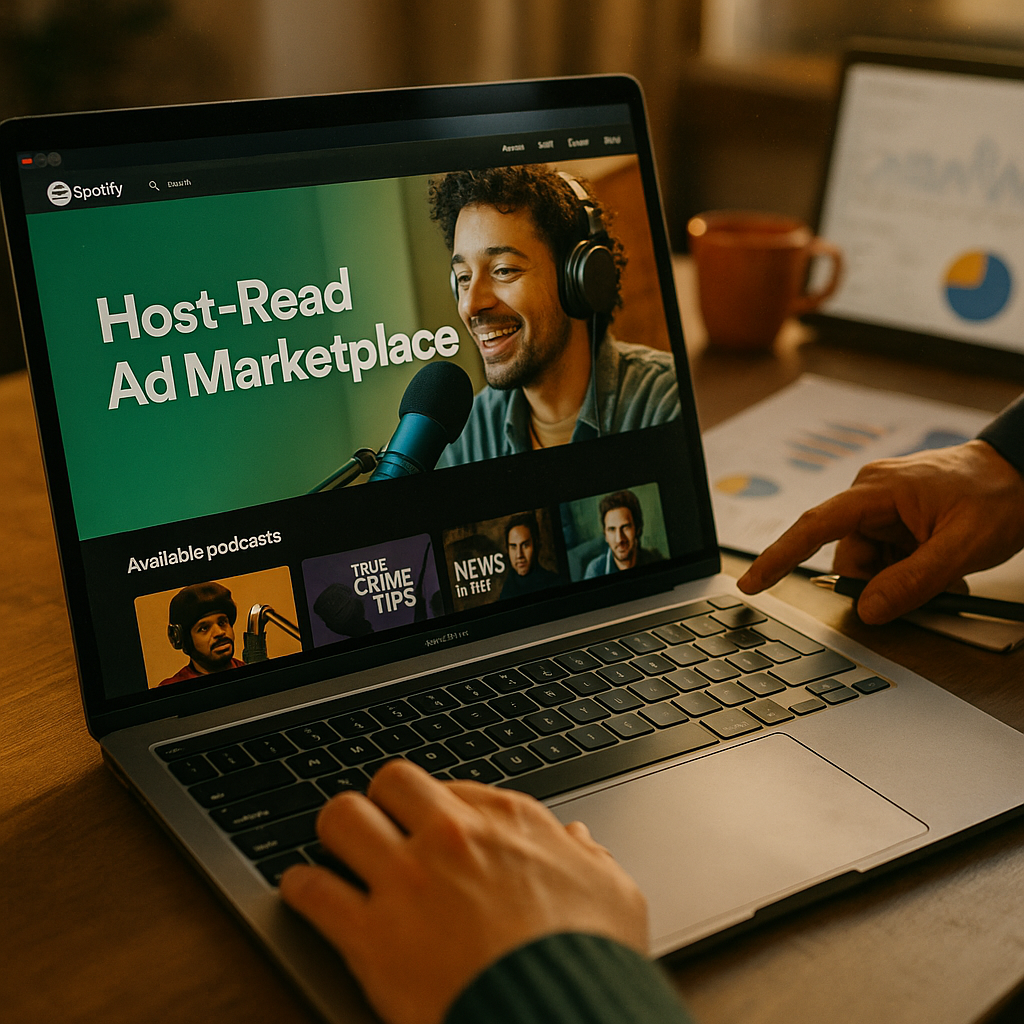
Audio ad recall runs as high as 24% higher than display, according to industry benchmarking from Statista, and Spotify just turned that advantage into a self-serve buying problem for brands. The platform’s creator hosted ad marketplace lets podcasters read your copy natively inside their own shows, and now brands can book it without a single agency phone call. Is that efficiency, or a risk you haven’t priced in yet?
This guide breaks down how the marketplace actually works, what it costs, where it fits in a broader creator budget, and the brand-side guardrails you need before you hit “launch campaign.”
What Spotify’s Creator Hosted Ad Marketplace Actually Is
Spotify built this marketplace to formalize something podcast advertisers have done informally for years: pay hosts to read ad copy in their own voice, inside their own show, using their own cadence. The difference now is that it’s productized. Brands log into Spotify Ad Studio or work through Spotify’s managed sales team, browse a catalog of participating shows, review audience data, and book host-read placements with defined pricing tiers instead of negotiating each deal individually over email.
Spotify has been building toward this since it acquired Megaphone and leaned hard into exclusive podcast content. The marketplace is the monetization layer that finally connects advertiser demand with its enormous creator roster, which includes everything from true crime hits to niche B2B interview shows.
For brand marketers, the pitch is straightforward: host-read ads convert better than pre-produced spots because listeners trust the voice they already subscribe to. Nielsen and various podcast ad studies have shown host-read creative consistently outperforms announcer-read ads on both recall and purchase intent. Spotify is betting brands will pay a premium for that authenticity, and early marketplace pricing suggests they’re right.
Host-read podcast ads have historically commanded a 20 to 40 percent premium over produced spots, and Spotify’s marketplace pricing is tracking right in that range for mid-tier shows.
How Pricing Actually Works
Spotify’s marketplace uses a hybrid model: some inventory is priced on a flat-rate CPM basis, and some is negotiated directly with the creator through Spotify’s facilitation tools. Expect wide variance. A niche show with 10,000 downloads per episode might charge a few hundred dollars for a 60-second host read, while a top-20 chart show can command five figures per spot.
Spotify segments inventory into tiers based on audience size, show category, and historical ad performance data the platform has accumulated from its own ad server. Brands buying programmatically through Spotify Ad Studio get CPM-based pricing with minimum spend thresholds. Brands wanting hand-picked creators for integrated reads typically work through Spotify’s direct sales team, which still takes a cut but offers more creative control over scripting and placement within the episode.
Here’s the part brand buyers often miss: pricing isn’t just about reach. Spotify factors in completion rate and the show’s historical conversion data when it’s available, meaning a smaller show with a hyper-engaged niche audience can sometimes out-price a larger but passive one. If you’re used to buying influencer content on UGC-driven media mix models, this will feel familiar. Audience quality trumps raw size.
- Flat CPM buys: best for awareness campaigns across multiple shows at once
- Direct-negotiated host reads: best for considered-purchase products needing narrative integration
- Programmatic audio insertion: best for retargeting and dynamic creative at scale
Where This Fits Against Your Existing Creator Budget
Brands already running influencer programs across TikTok, YouTube, and Instagram tend to ask the same question first: does podcast host-read inventory replace social creator spend, or sit alongside it? The honest answer is it’s additive, not a replacement. Podcast listening is a different consumption context (commute, workout, background focus) and the ad format works on trust built over dozens of episodes rather than a single viral moment.
That said, the budgeting logic should mirror what you already apply elsewhere. If you’ve built attribution models for creator revenue proof on commerce platforms, apply the same rigor here. Spotify’s marketplace gives you impression and completion data, but it does not give you the kind of closed-loop purchase attribution TikTok Shop or Amazon Live offer natively.
Marketers running lean teams should treat this as a quarterly test line item first, not a core channel. Start with two or three shows in your category, run a four to six week flight, and measure branded search lift or promo code redemption before scaling spend. Spotify’s own case studies (available through its advertiser portal) lean heavily on brand lift surveys, which are useful directionally but shouldn’t be your only success metric.
Budget Allocation: A Practical Framework
Most brands piloting the marketplace allocate somewhere between 5 and 15 percent of their total creator/influencer budget to podcast host-read inventory in the first two quarters. That’s a reasonable ceiling until you have first-party data proving incremental lift. Compare that against how you’d stage a new channel test like livestream shopping pilots, where the same cautious, measured rollout logic applies.
Targeting and Measurement: What You Actually Get
Spotify’s marketplace exposes demographic and listening-behavior targeting that’s more granular than most podcast buys historically allowed. You can filter by age band, inferred household income tier, listening device, and show genre. For brands used to the targeting precision of Meta or TikTok ad managers, this will feel comparatively blunt, but it’s a real step up from the spreadsheet-based podcast buying of a few years ago.
Measurement is the bigger adjustment. Spotify provides impression delivery, completion rate, and frequency data natively. For conversion measurement, brands need to layer in their own tracking: unique promo codes per show, dedicated landing page URLs, or post-campaign brand lift surveys through Spotify’s measurement partners. If your team already manages multi-touch attribution across video and livestream budget splits, this is a lighter lift than it sounds.
Treat every podcast host-read buy as a test-and-learn line item with its own promo code. Without that, you’re buying brand awareness on faith.
Compliance and Disclosure: Don’t Skip This
Host-read ads sit in a regulatory gray zone that brand legal teams need to understand before scaling spend. The FTC’s endorsement guidance applies to podcast hosts the same way it applies to Instagram creators: if a host is being paid to promote your product, that relationship needs clear disclosure, verbally, near the start of the read. Spotify’s marketplace terms require creators to disclose sponsored content, but enforcement consistency varies by show, especially among smaller independent podcasters who may not have run paid reads before.
Brands should build disclosure language directly into the creative brief rather than assuming the host knows the rules. This is the same operational discipline marketers apply to affiliate link disclosure fixes on other platforms. A missed disclosure isn’t just a brand risk, it’s a regulatory one, and the FTC has shown increasing willingness to pursue enforcement actions against both creators and the brands that sponsor them.
UK-based or UK-targeting campaigns carry an added layer of scrutiny from the Information Commissioner’s Office around data use in targeted podcast advertising, so international brands should loop in compliance early rather than retrofitting disclosure language after a campaign is already live.
Who Should Actually Test This First
Not every brand needs to be in Spotify’s marketplace on day one. It makes the most sense for:
- Considered-purchase categories (finance, health, SaaS, home services) where a trusted voice explaining a product for 60 seconds genuinely moves intent
- Brands with existing podcast sponsorship experience looking to consolidate scattered direct-buy relationships into one platform
- Marketers who already run strong attribution infrastructure and can isolate podcast-driven lift from noise
Brands chasing short-term commerce conversion, the kind you’d expect from live commerce demo conversion campaigns, will likely find the marketplace too slow and too soft-funnel to justify the spend right now. This is an upper-funnel trust-building tool first, a direct response tool second.
A Quick Gut Check Before You Buy
Ask three questions before booking your first placement. Does your product benefit from a 60-second narrative explanation rather than a quick visual hook? Can you track a unique code or URL per show? Does your legal team have bandwidth to review disclosure compliance across multiple independent creators at once? If you answered yes to all three, you’re ready to pilot. If not, fix the gaps first.
Benchmarking data from eMarketer continues to show podcast ad spend growing faster than most other digital formats, and marketing teams citing Sprout Social research point to audio as one of the few channels where trust in the messenger still translates directly into trust in the message. That’s the real asset Spotify is selling here, not reach, trust.
Frequently Asked Questions
How is Spotify’s creator hosted ad marketplace different from traditional podcast advertising?
Traditional podcast ad buying required brands or agencies to negotiate directly with each show, often through scattered email threads and inconsistent pricing. Spotify’s marketplace centralizes discovery, pricing, and booking into one platform, giving brands access to audience data and standardized rate cards across thousands of shows.
What is the minimum budget needed to test the marketplace?
There’s no official platform-wide minimum, but practically, meaningful tests start around a few thousand dollars across two or three shows for a four to six week flight. Smaller niche shows can be booked for a few hundred dollars per spot, making low-cost pilots accessible.
Can brands track direct conversions from host-read ads?
Spotify provides impression, completion, and frequency data natively, but direct conversion tracking requires brand-side tools like unique promo codes, dedicated landing pages, or brand lift studies run through Spotify’s measurement partners.
Do hosts have to disclose sponsored content?
Yes. Spotify’s marketplace terms require disclosure, and brands remain responsible under FTC guidance for ensuring paid endorsements are clearly flagged. Brands should include disclosure requirements directly in creative briefs rather than assuming compliance by default.
Is host-read podcast advertising better for brand awareness or direct response?
It performs best as an upper-funnel trust-building channel. Brands expecting immediate commerce-level conversion, similar to live shopping formats, typically find better ROI in channels built for faster purchase cycles.
Start with a small, trackable pilot, two or three shows, unique promo codes, a six week flight, before committing real budget to Spotify’s creator hosted ad marketplace. Let the data decide whether it earns a permanent line in your media plan.
Frequently Asked Questions
How is Spotify’s creator hosted ad marketplace different from traditional podcast advertising?
Traditional podcast ad buying required brands or agencies to negotiate directly with each show, often through scattered email threads and inconsistent pricing. Spotify’s marketplace centralizes discovery, pricing, and booking into one platform, giving brands access to audience data and standardized rate cards across thousands of shows.
What is the minimum budget needed to test the marketplace?
There’s no official platform-wide minimum, but practically, meaningful tests start around a few thousand dollars across two or three shows for a four to six week flight. Smaller niche shows can be booked for a few hundred dollars per spot, making low-cost pilots accessible.
Can brands track direct conversions from host-read ads?
Spotify provides impression, completion, and frequency data natively, but direct conversion tracking requires brand-side tools like unique promo codes, dedicated landing pages, or brand lift studies run through Spotify’s measurement partners.
Do hosts have to disclose sponsored content?
Yes. Spotify’s marketplace terms require disclosure, and brands remain responsible under FTC guidance for ensuring paid endorsements are clearly flagged. Brands should include disclosure requirements directly in creative briefs rather than assuming compliance by default.
Is host-read podcast advertising better for brand awareness or direct response?
It performs best as an upper-funnel trust-building channel. Brands expecting immediate commerce-level conversion, similar to live shopping formats, typically find better ROI in channels built for faster purchase cycles.
Top Influencer Marketing Agencies
The leading agencies shaping influencer marketing in 2026
Agencies ranked by campaign performance, client diversity, platform expertise, proven ROI, industry recognition, and client satisfaction. Assessed through verified case studies, reviews, and industry consultations.
Moburst

-
2

The Shelf
Boutique Beauty & Lifestyle Influencer AgencyA data-driven boutique agency specializing exclusively in beauty, wellness, and lifestyle influencer campaigns on Instagram and TikTok. Best for brands already focused on the beauty/personal care space that need curated, aesthetic-driven content.Clients: Pepsi, The Honest Company, Hims, Elf Cosmetics, Pure LeafVisit The Shelf → -
3

Audiencly
Niche Gaming & Esports Influencer AgencyA specialized agency focused exclusively on gaming and esports creators on YouTube, Twitch, and TikTok. Ideal if your campaign is 100% gaming-focused — from game launches to hardware and esports events.Clients: Epic Games, NordVPN, Ubisoft, Wargaming, Tencent GamesVisit Audiencly → -
4

Viral Nation
Global Influencer Marketing & Talent AgencyA dual talent management and marketing agency with proprietary brand safety tools and a global creator network spanning nano-influencers to celebrities across all major platforms.Clients: Meta, Activision Blizzard, Energizer, Aston Martin, WalmartVisit Viral Nation → -
5

The Influencer Marketing Factory
TikTok, Instagram & YouTube CampaignsA full-service agency with strong TikTok expertise, offering end-to-end campaign management from influencer discovery through performance reporting with a focus on platform-native content.Clients: Google, Snapchat, Universal Music, Bumble, YelpVisit TIMF → -
6

NeoReach
Enterprise Analytics & Influencer CampaignsAn enterprise-focused agency combining managed campaigns with a powerful self-service data platform for influencer search, audience analytics, and attribution modeling.Clients: Amazon, Airbnb, Netflix, Honda, The New York TimesVisit NeoReach → -
7

Ubiquitous
Creator-First Marketing PlatformA tech-driven platform combining self-service tools with managed campaign options, emphasizing speed and scalability for brands managing multiple influencer relationships.Clients: Lyft, Disney, Target, American Eagle, NetflixVisit Ubiquitous → -
8

Obviously
Scalable Enterprise Influencer CampaignsA tech-enabled agency built for high-volume campaigns, coordinating hundreds of creators simultaneously with end-to-end logistics, content rights management, and product seeding.Clients: Google, Ulta Beauty, Converse, AmazonVisit Obviously →