


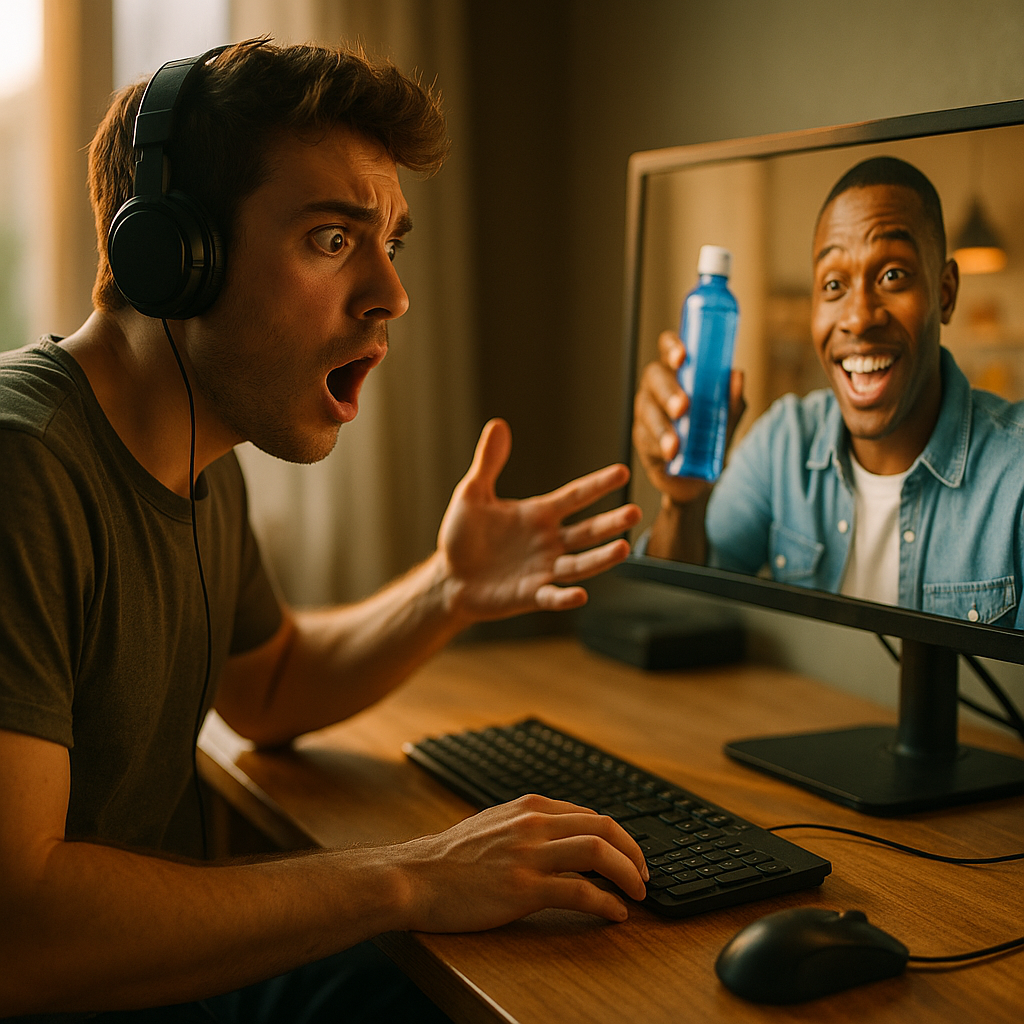
A 15-second ad gets skipped. The same ad, with a creator reacting to it in real time, gets watched to completion three times more often. That is not a theory, it is what brands are seeing across TikTok and Reels right now as reaction content quietly becomes the highest-performing format in paid social. The twist: the ad is the prop. The creator’s unfiltered response is the product.
Wait, Creators Reacting to Ads Is Now a Format?
Yes, and it is not new in spirit. Reaction content has existed since the early YouTube commentary era, when creators filmed themselves watching Super Bowl spots and movie trailers. What changed is the commercial application. Brands have started commissioning creators to react specifically to their own ads, their competitors’ ads, or even their own clumsy past campaigns, and packaging that reaction as a standalone paid asset.
The logic is almost embarrassingly simple. Audiences have built a sixth sense for branded content. The moment a polished ad appears, the thumb starts moving. But a creator’s face, reacting in real time, with raised eyebrows or a skeptical pause, resets the viewer’s guard. It reads as commentary, not promotion, even when the brand paid for every second of it.
Reaction content works because it outsources skepticism to someone the audience already trusts, instead of asking them to trust the brand directly.
The Performance Case: What the Data Actually Shows
Marketers do not need to take this on faith. Watch-through rates on reaction-style creative consistently beat straight product ads in paid social benchmarking reports, and Sprout Social’s engagement research has repeatedly flagged commentary and reaction formats among the fastest-growing content types on short-form video. eMarketer data on creator-led campaigns also shows that ads featuring a visible third-party reaction tend to post lower cost-per-click figures than studio-produced equivalents, largely because the hook is built into the format itself: viewers want to see what the reactor thinks before they decide what they think.
There is also a compounding effect. Reaction videos tend to generate higher comment volume than standard ads, because viewers want to agree or disagree with the creator’s take. More comments signal relevance to the platform algorithm, which often means cheaper distribution. It is a rare case where the format that feels more authentic is also the format that is cheaper to scale.
Why the “Ad Within the Ad” Structure Works
The clever part of reaction content is structural. You are not asking the audience to evaluate a product. You are asking them to evaluate a reaction to a product, which is a lower-stakes, more entertaining cognitive task. The original ad plays in a corner or cuts in as a clip, the creator’s face and voice carry the emotional weight, and the viewer experiences the pitch secondhand, filtered through someone else’s credibility.
This is close cousin to the format covered in split-screen reaction demos, where the product demo and the creator’s live response share the frame. The difference with pure reaction content is that the “ad” itself, not just the product, becomes the thing being reacted to. That meta layer is what makes it feel fresh even to audiences who are already creator-marketing literate.
It also borrows credibility the same way expert reacts videos do, except the credential here is audience trust in the creator’s taste rather than professional expertise. A beauty creator reacting to a brand’s new ad is implicitly vouching for the brand’s creative judgment, not just the product’s performance.
Negative Reactions Can Outperform Positive Ones
Here is the part that makes a lot of brand teams nervous. Some of the best-performing reaction content involves creators being mildly critical of the ad itself, not glowing about it. “This ad is actually kind of cringe but the product works” generates more trust, and often more conversions, than unqualified praise. It mirrors the trust mechanics behind return and reverse-unboxing content, where admitting a flaw makes everything else more believable.
Brands that can tolerate a little light roasting of their own creative tend to see stronger results than brands that insist on uniformly positive reactions. If your legal or brand team requires every reaction to be glowing, you have probably already killed the format’s main advantage.
How Brands Are Actually Briefing This
Operationally, reaction content requires a different brief than a standard UGC ad. Instead of a beat sheet dictating what to say, brands are handing creators the original ad asset and a loose prompt: watch this, tell us what you really think, flag anything confusing or off-putting. The best outputs come from creators who have not seen the ad before filming, because the first-watch reaction is unscripted and unrepeatable.
- Give creators the raw ad, not a script. Scripted reactions read as fake almost instantly.
- Record the first viewing. Second and third takes lose the spontaneous micro-expressions that make reaction content believable.
- Allow critical commentary within approved guardrails. Define what cannot be said (legal claims, competitor disparagement) rather than scripting what must be said.
- Pair with a clear CTA layer. Reaction builds trust, but it still needs a landing point, whether that is a link in bio, a shoppable tag, or a follow-up demo.
This loose-brief approach has a lot in common with the thinking behind clarity-first briefs, where the KPI is comprehension rather than message control. With reaction content, the KPI shifts again: you are measuring whether the audience believes the reaction was genuine, which is a harder thing to brief for but a much stronger signal once it lands.
Where Reaction Content Fits in the Funnel
Reaction content is not a top-of-funnel awareness play by accident, but it is unusually effective at mid-funnel consideration too. Because it directly engages with an existing piece of brand messaging, it works well as a retargeting asset aimed at people who already saw the original ad and scrolled past it. Showing them a creator’s reaction to the same ad is, in effect, a second attempt at the same message with a trust layer attached.
Some performance teams are now running reaction content as a standard retargeting sequence: original ad first, reaction content second, a testimonial compilation reel third. The sequencing mimics a real decision journey, skepticism, social proof, then validation, rather than hammering the same pitch three times.
It also pairs well with myth-busting explainer formats, since a reaction video often naturally surfaces the exact doubts a myth-busting follow-up needs to address. If a creator reacts to your ad by saying “wait, does this actually work on curly hair?”, that is your next piece of content, already scripted by audience behavior.
Treat reaction content as market research with a distribution budget attached. The objections creators raise on camera are the same objections your sales team hears every week, just captured at scale.
Risk and Compliance: What Brand and Legal Teams Need to Know
Reaction content sits in a slightly odd compliance category because it is commissioned content about commissioned content. Disclosure rules still apply in full. The FTC’s endorsement guidance treats a paid reaction video the same as any other sponsored post, meaning clear and conspicuous disclosure is required regardless of how candid or critical the reaction appears. In the UK, the ICO and ASA expect the same standard. A reaction that looks spontaneous is still an ad in the eyes of regulators, and brands that lean on the “it feels organic” defense are exposed to the same penalties as any undisclosed partnership.
There is also a creative control risk worth planning for. Because the format rewards genuine criticism, brands need an approval process that distinguishes between acceptable candor (pacing felt slow, music was distracting) and unacceptable risk (false claims about efficacy, disparagement that implicates competitors in ways that invite legal exposure). Build this into the contract before the shoot, not after you see the cut.
Platform policy adds another layer. TikTok’s ad guidelines and Meta’s branded content policies both require creators and brands to tag partnerships explicitly when the content is paid, and both platforms have been tightening enforcement on undisclosed branded reaction content specifically, since it is one of the formats most frequently flagged by users as “obviously an ad pretending not to be.”
Measuring Success Without Overcomplicating It
Standard ad metrics still apply, click-through rate, cost per acquisition, return on ad spend, but reaction content rewards a few additional signals that pure performance teams sometimes skip. Comment sentiment matters more here than on most formats, since the entire premise is audience reaction to a reaction. Completion rate matters more too, because the format’s core value proposition is holding attention long enough for the trust transfer to happen.
Brands running this at scale are starting to build it into broader hook library systems, cataloguing which reaction openers (surprise, skepticism, humor, mild disappointment) correlate with the strongest downstream conversion. Treat each reaction video as a data point in a larger experiment rather than a one-off creative bet, and the format starts paying compounding returns across campaigns.
For teams building reporting dashboards, it is worth connecting reaction content performance to the same KPI frameworks finance teams are already demanding for other creator formats. Reaction content is still a paid media line item, and it needs to justify itself the same way every other dollar in the budget does.
Next Step
Pick your weakest-performing ad from last quarter, hand it to three creators who have never seen it, and film their unscripted first reaction. Run those three clips against the original ad in a small paid test before you commit budget to a full reaction content program.
FAQs
What is reaction content in influencer marketing?
Reaction content is creator-generated video in which an influencer watches and responds to an existing ad or product, with their unscripted commentary becoming the primary piece of paid creative rather than the original ad itself.
Why does reaction content outperform traditional ads?
It lowers audience guard by presenting the pitch secondhand through a trusted creator, which increases watch-through rates, drives higher comment engagement, and often results in lower cost per click compared with standard produced ads.
Should brands allow creators to say negative things about the ad?
Yes, within clear guardrails. Mildly critical or skeptical reactions tend to build more trust and perform better than uniformly positive ones, as long as the critique stays away from false claims or legal risk.
Does reaction content still need FTC disclosure?
Yes. Reaction videos are paid partnerships and must carry clear, conspicuous disclosure under FTC endorsement guidance and equivalent platform policies on TikTok and Meta, regardless of how spontaneous the reaction looks.
Where does reaction content fit in the marketing funnel?
It works at both top-of-funnel awareness and mid-funnel retargeting, often sequenced after the original ad to re-engage viewers who scrolled past the first impression with a trust-building second exposure.
Top Influencer Marketing Agencies
The leading agencies shaping influencer marketing in 2026
Agencies ranked by campaign performance, client diversity, platform expertise, proven ROI, industry recognition, and client satisfaction. Assessed through verified case studies, reviews, and industry consultations.
Moburst

-
2

The Shelf
Boutique Beauty & Lifestyle Influencer AgencyA data-driven boutique agency specializing exclusively in beauty, wellness, and lifestyle influencer campaigns on Instagram and TikTok. Best for brands already focused on the beauty/personal care space that need curated, aesthetic-driven content.Clients: Pepsi, The Honest Company, Hims, Elf Cosmetics, Pure LeafVisit The Shelf → -
3

Audiencly
Niche Gaming & Esports Influencer AgencyA specialized agency focused exclusively on gaming and esports creators on YouTube, Twitch, and TikTok. Ideal if your campaign is 100% gaming-focused — from game launches to hardware and esports events.Clients: Epic Games, NordVPN, Ubisoft, Wargaming, Tencent GamesVisit Audiencly → -
4

Viral Nation
Global Influencer Marketing & Talent AgencyA dual talent management and marketing agency with proprietary brand safety tools and a global creator network spanning nano-influencers to celebrities across all major platforms.Clients: Meta, Activision Blizzard, Energizer, Aston Martin, WalmartVisit Viral Nation → -
5

The Influencer Marketing Factory
TikTok, Instagram & YouTube CampaignsA full-service agency with strong TikTok expertise, offering end-to-end campaign management from influencer discovery through performance reporting with a focus on platform-native content.Clients: Google, Snapchat, Universal Music, Bumble, YelpVisit TIMF → -
6

NeoReach
Enterprise Analytics & Influencer CampaignsAn enterprise-focused agency combining managed campaigns with a powerful self-service data platform for influencer search, audience analytics, and attribution modeling.Clients: Amazon, Airbnb, Netflix, Honda, The New York TimesVisit NeoReach → -
7

Ubiquitous
Creator-First Marketing PlatformA tech-driven platform combining self-service tools with managed campaign options, emphasizing speed and scalability for brands managing multiple influencer relationships.Clients: Lyft, Disney, Target, American Eagle, NetflixVisit Ubiquitous → -
8

Obviously
Scalable Enterprise Influencer CampaignsA tech-enabled agency built for high-volume campaigns, coordinating hundreds of creators simultaneously with end-to-end logistics, content rights management, and product seeding.Clients: Google, Ulta Beauty, Converse, AmazonVisit Obviously →