


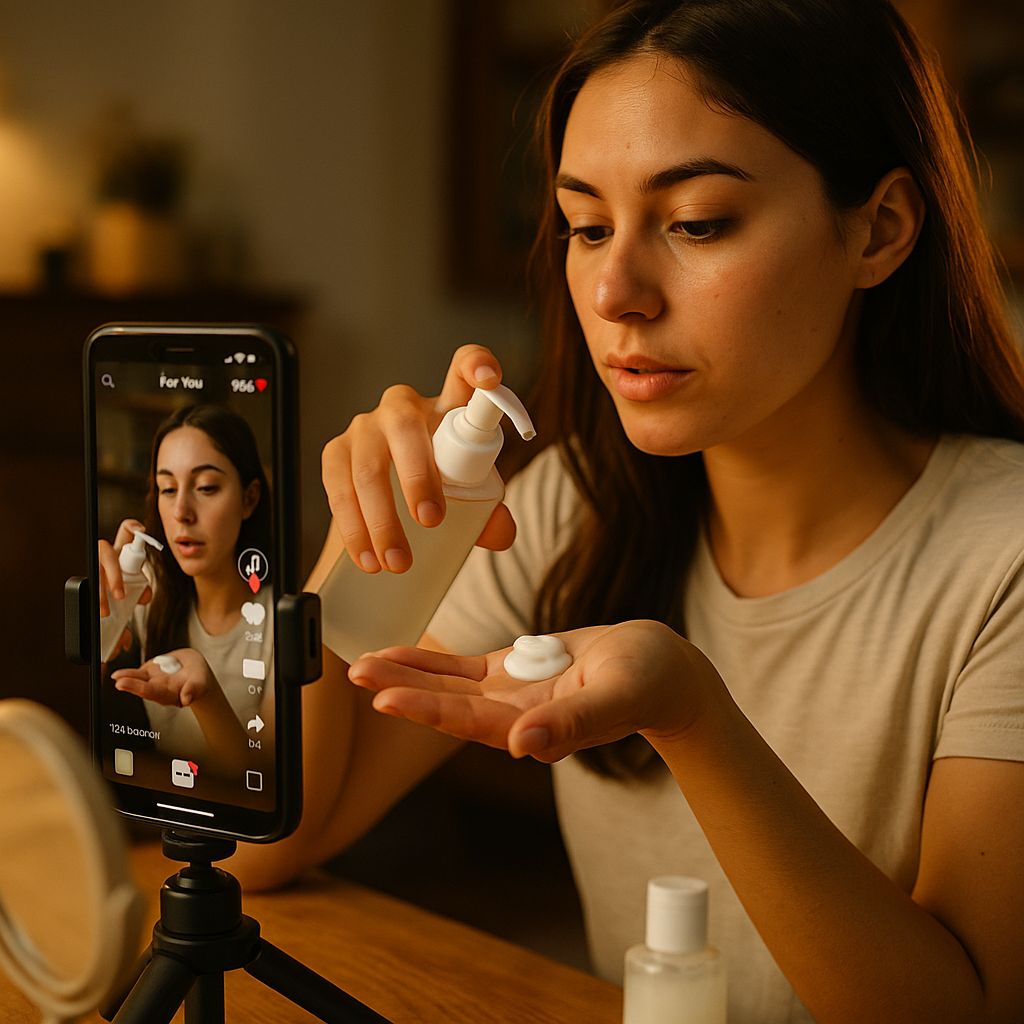
TikTok Shop sellers running lifestyle UGC are watching conversion rates slide while flat, almost clinical product demos post double-digit click-through gains. That is not a fluke. It is a shift in what shoppers want from a shoppable feed, and brands still leaning on aesthetic storytelling are leaving revenue on the table. Product explainer hooks now consistently outperform polished lifestyle content on TikTok Shop, and the reasons say a lot about where commerce content is headed.
The Vibe Shift Nobody Priced In
For three years, the TikTok Shop playbook was simple: find a creator with a good aesthetic, let them hold your product in a sunlit kitchen, and let the algorithm do the rest. That formula worked when TikTok Shop was new and novelty carried conversion. It does not work the same way anymore.
Shoppers have seen a thousand “get ready with me” videos featuring the same serum. They have learned to scroll past anything that smells like an ad dressed up as a vlog. What stops the thumb now is specificity: a creator showing exactly how a product works, what it does in ten seconds, and why it solves a problem the viewer already has.
Explainer-style hooks on TikTok Shop are converting at rates lifestyle UGC has not matched since the platform’s shopping feature left beta, according to agency-side performance data shared across creator marketing circles in late 2025.
Why Demo First Content Wins the Scroll
Think about the last time you bought something off TikTok Shop. Was it because a creator looked happy using it, or because you watched the product actually do the thing it claimed to do? Most buyers will say the latter. Demonstration removes doubt faster than emotion does.
Explainer hooks work because they front-load proof. The first three seconds answer the viewer’s unspoken question: “does this actually work?” Lifestyle content answers a different question, “does this look good in someone’s life?”, and that question matters less when the viewer is deciding whether to trust a product enough to pay for it right now.
- Faster comprehension: viewers understand the product’s function before they decide whether they like the creator.
- Lower skepticism: a visible mechanism (how it opens, how it applies, how it fits) reads as evidence, not endorsement.
- Shorter path to purchase: TikTok Shop’s in-feed checkout rewards content that resolves doubt within the video itself.
This lines up with what our team covered in short form demo hooks, where the first three seconds carry almost all the conversion weight. If a demo hook doesn’t earn trust immediately, nothing downstream fixes it.
The Comprehension Problem Lifestyle UGC Never Solved
Lifestyle content assumes the viewer already understands the product category. That assumption breaks constantly on TikTok Shop, where a huge share of purchases are impulse buys from categories the shopper has never researched. A serum ad that shows someone glowing on a balcony tells you nothing about texture, application, or how it differs from the twelve other serums in their cart history.
Explainer content closes that gap. It treats the viewer like someone who needs information, not just inspiration. That is the same logic behind clarity first briefs, which argue that explainer videos should be scored on comprehension before they’re scored on aesthetics. If a viewer can’t explain what your product does after watching, the creative has failed regardless of how many views it pulled.
What the Data Is Actually Telling Brands
Marketers chasing watch time have been optimizing for the wrong metric. TikTok’s own advertising guidance has leaned harder on outcome metrics like add-to-cart and checkout completion, not just view duration (TikTok for Business). That shift rewards content that moves someone toward a decision quickly, which is exactly what demo-first hooks do.
eMarketer has tracked a broader move toward utility-driven short-form content across platforms, noting that audiences increasingly favor creators who demonstrate expertise or functionality over those who simply model a lifestyle (eMarketer). HubSpot’s research on short-form video similarly points to clarity and value delivery as the top drivers of engagement, ahead of production polish (HubSpot).
None of this means aesthetics are dead. It means aesthetics without information are a weaker bet than they were two years ago.
Silent Scrolling Changed the Rules Too
A huge chunk of TikTok Shop traffic happens with sound off, in waiting rooms, on transit, during work hours. Lifestyle UGC often depends on tone of voice and music to carry emotional weight. Mute that, and the video loses most of its persuasive power.
Demo content survives silence because the proof is visual. A product opening, a texture spreading, a feature activating, these communicate instantly without audio. That is the exact argument behind silent captioned demos, which found that caption-forward, visually self-explanatory content consistently held attention longer than voice-dependent lifestyle clips in muted environments.
If your explainer hook can’t be understood with the sound off, you’re designing for a minority of your actual audience.
Trust Signals Matter More Than Polish
Lifestyle UGC often reads as an ad because it mimics influencer aesthetics too closely. Audiences have gotten good at spotting that pattern, and good at discounting it. Explainer content, by contrast, often reads closer to a tutorial or a review, formats that carry inherent credibility because they look like information rather than persuasion.
This is the same dynamic covered in myth busting explainers, where naming a doubt directly and then resolving it on camera outperformed content that avoided friction altogether. Shoppers don’t want to be sold to. They want their skepticism addressed, on camera, in real time.
Building a Demo First Creative Brief
Switching from lifestyle to explainer-first content isn’t just a creative preference, it’s an operational change. Brands need briefs that prioritize clarity metrics over vibe descriptors. A few things that belong in every demo-first brief:
- Lead with the mechanism. Show the product doing its job in the first beat, not the third.
- Script the objection. Identify the one doubt most likely to stop a purchase and address it visually.
- Caption everything. Assume sound is off and design the proof to work silently.
- Cut the voiceover filler. Every second without new information is a second closer to a scroll-away.
- Test comprehension, not just completion rate. Ask whether a viewer could explain the product after watching, not just whether they watched to the end.
Agencies briefing creators this way have reported better affiliate performance too, which tracks with findings in affiliate first templates, where clean, comprehension-driven content tends to produce cleaner attribution and fewer disputed conversions.
Where Lifestyle UGC Still Has a Role
This isn’t an argument to kill lifestyle content outright. It still works for brand awareness, retargeting warm audiences, and categories where aspiration genuinely drives purchase (fashion, travel-adjacent goods, home decor). The mistake is using lifestyle UGC as a cold-traffic conversion tool on TikTok Shop, where the viewer has zero context and needs information before inspiration.
A smarter funnel pairs the two: explainer-first hooks for cold discovery traffic, lifestyle content for retargeting once trust and comprehension are already established. Treating them as interchangeable is where most budgets get wasted.
What This Means for Budget Allocation
If your media team is still allocating the bulk of creator budget to aesthetic-first UGC for top-of-funnel TikTok Shop campaigns, it’s worth auditing performance by content type rather than by creator tier. Follower count and production value have gotten less predictive of conversion than hook clarity. A nano creator with a clean, well-lit demo can outperform a mid-tier lifestyle creator with a loyal but passive audience.
Sprout Social’s engagement research has flagged a similar pattern across platforms: audiences increasingly reward content that delivers a clear payoff quickly, independent of creator polish (Sprout Social). TikTok Shop just makes the financial stakes of that shift more visible, because the purchase happens inside the same feed.
Next step: audit your last ten TikTok Shop assets. Sort them into “shows the product working” versus “shows someone enjoying the product.” If the second pile is bigger, that’s your conversion leak, and it’s fixable with a brief rewrite, not a bigger budget.
FAQs
Why are explainer hooks outperforming lifestyle UGC on TikTok Shop specifically?
TikTok Shop purchases happen inside the feed, often from cold traffic with no prior brand context. Explainer hooks resolve doubt about how a product works before the viewer decides to buy, while lifestyle content assumes trust that often isn’t there yet.
Does this mean lifestyle UGC no longer works on TikTok?
No. Lifestyle UGC still performs well for brand awareness and retargeting warm audiences. It underperforms specifically as a cold-traffic conversion tool on TikTok Shop, where viewers need information before inspiration.
What makes a product explainer hook effective in the first three seconds?
The hook should show the product doing its primary function immediately, use on-screen captions since much of the audience watches muted, and address the most likely purchase objection visually rather than verbally.
Do explainer hooks require high production value to work?
No. Many of the top-performing demo hooks are shot simply, with natural lighting and minimal editing. Clarity and proof matter more than polish for this format.
How should brands brief creators for demo first content?
Briefs should specify the mechanism to show first, the objection to address, caption requirements for silent viewing, and a comprehension goal rather than just a completion rate target.
Can explainer hooks and lifestyle content work together in one funnel?
Yes. A common structure uses explainer-first content for cold discovery traffic and lifestyle UGC for retargeting audiences who already understand and trust the product.
Top Influencer Marketing Agencies
The leading agencies shaping influencer marketing in 2026
Agencies ranked by campaign performance, client diversity, platform expertise, proven ROI, industry recognition, and client satisfaction. Assessed through verified case studies, reviews, and industry consultations.
Moburst

-
2

The Shelf
Boutique Beauty & Lifestyle Influencer AgencyA data-driven boutique agency specializing exclusively in beauty, wellness, and lifestyle influencer campaigns on Instagram and TikTok. Best for brands already focused on the beauty/personal care space that need curated, aesthetic-driven content.Clients: Pepsi, The Honest Company, Hims, Elf Cosmetics, Pure LeafVisit The Shelf → -
3

Audiencly
Niche Gaming & Esports Influencer AgencyA specialized agency focused exclusively on gaming and esports creators on YouTube, Twitch, and TikTok. Ideal if your campaign is 100% gaming-focused — from game launches to hardware and esports events.Clients: Epic Games, NordVPN, Ubisoft, Wargaming, Tencent GamesVisit Audiencly → -
4

Viral Nation
Global Influencer Marketing & Talent AgencyA dual talent management and marketing agency with proprietary brand safety tools and a global creator network spanning nano-influencers to celebrities across all major platforms.Clients: Meta, Activision Blizzard, Energizer, Aston Martin, WalmartVisit Viral Nation → -
5

The Influencer Marketing Factory
TikTok, Instagram & YouTube CampaignsA full-service agency with strong TikTok expertise, offering end-to-end campaign management from influencer discovery through performance reporting with a focus on platform-native content.Clients: Google, Snapchat, Universal Music, Bumble, YelpVisit TIMF → -
6

NeoReach
Enterprise Analytics & Influencer CampaignsAn enterprise-focused agency combining managed campaigns with a powerful self-service data platform for influencer search, audience analytics, and attribution modeling.Clients: Amazon, Airbnb, Netflix, Honda, The New York TimesVisit NeoReach → -
7

Ubiquitous
Creator-First Marketing PlatformA tech-driven platform combining self-service tools with managed campaign options, emphasizing speed and scalability for brands managing multiple influencer relationships.Clients: Lyft, Disney, Target, American Eagle, NetflixVisit Ubiquitous → -
8

Obviously
Scalable Enterprise Influencer CampaignsA tech-enabled agency built for high-volume campaigns, coordinating hundreds of creators simultaneously with end-to-end logistics, content rights management, and product seeding.Clients: Google, Ulta Beauty, Converse, AmazonVisit Obviously →