


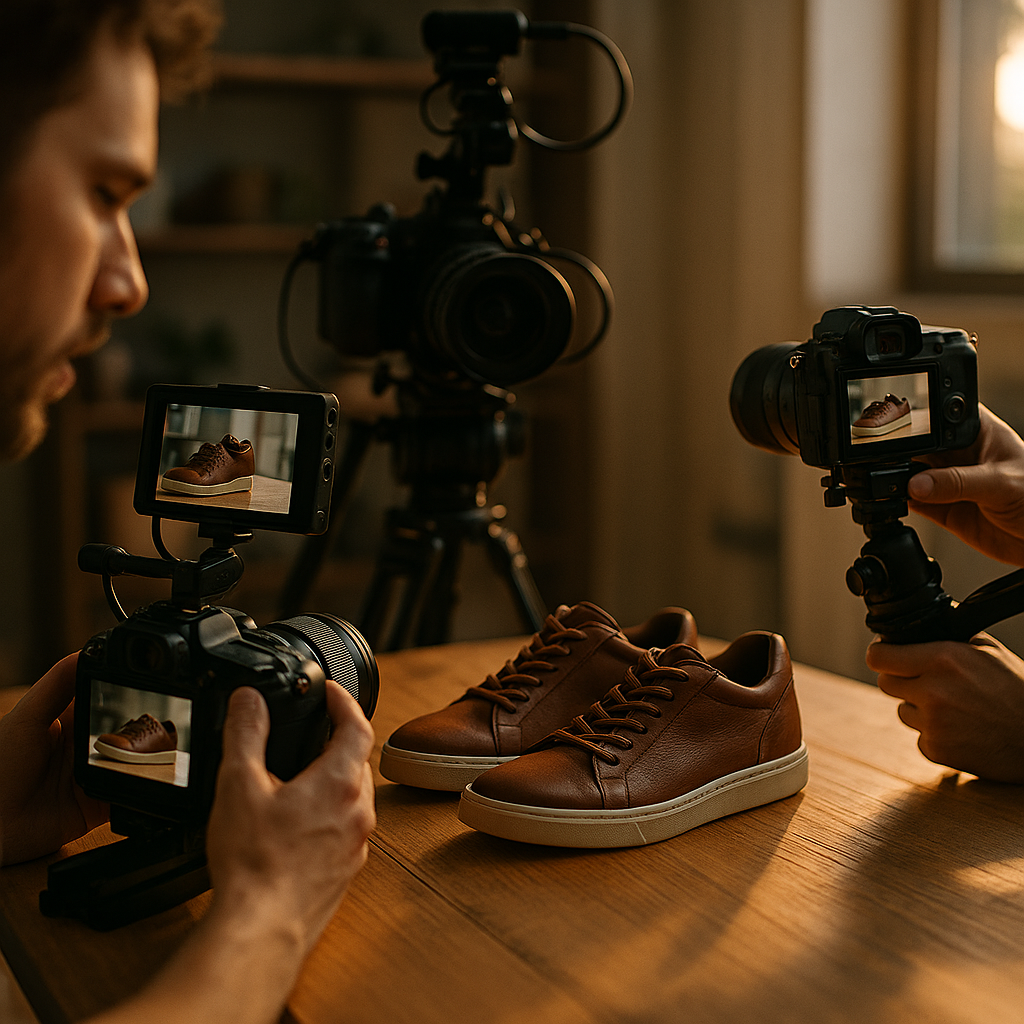
Seventy percent of shoppers say they want to see a product from multiple angles before buying it online, yet most commerce content still ships as a single flat clip. Multi angle product demos are the fix, and the brands treating product video like mini films, with coverage shots, cutaways, and intentional pacing, are the ones winning the watch time battle on TikTok Shop and Instagram Shopping right now.
This isn’t a production trend. It’s a response to how shoppers actually evaluate products when they can’t touch them.
Why a Single Camera Angle Stopped Working
For years, a phone propped against a water bottle was enough. Creator talks, holds product, points at screen, done. That format still exists, but its conversion ceiling has dropped as feeds get more crowded and shoppers get pickier. When every seller is shooting the same static talking-head clip, nothing stands out, and nothing builds the confidence needed to click “buy” on something you’ve never held.
Multi angle demos solve a trust problem, not just a boredom problem. A single angle hides seams, texture flaws, and sizing truth. Three or four angles, cut together with intention, expose the product honestly. That honesty reads as credibility, and credibility is what actually moves someone from “interesting” to “in cart.”
A product shown from one angle looks like an ad. A product shown from four angles, cut like a scene, looks like proof.
What “Shooting Like a Mini Film” Actually Means
Brands aren’t suddenly hiring cinematographers for a lip gloss demo. “Mini film” here means applying basic film grammar, establishing shot, close-up, cutaway, reaction, to a 30 to 60 second commerce clip. It’s a structural shift, not a budget shift.
- Establishing shot: the product in context, often in someone’s hand or on a counter, setting scale and environment.
- Close-up detail: texture, zipper, stitching, screen interface, the thing a photo can’t convey.
- Functional angle: the product actually working, from the angle that proves the claim (pouring, snapping shut, lighting up).
- Reaction or payoff shot: the creator’s face, a before/after cut, or a result reveal.
Stitch those four together with tight cuts and you’ve got a mini film. It mirrors the pacing of a demo to drama hybrid, where the structure itself keeps viewers watching past the first three seconds, which is usually where most commerce content dies.
The Data Behind the Format Shift
Platforms are rewarding this structurally, not just anecdotally. TikTok’s own creative guidance has repeatedly flagged that videos with multiple shot types and scene changes hold attention longer than single-take content, and TikTok’s advertising resources continue to push dynamic creative formats over static ones for Shop placements. Meta’s commerce tools show similar patterns: product tags embedded in multi-scene Reels get more taps than tags on single-angle static video, based on trends Meta’s business platform has surfaced in its creative best practices.
Separately, eMarketer’s research on commerce video has tracked rising average watch times correlating with videos that use more than one camera setup, a signal that production variety, not just creator charisma, drives retention. None of this means every brand needs a full crew. It means the editing decisions matter as much as the footage itself.
Does This Actually Move Conversion, or Just Watch Time?
Fair question, and the honest answer is: both, but watch time is the lever that pulls conversion. Longer watch time signals the algorithm to push the content further, which means more impressions, which means more shoppers reaching the CTA. A beautifully shot demo nobody sees converts nothing.
Brands running multi angle demos alongside single-angle control clips in split tests have generally reported higher add-to-cart rates on the multi angle version, particularly in categories where texture or fit is a purchase blocker (apparel, skincare, home goods). This tracks with findings in split screen review formats, where pairing visual proof with reaction cuts has already shown conversion lift over single-shot reviews.
Watch time is the algorithm’s currency. Multi angle structure is how you earn more of it without changing the product itself.
Operational Reality: What This Costs a Brand Program
Here’s where marketers get nervous. “Mini film” sounds like it needs a bigger budget, a tighter brief, and more creator hand-holding. It doesn’t have to.
Most multi angle demos can be shot on a phone with a basic tripod and a cheap ring light. The real cost isn’t equipment, it’s briefing discipline. Creators need a shot list, not just a vibe. Brands that hand creators a loose “show the product” brief get loose, single-angle footage back. Brands that specify four shot types in the brief get mini films back.
- Write the shot list into the brief, not just the talking points.
- Specify which angle proves which claim (texture claim gets close-up, function claim gets working shot).
- Ask for raw b-roll separately so your team can re-cut for paid amplification later.
- Budget slightly more creator time (10 to 15 extra minutes on set) rather than more creator fee.
This operational discipline pays off twice. Once in organic performance, and again when you pull the best clips into paid. A clean multi angle shoot gives your media buyers raw material for testimonial compilation reels or price comparison cutdowns without a reshoot.
Where Brands Get the Format Wrong
The most common mistake is over-polishing. A mini film doesn’t mean a cinematic film. The moment a demo looks like a studio commercial, shoppers’ trust radar flags it as “ad,” and engagement drops. The format works because it still feels native to the feed, just better structured. Keep the handheld energy. Keep the natural lighting. Just add the shot variety.
The second mistake is ignoring sound-off viewers. A huge share of commerce content gets watched muted, so your multi angle cuts need visual clarity and captions carrying the narrative weight, similar to the logic behind silent captioned demo formats. If your “reveal” shot only lands with audio, you’ve lost half your audience’s comprehension before the CTA even appears.
The third mistake: treating this as a one-format solution. Multi angle structure pairs well with other formats already proven on commerce feeds, like transformation reveal pacing or countdown hook structures. The angles are a production technique, not a replacement for a hook strategy.
Compliance and Disclosure, Still Non-Negotiable
More camera angles doesn’t change disclosure obligations. If a creator is paid or gifted product, the FTC’s endorsement guidance still applies regardless of how many shots are in the edit. Make sure the disclosure appears clearly in whichever shot carries the claim, not buried in a description nobody reads. Brands running influencer programs across UK audiences should also check ICO guidance on data handling if any demo content captures user information through interactive commerce features.
This matters more as multi angle demos get repurposed into paid ads. A disclosure that was compliant in an organic post needs to stay visible and legible when the clip gets re-cut for a 15-second ad unit. Don’t let your editing team crop it out by accident.
What This Means for Creator Briefs Going Forward
The brands pulling ahead on commerce content aren’t necessarily spending more. They’re briefing smarter. A multi angle shot list costs nothing extra to write into a creator contract, but it changes the entire output quality. Pair it with proven hook structures from formats like product explainer hooks or three-second demo openers, and you’ve got a repeatable production system instead of a one-off creative win.
Start small: pick your next three creator briefs and add a four-shot requirement to each. Measure watch time and add-to-cart against your last single-angle batch, and let the data make the case for scaling it across your full program.
Frequently Asked Questions
What is a multi angle product demo?
It’s a short commerce video that combines several camera angles, typically an establishing shot, a close-up detail, a functional shot, and a reaction or payoff shot, cut together to show a product more completely than a single static clip can.
Do multi angle demos require professional camera equipment?
No. Most brands produce these with a smartphone, a basic tripod, and a simple light source. The improvement comes from shot planning and editing structure, not equipment upgrades.
How does this format affect algorithmic reach?
Platforms like TikTok and Meta tend to reward content with longer watch times, and multi angle structure typically holds viewer attention longer than single-shot clips, which can lead to greater organic distribution.
Does this format work for every product category?
It performs especially well for categories where texture, fit, or function are purchase concerns, such as apparel, skincare, and home goods. Simpler products may only need two or three angles rather than a full four-shot sequence.
How should brands brief creators for this format?
Specify the required shot types directly in the creative brief rather than leaving coverage to the creator’s judgment, and request raw b-roll separately so the footage can be repurposed for paid ads later.
Does multi angle shooting change FTC disclosure requirements?
No. Standard endorsement disclosure rules still apply. Brands should ensure disclosures remain visible in whichever shot carries the product claim, especially if the clip gets re-cut for paid placements.
FAQs
See above.
Top Influencer Marketing Agencies
The leading agencies shaping influencer marketing in 2026
Agencies ranked by campaign performance, client diversity, platform expertise, proven ROI, industry recognition, and client satisfaction. Assessed through verified case studies, reviews, and industry consultations.
Moburst

-
2

The Shelf
Boutique Beauty & Lifestyle Influencer AgencyA data-driven boutique agency specializing exclusively in beauty, wellness, and lifestyle influencer campaigns on Instagram and TikTok. Best for brands already focused on the beauty/personal care space that need curated, aesthetic-driven content.Clients: Pepsi, The Honest Company, Hims, Elf Cosmetics, Pure LeafVisit The Shelf → -
3

Audiencly
Niche Gaming & Esports Influencer AgencyA specialized agency focused exclusively on gaming and esports creators on YouTube, Twitch, and TikTok. Ideal if your campaign is 100% gaming-focused — from game launches to hardware and esports events.Clients: Epic Games, NordVPN, Ubisoft, Wargaming, Tencent GamesVisit Audiencly → -
4

Viral Nation
Global Influencer Marketing & Talent AgencyA dual talent management and marketing agency with proprietary brand safety tools and a global creator network spanning nano-influencers to celebrities across all major platforms.Clients: Meta, Activision Blizzard, Energizer, Aston Martin, WalmartVisit Viral Nation → -
5

The Influencer Marketing Factory
TikTok, Instagram & YouTube CampaignsA full-service agency with strong TikTok expertise, offering end-to-end campaign management from influencer discovery through performance reporting with a focus on platform-native content.Clients: Google, Snapchat, Universal Music, Bumble, YelpVisit TIMF → -
6

NeoReach
Enterprise Analytics & Influencer CampaignsAn enterprise-focused agency combining managed campaigns with a powerful self-service data platform for influencer search, audience analytics, and attribution modeling.Clients: Amazon, Airbnb, Netflix, Honda, The New York TimesVisit NeoReach → -
7

Ubiquitous
Creator-First Marketing PlatformA tech-driven platform combining self-service tools with managed campaign options, emphasizing speed and scalability for brands managing multiple influencer relationships.Clients: Lyft, Disney, Target, American Eagle, NetflixVisit Ubiquitous → -
8

Obviously
Scalable Enterprise Influencer CampaignsA tech-enabled agency built for high-volume campaigns, coordinating hundreds of creators simultaneously with end-to-end logistics, content rights management, and product seeding.Clients: Google, Ulta Beauty, Converse, AmazonVisit Obviously →