


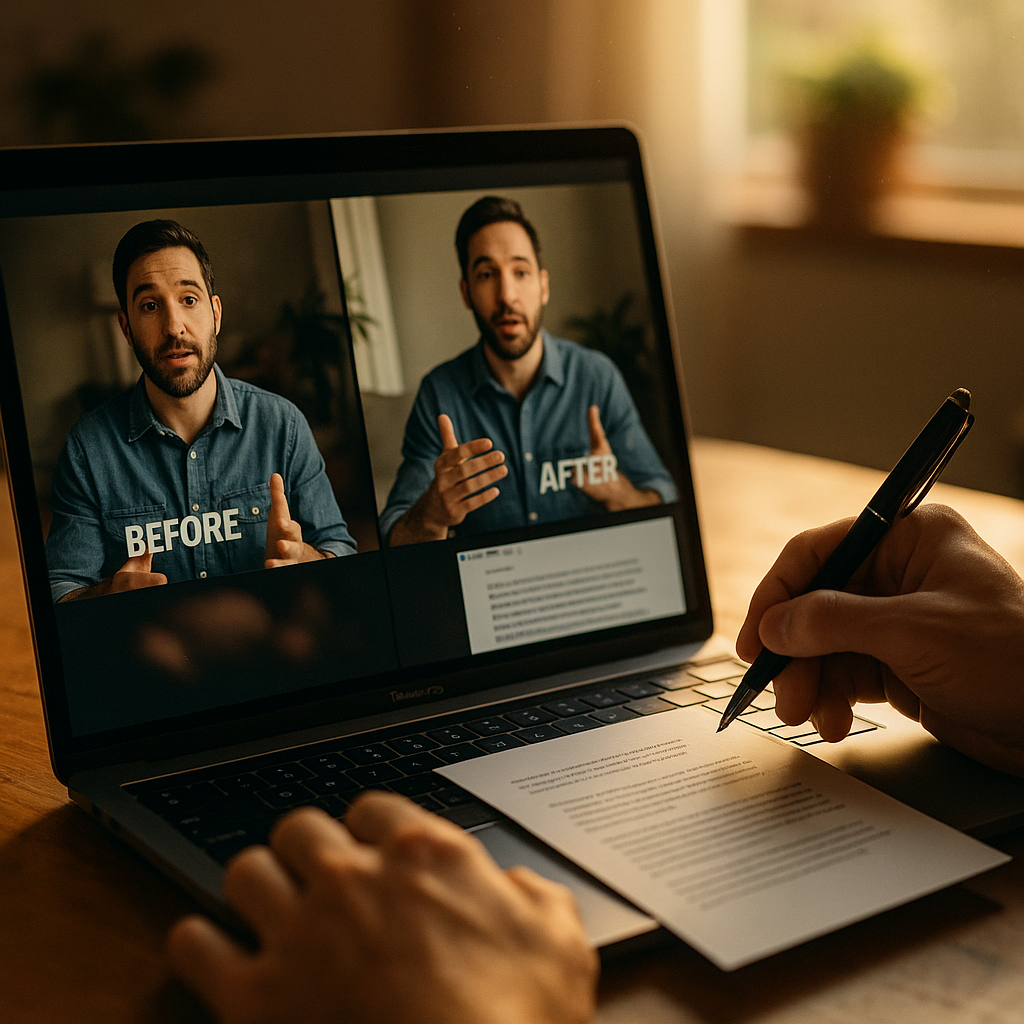
Viewers decide whether an ad is worth watching in under two seconds. Split screen comparison videos cut that decision time even further, because the brain processes a visual “us versus them” contrast almost instantly. For brands fighting commoditized categories, this format has quietly become one of the highest-converting creative structures on paid social. It does not just claim superiority. It shows it, side by side, frame by frame.
This isn’t a new trick. Infomercials built an entire industry on it decades ago. What’s changed is the delivery system: short-form video, creator authenticity, and algorithmic feeds that reward instant visual tension. Brands that understand why split screen comparison videos work, and how to script them without triggering legal or platform risk, are seeing meaningfully better performance than brands still relying on single-angle testimonials.
Why the Format Works: It Replaces Claims With Evidence
Marketers love to say “better,” “faster,” or “more effective.” Consumers have learned to tune that language out. A split screen comparison video sidesteps the credibility gap entirely by letting the viewer judge for themselves. One side shows the competitor struggling, cracking, smearing, or taking longer. The other shows your product succeeding in real time. No voiceover claim required.
This matters because trust in advertising has eroded steadily. According to eMarketer research on consumer ad sentiment, skepticism toward branded claims has risen in parallel with ad spend, meaning brands are paying more to be believed less. Comparison formats work around that skepticism by shifting the burden of proof from the brand’s words to the viewer’s own eyes.
A split screen comparison doesn’t ask viewers to trust the brand. It asks them to trust their own perception, which is a much harder thing to argue with.
There’s also a cognitive efficiency angle. Split screen framing compresses two demos into the runtime of one, which matters enormously on platforms where average watch time is measured in single-digit seconds. You’re not asking someone to watch a before clip, scroll away, then come back for an after clip. You’re giving them the whole argument in one continuous frame.
The Anatomy of a High-Performing Split Screen Comparison Video
Not every side-by-side video performs. The format has a structure, and skipping steps usually shows up in weak completion rates or, worse, in comments accusing the brand of rigging the demo.
- The hook frame: Both sides need to start in a visually identical state. If the competitor side looks sabotaged or pre-damaged, viewers notice immediately and the comment section turns hostile.
- The tension beat: Somewhere around the two to four second mark, a visible gap should start forming between the two sides. This is the moment that stops the scroll.
- The proof close: End on a clear, unambiguous visual difference, not a subjective one. Stain removed versus stain remaining. Battery indicator at 80 percent versus 40 percent. Numbers and visible states outperform vague “looks better” framing.
- The caption layer: Many split screen videos are watched without sound, so on-screen text labeling each side (and the result) is not optional. For more on structuring visuals for silent viewing, see our breakdown on silent demo scripting.
Brands that treat this as a formula rather than a one-off creative bet tend to build a repeatable content engine out of it. One beauty brand we tracked ran the same split screen structure across eleven creators with different product categories (serum, cleanser, SPF) and saw consistent lift across all eleven, which suggests the format itself, not the specific creator, was driving performance.
Where This Fits in the Broader Creative Mix
Split screen comparison videos are not a replacement for every format in your content calendar. They’re a conversion-stage asset, best suited for retargeting audiences or bottom-funnel placements where the viewer already has some category awareness. Someone who has never heard of your product category probably needs a multi angle product demo first, something that builds basic understanding before a comparison means anything to them.
Once that awareness exists, comparison content becomes one of the sharpest tools for moving someone from “I know this exists” to “I should switch.”
It pairs particularly well with reaction-based formats. Our piece on split screen reviews covers the adjacent format where a creator’s genuine reaction sits alongside the product proof, which works well as a sequel asset after an initial comparison video has already done the heavy lifting on claims.
Legal and Platform Risk: The Part Brands Skip at Their Peril
Here’s where a lot of marketing teams get sloppy, and it’s the single biggest reason comparison campaigns get pulled or flagged. Comparative advertising is legal in most markets, but it carries specific obligations. The FTC requires that comparative claims be substantiated, meaning if your video shows a competitor’s product performing worse, you need to be able to prove that result is representative, not cherry-picked from a single unfavorable test run.
In the UK, the ICO and advertising standards bodies apply similar scrutiny, particularly around identifiable competitor branding.
The fastest way to turn a high-performing comparison ad into a legal headache is skipping substantiation testing before the creative goes live.
Practical risk mitigation steps that should sit in every brief:
- Run the comparison test multiple times before filming, not once, and keep documentation of results.
- Blur or genericize competitor branding unless your legal team has specifically cleared named comparisons.
- Avoid absolute language like “always” or “every time” in captions or voiceover, since this raises the substantiation bar considerably.
- Have legal review before the creator posts, not after it’s already live and collecting impressions.
Platform policy is a separate layer. TikTok’s advertising policies and Meta’s advertising standards both restrict disparaging or misleading claims about competitors, and automated review systems sometimes flag comparison content even when it’s compliant, simply because it contains dual product imagery that pattern-matches to disallowed categories. Building in a few days of buffer before a planned launch date accounts for potential manual review delays.
Creator Selection Matters More Than Brands Assume
A split screen comparison video lives or dies on perceived neutrality. If the creator is obviously a paid brand partner with a history of only promoting one company, viewers discount the comparison before it even finishes playing. The creators who get the best results tend to have some history of reviewing multiple brands in a category, giving them earned credibility that a first-time brand partner simply doesn’t have yet.
This is also where disclosure matters for trust, not just compliance. A clearly labeled #ad or #partner tag paired with a genuinely rigorous test reads as more credible than an undisclosed comparison, because audiences increasingly assume undisclosed content is hiding something.
Consider pairing the comparison format with a confessional framing, where the creator admits they expected the competitor to win. That narrative device, covered in our guide to confessional video briefs, adds a layer of perceived objectivity that straight comparison footage sometimes lacks. The twist of a skeptical creator being proven wrong on camera tends to outperform a creator who seems to already know the outcome.
Measuring Performance Beyond Vanity Metrics
View counts tell you almost nothing about whether a comparison video is doing its job. The metrics that matter for this format are completion rate (since the payoff sits at the end), click-through from the caption or pinned comment, and, critically, post-view conversion within the retargeting window. According to HubSpot’s research on video marketing benchmarks, comparison and demo-style content consistently ranks among the highest-converting video types for consideration-stage buyers, which tracks with what most performance marketing teams see in their own dashboards.
Sprout Social’s platform data (available via Sprout Social) also points to comparison content generating disproportionately high save and share rates relative to like counts, a signal that viewers are treating these videos as reference material, something to pull back up before a purchase decision, rather than passive entertainment. That’s a meaningfully different engagement pattern than most influencer content generates, and it should change how brands weight success for this format in reporting.
If you’re running split screen tests across multiple platforms, don’t assume a winning hook on TikTok will translate directly to Meta or YouTube Shorts. Our cross channel hook testing framework is worth applying here specifically, since comparison videos tend to need different pacing on each platform based on autoplay behavior and typical scroll speed.
What This Looks Like in Practice
A direct-to-consumer cookware brand we’ve seen cited in industry case discussions ran a split screen series comparing nonstick performance against a well-known competitor. They didn’t name the competitor directly (smart move, legally speaking), just showed a generic pan labeled “Leading Brand.” The egg-stick test alone, filmed in one continuous take with no cuts, generated enough organic share volume that it outperformed their paid comparison ads on cost per acquisition. The lesson there isn’t that organic always wins. It’s that visual proof this clear travels on its own, with or without ad spend behind it.
Brands in SaaS and service categories can adapt the same logic even without a physical product to film. Screen recordings comparing load times, dashboard complexity, or checkout steps follow an identical split screen logic, just with software interfaces standing in for the egg pan.
Common Mistakes That Sink Comparison Campaigns
- Overproduced competitor shots: If your side looks cinematic and theirs looks like a flip phone photo, viewers assume bias before the test even starts.
- No repeatability: A one-time dramatic result that can’t be reproduced invites both legal risk and comment section debunking.
- Ignoring the caption layer: Silent autoplay means an unlabeled split screen is often meaningless to half your audience.
- Skipping the legal review step: This is the single most expensive mistake on this list, both in fines and in brand reputation.
Treat the format with the same rigor you’d apply to a product claim in a press release, because that’s effectively what it is, just dressed up in nine seconds of vertical video.
The brands winning with this format aren’t the ones with the biggest production budgets. They’re the ones willing to document their proof, label it clearly, and let the visual contrast do the selling instead of a script full of adjectives. Start with one honest, repeatable test, brief your legal team early, and build from there.
Frequently Asked Questions
Is it legal to compare my product directly against a named competitor in a video ad?
In most markets, comparative advertising is legal as long as claims are substantiated and not misleading. Regulators like the FTC require that any comparative result be representative and provable, not a cherry-picked outlier. Many brands choose to genericize competitor branding to reduce legal exposure while still making the visual comparison clear.
What makes split screen comparison videos perform better than standard product demos?
They remove the need for the viewer to trust a spoken claim, since the visual contrast does the persuading. This shifts the burden of proof from brand messaging to the viewer’s own perception, which tends to generate higher trust and higher completion rates than single-angle demo content.
Which platforms work best for this format?
TikTok and Instagram Reels tend to perform well for quick, punchy comparisons under fifteen seconds, while YouTube Shorts and longer-form placements can support a slightly extended comparison with more context. Pacing should be adjusted per platform rather than reused identically.
How do I measure success beyond views and likes?
Track completion rate, save and share rate, and post-view conversion within your retargeting window. Comparison content often generates high save rates because viewers treat it as reference material before purchasing, which is a stronger buying signal than passive likes.
Do I need to disclose a paid partnership in a comparison video?
Yes. Disclosure is both a legal requirement in most markets and a trust signal for audiences, who increasingly assume undisclosed comparison content is biased or incomplete.
Top Influencer Marketing Agencies
The leading agencies shaping influencer marketing in 2026
Agencies ranked by campaign performance, client diversity, platform expertise, proven ROI, industry recognition, and client satisfaction. Assessed through verified case studies, reviews, and industry consultations.
Moburst

-
2

The Shelf
Boutique Beauty & Lifestyle Influencer AgencyA data-driven boutique agency specializing exclusively in beauty, wellness, and lifestyle influencer campaigns on Instagram and TikTok. Best for brands already focused on the beauty/personal care space that need curated, aesthetic-driven content.Clients: Pepsi, The Honest Company, Hims, Elf Cosmetics, Pure LeafVisit The Shelf → -
3

Audiencly
Niche Gaming & Esports Influencer AgencyA specialized agency focused exclusively on gaming and esports creators on YouTube, Twitch, and TikTok. Ideal if your campaign is 100% gaming-focused — from game launches to hardware and esports events.Clients: Epic Games, NordVPN, Ubisoft, Wargaming, Tencent GamesVisit Audiencly → -
4

Viral Nation
Global Influencer Marketing & Talent AgencyA dual talent management and marketing agency with proprietary brand safety tools and a global creator network spanning nano-influencers to celebrities across all major platforms.Clients: Meta, Activision Blizzard, Energizer, Aston Martin, WalmartVisit Viral Nation → -
5

The Influencer Marketing Factory
TikTok, Instagram & YouTube CampaignsA full-service agency with strong TikTok expertise, offering end-to-end campaign management from influencer discovery through performance reporting with a focus on platform-native content.Clients: Google, Snapchat, Universal Music, Bumble, YelpVisit TIMF → -
6

NeoReach
Enterprise Analytics & Influencer CampaignsAn enterprise-focused agency combining managed campaigns with a powerful self-service data platform for influencer search, audience analytics, and attribution modeling.Clients: Amazon, Airbnb, Netflix, Honda, The New York TimesVisit NeoReach → -
7

Ubiquitous
Creator-First Marketing PlatformA tech-driven platform combining self-service tools with managed campaign options, emphasizing speed and scalability for brands managing multiple influencer relationships.Clients: Lyft, Disney, Target, American Eagle, NetflixVisit Ubiquitous → -
8

Obviously
Scalable Enterprise Influencer CampaignsA tech-enabled agency built for high-volume campaigns, coordinating hundreds of creators simultaneously with end-to-end logistics, content rights management, and product seeding.Clients: Google, Ulta Beauty, Converse, AmazonVisit Obviously →