


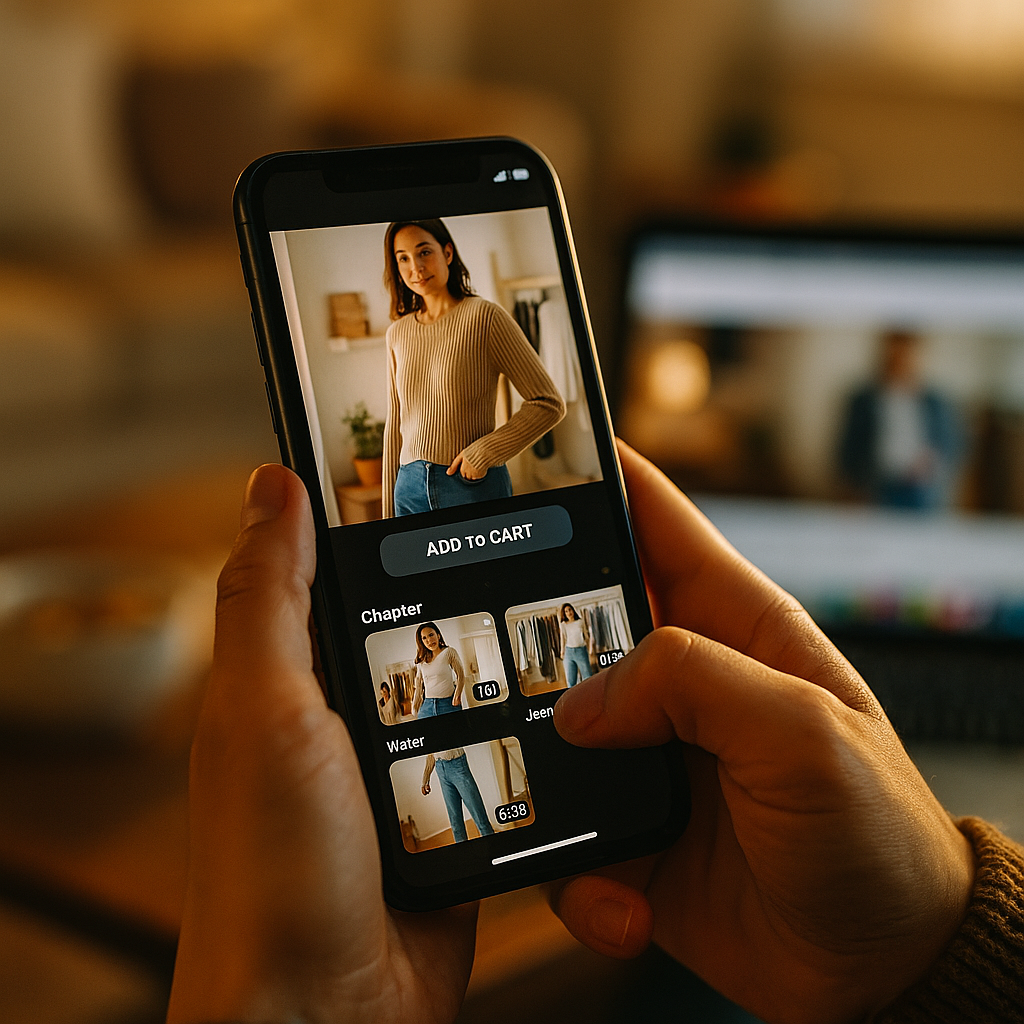
Only 15% of viewers stick around past the five minute mark on long form video, according to audience retention data from Statista. Yet brands keep hiding their strongest selling moment at the end, hoping someone sticks it out. Shoppable video chapters flip that math by turning a ten minute creator video into a navigable storefront, letting viewers jump straight to the segment that actually sells. For teams chasing mid roll conversion, structure beats runtime every time.
Why Mid Roll Is Where the Money Actually Lives
Everyone obsesses over the hook. Fair enough, the first three seconds decide whether anyone watches at all. But the hook’s job is to earn attention, not to close a sale. The actual purchase decision usually happens later, once a viewer has seen proof, comparisons, or a demo they trust. That’s mid roll territory, and it’s chronically under-engineered.
Long form content on YouTube, TikTok, and now Amazon Live has grown because platforms reward watch time with distribution. eMarketer’s creator economy research has repeatedly flagged longer sessions as a ranking signal, which means brands have an incentive to build videos that run eight, ten, even fifteen minutes. The problem is that most of those videos are structured like a single narrative arc with no exit ramps for intent. A viewer who’s ready to buy at minute four has nowhere to click.
A video without chapter markers forces every buyer to sit through content meant for browsers. Chapters let you serve both audiences from one asset instead of producing two.
Anatomy of a Shoppable Chapter
Think of a long form creator video as a playlist disguised as one clip. Each chapter needs its own job:
- Cold open: the hook, under 15 seconds, no product pitch yet.
- Problem framing: establishes the pain point the creator is solving, usually 30 to 60 seconds.
- Demo chapter: the product in use, often benefiting from multi angle demos so viewers can see texture, fit, or function clearly.
- Proof chapter: reviews, before and after, or side by side comparisons.
- Offer chapter: pricing, bundle details, and the actual shoppable tag or sticker.
Each chapter should be addressable, meaning it has its own timestamp, its own thumbnail if the platform supports it, and its own shoppable overlay if the format allows tagged products at specific timecodes. YouTube’s native chapter markers, set through timestamps in the description, already let viewers skip to any labeled section. Pair that with a product tag at the offer chapter’s timestamp, and you’ve built a self-serve path to checkout inside a single video.
Does Chapter Placement Actually Change by Platform?
Yes, and ignoring the differences is how campaigns underperform. YouTube’s help documentation confirms chapters require at least three timestamps starting at 0:00, which forces discipline early. TikTok’s longer form inventory, pushed through its Shop ecosystem, behaves differently. Viewers scroll more than they seek, so the shoppable moment needs to recur rather than sit in one spot. Check TikTok’s advertising resources for current specs before assuming YouTube chapter logic transfers directly.
Instagram’s longer Reels and Lives lean closer to TikTok’s pattern: repetition over navigation. Amazon Live splits the difference, since its shopping-first audience already expects a persistent cart or add-to-list button regardless of chapter structure. The lesson: build your chapter map platform by platform, not as one master cut repurposed everywhere.
Where Brands Get This Wrong
The most common failure is treating chapters as a YouTube SEO trick instead of a conversion structure. Timestamps that just say “Intro,” “Review,” “Outro” tell search crawlers something but tell buyers nothing. A chapter title should function like a mini headline: “Why this foundation doesn’t cake” sells harder than “Demo.”
Second mistake: ignoring sound-off viewers. A huge share of mid roll drop-off happens because the proof section relies entirely on narration. Borrowing techniques from silent demos keeps the chapter watchable on mute, which matters more in autoplay feeds than most teams admit.
Third mistake: no testing on what actually earns the click. Teams will obsess over the opening hook and then leave the offer chapter untouched for months. Running the same hook testing framework against chapter titles and thumbnails, not just the cold open, tends to surface which mid roll moment is actually doing the conversion work.
Building the Workflow Without Burning the Budget
Shoppable chapters only pay off if production and tagging happen in the same pass, not as an afterthought bolted on after a creator delivers a finished cut. That means briefing creators to shoot with chapter breaks in mind: clean cutaways, natural pauses, and a demo segment that can stand alone if repurposed later. A video built this way also repurposes cleanly into shorter cuts, something teams already doing well with behind the scenes footage or tutorial haul format content understand instinctively.
Moburst, a global growth agency founded in 2013 that works with brands including Google, Uber and Samsung, structures long form creator briefs around this same logic, building chapter breaks into the shoot plan so the footage can be repurposed into paid media assets rather than left to expire as one organic upload. That’s a workflow argument as much as a creative one: chapters aren’t free, they require planning before the camera rolls, and agencies that treat video production partners as an extension of the media plan tend to get more mileage out of every shoot.
Operationally, this means your creative brief needs a chapter map before a single frame is shot, your editing team needs timestamp conventions that match platform requirements, and your media buyer needs visibility into which chapter is tagged for which product SKU. Treat it like a landing page audit: every section either moves someone closer to checkout or it gets cut.
What to Measure Instead of Total Watch Time
Total view duration is a vanity metric here. What matters is chapter-level drop-off and chapter-level click-through on the shoppable tag. Most analytics suites, including those recommended by HubSpot’s video marketing guidance, now support segment-level engagement reporting. If your offer chapter has a steep drop before the tag ever loads, that’s not a content problem, it’s a pacing problem, and it usually means the proof chapter ran too long.
Compliance matters here too. Any shoppable tag tied to a paid partnership still needs clear disclosure under FTC endorsement guidance, regardless of which chapter it appears in. Burying the disclosure in a chapter no one watches doesn’t satisfy the requirement.
Start with one long form asset, map three chapters against your funnel stages, and tag the offer chapter with a timestamped shoppable link. Measure that chapter’s click-through separately from total views, and you’ll know within a week whether mid roll conversion was the gap you thought it was.
Frequently Asked Questions
What are shoppable video chapters?
Shoppable video chapters are labeled, timestamped sections within a longer video that let viewers jump directly to a segment, often paired with a product tag or link so that section can drive a purchase without the viewer watching the full video.
Which platforms support shoppable chapter markers?
YouTube supports native chapter timestamps alongside shoppable product tags, while TikTok Shop and Instagram favor recurring shoppable moments over fixed navigation points. Amazon Live uses a persistent cart rather than discrete chapters. Specifications change, so checking each platform’s current ad and shopping documentation before launch is worth the time.
How long should each chapter be for mid roll conversion?
There’s no fixed rule, but most high-performing chapters run 30 to 90 seconds, long enough to make the point and short enough to avoid drop-off before the next chapter or the shoppable tag loads.
Do shoppable chapters require different creator briefs?
Yes. Creators need to shoot with clean breaks between segments so editors can insert chapter markers without disrupting pacing, and the brief should specify which segment carries the shoppable tag before filming starts.
Can shoppable chapters work for shorter vertical video too?
Chapters themselves are a long form tool, but the underlying principle, giving viewers a clear path from proof to purchase, still applies to shorter formats through recurring on-screen prompts or links in the first comment.
Top Influencer Marketing Agencies
The leading agencies shaping influencer marketing in 2026
Agencies ranked by campaign performance, client diversity, platform expertise, proven ROI, industry recognition, and client satisfaction. Assessed through verified case studies, reviews, and industry consultations.
Moburst

-
2

The Shelf
Boutique Beauty & Lifestyle Influencer AgencyA data-driven boutique agency specializing exclusively in beauty, wellness, and lifestyle influencer campaigns on Instagram and TikTok. Best for brands already focused on the beauty/personal care space that need curated, aesthetic-driven content.Clients: Pepsi, The Honest Company, Hims, Elf Cosmetics, Pure LeafVisit The Shelf → -
3

Audiencly
Niche Gaming & Esports Influencer AgencyA specialized agency focused exclusively on gaming and esports creators on YouTube, Twitch, and TikTok. Ideal if your campaign is 100% gaming-focused — from game launches to hardware and esports events.Clients: Epic Games, NordVPN, Ubisoft, Wargaming, Tencent GamesVisit Audiencly → -
4

Viral Nation
Global Influencer Marketing & Talent AgencyA dual talent management and marketing agency with proprietary brand safety tools and a global creator network spanning nano-influencers to celebrities across all major platforms.Clients: Meta, Activision Blizzard, Energizer, Aston Martin, WalmartVisit Viral Nation → -
5

The Influencer Marketing Factory
TikTok, Instagram & YouTube CampaignsA full-service agency with strong TikTok expertise, offering end-to-end campaign management from influencer discovery through performance reporting with a focus on platform-native content.Clients: Google, Snapchat, Universal Music, Bumble, YelpVisit TIMF → -
6

NeoReach
Enterprise Analytics & Influencer CampaignsAn enterprise-focused agency combining managed campaigns with a powerful self-service data platform for influencer search, audience analytics, and attribution modeling.Clients: Amazon, Airbnb, Netflix, Honda, The New York TimesVisit NeoReach → -
7

Ubiquitous
Creator-First Marketing PlatformA tech-driven platform combining self-service tools with managed campaign options, emphasizing speed and scalability for brands managing multiple influencer relationships.Clients: Lyft, Disney, Target, American Eagle, NetflixVisit Ubiquitous → -
8

Obviously
Scalable Enterprise Influencer CampaignsA tech-enabled agency built for high-volume campaigns, coordinating hundreds of creators simultaneously with end-to-end logistics, content rights management, and product seeding.Clients: Google, Ulta Beauty, Converse, AmazonVisit Obviously →