


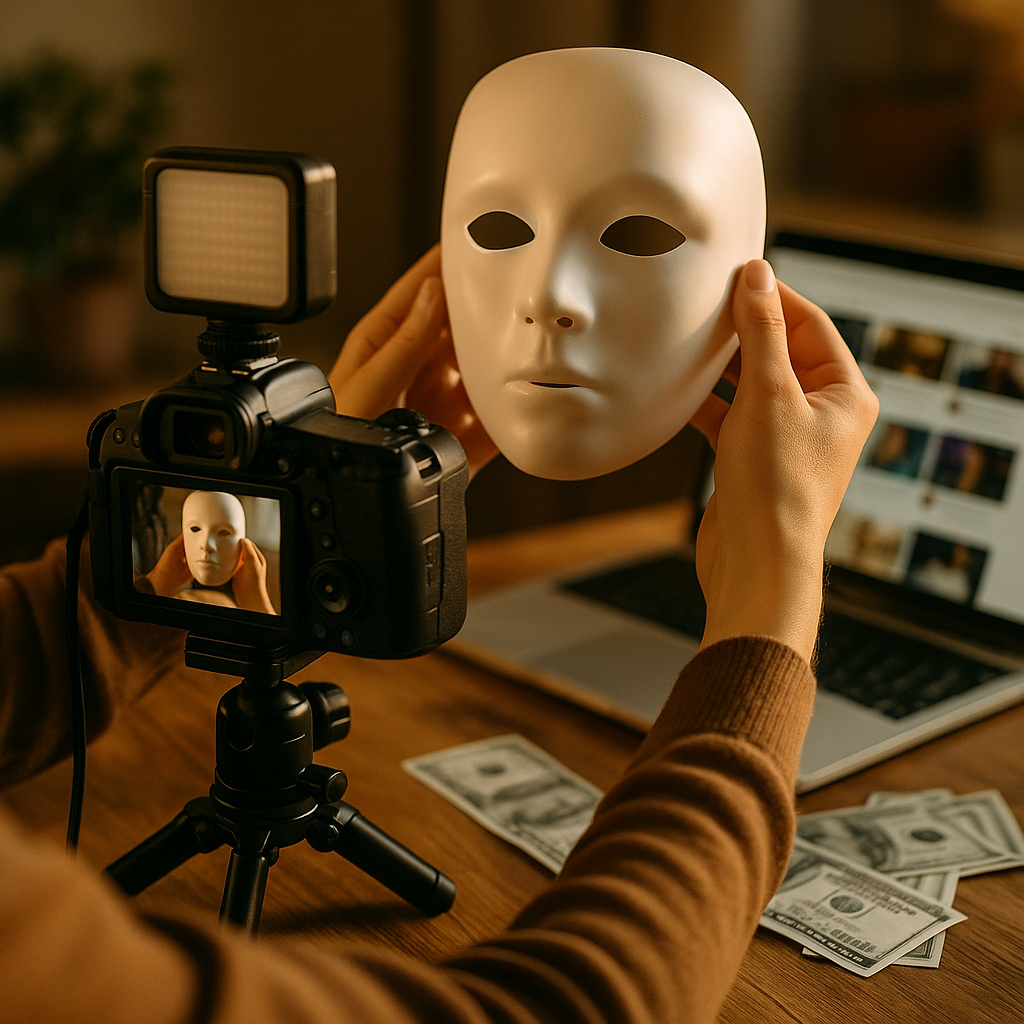
Nearly a third of top-performing TikTok ads in 2026 don’t show a human face at all. No talking head, no personal brand, just hands, products, text overlays, and voiceover. Faceless creator content has quietly become one of the most efficient formats in the influencer playbook, and brands that dismiss it as a fad are leaving budget on the table.
Why would a format with zero “personality” outperform polished talent? Because audiences have stopped trusting the face and started trusting the proof.
What Faceless Content Actually Means in Practice
Faceless creator content isn’t a single format. It’s a category that includes voiceover-led product demos, screen recordings, hand-only tutorials, text-on-screen storytelling, AI-generated avatars, and even fully automated channels run by a single editor managing dozens of accounts. The common thread: the creator’s identity is irrelevant to the message. Trust gets transferred to the product, the data, or the narrative structure instead of a recognizable personality.
This matters for brands because it decouples content performance from influencer risk. No more worrying about a creator’s off-platform behavior torching a campaign. No more renegotiating usage rights every time a face becomes a liability. The content itself does the work.
Why Brands Are Shifting Budget Toward Anonymous Formats
Three forces are driving the move: cost, scalability, and risk mitigation. A faceless production run can cost a fraction of a talent-led shoot because you’re not paying for likeness, personal brand equity, or usage buyouts across every platform. You’re paying for editing skill and a script that converts.
Scalability is the bigger prize. One editor with a library of B-roll, stock hands, and a text-to-speech tool can produce ten variations of the same ad in a day. Compare that to coordinating ten creators, ten contracts, and ten rounds of approvals. Agencies running always-on testing programs have found faceless formats slot neatly into cross channel hook testing workflows because iteration speed matters more than star power.
A faceless format strips out the variable brands can’t control (the creator’s public image) and replaces it with variables brands can optimize endlessly: script, pacing, and proof.
Then there’s risk. Every brand safety team has a story about a creator partnership that soured mid-campaign. Faceless content sidesteps a lot of that exposure. If the account gets shut down or the trend dies, you haven’t tied your brand equity to one person’s reputation.
The Formats Actually Winning Right Now
Not all anonymous content performs equally. A few sub-formats are carrying the category:
- Hands-only demos: Close-up shots of product use with no face in frame, often paired with ASMR-style audio. These overlap heavily with the tactics covered in ASMR product sound briefs.
- Text-overlay storytelling: A narrative told entirely through on-screen captions and b-roll, no voice at all. This format thrives in sound-off environments, which is why sound off scripting has become a core skill for creative teams.
- Screen recordings and tutorials: Software demos, app walkthroughs, and “how I use this tool” content where the product itself is the star.
- AI avatar spokespeople: Synthetic presenters delivering scripted messages at scale, popular with brands testing dozens of ad variants simultaneously.
- Fulfillment and process content: Packing, shipping, and behind-the-counter clips that build trust through transparency rather than charisma, similar in spirit to pack an order with me content.
What unites these formats is proof over persona. The viewer isn’t buying into a creator’s lifestyle. They’re watching evidence that a product works, unfolds, or solves a problem, and that evidence doesn’t need a face attached to be credible.
Does Anonymity Actually Hurt Trust?
This is the question every skeptical CMO asks, and it’s a fair one. Doesn’t influencer marketing rely on the “influence” part, the parasocial bond between creator and audience?
The data suggests it’s more nuanced. Research from eMarketer has repeatedly shown that consumers trust peer-style content (reviews, demos, unscripted reactions) more than branded advertising, regardless of whether a recognizable face delivers it. Trust is tied to format authenticity, not celebrity. A shaky, hand-held demo with no face can read as more honest than a glossy influencer testimonial, because it looks like something a real person filmed for themselves, not for a brand deal.
That said, faceless content works best for specific jobs. It excels at proof-of-concept, product demos, and top-of-funnel discovery. It’s weaker for building long-term brand loyalty or community, which still benefits from a recognizable personality audiences can follow over time. Smart brands run both in parallel: faceless formats for acquisition and testing, face-led formats for retention and brand-building.
Operational Playbook: How to Brief Faceless Content
Briefing faceless content requires a different muscle than briefing a talent-led campaign. There’s no creator bio to lean on, no personal voice to match. The script and the visual sequence have to carry the entire persuasive load.
- Lead with the proof point, not the hook. Faceless content lives or dies on whether the first three seconds show something worth watching: a transformation, a reveal, a surprising result.
- Script for silence first. Assume half your audience will watch muted. Text overlays and visual storytelling need to carry the message independent of voiceover, a principle borrowed directly from silent demo scripting.
- Build modular assets. Faceless formats are built for remixing. Shoot B-roll once, then cut a dozen variants with different hooks, captions, and pacing, similar to the approach in template seeding strategies.
- Disclose partnerships regardless of anonymity. Faceless doesn’t mean exempt. If the content is sponsored or the brand compensated an editor or account owner, FTC disclosure rules still apply. Review current guidance at the FTC’s endorsement guidelines page before launch.
- Track performance by format element, not creator. Since there’s no personal brand to measure, success metrics shift to hook retention, completion rate, and click-through by script variant.
Where Faceless Content Falls Short
It’s not a silver bullet. Faceless formats struggle to build the kind of long-term community that fuels repeat engagement and brand advocacy. There’s no face for the algorithm or the audience to recognize and follow across posts, which can cap follower growth and limit the compounding reach that personality-driven accounts enjoy over time.
There’s also a saturation risk. As more brands lean into AI avatars and templated hands-only demos, audiences will get better at spotting the formula, and the novelty that currently drives performance will fade. Brands relying entirely on anonymity without rotating formats, hooks, or visual treatments will see diminishing returns within a few campaign cycles, the same pattern seen with overused formats like photo dump carousels once every brand copied the same aesthetic.
Compliance teams should also watch closely as AI-generated spokespeople become common. Platforms including Meta and TikTok have been tightening disclosure requirements around synthetic media, and regulators in the UK and elsewhere are paying close attention. Check guidance from bodies like the ICO if your campaigns touch European or UK audiences.
Measuring ROI Without a Face to Track
Attribution gets simpler in some ways and trickier in others. You lose the ability to measure creator-specific brand lift or long-term follower value, since there’s no persona accumulating equity. But you gain cleaner A/B testing, because every variable in the content is something you controlled and scripted. Brands running faceless programs at scale typically track:
- Cost per completed view against face-led benchmarks
- Click-through rate by script variant and hook style
- Conversion rate on shoppable links embedded mid-content, a tactic explored in shoppable video chapters
- Production cost per asset relative to talent-led equivalents
Tools like those found through Sprout Social or HubSpot can help standardize this reporting across both faceless and face-led assets, so finance teams get an apples-to-apples view of which format actually drives cheaper acquisition.
Frequently Asked Questions
What is faceless creator content?
Faceless creator content refers to influencer or branded content where no identifiable person appears on camera. It includes hands-only demos, screen recordings, text-overlay storytelling, voiceover content, and AI-generated avatars.
Is faceless content cheaper than working with traditional influencers?
Generally yes. Faceless production avoids likeness fees, personal brand premiums, and talent usage buyouts, which lowers per-asset cost and makes high-volume testing more affordable.
Do FTC disclosure rules still apply to faceless sponsored content?
Yes. Disclosure requirements are based on whether compensation or a material connection exists, not on whether a face appears on screen. Brands should always disclose sponsored faceless content per current FTC guidance.
Can faceless content build long-term brand loyalty?
It’s weaker for loyalty building compared to personality-driven creator relationships, since there’s no recognizable figure for audiences to follow over time. It performs best for top-of-funnel discovery and product proof.
How do brands measure ROI on faceless campaigns?
Brands typically track cost per completed view, click-through rate by script variant, and conversion rate, comparing these against face-led benchmarks rather than measuring individual creator influence.
Next step: Run a small-scale test splitting the same product message across one faceless format and one creator-led format, then compare cost per acquisition before committing budget either direction.
Top Influencer Marketing Agencies
The leading agencies shaping influencer marketing in 2026
Agencies ranked by campaign performance, client diversity, platform expertise, proven ROI, industry recognition, and client satisfaction. Assessed through verified case studies, reviews, and industry consultations.
Moburst

-
2

The Shelf
Boutique Beauty & Lifestyle Influencer AgencyA data-driven boutique agency specializing exclusively in beauty, wellness, and lifestyle influencer campaigns on Instagram and TikTok. Best for brands already focused on the beauty/personal care space that need curated, aesthetic-driven content.Clients: Pepsi, The Honest Company, Hims, Elf Cosmetics, Pure LeafVisit The Shelf → -
3

Audiencly
Niche Gaming & Esports Influencer AgencyA specialized agency focused exclusively on gaming and esports creators on YouTube, Twitch, and TikTok. Ideal if your campaign is 100% gaming-focused — from game launches to hardware and esports events.Clients: Epic Games, NordVPN, Ubisoft, Wargaming, Tencent GamesVisit Audiencly → -
4

Viral Nation
Global Influencer Marketing & Talent AgencyA dual talent management and marketing agency with proprietary brand safety tools and a global creator network spanning nano-influencers to celebrities across all major platforms.Clients: Meta, Activision Blizzard, Energizer, Aston Martin, WalmartVisit Viral Nation → -
5

The Influencer Marketing Factory
TikTok, Instagram & YouTube CampaignsA full-service agency with strong TikTok expertise, offering end-to-end campaign management from influencer discovery through performance reporting with a focus on platform-native content.Clients: Google, Snapchat, Universal Music, Bumble, YelpVisit TIMF → -
6

NeoReach
Enterprise Analytics & Influencer CampaignsAn enterprise-focused agency combining managed campaigns with a powerful self-service data platform for influencer search, audience analytics, and attribution modeling.Clients: Amazon, Airbnb, Netflix, Honda, The New York TimesVisit NeoReach → -
7

Ubiquitous
Creator-First Marketing PlatformA tech-driven platform combining self-service tools with managed campaign options, emphasizing speed and scalability for brands managing multiple influencer relationships.Clients: Lyft, Disney, Target, American Eagle, NetflixVisit Ubiquitous → -
8

Obviously
Scalable Enterprise Influencer CampaignsA tech-enabled agency built for high-volume campaigns, coordinating hundreds of creators simultaneously with end-to-end logistics, content rights management, and product seeding.Clients: Google, Ulta Beauty, Converse, AmazonVisit Obviously →