


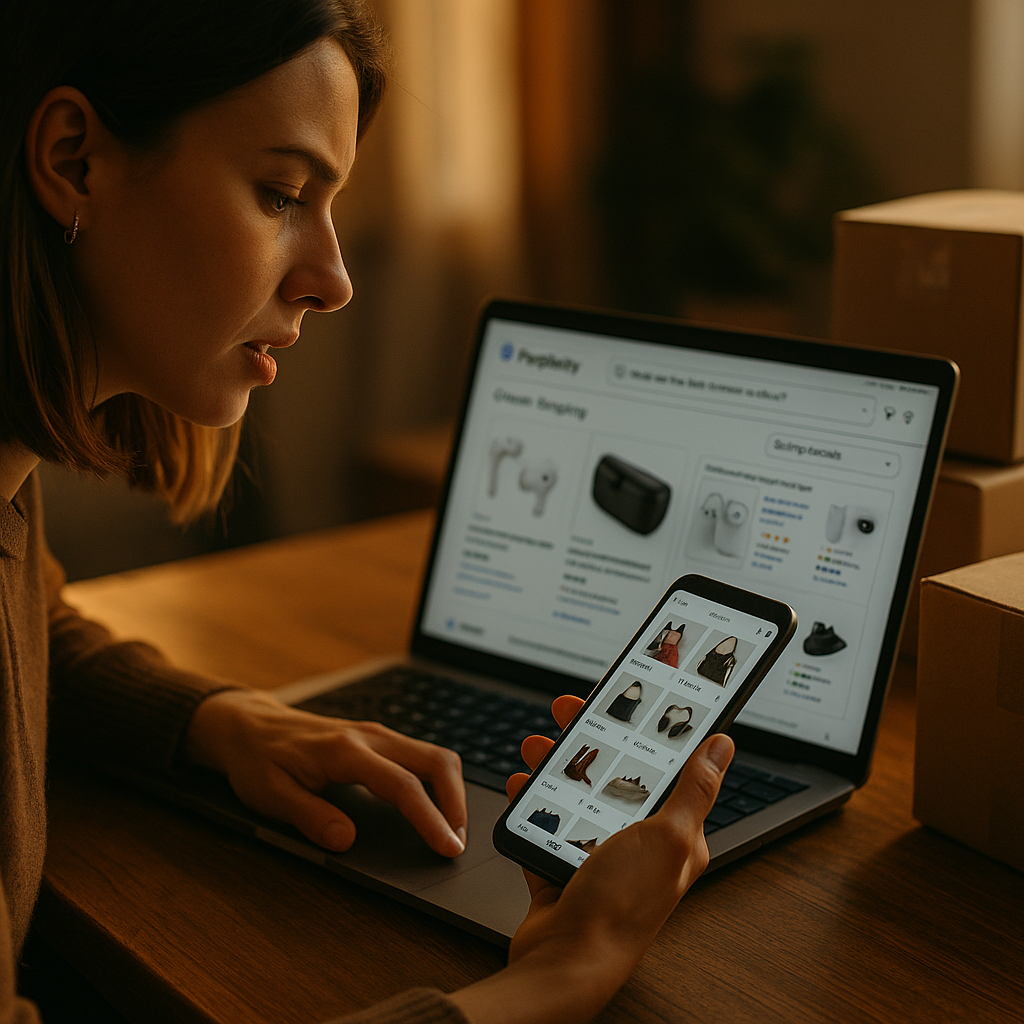
Seventy percent of Gen Z shoppers now start product research in a chat interface before they ever open a retailer’s app. Perplexity added agentic checkout. Microsoft Copilot folded Shopping into its sidebar. Neither asked creators for permission first. If your influencer program still measures success in swipe-up clicks, Perplexity and Copilot shopping features just made that scoreboard obsolete.
This isn’t a minor UI update. It’s a structural shift in where purchase decisions get made, and it changes what “creator led discovery” actually means for brands running paid influencer programs.
What Perplexity and Copilot Actually Shipped
Perplexity’s shopping layer lets users ask a question like “best wireless earbuds under $150” and get a synthesized answer with product cards, pricing, and a direct buy button, often powered by its partnership infrastructure with payment processors. Microsoft Copilot’s Shopping feature, embedded in Edge and Windows, does something similar: it compares products, pulls reviews, and surfaces deals, then hands off to checkout with minimal friction.
Neither tool sends you to ten blue links anymore. The AI reads the web, decides what’s credible, and presents a condensed verdict. Creator content becomes raw material for that verdict rather than the final stop in the customer journey.
When an AI assistant completes the purchase inside its own interface, the creator’s call to action never gets clicked. Attribution dies at the exact moment that used to generate affiliate revenue.
That’s the uncomfortable part. A creator can still move a viewer emotionally, build trust, and shape intent. But if the actual transaction happens inside Copilot’s sidebar, the brand’s existing tracking stack (UTM links, promo codes, pixel-based attribution) may never register that influence at all.
Why This Breaks Traditional Attribution Models
Most influencer programs still run on last-click or multi-touch models tied to trackable URLs. Those models assume a human clicks a link, lands on a page, and converts. Generative shopping assistants compress that path. The research phase, the comparison phase, and the checkout phase can now happen in a single conversational session, with the creator’s actual content stripped of its wrapper and reduced to a data point the model cites (or doesn’t).
Brands that have already started auditing how their attribution vendors handle creator sales are better positioned here, because they’re used to thinking beyond single-channel click tracking. Everyone else is about to get a rude awakening when Q3 reports show a mysterious drop in referral traffic that coincides with a spike in direct conversions nobody can explain.
Creator Content Is Becoming AI Training Material, Whether You Planned For It Or Not
Here’s the part most marketing teams haven’t internalized yet: Perplexity and Copilot don’t rank creator posts the way Google ranks a webpage. They extract entities, claims, and sentiment, then decide which sources deserve a citation in the synthesized answer. A glowing TikTok review with no structured product data, no clear brand mention, and no corroborating text anywhere else on the web is much less likely to get pulled into that answer than a review paired with a well-structured blog post, a retailer’s spec sheet, and consistent brand language across channels.
This is the same dynamic already reshaping generative engine optimization (GEO) strategy across the industry. Just as advertorial pages rarely earn AI model citations, heavily sponsored or disclosure-light creator content may struggle to earn citations in shopping assistants too. The models are tuned to favor content that reads as credible and corroborated, not content that reads as an ad.
What does earn citations? Specific, verifiable claims. “This blender crushed ice in four seconds” beats “I love this blender so much.” Creators who build structured comparison content, who mention exact model numbers, who quantify performance, give these models something to extract and cite. Vague vibes-based endorsement doesn’t translate well into a machine-readable answer engine.
The Compliance Angle Nobody’s Talking About Yet
If an AI shopping assistant pulls product claims from a creator’s sponsored post and presents them as fact in a purchase recommendation, who’s liable if that claim is false or misleading? The FTC’s disclosure guidance was written for human readers scrolling a feed, not for language models synthesizing claims into a checkout-ready summary. Brands running influencer programs need to revisit how disclosure requirements get interpreted when the content is consumed by a model first and a human second.
This is exactly the kind of gap that creator ops automation audits are starting to flag. Legal and compliance teams that only reviewed content for platform-native disclosure rules now need a second pass: is this claim specific enough, sourced enough, and disclosed clearly enough that it survives being lifted out of context by an AI assistant and placed next to a buy button?
Check the FTC’s endorsement guidance directly if your legal team hasn’t updated internal playbooks in the last year. The agency hasn’t issued AI-shopping-specific rules yet, but existing endorsement principles still apply regardless of who (or what) is reading the content.
Rethinking KPIs: From Clicks to Citations
If the purchase happens inside a chat window, the metric that matters shifts from click-through rate to citation rate: how often does your brand, your product, or your creator’s specific content get referenced when a relevant query runs through Perplexity or Copilot? That’s a fundamentally different measurement problem, and most martech stacks aren’t built for it yet.
- Citation frequency: How often does branded or creator content appear in AI-generated shopping answers for relevant queries?
- Sentiment in citation: Is the brand mentioned favorably, neutrally, or as a cautionary comparison point?
- Source diversity: Are multiple creator posts, retailer pages, and review sites corroborating the same claims, which increases citation likelihood?
- Checkout proximity: Does the citation appear in a context close to a buy button, or buried in general informational content?
Teams already building GEO monitoring into their reporting cadence have a head start. The GEO audit checklist for tracking brand citations originally built for ChatGPT applies directly here, since Perplexity and Copilot use similar retrieval and synthesis logic. If you haven’t run a citation audit against your top creator content pieces, do it this quarter, not next.
Picking the Right Tools to Track This
Vendors like OtterlyAI and Brandi AI already track brand mentions across generative engines, and some are extending coverage into shopping-specific queries. Before committing budget, run a proper evaluation. The comparison between Brandi AI and OtterlyAI is a useful starting point if you’re choosing between platforms, and the broader CMO checklist for vetting GEO tools helps you avoid locking into a vendor that can’t actually prove ROI six months in.
Don’t assume every GEO tool handles shopping-intent queries the same way they handle general informational queries. Ask vendors directly whether their indexing covers Perplexity’s shopping results and Copilot’s product comparison cards specifically, not just standard chat answers.
What This Means for Creator Briefs and Content Formats
Briefs built purely around aesthetic direction and brand voice now need a structured-data layer. Creators should be encouraged (or contractually required) to include specific product details, measurable claims, and consistent naming conventions that match how the brand describes the product elsewhere. Entity consistency across a creator’s post, the brand’s own site, and third-party reviews increases the odds that an AI model treats all of it as corroborating evidence rather than isolated opinion.
This lines up with a broader shift already underway in brief development. As entity salience replaces keyword density in AI creator briefs, the same logic applies to shopping assistants: specificity and consistency beat generic enthusiasm every time. A creator saying “best running shoe I’ve tried” is forgettable to a model. A creator saying “the Pegasus 42’s foam compound reduced heel strike fatigue over 10 miles” gives the model something concrete to cite.
Treat every creator post like it’s being read by two audiences at once: a human scrolling for inspiration, and a language model deciding whether to cite it in a purchase recommendation.
Platform Strategy: Don’t Abandon the Funnel, Rebuild It
None of this means influencer marketing on TikTok, Instagram, or YouTube stops mattering. Social discovery still drives the emotional pull that gets someone to open a chat assistant in the first place and ask “what’s the best option for X.” The funnel just got a new middle layer. Brands need creator content that performs on the platform natively and holds up as a citable, structured source when it gets pulled into an AI-mediated shopping decision downstream.
Check how Sprout Social’s platform research frames shifting discovery behavior, and compare it against eMarketer’s commerce forecasting to see how fast retail media and conversational commerce are converging. Both point in the same direction: the discovery and transaction layers are merging, and creator content needs to work across both.
A Quick Gut Check for Your Team
Ask three questions before your next campaign cycle locks in:
- Can we currently detect whether our creator content shows up in Perplexity or Copilot shopping answers for our category’s top queries?
- Do our creator contracts and briefs require specific, verifiable claims rather than general sentiment?
- Does our compliance review account for AI-mediated citation, not just platform-native disclosure rules?
If the honest answer to any of these is no, that’s your next quarter’s priority, not a someday project.
FAQs
Do Perplexity and Copilot shopping features replace social media discovery?
No. They add a new layer between social discovery and purchase. Creators still drive awareness and intent on platforms like TikTok and Instagram, but the actual transaction increasingly happens inside the AI assistant rather than through a traditional affiliate link.
How can brands track whether creator content gets cited in AI shopping answers?
Dedicated GEO monitoring tools track brand and content mentions across generative engines. Run a citation audit specifically on shopping-intent queries relevant to your category, and compare coverage across tools before committing budget to one vendor.
Does FTC disclosure guidance apply when an AI assistant summarizes creator content?
The FTC hasn’t issued AI-shopping-specific rules yet, but existing endorsement and disclosure principles still apply. Brands should assume their legal exposure extends to how claims get repackaged by AI assistants, not just how they originally appeared on a creator’s post.
What content formats perform best for AI shopping citation?
Specific, quantifiable claims paired with consistent product naming across the creator’s post, the brand’s own site, and third-party reviews. Vague enthusiasm performs poorly; structured, corroborated detail performs well.
Should influencer budgets shift because of these shopping features?
Not immediately, but reporting and brief structures should change now. Budget shifts should follow once citation tracking data shows which creators and content formats actually drive AI-mediated conversions.
Start small: pick your top five creator partnerships, run their recent content through a citation check against Perplexity and Copilot shopping queries in your category, and use whatever you find to rewrite next quarter’s briefs.
Top Influencer Marketing Agencies
The leading agencies shaping influencer marketing in 2026
Agencies ranked by campaign performance, client diversity, platform expertise, proven ROI, industry recognition, and client satisfaction. Assessed through verified case studies, reviews, and industry consultations.
Moburst

-
2

The Shelf
Boutique Beauty & Lifestyle Influencer AgencyA data-driven boutique agency specializing exclusively in beauty, wellness, and lifestyle influencer campaigns on Instagram and TikTok. Best for brands already focused on the beauty/personal care space that need curated, aesthetic-driven content.Clients: Pepsi, The Honest Company, Hims, Elf Cosmetics, Pure LeafVisit The Shelf → -
3

Audiencly
Niche Gaming & Esports Influencer AgencyA specialized agency focused exclusively on gaming and esports creators on YouTube, Twitch, and TikTok. Ideal if your campaign is 100% gaming-focused — from game launches to hardware and esports events.Clients: Epic Games, NordVPN, Ubisoft, Wargaming, Tencent GamesVisit Audiencly → -
4

Viral Nation
Global Influencer Marketing & Talent AgencyA dual talent management and marketing agency with proprietary brand safety tools and a global creator network spanning nano-influencers to celebrities across all major platforms.Clients: Meta, Activision Blizzard, Energizer, Aston Martin, WalmartVisit Viral Nation → -
5

The Influencer Marketing Factory
TikTok, Instagram & YouTube CampaignsA full-service agency with strong TikTok expertise, offering end-to-end campaign management from influencer discovery through performance reporting with a focus on platform-native content.Clients: Google, Snapchat, Universal Music, Bumble, YelpVisit TIMF → -
6

NeoReach
Enterprise Analytics & Influencer CampaignsAn enterprise-focused agency combining managed campaigns with a powerful self-service data platform for influencer search, audience analytics, and attribution modeling.Clients: Amazon, Airbnb, Netflix, Honda, The New York TimesVisit NeoReach → -
7

Ubiquitous
Creator-First Marketing PlatformA tech-driven platform combining self-service tools with managed campaign options, emphasizing speed and scalability for brands managing multiple influencer relationships.Clients: Lyft, Disney, Target, American Eagle, NetflixVisit Ubiquitous → -
8

Obviously
Scalable Enterprise Influencer CampaignsA tech-enabled agency built for high-volume campaigns, coordinating hundreds of creators simultaneously with end-to-end logistics, content rights management, and product seeding.Clients: Google, Ulta Beauty, Converse, AmazonVisit Obviously →