


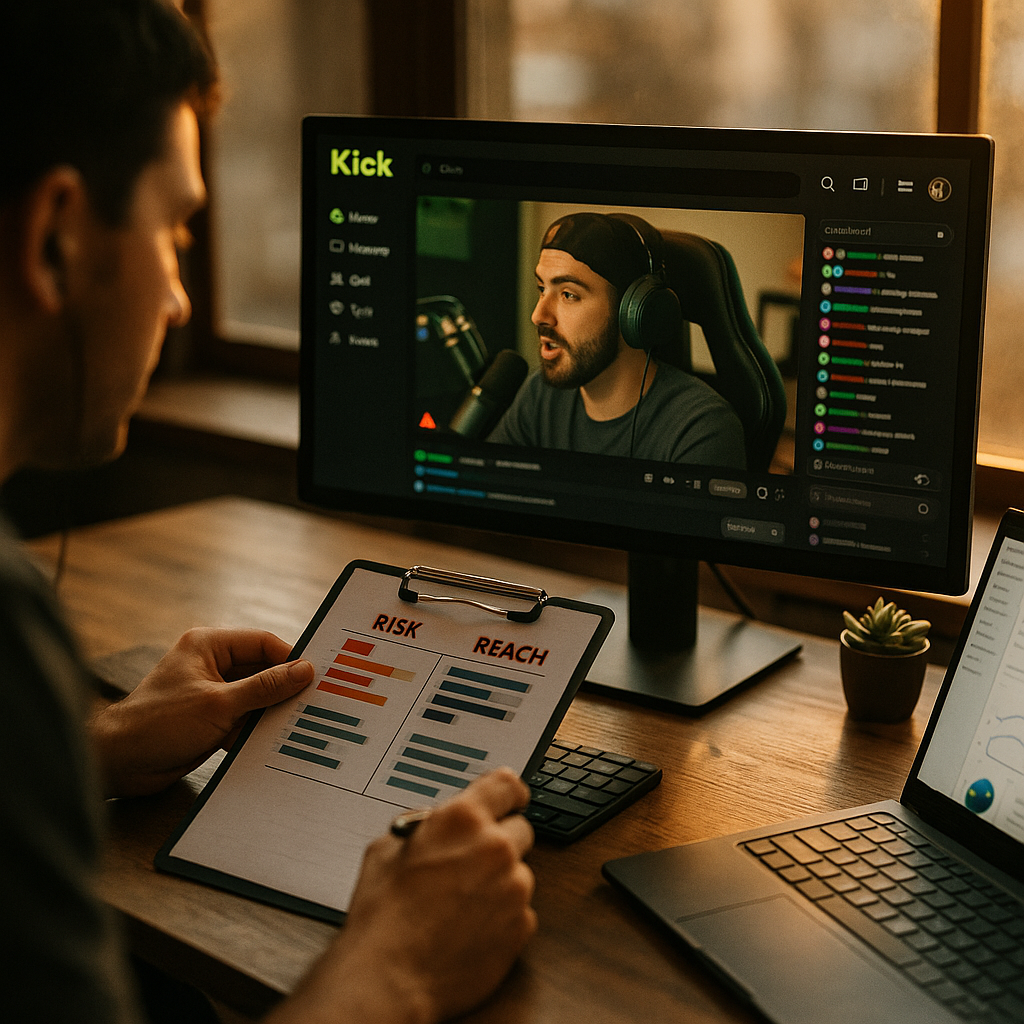
Kick streamers pull in audiences that have all but vanished from traditional TV: young men aged 18 to 34 who skip ads and ignore banner placements. But Kick also hosts gambling streams, bans almost nobody, and has weathered controversies that would get a Twitch partner dropped overnight. So is Kick streaming for brands a growth hack or a liability waiting to happen? The honest answer is both, depending on how carefully you vet.
What Kick Actually Is (And Why It Grew So Fast)
Kick launched in 2023 backed by Stake, the crypto casino platform, and it built its early growth engine on exactly what you’d expect: slot streamers and gambling content that Twitch had started cracking down on. The platform offers streamers a 95/5 revenue split compared to Twitch’s standard 50/50, which pulled over a wave of mid-tier and top-tier creators looking for better economics. Names like Adin Ross, Kai Cenat (for exclusive events), and Amouranth have all streamed there, and the platform has since diversified into gaming, IRL content, and sports commentary.
The audience is real. Kick reports tens of millions of monthly active users, and its Discord and social spillover amplify reach well beyond the platform itself. For brands chasing Gen Z and young millennial male audiences who have largely tuned out linear media, that’s a hard number to ignore.
Kick’s lighter content moderation isn’t a bug for its core demographic, it’s the entire value proposition. That’s precisely why it demands more diligence from brand marketers, not less.
The Reach Argument: Why Brands Are Even Considering This
Let’s be fair to the platform. Kick streamers often have deeply engaged, parasocial relationships with their chat communities in ways that feel more intimate than a polished YouTube upload. Engagement rates on live content tend to outperform pre-recorded video, and sponsorship integrations (a streamer casually mentioning a product mid-session) read as more authentic than a scripted ad read.
Brands in gaming peripherals, energy drinks, mobile apps, and betting-adjacent categories (where legal) have already tested the waters. Some report strong click-through and conversion numbers specifically because the audience isn’t ad-fatigued the way Twitch or YouTube viewers are. A smaller, hungrier platform sometimes means better rates and more flexible deal terms too, since Kick streamers are often building their brand partnership portfolios from scratch.
If your brand already runs live shopping timing strategies on other platforms, the operational muscle memory transfers reasonably well. Live commerce and live sponsorship integration share a lot of the same production and staffing logic.
The Risk Side Nobody Wants to Talk About
Here’s where it gets uncomfortable. Kick’s moderation policy is, by design, looser than most competitors. The platform has taken heat for hosting streamers during controversial or borderline-illegal broadcasts, and its gambling roots mean slot and casino content still runs heavy on trending pages even as the platform tries to broaden its catalog. For a brand safety officer, that’s a flashing warning light.
The core risk isn’t that your ad will run next to something offensive (though that happens). It’s reputational contagion: association by proximity. If a streamer you’ve sponsored gets banned for a TOS violation, gets caught in a controversy, or says something that goes viral for the wrong reasons, your brand name is sitting right there in the clip that circulates on X and TikTok for the next 72 hours.
- Unpredictable moderation: Content that gets pulled on Twitch stays up on Kick far longer, sometimes indefinitely.
- Gambling adjacency: Even if your sponsored streamer doesn’t gamble on stream, their peer network and platform trending page often do.
- Volatile creator behavior: Many top Kick streamers built audiences on edgy, unfiltered content. That’s the appeal to viewers and the risk to sponsors.
- Limited third-party verification tools: Brand safety vendors have far less mature coverage of Kick than they do of YouTube, Meta, or TikTok.
This is the same tension brands have had to navigate with other platforms expanding faster than their safety infrastructure. The brand safety rollout approach Reddit took with third-party verification is instructive: it shows what a platform looks like when it’s actively trying to close that gap. Kick isn’t there yet.
How Does Kick Compare to Twitch and YouTube Live on Risk?
Twitch and YouTube both have mature, if imperfect, trust and safety operations, automated flagging, appeals processes, and documented community guidelines that get enforced with some consistency. Kick’s enforcement is reactive and inconsistent by comparison, often driven by public pressure rather than proactive review. That doesn’t mean Kick is lawless. It means the margin for error is thinner, and the brand’s own vetting has to do more of the work that platform-level moderation would otherwise handle.
Industry data from eMarketer consistently shows that live streaming ad spend is growing faster than static influencer content budgets, which tells you brands want in on this format generally. The question for Kick specifically is whether the audience quality justifies the additional risk layer, and that calculation looks different for a gambling-adjacent brand than it does for, say, a consumer packaged goods company with a family-friendly image to protect.
A Practical Vetting Framework Before You Sign Anything
If you’re going to run a Kick campaign, don’t treat it like a standard influencer deal. Build in extra diligence steps that you might skip on more established platforms.
- Watch, don’t just read bios. Spend at least three to five hours of actual VOD review per creator before any contract conversation. Metrics don’t show you tone, unscripted comments, or chat moderation quality.
- Check the chat moderation team. A streamer who actively moderates toxic chat behavior is a different risk profile than one who lets it run wild for “engagement.”
- Clause everything. Morality clauses, content approval windows, and immediate termination rights need to be airtight, tighter than you’d write for a Twitch or YouTube deal.
- Diversify placement. Don’t put your entire creator budget into one or two Kick personalities. Spread exposure so one controversy doesn’t sink the whole campaign.
- Set a monitoring cadence. Weekly check-ins on sentiment and controversy flags, not monthly. Things move fast on this platform.
This is similar in spirit to the vetting rigor brands have had to apply to Discord server partnerships, where community culture and moderation quality matter as much as follower counts. Kick demands the same mindset: audience size is a vanity metric until you’ve confirmed the environment around it.
Treat every Kick partnership like you’re vetting a community, not booking a media placement. The streamer is only half the risk equation, their audience culture is the other half.
Which Brand Categories Make Sense Here?
Gaming peripherals, energy and functional beverage brands, mobile gaming apps, and sportsbook-adjacent products (where legally permitted) tend to have the best risk-reward fit on Kick. These categories already accept a certain amount of edge in their marketing, and their target demo overlaps tightly with Kick’s core audience.
Brands in regulated industries (finance, healthcare, children’s products, anything requiring strict FTC disclosure compliance) should think twice, or at minimum run a much smaller, tightly controlled pilot before committing real budget. The FTC’s influencer disclosure rules apply on Kick exactly as they do everywhere else, but enforcement visibility and creator compliance habits are less established on a newer platform, which adds another layer of operational risk for legal and compliance teams to manage.
Agencies that have already built workflows around nano creator seeding at scale may find it useful to apply a similar tiered-risk model here: start small with multiple low-commitment creators rather than one large exclusive deal, and let performance and safety data guide where you scale spend next.
Measuring ROI When the Platform Lacks Mature Analytics
One underappreciated challenge: Kick’s native analytics and third-party measurement tooling lag well behind Twitch, YouTube, and TikTok. Brands used to granular attribution dashboards will find themselves relying more heavily on unique promo codes, UTM-tagged links, and direct creator reporting than on platform-provided data.
Build your measurement plan before launch, not after. Assign unique discount codes per streamer, track referral traffic separately, and set clear benchmarks for what “success” looks like given the smaller, less mature analytics ecosystem. Tools like Sprout Social and HubSpot can help bridge some of the attribution gap on the marketing operations side, even though neither has native deep Kick integration yet.
FAQs
Frequently Asked Questions
Is Kick streaming safe for mainstream consumer brands?
It can be, but it requires significantly more vetting than platforms like YouTube or Instagram. Mainstream brands should start with small pilots, strict contract clauses, and weekly content monitoring rather than large upfront commitments.
What makes Kick riskier than Twitch for brand partnerships?
Kick’s content moderation is less mature and more reactive than Twitch’s, and the platform’s gambling-heavy origins mean casino and slot content still surfaces prominently in trending feeds, increasing the chance of unwanted brand association.
How do I measure ROI on a Kick sponsorship?
Since Kick’s native analytics are less developed than competitors, use unique promo codes, dedicated UTM links, and direct creator-provided viewership data to track performance rather than relying solely on platform metrics.
Which brand categories perform best on Kick?
Gaming, energy and functional beverage, mobile apps, and sportsbook-adjacent categories (where legally permitted) tend to see the strongest audience fit and risk tolerance alignment on the platform.
Do FTC disclosure rules apply to Kick streamers?
Yes. FTC sponsorship disclosure requirements apply regardless of platform, and brands should confirm each creator’s disclosure practices as part of the vetting process before signing any agreement.
Bottom line: Kick’s reach is real, but it only pays off if your vetting process is tighter than what you’d apply elsewhere. Run a small, contractually protected pilot with diversified creators before committing meaningful budget, and build your own monitoring cadence since the platform won’t do that work for you.
Top Influencer Marketing Agencies
The leading agencies shaping influencer marketing in 2026
Agencies ranked by campaign performance, client diversity, platform expertise, proven ROI, industry recognition, and client satisfaction. Assessed through verified case studies, reviews, and industry consultations.
Moburst

-
2

The Shelf
Boutique Beauty & Lifestyle Influencer AgencyA data-driven boutique agency specializing exclusively in beauty, wellness, and lifestyle influencer campaigns on Instagram and TikTok. Best for brands already focused on the beauty/personal care space that need curated, aesthetic-driven content.Clients: Pepsi, The Honest Company, Hims, Elf Cosmetics, Pure LeafVisit The Shelf → -
3

Audiencly
Niche Gaming & Esports Influencer AgencyA specialized agency focused exclusively on gaming and esports creators on YouTube, Twitch, and TikTok. Ideal if your campaign is 100% gaming-focused — from game launches to hardware and esports events.Clients: Epic Games, NordVPN, Ubisoft, Wargaming, Tencent GamesVisit Audiencly → -
4

Viral Nation
Global Influencer Marketing & Talent AgencyA dual talent management and marketing agency with proprietary brand safety tools and a global creator network spanning nano-influencers to celebrities across all major platforms.Clients: Meta, Activision Blizzard, Energizer, Aston Martin, WalmartVisit Viral Nation → -
5

The Influencer Marketing Factory
TikTok, Instagram & YouTube CampaignsA full-service agency with strong TikTok expertise, offering end-to-end campaign management from influencer discovery through performance reporting with a focus on platform-native content.Clients: Google, Snapchat, Universal Music, Bumble, YelpVisit TIMF → -
6

NeoReach
Enterprise Analytics & Influencer CampaignsAn enterprise-focused agency combining managed campaigns with a powerful self-service data platform for influencer search, audience analytics, and attribution modeling.Clients: Amazon, Airbnb, Netflix, Honda, The New York TimesVisit NeoReach → -
7

Ubiquitous
Creator-First Marketing PlatformA tech-driven platform combining self-service tools with managed campaign options, emphasizing speed and scalability for brands managing multiple influencer relationships.Clients: Lyft, Disney, Target, American Eagle, NetflixVisit Ubiquitous → -
8

Obviously
Scalable Enterprise Influencer CampaignsA tech-enabled agency built for high-volume campaigns, coordinating hundreds of creators simultaneously with end-to-end logistics, content rights management, and product seeding.Clients: Google, Ulta Beauty, Converse, AmazonVisit Obviously →