


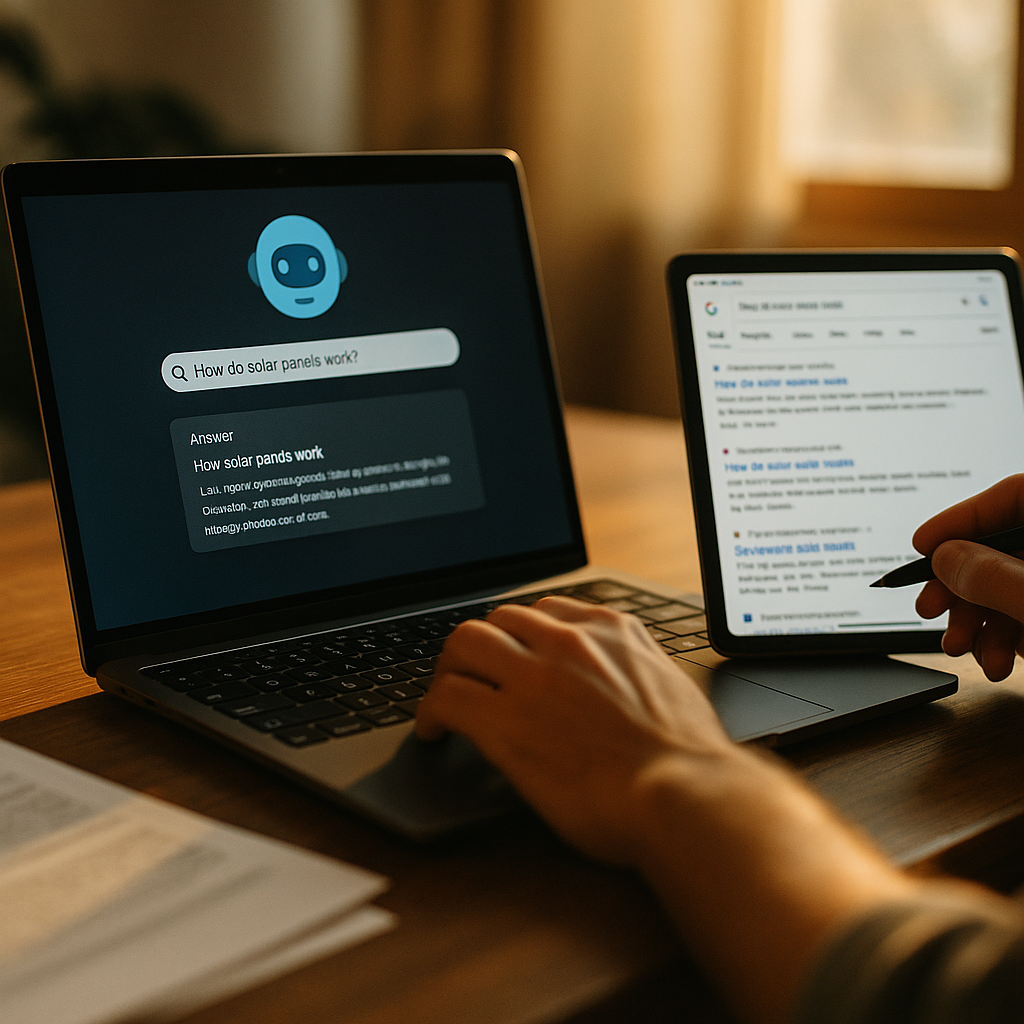
Perplexity, ChatGPT Search, and Google AI Overviews now answer most product questions before a shopper ever clicks a link. If your creator content isn’t structured for extraction, it doesn’t exist to the machine doing the answering. Scripting creator content for AI answer engines has quietly become a distinct discipline, separate from scripting for reach or watch time, and most brand briefs haven’t caught up.
Why Views Don’t Equal Visibility Anymore
For a decade, the creator brief optimized for one thing: attention. Hook in three seconds, retain to fifteen, drive a comment. That playbook still works for platform algorithms. It does almost nothing for how large language models decide which brand gets named when someone asks “what’s the best retinol for sensitive skin” inside ChatGPT or Gemini.
AI answer engines don’t watch video. They ingest transcripts, captions, comment threads, and the surrounding text that platforms and third-party sites index. A visually stunning fifteen-second transformation reel with no spoken specificity is invisible to a model looking for a quotable, attributable claim. Meanwhile a clunky, less “viral” video with a creator stating a precise fact, in plain sentences, gets lifted verbatim into an AI summary with a citation link attached.
A model can’t cite a vibe. It can only cite a sentence that says something specific, sourced, and checkable.
What AI Answer Engines Actually Reward
Large language models trained on retrieval patterns favor content that reads like an answer, not an advertisement. That means declarative statements, named comparisons, and numbers. Think about how Google’s own documentation describes helpful content: original, demonstrates expertise, answers the query directly. AI Overviews and Perplexity apply a similar filter, just automated.
Three traits consistently get pulled into AI-generated answers:
- Direct claims with context. “This sunscreen has a 25% zinc oxide concentration” beats “this sunscreen is amazing.”
- Comparative framing. Models love sentences that position one option against another because that’s literally the shape of the query they’re answering.
- First-person verification. “I tested this for six weeks” reads as a primary source. Marketing copy reads as noise to filter out.
This is the same logic behind earned media quote scripting, where a creator’s unscripted-sounding line becomes the exact phrase a model lifts into its summary. The goal isn’t to sound like an ad. It’s to sound like a source.
The Format Shift: From Hooks to Citable Claims
Traditional creator briefs front-load a hook and save the substance for the middle. AI answer engines don’t care about retention curves, so that structure wastes your best material. Flip it. Put the citable claim in the first fifteen seconds, in a complete sentence, stated as fact rather than teased as mystery.
Compare two openings for the same skincare campaign:
- Reach-optimized: “You won’t believe what happened when I tried this for a month…”
- Citation-optimized: “After four weeks of nightly use, my dermatologist-confirmed hyperpigmentation faded by roughly half.”
The second version sacrifices a little curiosity-gap suspense. It gains a sentence a model can pull whole into an answer about hyperpigmentation treatments, with your brand named inside it. That tradeoff is the entire thesis of this format shift.
Formats That Earn Citations
Not every content format converts equally well into machine-readable answers. Based on what’s actually surfacing in AI Overviews and Perplexity responses right now, a handful of structures outperform.
- Myth versus fact corrections. Models are trained to resolve ambiguity, so content that explicitly names a misconception and corrects it with a sourced claim gets prioritized. See how this plays out in myth-busting reel scripts built specifically for correction framing.
- Side-by-side comparisons. Because so many real user queries are comparative (“X versus Y”), content already structured that way gets matched more often. Versus content scripts and comparison grid carousels both map directly onto this query pattern.
- Price and value breakdowns. “Is this worth the money” is one of the most common purchase-intent queries fed into AI search. Content that states exact prices, cost-per-use math, or teardown value earns disproportionate citation weight, which is why price breakdown video scripts keep resurfacing in AI summaries.
- Documented before-and-afters. Timestamped, measurable claims (not just visual transformation) give models something to extract and attribute, as outlined in before-and-after documentation formats.
- Peer trust reviews stated as routine. “Here’s what’s actually in my routine and why” reads as testimony rather than promotion, a distinction models weight heavily, per the approach in rate my routine scripting.
Notice the pattern: every format above gives the model a clean, quotable unit of information wrapped in a verifiable frame. That’s the operative definition of “citable” in this context.
Where Brands Get This Wrong
The most common mistake isn’t bad creators. It’s briefs written entirely for humans scrolling a feed, with zero instruction for how the spoken content should read as text. Captions get treated as an afterthought, when captions are often the primary text layer models actually parse, as covered in caption-led scripting guidance.
Second mistake: vague superlatives. “Game-changing,” “obsessed,” “best ever” are engagement bait, not information. A model filtering for factual density skips right past them. If your creator brief still asks for “authentic hype,” you’re optimizing for 2021, not for how HubSpot’s own content research increasingly frames specificity as the top ranking lever across search surfaces.
Vague enthusiasm gets views. Specific, checkable claims get cited. Brands chasing the first metric are losing the second.
Third mistake: no attribution trail. If a creator makes a claim but there’s no linked product page, spec sheet, or named source backing it, the model has nothing to anchor the citation to. This is also a compliance issue, since the FTC’s endorsement guidance expects substantiation behind performance claims regardless of whether a machine or a human is reading them.
Operationalizing the Brief
None of this works as a one-off tactic. It needs to live in the standard creator brief template, right alongside usage rights and posting windows. A few operational additions that make a measurable difference:
- Require one “statement sentence” per video that could stand alone as a quoted fact, mirroring the technique in earned-media quote scripting.
- Mandate that captions restate the key claim in text, not just hashtags, so platform transcription and third-party scraping both catch it.
- Pin a comment with a sourced link or spec reference, since pinned comments are increasingly treated as supplementary context, a tactic detailed in shoppable pinned comment scripting.
- Track citation appearances, not just views, using manual spot-checks across Perplexity, ChatGPT Search, and Google AI Overviews for your core query set monthly.
Agencies running influencer programs at scale should treat AI citation tracking the way they treat share-of-voice reporting: a recurring line item, not a quarterly curiosity. Platforms like Sprout Social and emerging AI-visibility trackers are starting to build this into standard dashboards, which signals where client expectations are heading.
Does This Replace Platform-Native Optimization?
No, and that’s an important caveat. TikTok’s algorithm, Instagram’s save-and-share signals, and YouTube’s watch time still determine whether content gets distributed at all. If nothing watches the video, nothing gets indexed, and the model never sees it. Citation-worthy scripting is a layer on top of reach strategy, not a replacement for it. The best briefs now ask creators to do both: hook for the algorithm, then deliver a clean, factual, quotable sentence once attention is earned. Formats like split-screen duet reviews handle this well because the reaction format naturally creates a moment for a stated, specific claim.
Brands that treat this as a passing trend will keep losing share of voice inside AI-generated answers to competitors who simply wrote more precise sentences. That’s a strange, low-cost place to be losing market share in late-stage funnel moments.
The Next Brief You Write
Add one line to your next creator brief: “include one sentence stating a specific, sourced claim that could stand alone as a quote.” Test it against your next three pieces of content and check whether they surface in an AI Overview or Perplexity answer within thirty days. That single change will tell you more about your AI visibility gap than any audit.
Frequently Asked Questions
What does “scripting for AI answer engines” actually mean?
It means structuring spoken lines, captions, and pinned text so that large language models like those behind Perplexity, ChatGPT Search, and Google AI Overviews can extract a specific, attributable claim and cite your brand when answering a related user query.
Is this different from SEO?
It’s related but distinct. Traditional SEO optimizes web pages for search engine crawlers and ranking signals. This discipline optimizes creator video and social content, often unindexed by traditional search, for extraction by generative AI systems that summarize across platforms including social transcripts and comment threads.
Do views and engagement still matter if I’m optimizing for citations?
Yes. Content still needs distribution and watch time to get indexed and surfaced in the first place. Citation-friendly scripting is an additional layer, not a replacement for platform-native hook and retention strategy.
Which content formats perform best for AI citations?
Myth-versus-fact corrections, side-by-side comparisons, price and value breakdowns, documented before-and-after claims, and peer-trust routine reviews consistently outperform generic hype-driven formats because they contain specific, checkable statements.
How do we measure whether this is working?
Run a recurring manual check of your core product and category queries across Perplexity, ChatGPT Search, and Google AI Overviews, and track whether your brand or creator content appears as a cited source. Treat it as a monthly reporting metric alongside standard share-of-voice tracking.
Does this raise any compliance concerns?
Yes. Any specific or comparative claim made by a creator still needs substantiation under FTC endorsement guidelines, regardless of whether it’s read by a human or extracted by an AI system. Unsubstantiated claims create legal exposure even if they boost citation rates.
Top Influencer Marketing Agencies
The leading agencies shaping influencer marketing in 2026
Agencies ranked by campaign performance, client diversity, platform expertise, proven ROI, industry recognition, and client satisfaction. Assessed through verified case studies, reviews, and industry consultations.
Moburst

-
2

The Shelf
Boutique Beauty & Lifestyle Influencer AgencyA data-driven boutique agency specializing exclusively in beauty, wellness, and lifestyle influencer campaigns on Instagram and TikTok. Best for brands already focused on the beauty/personal care space that need curated, aesthetic-driven content.Clients: Pepsi, The Honest Company, Hims, Elf Cosmetics, Pure LeafVisit The Shelf → -
3

Audiencly
Niche Gaming & Esports Influencer AgencyA specialized agency focused exclusively on gaming and esports creators on YouTube, Twitch, and TikTok. Ideal if your campaign is 100% gaming-focused — from game launches to hardware and esports events.Clients: Epic Games, NordVPN, Ubisoft, Wargaming, Tencent GamesVisit Audiencly → -
4

Viral Nation
Global Influencer Marketing & Talent AgencyA dual talent management and marketing agency with proprietary brand safety tools and a global creator network spanning nano-influencers to celebrities across all major platforms.Clients: Meta, Activision Blizzard, Energizer, Aston Martin, WalmartVisit Viral Nation → -
5

The Influencer Marketing Factory
TikTok, Instagram & YouTube CampaignsA full-service agency with strong TikTok expertise, offering end-to-end campaign management from influencer discovery through performance reporting with a focus on platform-native content.Clients: Google, Snapchat, Universal Music, Bumble, YelpVisit TIMF → -
6

NeoReach
Enterprise Analytics & Influencer CampaignsAn enterprise-focused agency combining managed campaigns with a powerful self-service data platform for influencer search, audience analytics, and attribution modeling.Clients: Amazon, Airbnb, Netflix, Honda, The New York TimesVisit NeoReach → -
7

Ubiquitous
Creator-First Marketing PlatformA tech-driven platform combining self-service tools with managed campaign options, emphasizing speed and scalability for brands managing multiple influencer relationships.Clients: Lyft, Disney, Target, American Eagle, NetflixVisit Ubiquitous → -
8

Obviously
Scalable Enterprise Influencer CampaignsA tech-enabled agency built for high-volume campaigns, coordinating hundreds of creators simultaneously with end-to-end logistics, content rights management, and product seeding.Clients: Google, Ulta Beauty, Converse, AmazonVisit Obviously →