


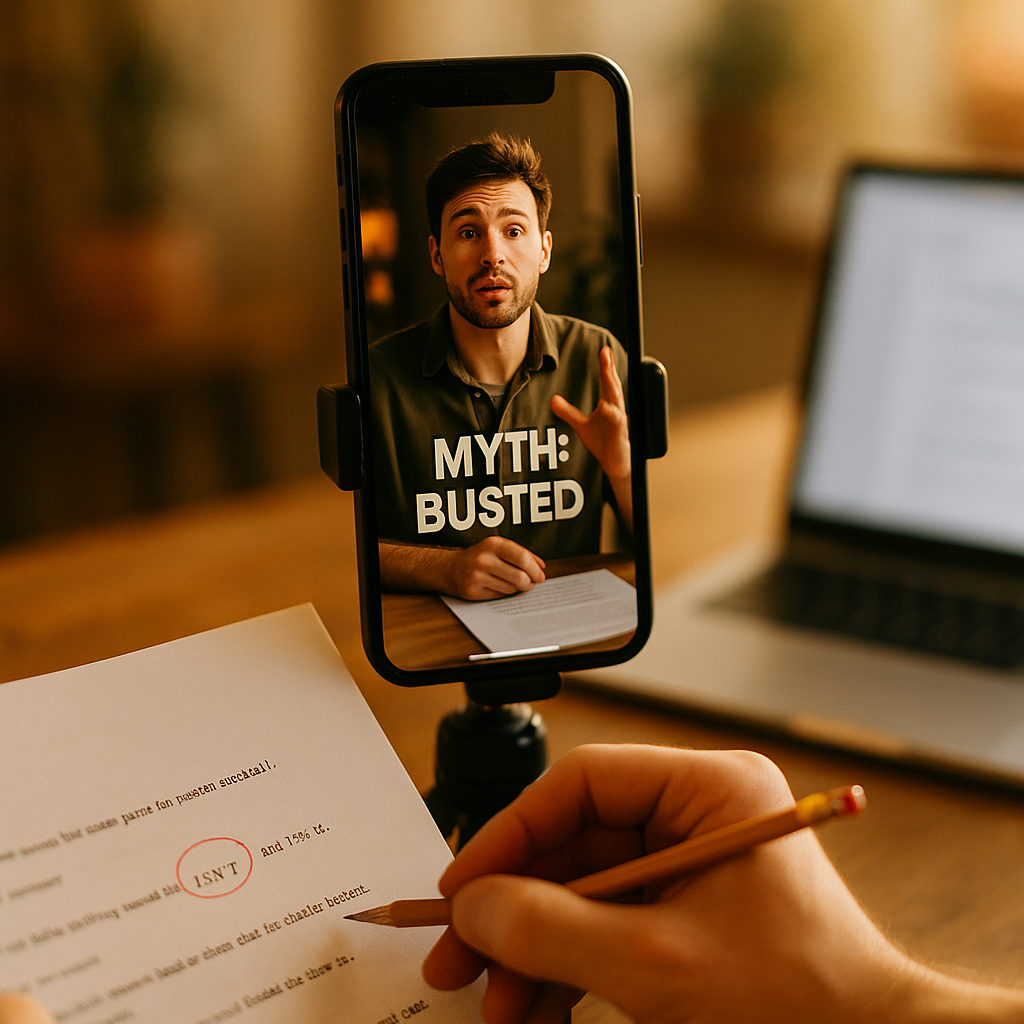
68% of consumers say they have stopped trusting a brand after discovering it misled them on a product claim, according to Sprout Social’s ongoing trust research. Yet most categories, from skincare to supplements to fintech, are riddled with myths that quietly suppress conversion. What if the fastest path to more sales wasn’t a new hook, but a correction? That’s the premise behind the myth busting reel, and it’s quietly becoming one of the highest-ROI formats in the influencer toolkit.
This isn’t about “debunking” for entertainment value. It’s a structured, repeatable format that brands can brief, scale, and measure like any other content line item. Done right, it reduces purchase hesitation at the exact moment a consumer is Googling “is this actually true” before checkout.
Why Misconceptions Are a Bigger Conversion Killer Than Bad Ads
Marketers obsess over hooks, CTAs, and creative fatigue. Meanwhile, a lingering category myth, the kind that’s been repeated in forums, group chats, and skeptical comment sections for years, sits untouched in the funnel like a landmine. A shopper who believes “retinol thins your skin” or “all business credit cards hurt your personal score” won’t convert no matter how good your ad creative is. The objection isn’t about your product. It’s about the category.
That’s precisely why myth busting content converts at a different level than standard product demos. It meets the customer at the objection stage, not the awareness stage. It’s bottom-funnel content disguised as top-funnel entertainment.
Myth busting reels don’t sell the product first. They sell permission to believe the product can work, which is often the actual barrier to purchase.
The Four-Part Framework
Every effective myth busting reel follows a tight structural logic. Skip a step and the content reads as either preachy or unconvincing.
- State the myth exactly as consumers say it. Not a strawman version. Pull language directly from reviews, Reddit threads, or customer service tickets. Specificity builds instant credibility.
- Name why the myth exists. Most myths have a kernel of outdated truth or a bad historical example behind them. Acknowledging this disarms skepticism faster than flatly denying it.
- Deliver the correction with evidence, not opinion. This is where studies, third-party certifications, or visible demonstrations do the heavy lifting. Creator opinion alone invites counter-argument; data and visual proof don’t.
- Close with a low-pressure next step. Not a hard sell. A soft bridge like “that’s why we formulated it differently” or “here’s what to look for instead” keeps the content feeling educational, not promotional.
Brands running this well often pair it with formats like before and after documentation to show rather than tell, which matters enormously in categories where skepticism is high and claims are heavily scrutinized.
Casting: Who Should Deliver the Correction?
Not every creator can pull off myth busting credibly. The format demands a specific trust posture: someone who reads as informed but not corporate. Nano and micro creators with a track record of niche expertise, think a pharmacist who posts skincare content or a former bank teller talking personal finance, outperform mega influencers here because their correction reads as independent rather than paid-for.
This is also where nano creator ensemble casts become useful. Instead of betting the whole campaign on one voice correcting a myth, brands can seed the same correction across five or six smaller accounts with slightly different framing. If one angle underperforms, the campaign isn’t dead. It’s a portfolio approach to a format that lives or dies on perceived authenticity.
Scripting the Hook: Don’t Bury the Myth
The biggest mistake brands make is softening the myth statement to avoid sounding negative. Wrong move. The hook needs to state the misconception boldly in the first two seconds, because that’s the line that stops scroll among people who currently believe it.
Compare these two hooks:
- Weak: “Let’s talk about some skincare myths today.”
- Strong: “If you think retinol makes your skin worse before it gets better, you’re using it wrong.”
The second version works because it’s specific, slightly confrontational, and implies the viewer has been getting something wrong, a mild ego hook that drives curiosity. This pairs naturally with comment bait hooks, since myth content tends to generate disagreement in the comments, which is exactly the engagement signal platforms reward with extra distribution.
What Format Should the Correction Take?
Myth busting doesn’t have to be a straight talking-head video. Several sub-formats consistently outperform generic “fact or fiction” templates:
- Split screen proof. Myth on one side, reality demonstrated live on the other. This works especially well when paired with split screen comparison videos as a production template.
- Versus content. Positioning the myth against a competitor’s marketing claim, carefully scripted to avoid disparagement risk, using the approach outlined in versus content scripts.
- Price transparency breakdowns. Useful when the myth is cost-related, such as “subscription boxes are a ripoff.” A price breakdown video format can dismantle that myth with receipts, literally.
- Confessional framing. A creator admitting they used to believe the myth themselves before trying the product, which borrows credibility from confessional video briefs.
Rotating between these sub-formats prevents the series from feeling like a single repeated ad unit, which matters because myth busting series work best as a recurring content pillar, not a one-off post.
The Compliance Layer Nobody Scripts For
Here’s where legal and brand safety teams earn their keep. Correcting a myth often means making a comparative or superiority claim, even implicitly. “Unlike other brands, ours doesn’t contain X” is a factual claim that needs substantiation on file, not just a creator’s confident delivery.
The FTC’s endorsement guidance applies fully here: if a creator is paid to bust a myth that happens to favor your product, disclosure rules still apply, and any claim made needs to be one the brand can defend if challenged. This is especially true in regulated categories like health, finance, and beauty, where a single unsubstantiated “fact” in a viral reel can trigger regulatory scrutiny or a competitor complaint.
A myth busting reel that makes an unverifiable counter-claim doesn’t just risk a platform strike, it risks replacing one myth with a new liability.
Before any myth busting script goes to a creator, run it through three checks: Is the myth being corrected actually false, or just inconvenient? Is the correction backed by something citable (study, certification, internal testing data)? Does the script avoid disparaging a named competitor without substantiation? Brands that skip this step tend to find out the hard way, usually in a comment section, that creators aren’t lawyers and shouldn’t be asked to improvise legal nuance on camera.
Measuring Whether It’s Actually Working
Standard engagement metrics undersell this format. Likes and shares matter less here than two specific signals: comment sentiment shift and assisted conversion rate. Track whether comments move from “I didn’t know that” to “wait, is this true?” to “okay I’m convinced,” since that progression is the actual proof the myth is dying in your target audience. Tools like HubSpot or platform-native analytics can help tie this content to downstream conversion when UTM-tagged links or shoppable tags are attached, something worth building into the brief using a shoppable video chapter structure so the correction has an immediate path to purchase.
It’s also smart to benchmark performance across platforms rather than assuming one format wins everywhere. A cross channel hook testing approach lets you confirm whether the same myth correction needs a punchier hook on TikTok versus a more measured tone on Instagram or YouTube Shorts.
Building a Repeatable Content Calendar Around It
The brands getting the most mileage out of this format don’t treat it as a one-time campaign. They maintain a running list of category myths, sourced quarterly from customer service logs, review mining, and social listening, and release corrections on a steady cadence. One myth per month, scripted across two or three creators and sub-formats, builds a library of trust-building content that keeps paying off in search and social long after the posting date.
Data from eMarketer consistently shows that educational and trust-building creator content retains relevance (and search traffic) far longer than trend-based content, which has a shelf life measured in days. Myth busting reels, because they answer an evergreen question, tend to keep converting for quarters, not weeks.
Final Word
Start with one myth, the single biggest objection buried in your reviews or support tickets, and script it using the four-part framework before you touch a bigger content calendar. Test it with two creator types and one split-screen format, then let the comment sentiment tell you whether it’s worth building into a recurring series.
FAQs
What makes a myth busting reel different from a standard product demo?
A product demo shows how something works. A myth busting reel first addresses why a viewer doesn’t believe it will work, removing a category-level objection before the product is even the focus.
Which creators perform best for myth busting content?
Nano and micro creators with perceived subject-matter credibility (a pharmacist, a former industry employee, a longtime category user) tend to outperform larger influencers because the correction reads as independent rather than sponsored.
Do myth busting reels need FTC disclosure?
Yes. If a creator is compensated and the content favors a brand, standard endorsement disclosure rules apply regardless of how educational the framing feels.
How do you find which myths are worth busting?
Mine customer service tickets, product reviews, and social comments for recurring objections. The myths worth addressing are the ones showing up repeatedly right before a customer abandons cart or asks a skeptical question.
How often should a brand run this format?
Monthly works well for most categories. It’s frequent enough to build a recognizable content pillar without exhausting the supply of genuine, defensible myths worth correcting.
FAQs
What makes a myth busting reel different from a standard product demo?
A product demo shows how something works. A myth busting reel first addresses why a viewer doesn’t believe it will work, removing a category-level objection before the product is even the focus.
Which creators perform best for myth busting content?
Nano and micro creators with perceived subject-matter credibility (a pharmacist, a former industry employee, a longtime category user) tend to outperform larger influencers because the correction reads as independent rather than sponsored.
Do myth busting reels need FTC disclosure?
Yes. If a creator is compensated and the content favors a brand, standard endorsement disclosure rules apply regardless of how educational the framing feels.
How do you find which myths are worth busting?
Mine customer service tickets, product reviews, and social comments for recurring objections. The myths worth addressing are the ones showing up repeatedly right before a customer abandons cart or asks a skeptical question.
How often should a brand run this format?
Monthly works well for most categories. It’s frequent enough to build a recognizable content pillar without exhausting the supply of genuine, defensible myths worth correcting.
Top Influencer Marketing Agencies
The leading agencies shaping influencer marketing in 2026
Agencies ranked by campaign performance, client diversity, platform expertise, proven ROI, industry recognition, and client satisfaction. Assessed through verified case studies, reviews, and industry consultations.
Moburst

-
2

The Shelf
Boutique Beauty & Lifestyle Influencer AgencyA data-driven boutique agency specializing exclusively in beauty, wellness, and lifestyle influencer campaigns on Instagram and TikTok. Best for brands already focused on the beauty/personal care space that need curated, aesthetic-driven content.Clients: Pepsi, The Honest Company, Hims, Elf Cosmetics, Pure LeafVisit The Shelf → -
3

Audiencly
Niche Gaming & Esports Influencer AgencyA specialized agency focused exclusively on gaming and esports creators on YouTube, Twitch, and TikTok. Ideal if your campaign is 100% gaming-focused — from game launches to hardware and esports events.Clients: Epic Games, NordVPN, Ubisoft, Wargaming, Tencent GamesVisit Audiencly → -
4

Viral Nation
Global Influencer Marketing & Talent AgencyA dual talent management and marketing agency with proprietary brand safety tools and a global creator network spanning nano-influencers to celebrities across all major platforms.Clients: Meta, Activision Blizzard, Energizer, Aston Martin, WalmartVisit Viral Nation → -
5

The Influencer Marketing Factory
TikTok, Instagram & YouTube CampaignsA full-service agency with strong TikTok expertise, offering end-to-end campaign management from influencer discovery through performance reporting with a focus on platform-native content.Clients: Google, Snapchat, Universal Music, Bumble, YelpVisit TIMF → -
6

NeoReach
Enterprise Analytics & Influencer CampaignsAn enterprise-focused agency combining managed campaigns with a powerful self-service data platform for influencer search, audience analytics, and attribution modeling.Clients: Amazon, Airbnb, Netflix, Honda, The New York TimesVisit NeoReach → -
7

Ubiquitous
Creator-First Marketing PlatformA tech-driven platform combining self-service tools with managed campaign options, emphasizing speed and scalability for brands managing multiple influencer relationships.Clients: Lyft, Disney, Target, American Eagle, NetflixVisit Ubiquitous → -
8

Obviously
Scalable Enterprise Influencer CampaignsA tech-enabled agency built for high-volume campaigns, coordinating hundreds of creators simultaneously with end-to-end logistics, content rights management, and product seeding.Clients: Google, Ulta Beauty, Converse, AmazonVisit Obviously →