


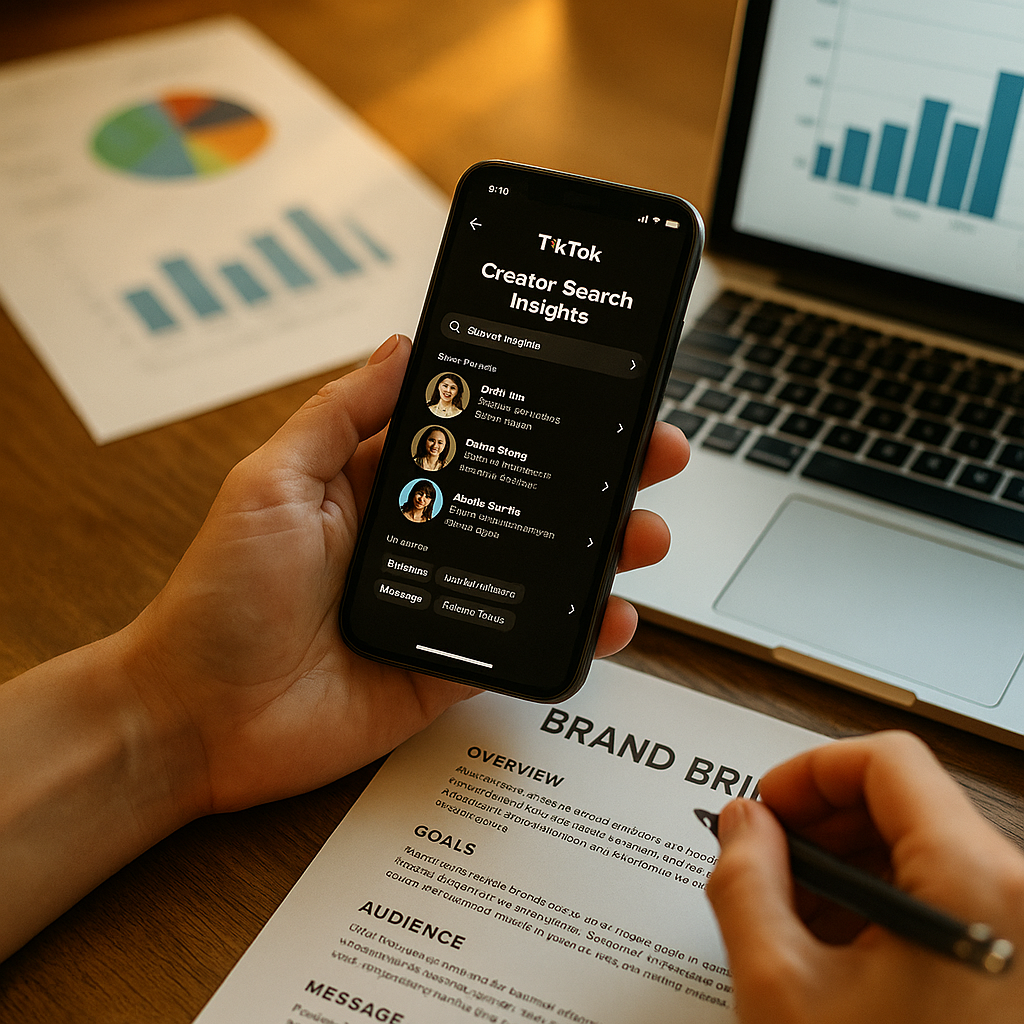
Here’s an uncomfortable truth for brands still chasing follower counts: a creator with 40,000 followers and the right keyword alignment can outrank a 500,000-follower account in TikTok Creator Search Insights. Reach is vanity. Discoverability is the metric that actually compounds. If your briefs still read like reach-maximization documents, you’re optimizing for the wrong algorithm entirely.
What Creator Search Insights Actually Measures
TikTok Creator Search Insights (CSI) is the tool TikTok built to help creators understand what people are searching for inside the app, surfaced through the Creativity Center and now embedded deeper into TikTok Shop and brand collaboration dashboards. It’s not a vanity metric panel. It’s a window into TikTok’s search index, which behaves less like a social feed algorithm and more like a lightweight search engine crossed with a recommendation system.
For brands, this changes the brief fundamentally. A brief built for “reach” asks a creator to maximize views. A brief built for “discoverability” asks a creator to rank for specific search queries, phrases, and intent clusters that CSI has already validated as high-volume and low-competition. Those are two different creative assignments, and most agencies are still writing the first one.
A piece of content optimized for search intent can keep generating impressions for months after posting, while a pure-reach video dies within 72 hours. That’s the entire argument for rebuilding your brief template around discoverability.
Why Reach-First Briefs Are Leaving Money on the Table
Most influencer briefs are still written like TV spot instructions: hit these talking points, show the product in the first three seconds, end with a CTA. That structure optimizes for immediate watch time and completion rate, both of which matter for initial distribution. But TikTok’s search layer rewards something different: specificity, keyword density in spoken audio and on-screen text, and alignment with queries real users are typing into the search bar.
Think about how people actually use TikTok now. Gen Z and younger millennials increasingly use it as a search engine, a trend eMarketer has tracked for several years running. They’re not just scrolling the For You feed, they’re typing “best budget skincare for combination skin” or “how to style wide leg jeans short” directly into TikTok search. If your creator’s video doesn’t contain those phrases, spoken or written, it doesn’t surface. Reach from the FYP is a bonus. Search visibility is the compounding asset.
This is why a brief focused purely on impressions and reach targets misses the bigger opportunity. You can hit your reach KPI and still get zero long-tail search traffic, because nobody told the creator which phrases to actually say out loud.
The Brief Template That Actually Works
Rebuilding your brief around CSI data isn’t complicated, but it does require a different input process. Here’s the structure that’s working for brands running TikTok Shop and organic creator programs right now:
- Query research first, creative brief second. Pull top-performing search terms from Creator Search Insights for your category before you write a single creative direction line.
- Mandate spoken keyword inclusion. TikTok’s speech-to-text indexing means the words a creator says matter almost as much as captions. Require 2 to 3 target phrases spoken naturally within the first 15 seconds.
- Specify on-screen text keywords. Captions and overlay text get indexed too. Give creators exact phrasing, not just “mention the benefits.”
- Build in intent variation. Different creators should target different query clusters within the same campaign, rather than all chasing the same head term.
- Attach a discoverability KPI, not just a reach KPI. Track search impressions and search-referred views separately from FYP-referred views where TikTok’s analytics allow it.
Notice what’s missing from that list: follower count thresholds. That’s intentional. Discoverability briefs work just as well, often better, with mid-tier and micro creators who have tighter niche authority and higher trust signals within a specific search vertical.
Where This Intersects With TikTok Shop GMV Goals
If you’re running TikTok Shop, discoverability briefs aren’t just a nice-to-have, they’re directly tied to revenue. Search-driven discovery feeds into the Showcase tab and affiliate marketplace rankings, meaning content that ranks well for search also tends to surface more consistently in shoppable placements. Brands already working through Showcase tab ranking tactics should treat CSI optimization as the upstream input, not a separate workstream.
The same logic applies to creator matching. When you’re sourcing creators through TikTok’s AI matching tools, briefing for discoverability gives you a cleaner signal to evaluate fit. A creator whose existing content already ranks for your target queries is a safer bet than one chosen purely on follower count or past brand deal volume. This is worth folding into your process if you’re using AI creator matching for onboarding, since the matching algorithm itself weighs engagement and relevance signals that overlap with search performance.
Brands that pair discoverability-focused briefs with Shop-optimized posting windows are seeing meaningfully longer content lifespans, sometimes three to four times the active search-referred traffic window of a standard campaign asset.
Spark Ads Change the Math Again
Once a piece of organic content starts ranking in search, whitelisting it through Spark Ads amplifies both the paid distribution and the organic search signal simultaneously, because TikTok treats boosted authentic posts differently than cold-start ad creative in its ranking logic. If you’re already running authorization workflows, it’s worth revisiting your Spark Ads authorization process to prioritize assets that are already showing search pickup over assets that simply hit reach benchmarks in week one. You’re not choosing your best-performing video, you’re choosing your most discoverable one, and those aren’t always the same video.
This also affects how you brief creators on posting cadence. A video that’s built to rank for search doesn’t need to front-load every hook trick in the first second. It needs clear, specific language that matches query intent, which sometimes means a slightly slower, more explanatory opening than a pure entertainment-first hook. That’s a real tension brief writers need to navigate, and it’s worth testing both formats against your CSI data rather than assuming entertainment value always wins.
Measuring What Actually Matters
Standard campaign reporting leans heavily on views, engagement rate, and reach, metrics that are easy to pull and easy to benchmark. Discoverability requires different tracking. Ask your creators or your analytics partner for search-referred traffic data where TikTok exposes it, and track keyword ranking movement over a 30 to 60 day window rather than judging performance at the 48-hour mark like a traditional campaign wrap report.
Tools like Sprout Social and TikTok’s native Creativity Center dashboards are starting to surface more search-adjacent metrics, though the category is still maturing compared to the robust reporting available for reach and engagement. Don’t wait for perfect tooling. Build your own tracking sheet now, even if it’s manual, because the brands that start building this historical data set will have a real competitive edge within a year.
It’s also worth coordinating discoverability goals with your nano and micro seeding programs, since volume-based seeding at scale generates a huge amount of raw content that can be mined for keyword performance patterns. If you’re running a seeding program, cross-reference it against the frameworks in our nano creator seeding playbook to make sure discoverability isn’t an afterthought bolted onto a reach-first seeding strategy.
Compliance and Risk Considerations Don’t Disappear
Keyword-stuffing a brief doesn’t mean abandoning disclosure standards. The FTC’s endorsement guidance still applies regardless of whether content is optimized for search or reach, and creators packing in keyword phrases for algorithmic benefit still need clear, conspicuous disclosure when the content is sponsored. Brief writers should build disclosure language requirements into the same template section as keyword requirements, not treat them as separate legal boilerplate tacked on at the end.
There’s a subtler risk too: over-optimized, keyword-heavy scripts can read as inauthentic, which tanks both engagement and trust, the opposite of what you want. The best discoverability briefs give creators target phrases and intent, then let them write the actual script in their own voice. Mandating verbatim language is a mistake that shows up fast in completion rate data.
Next Step
Pull Creator Search Insights data for your top three product categories this week, rewrite one upcoming brief around those query clusters instead of reach targets, and compare search-referred performance against your last reach-first campaign at the 30-day mark. That single test will tell you more about where your 2026 budget should go than another quarter of follower-count sourcing ever will.
Frequently Asked Questions
What is TikTok Creator Search Insights used for?
It shows brands and creators which search terms and content gaps exist within a given topic or category on TikTok, helping them align content with actual user search intent rather than guessing at trends.
How is discoverability different from reach in a TikTok brief?
Reach measures how many people saw a video, usually through the For You feed. Discoverability measures whether that video surfaces in TikTok search results for relevant queries, which tends to create longer-lasting, more durable traffic.
Does follower count still matter if I’m briefing for discoverability?
Less than it used to. Niche authority, keyword alignment, and existing search ranking performance often matter more than raw follower count when the goal is CSI-driven visibility.
Can discoverability-focused content still work with Spark Ads?
Yes, and it often performs better. Boosting content that’s already showing organic search pickup tends to compound both paid and organic signals rather than starting from zero with cold creative.
How long should I wait before judging a discoverability campaign’s performance?
At least 30 days, ideally 60. Search-driven content builds momentum slower than reach-driven content but typically sustains performance far longer than a standard 48-hour campaign window.
FAQs
(Schema version below for search engines; content matches the visible FAQ section above.)
Top Influencer Marketing Agencies
The leading agencies shaping influencer marketing in 2026
Agencies ranked by campaign performance, client diversity, platform expertise, proven ROI, industry recognition, and client satisfaction. Assessed through verified case studies, reviews, and industry consultations.
Moburst

-
2

The Shelf
Boutique Beauty & Lifestyle Influencer AgencyA data-driven boutique agency specializing exclusively in beauty, wellness, and lifestyle influencer campaigns on Instagram and TikTok. Best for brands already focused on the beauty/personal care space that need curated, aesthetic-driven content.Clients: Pepsi, The Honest Company, Hims, Elf Cosmetics, Pure LeafVisit The Shelf → -
3

Audiencly
Niche Gaming & Esports Influencer AgencyA specialized agency focused exclusively on gaming and esports creators on YouTube, Twitch, and TikTok. Ideal if your campaign is 100% gaming-focused — from game launches to hardware and esports events.Clients: Epic Games, NordVPN, Ubisoft, Wargaming, Tencent GamesVisit Audiencly → -
4

Viral Nation
Global Influencer Marketing & Talent AgencyA dual talent management and marketing agency with proprietary brand safety tools and a global creator network spanning nano-influencers to celebrities across all major platforms.Clients: Meta, Activision Blizzard, Energizer, Aston Martin, WalmartVisit Viral Nation → -
5

The Influencer Marketing Factory
TikTok, Instagram & YouTube CampaignsA full-service agency with strong TikTok expertise, offering end-to-end campaign management from influencer discovery through performance reporting with a focus on platform-native content.Clients: Google, Snapchat, Universal Music, Bumble, YelpVisit TIMF → -
6

NeoReach
Enterprise Analytics & Influencer CampaignsAn enterprise-focused agency combining managed campaigns with a powerful self-service data platform for influencer search, audience analytics, and attribution modeling.Clients: Amazon, Airbnb, Netflix, Honda, The New York TimesVisit NeoReach → -
7

Ubiquitous
Creator-First Marketing PlatformA tech-driven platform combining self-service tools with managed campaign options, emphasizing speed and scalability for brands managing multiple influencer relationships.Clients: Lyft, Disney, Target, American Eagle, NetflixVisit Ubiquitous → -
8

Obviously
Scalable Enterprise Influencer CampaignsA tech-enabled agency built for high-volume campaigns, coordinating hundreds of creators simultaneously with end-to-end logistics, content rights management, and product seeding.Clients: Google, Ulta Beauty, Converse, AmazonVisit Obviously →