


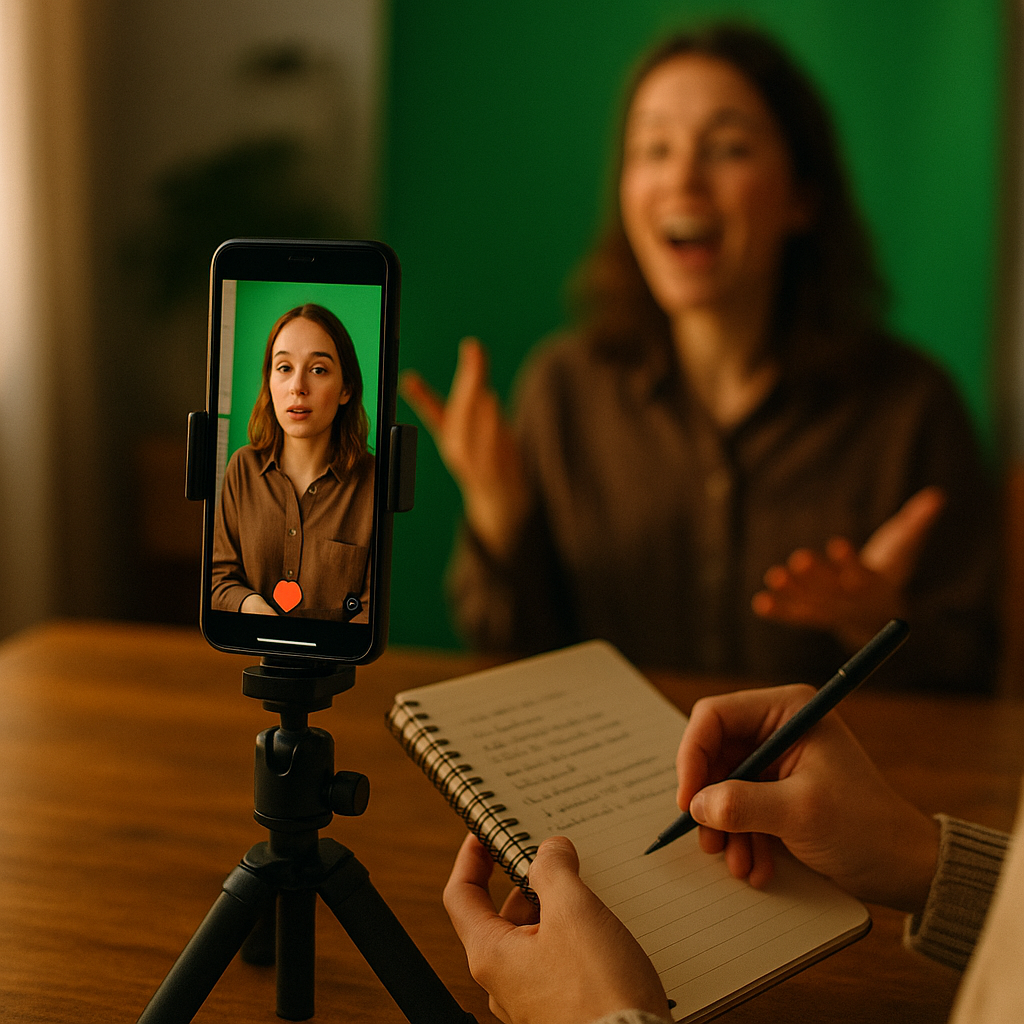
Reaction videos convert at rates traditional ads can only dream about, yet most brands still treat the format like a gimmick instead of a scripted asset. TikTok’s own creative benchmarking has repeatedly shown that reaction and duet style content outperforms polished brand ads on watch time and click-through. The green screen duet reaction sits at the center of that trend: one creator reacting to your product, your UGC, or a competitor’s claim, with your visual pinned behind them the entire time. Done right, it is equal parts entertainment and proof. Done wrong, it is a creator rambling in front of a screenshot nobody can read.
This guide breaks down how to script green screen duet reactions that brands can actually greenlight, measure, and scale without legal or compliance headaches.
Why Green Screen Reactions Outperform Standard UGC
The green screen effect lets a creator stand in front of a static image, video, or webpage while they talk. It is TikTok’s native tool, but creators now use it across Instagram Reels and YouTube Shorts with similar overlay effects. The format works because it solves a problem every brand has: how do you keep a product or claim visually present for the full duration of a video without it feeling like an ad?
Unlike a standard testimonial where the product appears for three seconds, a green screen reaction keeps your packaging, your price point, or your review screenshot locked in frame the entire time. Viewers are reading and listening simultaneously. That dual input is part of why these videos hold attention longer than talking-head UGC, according to patterns Sprout Social has documented around short-form engagement.
A green screen reaction only works if the pinned image earns its place in the frame. If the background could be swapped for anything and the script would not change, you have built a talking head video, not a reaction.
What Actually Belongs Behind the Creator
Brands often hand creators a product shot and call it done. That is a wasted opportunity. The background image should be the thing being reacted to, not just a logo placement. Strong options include:
- A screenshot of a negative or skeptical review, which the creator then responds to with proof
- A side-by-side price comparison between your product and a competitor
- A customer’s actual before-and-after photo
- A controversial claim or myth the creator is about to debunk
- A screenshot of your own ad, reacted to with “here’s what they didn’t tell you”
Notice the pattern. Every one of these gives the creator something to argue with, agree with, or build on. That tension is what keeps a viewer watching past the three-second mark. If your brief just says “put the product photo behind you and talk about how much you love it,” you are leaving half the format’s power on the table.
For brands still building out visual asset libraries for this kind of content, it is worth reviewing how before and after documentation series structure proof points, since those same assets often make the best green screen backgrounds.
The Five-Beat Script Skeleton
Every high-performing reaction follows a loose but repeatable beat structure. Brief creators on the beats, not word-for-word lines. The format needs to sound unscripted even though it is built on a framework.
- The setup (0 to 2 seconds): Creator states what is pinned behind them in plain language. “So someone sent me this review calling our serum a scam.”
- The gut reaction (2 to 5 seconds): A genuine, visible response. Laughing, raising eyebrows, saying “okay, let’s talk about this.”
- The breakdown (5 to 20 seconds): Creator walks through the claim point by point, referencing the pinned image directly (“see right here where it says…”).
- The verdict (20 to 25 seconds): A clear, personal opinion. Not a brand tagline. “Honestly, I think they’re wrong, and here’s why.”
- The nudge (last 3 to 5 seconds): A soft call to action tied to the creator’s own experience, not a hard sell.
This structure mirrors what we outlined in split screen duet reviews, with one key difference: green screen reactions lean more heavily on a single static image rather than a live side-by-side video feed. That makes the pinned asset even more important, since it has to carry visual weight for the full runtime.
Brand Script Template You Can Brief Today
Here is a usable brief skeleton for marketing teams working with creators on this format. Fill in the brackets and send it as-is.
- Background asset: [Insert screenshot, review, or comparison image]
- Hook line (first 2 seconds): Must name what’s pinned behind you within the first sentence
- Required disclosure: #ad or #sponsored stated verbally or on-screen, per FTC guidance
- Tone direction: Skeptical-turned-convinced, or confirmed-what-I-suspected
- Must-mention points: [List 2 to 3 non-negotiable facts, e.g., price, ingredient, return policy]
- Must-avoid claims: [List anything legally sensitive, e.g., medical claims, superlatives like “best”]
- CTA style: Soft personal recommendation, not a direct “buy now”
Keep the brief to one page. Creators who get a wall of mandatory talking points produce stiff, obviously-scripted reactions, and audiences can smell that from the first frame. The goal is constraint without a script, the same philosophy covered in POV script templates for paid social hooks.
Where This Format Creates Legal and Compliance Risk
Reaction content involving comparisons or reviews introduces risk that standard UGC does not. Brands need to think through three exposure points before approving a script.
Disparagement of competitors. If a creator reacts to a competitor’s product or pricing, factual accuracy matters. Opinions are generally protected speech, but false statements of fact about a named competitor can create liability. Brief creators to stick to verifiable facts (publicly listed prices, published ingredient lists) rather than subjective claims about quality.
Disclosure visibility. The FTC has been explicit that sponsorship disclosures need to be clear and conspicuous, not buried in a caption while the creator talks over it. With green screen reactions, the on-screen image can crowd out a text disclosure if it is not planned for. Build disclosure placement into the script brief itself, and review the FTC’s endorsement guidance before greenlighting any format involving comparisons.
Screenshot rights. If the pinned background is a screenshot of someone else’s review, post, or ad, confirm you have permission to use it, or that it falls under fair use for commentary. This gets murky fast when the reaction targets a specific named customer’s negative review. Get written consent before using any identifiable customer content as a background image.
Most compliance issues in reaction content do not come from what the creator says. They come from what brands pin behind them without checking usage rights first.
Teams managing disclosure workflows at scale should also look at how stitch and reply formats handle sourced content, since the same consent logic applies when reacting to public comments or reviews.
Measuring Whether It’s Actually Working
Standard engagement metrics undersell this format. Views and likes matter less here than three specific signals:
- Watch-through rate on the breakdown section (seconds 5 to 20). If viewers drop off during the explanation, the pinned image is not holding attention, or the claim isn’t compelling enough to track.
- Comment sentiment split. Reaction content naturally invites debate. A healthy mix of agreement and pushback in comments usually signals the content read as authentic rather than scripted.
- Save and share rate relative to like rate. Reaction videos that function as proof points tend to get saved for later reference (think: “saving this for when my mom asks why this is worth the price”) more than they get liked.
Platforms like TikTok Ads Manager let brands pull these breakdowns at the ad level when reaction content is boosted as Spark Ads, which is worth doing for any reaction video that overperforms organically. Benchmarking data from eMarketer continues to show reaction and review formats driving stronger click-through than product demo content across most verticals.
For brands scaling this across a creator roster, pairing green screen reactions with a broader duet and stitch campaign structure extends reach without paying each creator for a standalone asset.
Common Mistakes That Kill the Format
A few recurring errors show up across brand briefs for this content type.
Brands over-direct the reaction itself, scripting facial expressions and tone word-for-word. This kills the one thing that makes the format work: it has to look like a genuine, in-the-moment response. Direct the structure, not the performance.
Another mistake: using low-resolution or cluttered background images. Green screen rendering compresses detail, especially on older devices. Busy screenshots with small text become unreadable once the creator is standing in front of them. Test every background asset on a phone screen before approving it, not on a desktop monitor.
Finally, brands sometimes skip the verdict beat entirely, leaving the reaction open-ended. Viewers want resolution. A reaction that ends on “anyway, make of that what you will” performs worse than one that lands on a clear, personal take, even a mild one like “I’d still buy it, just maybe not at that price.”
Brands looking to pressure-test claims before a creator reacts to them on camera may also find value in the comparison logic used in versus content scripts, which covers how to frame direct comparisons without crossing into legal risk.
Green screen duet reactions work because they combine visual proof with unscripted human response, a combination most brand content can’t fake. Brief the structure, lock down the rights to whatever’s pinned behind the creator, and let the performance stay loose.
FAQs
What is a green screen duet reaction in creator marketing?
It is a short-form video format where a creator uses a platform’s green screen effect to pin a static image, such as a review, comparison, or product photo, behind them while they react to or discuss it on camera.
How long should a green screen reaction video be?
Most high-performing versions run between 20 and 40 seconds. Longer videos tend to lose viewers during the breakdown section unless the claim being reacted to is genuinely contentious.
Do green screen reactions need an FTC disclosure?
Yes. Any sponsored reaction video needs a clear and conspicuous disclosure, either spoken aloud or displayed as on-screen text that is not obscured by the pinned background image.
Can brands react to competitor products using this format?
Brands can, but creators should stick to verifiable, publicly available facts like pricing or ingredient lists rather than subjective quality claims, to avoid disparagement risk.
What metrics actually show if a reaction video is working?
Watch-through rate during the explanation section, comment sentiment, and save-to-like ratio are better indicators of impact than raw view counts or likes alone.
Should brands write full scripts for creators doing this format?
No. Brief the structure and the required talking points, but let the creator’s wording and reaction stay unscripted. Over-directing the performance is one of the most common reasons these videos underperform.
Top Influencer Marketing Agencies
The leading agencies shaping influencer marketing in 2026
Agencies ranked by campaign performance, client diversity, platform expertise, proven ROI, industry recognition, and client satisfaction. Assessed through verified case studies, reviews, and industry consultations.
Moburst

-
2

The Shelf
Boutique Beauty & Lifestyle Influencer AgencyA data-driven boutique agency specializing exclusively in beauty, wellness, and lifestyle influencer campaigns on Instagram and TikTok. Best for brands already focused on the beauty/personal care space that need curated, aesthetic-driven content.Clients: Pepsi, The Honest Company, Hims, Elf Cosmetics, Pure LeafVisit The Shelf → -
3

Audiencly
Niche Gaming & Esports Influencer AgencyA specialized agency focused exclusively on gaming and esports creators on YouTube, Twitch, and TikTok. Ideal if your campaign is 100% gaming-focused — from game launches to hardware and esports events.Clients: Epic Games, NordVPN, Ubisoft, Wargaming, Tencent GamesVisit Audiencly → -
4

Viral Nation
Global Influencer Marketing & Talent AgencyA dual talent management and marketing agency with proprietary brand safety tools and a global creator network spanning nano-influencers to celebrities across all major platforms.Clients: Meta, Activision Blizzard, Energizer, Aston Martin, WalmartVisit Viral Nation → -
5

The Influencer Marketing Factory
TikTok, Instagram & YouTube CampaignsA full-service agency with strong TikTok expertise, offering end-to-end campaign management from influencer discovery through performance reporting with a focus on platform-native content.Clients: Google, Snapchat, Universal Music, Bumble, YelpVisit TIMF → -
6

NeoReach
Enterprise Analytics & Influencer CampaignsAn enterprise-focused agency combining managed campaigns with a powerful self-service data platform for influencer search, audience analytics, and attribution modeling.Clients: Amazon, Airbnb, Netflix, Honda, The New York TimesVisit NeoReach → -
7

Ubiquitous
Creator-First Marketing PlatformA tech-driven platform combining self-service tools with managed campaign options, emphasizing speed and scalability for brands managing multiple influencer relationships.Clients: Lyft, Disney, Target, American Eagle, NetflixVisit Ubiquitous → -
8

Obviously
Scalable Enterprise Influencer CampaignsA tech-enabled agency built for high-volume campaigns, coordinating hundreds of creators simultaneously with end-to-end logistics, content rights management, and product seeding.Clients: Google, Ulta Beauty, Converse, AmazonVisit Obviously →