


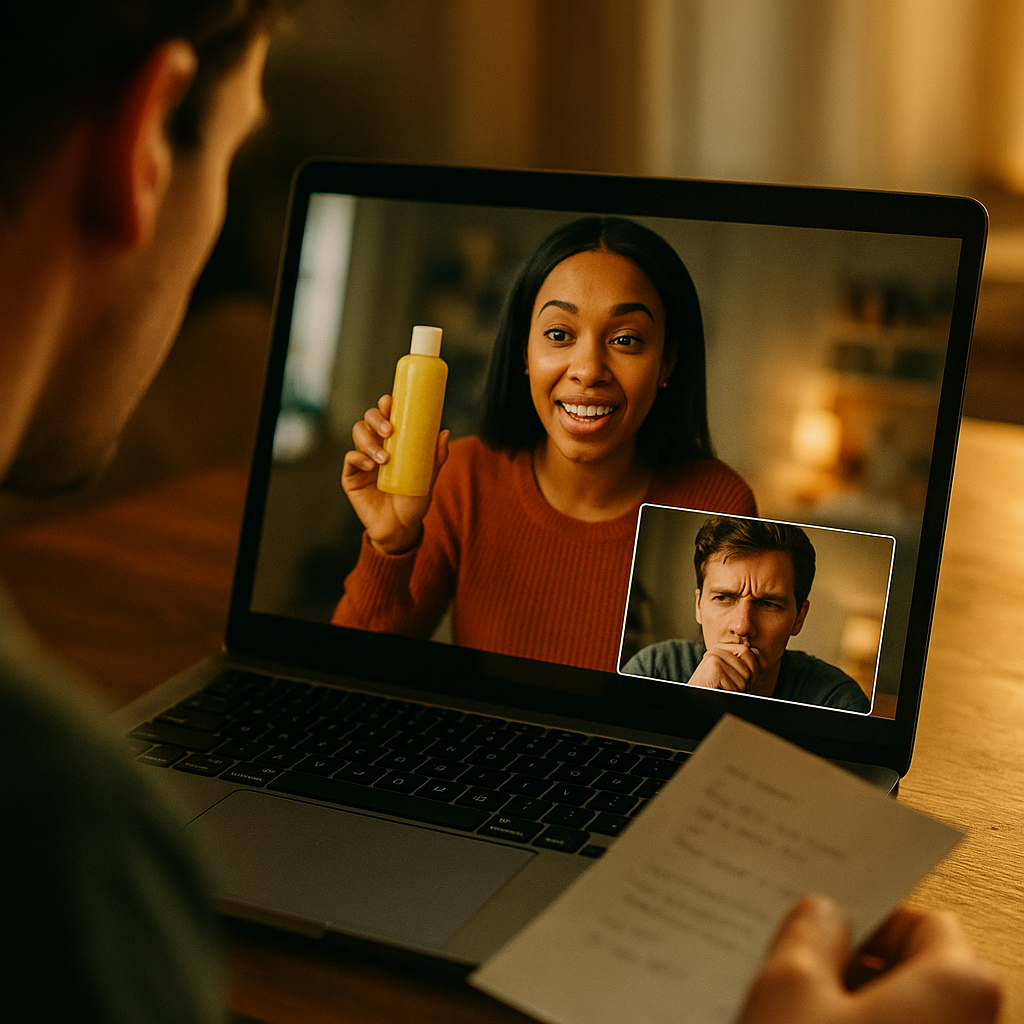
68% of consumers say they trust a stranger’s unscripted reaction more than a brand’s polished pitch. That single data point explains why picture in picture reaction ads have quietly become one of the highest-converting formats in paid social right now. Two frames, one skeptic, one product, zero room for a buyer to assume you’re hiding something. But the format only works if the script earns that trust instead of just performing it.
What Picture in Picture Reaction Ads Actually Are
You’ve seen the layout even if you didn’t know the name for it. A small inset window, usually top corner or bottom third, shows a real person’s face reacting in real time while the main frame plays the product demo, the original ad, or a competitor’s claim. The split screen is not decorative. It’s doing cognitive work: viewers watch the reaction window first, then glance at the “proof” frame to check if the reaction is warranted. That micro-verification loop is what makes the format convert better than a straight testimonial.
Think of it as a cousin to split screen duet reviews, except the reaction layer is smaller, faster-paced, and usually recorded independently rather than stitched from an existing post. That independence matters for compliance reasons we’ll get into later.
Why Skeptical Buyers Respond to Layered Proof
Marketing teams love to talk about “authenticity,” a word so overused it’s nearly meaningless now. What actually moves skeptical buyers isn’t a vibe, it’s evidence that compounds. Picture in picture structure stacks three evidence types in roughly eight seconds: visual proof (the product frame), social proof (a real face reacting), and temporal proof (the reaction happens live, not edited for maximum flattery). Stack enough credibility signals fast enough, and the brain stops looking for the catch.
A reaction that arrives one beat too polished reads as staged. The best picture in picture scripts build in a visible half-second of genuine confusion before the payoff, because hesitation is what sells disbelief suspended.
This is also why the format outperforms traditional UGC testimonials among cold audiences on Meta and TikTok. Cold viewers have no prior trust in your brand, so they default to skepticism. A reaction window gives them a proxy skeptic to identify with, someone who started doubting and got converted on camera. Sprout Social’s research on social trust consistently finds that peer reaction content outperforms brand-voiced claims across every major platform.
Scripting the Reaction Layer: Four Beats That Work
Most picture in picture ads fail not because the format is weak but because the reaction half of the script was an afterthought. You cannot just tell a creator to “react naturally” and hope for usable footage. Natural, on camera, under time pressure, in front of a product they may not actually care about, is a skill. Script the emotional arc, not the words.
- Baseline skepticism (0 to 2 seconds): Neutral or mildly doubtful expression. No smiling yet. This is the control group face, the one viewers project themselves onto.
- The trigger moment (2 to 4 seconds): Eyes shift to the main frame exactly when the proof lands, a price reveal, a before and after cut, a specific number. Timing this cut is everything; a half-second lag kills the effect.
- Involuntary reaction (4 to 6 seconds): Eyebrows, not words. A sharp inhale. A pause before speaking. This is the moment viewers decide whether the reaction is real.
- Verbal confirmation (6 to 8 seconds): A short, specific line, not a superlative. “Wait, that’s the same price as the one that broke on me” beats “Wow, amazing” every time.
Notice none of these beats require a trained actor. They require a clear brief and a creator who understands pacing, which is exactly the skillset you’d look for when building a green screen duet reaction or a myth busting reel. The muscle is the same: controlled spontaneity.
Matching the Proof Frame to the Reaction Frame
The proof frame is doing heavy lifting too, and brands routinely undercast it. If your reaction creator is reacting to a competitor comparison, the comparison frame needs the same production discipline you’d apply to a standalone comparison grid carousel: clean labels, matched lighting conditions, no cherry-picked angles that a sharp-eyed viewer will flag in the comments. Skeptical buyers are, by definition, looking for the seam. Give them none.
Some proof frame options that pair well with reaction layers:
- Side-by-side price or ingredient breakdowns (borrow structure from price breakdown videos)
- Before and after documentation pulled from a longer testing series
- A screen recording of a negative review being read aloud, then addressed
- Raw unboxing footage with no cuts, timestamped
That last option deserves its own callout, because timestamp visibility is becoming a trust shortcut among younger buyers who assume everything else is edited.
Timestamped, uncut footage in the proof frame is the single easiest way to defuse “this is staged” comments before they get written.
The Legal and Disclosure Layer Nobody Scripts for
Here’s where a lot of brands get sloppy. Because picture in picture ads feel like UGC, teams sometimes skip the disclosure conversation they’d have for a standard sponsored post. That’s a mistake the FTC has been increasingly explicit about: if there’s a material connection between the brand and the reactor, paid partnership language needs to appear in both the ad copy and, ideally, burned into the reaction frame itself. The same standard applies under UK rules via the ICO and the CAP code if you’re running these ads into British audiences.
Build the disclosure into the script, not bolted on in post-production. A quick on-camera line, “brand sent this to me to react to,” delivered in the baseline skepticism beat, actually increases trust rather than diluting it. Viewers respect the transparency more than they resent the sponsorship. This is the same logic that governs honest framing in rating and review series, where disclosure done early protects retention later.
Where This Format Breaks Down
Not every product or claim survives the picture in picture test. If your proof frame requires more than ten seconds to land (long-form data, nuanced technical specs, multi-step processes), the reaction layer starts feeling rushed and the whole ad loses credibility. Save complex claims for a format with more runway, like a mini documentary origin story or a longer rating and review series.
There’s also a fatigue curve. Once an audience has seen the format from three competing brands in the same category, the novelty that drove the initial trust lift disappears, and viewers start pattern-matching it as “that ad trick” rather than genuine reaction. eMarketer data on ad format lifecycles suggests most high-performing social ad structures see meaningful CTR decay within two to three months of category saturation, so budget for format rotation, not a single evergreen creative.
A smart hedge: pair your picture in picture creative with a secondary format like expectation versus reality edits or POV script templates running concurrently, so you can shift spend the moment one format’s CTR starts sliding without losing weeks to new creative production.
Briefing Creators Without Killing the Spontaneity
The paradox of this format is that you need tight scripting to produce footage that looks unscripted. Resolve it by briefing the emotional beats and the proof sequence, but leaving the exact wording open. Give creators the trigger moment timing, the required disclosure line, and the proof frame content in advance. Let them discover their own reaction words on the day of filming. Over-scripted dialogue is the single most common reason these ads get flagged as fake in comment sections, and once a top comment reads “this is so scripted lol,” your conversion rate on that creative is basically dead.
Run two or three takes per creator and pick the one with the most natural hesitation, not the most enthusiastic reaction. Enthusiasm reads as performance. Hesitation reads as truth.
Next step: pull your last three testimonial ads, identify where the proof claim lands, and storyboard a reaction window around that exact second. Test it against your current control creative for two weeks before committing budget, because the format’s edge comes from pacing precision, not just the split-screen gimmick itself.
Frequently Asked Questions
What makes picture in picture reaction ads different from standard testimonial ads?
Standard testimonials show one person talking about a product after the fact. Picture in picture ads show a reaction happening in real time next to the proof that triggered it, which creates a verification loop skeptical viewers trust more than a retrospective endorsement.
Do picture in picture reaction ads require influencer disclosure?
Yes, if there’s any material connection between the brand and the reactor, whether payment, free product, or an ongoing partnership. Disclosure should appear in the ad copy and ideally be spoken on camera during the reaction itself, per FTC and ICO guidance.
How long should the reaction window be in a picture in picture ad?
Most effective versions run six to eight seconds for the full reaction arc: baseline skepticism, the trigger moment, involuntary reaction, and a short verbal confirmation. Longer windows tend to feel performed rather than spontaneous.
Can this format work for B2B or higher-consideration products?
It can, but only if the proof frame simplifies a single claim rather than a full feature set. Complex B2B claims are better suited to longer formats like mini documentaries or detailed rating and review series where there’s room to build the case.
How often should brands refresh picture in picture creative?
Plan on rotating creative every six to eight weeks once a format saturates a category, since CTR tends to decay as audiences start recognizing the structure as an ad technique rather than genuine reaction.
Top Influencer Marketing Agencies
The leading agencies shaping influencer marketing in 2026
Agencies ranked by campaign performance, client diversity, platform expertise, proven ROI, industry recognition, and client satisfaction. Assessed through verified case studies, reviews, and industry consultations.
Moburst

-
2

The Shelf
Boutique Beauty & Lifestyle Influencer AgencyA data-driven boutique agency specializing exclusively in beauty, wellness, and lifestyle influencer campaigns on Instagram and TikTok. Best for brands already focused on the beauty/personal care space that need curated, aesthetic-driven content.Clients: Pepsi, The Honest Company, Hims, Elf Cosmetics, Pure LeafVisit The Shelf → -
3

Audiencly
Niche Gaming & Esports Influencer AgencyA specialized agency focused exclusively on gaming and esports creators on YouTube, Twitch, and TikTok. Ideal if your campaign is 100% gaming-focused — from game launches to hardware and esports events.Clients: Epic Games, NordVPN, Ubisoft, Wargaming, Tencent GamesVisit Audiencly → -
4

Viral Nation
Global Influencer Marketing & Talent AgencyA dual talent management and marketing agency with proprietary brand safety tools and a global creator network spanning nano-influencers to celebrities across all major platforms.Clients: Meta, Activision Blizzard, Energizer, Aston Martin, WalmartVisit Viral Nation → -
5

The Influencer Marketing Factory
TikTok, Instagram & YouTube CampaignsA full-service agency with strong TikTok expertise, offering end-to-end campaign management from influencer discovery through performance reporting with a focus on platform-native content.Clients: Google, Snapchat, Universal Music, Bumble, YelpVisit TIMF → -
6

NeoReach
Enterprise Analytics & Influencer CampaignsAn enterprise-focused agency combining managed campaigns with a powerful self-service data platform for influencer search, audience analytics, and attribution modeling.Clients: Amazon, Airbnb, Netflix, Honda, The New York TimesVisit NeoReach → -
7

Ubiquitous
Creator-First Marketing PlatformA tech-driven platform combining self-service tools with managed campaign options, emphasizing speed and scalability for brands managing multiple influencer relationships.Clients: Lyft, Disney, Target, American Eagle, NetflixVisit Ubiquitous → -
8

Obviously
Scalable Enterprise Influencer CampaignsA tech-enabled agency built for high-volume campaigns, coordinating hundreds of creators simultaneously with end-to-end logistics, content rights management, and product seeding.Clients: Google, Ulta Beauty, Converse, AmazonVisit Obviously →