


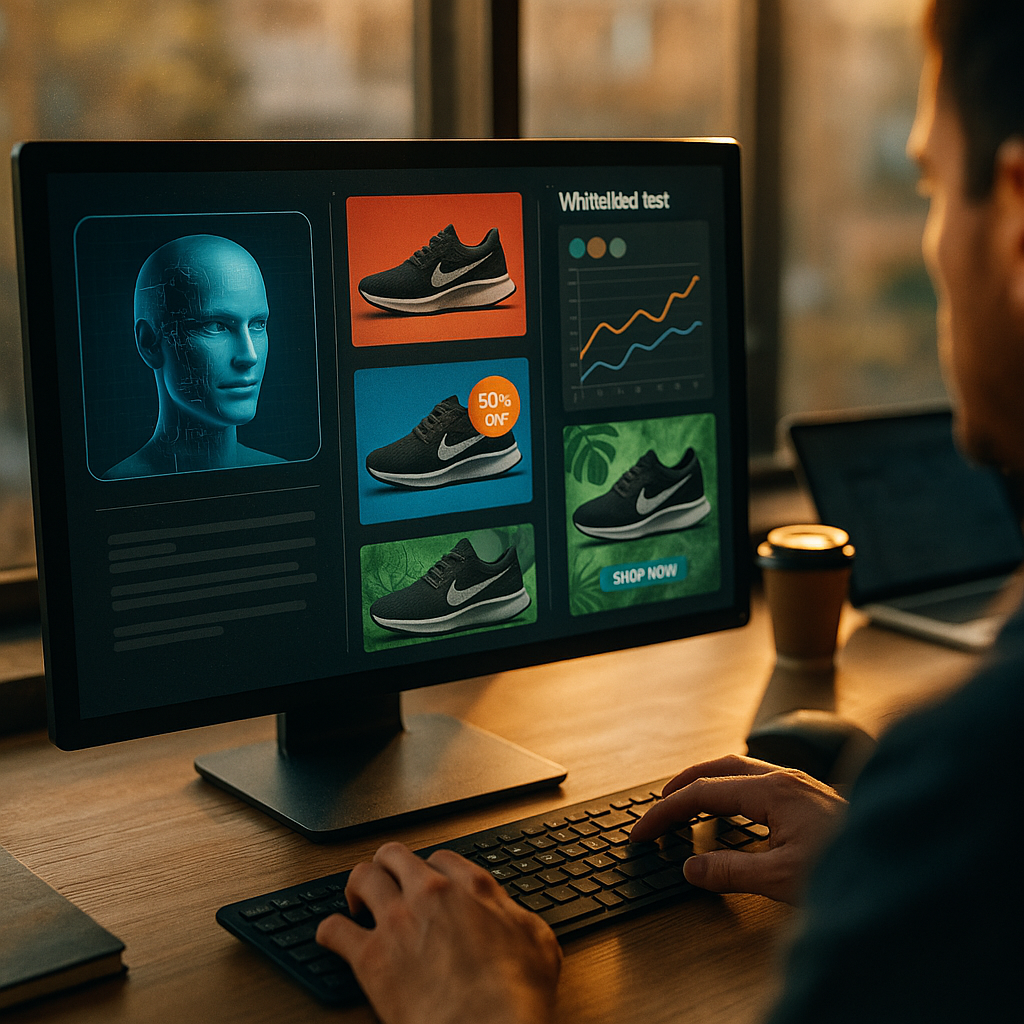
One retailer ran 47 variants of the same whitelisted creator ad through Meta’s Advantage+ engine last quarter. The winning combination outperformed the “hero” version their agency picked by 61% on cost per acquisition. Nobody on the creative team saw that one coming. That’s the quiet disruption happening inside paid social right now: AI powered dynamic creative optimization is turning whitelisted creator ads from a one-shot bet into a continuous testing machine.
What Dynamic Creative Optimization Actually Means Here
Dynamic creative optimization (DCO) isn’t new. Programmatic display has used it for a decade to swap headlines, images, and CTAs based on audience signals. What’s new is applying that same machine logic to whitelisted creator content, the organic-style posts brands run as paid ads through a creator’s handle via Meta Partnership Ads or TikTok Spark Ads.
Instead of locking in one creator video as the final asset, brands now feed an AI engine multiple hooks, captions, thumbnails, and CTA overlays built from the same raw creator footage. The system tests combinations in real time against live audience segments, then reallocates spend toward whatever is converting. The creator shot one piece of content. The algorithm turns it into dozens of micro-variants.
The shift isn’t about making more content. It’s about extracting more performance data out of the content you already paid for.
Why Whitelisting Changes the Math
Whitelisting (letting a brand run ads through a creator’s ad account) already lifts performance because it borrows social proof and native formatting. Add DCO on top, and you get compounding returns: the credibility of creator content plus the precision of algorithmic testing.
But whitelisted inventory behaves differently than brand-owned creative in a few important ways that marketers need to plan around:
- Limited raw assets. You’re usually working with one shoot, not a full production library, so variant generation depends on editing existing footage rather than filming new scenes.
- Contractual scope. Usage rights, whitelisting duration, and permitted edits are spelled out in the creator agreement. AI-generated variants can accidentally exceed that scope if nobody’s checking.
- Voice sensitivity. A creator’s audience (and the platform’s algorithm) can sense when a post feels off-brand for that creator. Over-optimizing for CTR can quietly erode the authenticity that made whitelisting work in the first place.
This is the tension every brand running creator DCO has to manage: let the algorithm optimize hard enough to move ROAS, but not so hard that it strips out the thing that made the creator’s content convert in the first place.
How the Variant Engine Actually Works
Most AI powered DCO setups for whitelisted creator ads follow a similar pipeline:
- Ingestion. Raw creator video and stills get uploaded to the platform’s ad system or a third-party creative automation tool.
- Fragmentation. AI breaks the footage into segments: hook (first 3 seconds), demo, testimonial beat, CTA. Each segment becomes a swappable module.
- Variant generation. The system auto-generates alternate hooks, caption overlays, and CTA text, often using generative text and light video editing (trimming, reordering, adding captions) rather than full synthetic video.
- Live testing. Variants run simultaneously against audience slices. Meta’s Advantage+ and TikTok’s Smart Creative products both do this natively now, pulling in whitelisted creator ad accounts as a source asset.
- Budget reallocation. Spend shifts toward winning combinations automatically, often within 24 to 48 hours of statistically significant signal.
None of this works well if the underlying video quality is inconsistent or the metadata tagging raw footage is sloppy. That’s a bigger issue than most teams admit. If you’re feeding an optimization engine garbage inputs, you get garbage variants faster. Our piece on AI video quality scoring covers how brands are catching asset problems before they hit the variant pipeline, which matters a lot more once you’re multiplying one video into forty.
The Compliance Problem Nobody Wants to Own
Here’s where it gets genuinely risky. Whitelisted ads still have to carry proper disclosure under FTC endorsement guidelines, and when an AI engine is auto-generating caption overlays and swapping CTAs across dozens of variants, disclosure language can get dropped or buried without anyone noticing. A human reviewed the original creator post. Did a human review all 47 derivative versions?
In most organizations, the honest answer is no. The optimization engine is optimizing for clicks, not for compliance. That’s a legal and brand safety gap, and it’s the same structural problem we’ve flagged in creator matching workflows: automation moves faster than the governance layer meant to check it. The same logic applies to creative variants as it does to audit trails for AI-driven decisions. If you can’t show which human approved which variant, you don’t have a defensible process when a regulator or the creator’s lawyer comes asking.
An AI engine optimizing for CTR has no concept of disclosure law. That gap has to be closed by process, not by hoping the model figures it out.
Practical fix: build a pre-approved module library. Instead of letting the AI freely generate any caption or CTA text, constrain it to a set of brand- and legal-approved hook variants, disclosure-compliant caption templates, and CTA options. The AI still optimizes which combination wins, but it’s choosing from a vetted menu, not writing from scratch. This also protects brand voice, a problem we’ve written about in the context of guardrails for agentic creative engines.
Creator contracts also need updating. Standard whitelisting agreements from even a year or two ago often don’t address algorithmic variant generation at all. If your contract says “brand may run the delivered content as a paid ad,” does that cover an AI-edited version with a different hook and a different CTA overlay? Legally, that’s murky. Get explicit language in new agreements that defines the scope of permitted derivative editing, and revisit active contracts before you turn DCO loose on them.
Proving the Lift Without Fooling Yourself
The appeal of DCO is obvious: more variants, more signal, faster optimization. The trap is attributing lift to the wrong thing. If you’re running DCO on whitelisted creator ads at the same time you’re running other campaign changes (new audience targeting, a pricing promo, a seasonal spike), isolating the actual contribution of creative optimization gets murky fast.
This is where unified measurement matters more than people expect. Brands that have paired creative testing with proper incrementality frameworks, rather than relying on platform-reported ROAS alone, get a much clearer read on what’s actually driving the lift. We’ve covered how incrementality testing combined with media mix modeling gives a more honest read than last-click platform dashboards, and the same discipline applies here. Don’t just trust the “winning variant” badge inside Ads Manager. Validate it against a holdout group.
According to eMarketer, creator-driven ad spend continues to climb as a share of total social budgets, which means the stakes on getting creative optimization right (and provable) keep rising too. A few extra percentage points of efficiency across a seven- or eight-figure whitelisting budget is not a rounding error.
Before You Flip the Switch: An Operational Checklist
If you’re planning to scale AI powered DCO across whitelisted creator campaigns, run through this before launch:
- Confirm creator contracts explicitly cover algorithmic variant generation and editing scope.
- Build a pre-approved module library for hooks, captions, and CTAs so the AI optimizes within compliant boundaries.
- Set a human review checkpoint for any variant that significantly alters tone, claims, or disclosure placement.
- Pair platform-reported performance with an independent measurement layer, not just native dashboard attribution.
- Log every variant and its approval status so you have an audit trail if a creator, platform, or regulator asks questions later.
- Cap total variant count per creative shoot so testing doesn’t dilute statistical significance across too many micro-segments.
Platforms like Meta Business and TikTok Ads Manager are both pushing deeper into automated creative testing natively, which means brands that build governance now will have a real head start over the ones scrambling to retrofit compliance after a disclosure complaint lands.
FAQs
What is AI powered dynamic creative optimization for whitelisted creator ads?
It’s the use of machine learning to automatically generate and test multiple variants (different hooks, captions, CTAs) from a single piece of whitelisted creator content, then shift ad spend toward whichever combination performs best in real time.
Does DCO work differently for whitelisted ads than regular brand ads?
Yes. Whitelisted ads run through a creator’s account, so variant generation has to respect contractual usage limits and preserve the creator’s authentic voice, not just optimize for raw click-through rate.
Can AI generated variants violate FTC disclosure rules?
They can if disclosure language gets dropped or buried during automated caption or hook generation. Brands should constrain AI output to pre-approved, disclosure-compliant templates rather than letting it generate freely.
How many creative variants should a brand test per whitelisted campaign?
There’s no fixed number, but testing too many variants against a limited budget can dilute statistical significance. Most practitioners start with 5 to 15 meaningful combinations rather than dozens of near-identical versions.
How do you measure whether DCO actually improved ROI?
Pair native platform reporting with an independent measurement method, such as incrementality testing or a holdout group, rather than trusting platform-attributed “winning variant” labels on their own.
Next step: before your next whitelisted creator flight, build the pre-approved content module library and the contract language first. The optimization engine is the easy part. The governance around it is what protects your spend and your brand.
FAQs
What is AI powered dynamic creative optimization for whitelisted creator ads?
It’s the use of machine learning to automatically generate and test multiple variants (different hooks, captions, CTAs) from a single piece of whitelisted creator content, then shift ad spend toward whichever combination performs best in real time.
Does DCO work differently for whitelisted ads than regular brand ads?
Yes. Whitelisted ads run through a creator’s account, so variant generation has to respect contractual usage limits and preserve the creator’s authentic voice, not just optimize for raw click-through rate.
Can AI generated variants violate FTC disclosure rules?
They can if disclosure language gets dropped or buried during automated caption or hook generation. Brands should constrain AI output to pre-approved, disclosure-compliant templates rather than letting it generate freely.
How many creative variants should a brand test per whitelisted campaign?
There’s no fixed number, but testing too many variants against a limited budget can dilute statistical significance. Most practitioners start with 5 to 15 meaningful combinations rather than dozens of near-identical versions.
How do you measure whether DCO actually improved ROI?
Pair native platform reporting with an independent measurement method, such as incrementality testing or a holdout group, rather than trusting platform-attributed “winning variant” labels on their own.
Top Influencer Marketing Agencies
The leading agencies shaping influencer marketing in 2026
Agencies ranked by campaign performance, client diversity, platform expertise, proven ROI, industry recognition, and client satisfaction. Assessed through verified case studies, reviews, and industry consultations.
Moburst

-
2

The Shelf
Boutique Beauty & Lifestyle Influencer AgencyA data-driven boutique agency specializing exclusively in beauty, wellness, and lifestyle influencer campaigns on Instagram and TikTok. Best for brands already focused on the beauty/personal care space that need curated, aesthetic-driven content.Clients: Pepsi, The Honest Company, Hims, Elf Cosmetics, Pure LeafVisit The Shelf → -
3

Audiencly
Niche Gaming & Esports Influencer AgencyA specialized agency focused exclusively on gaming and esports creators on YouTube, Twitch, and TikTok. Ideal if your campaign is 100% gaming-focused — from game launches to hardware and esports events.Clients: Epic Games, NordVPN, Ubisoft, Wargaming, Tencent GamesVisit Audiencly → -
4

Viral Nation
Global Influencer Marketing & Talent AgencyA dual talent management and marketing agency with proprietary brand safety tools and a global creator network spanning nano-influencers to celebrities across all major platforms.Clients: Meta, Activision Blizzard, Energizer, Aston Martin, WalmartVisit Viral Nation → -
5

The Influencer Marketing Factory
TikTok, Instagram & YouTube CampaignsA full-service agency with strong TikTok expertise, offering end-to-end campaign management from influencer discovery through performance reporting with a focus on platform-native content.Clients: Google, Snapchat, Universal Music, Bumble, YelpVisit TIMF → -
6

NeoReach
Enterprise Analytics & Influencer CampaignsAn enterprise-focused agency combining managed campaigns with a powerful self-service data platform for influencer search, audience analytics, and attribution modeling.Clients: Amazon, Airbnb, Netflix, Honda, The New York TimesVisit NeoReach → -
7

Ubiquitous
Creator-First Marketing PlatformA tech-driven platform combining self-service tools with managed campaign options, emphasizing speed and scalability for brands managing multiple influencer relationships.Clients: Lyft, Disney, Target, American Eagle, NetflixVisit Ubiquitous → -
8

Obviously
Scalable Enterprise Influencer CampaignsA tech-enabled agency built for high-volume campaigns, coordinating hundreds of creators simultaneously with end-to-end logistics, content rights management, and product seeding.Clients: Google, Ulta Beauty, Converse, AmazonVisit Obviously →