


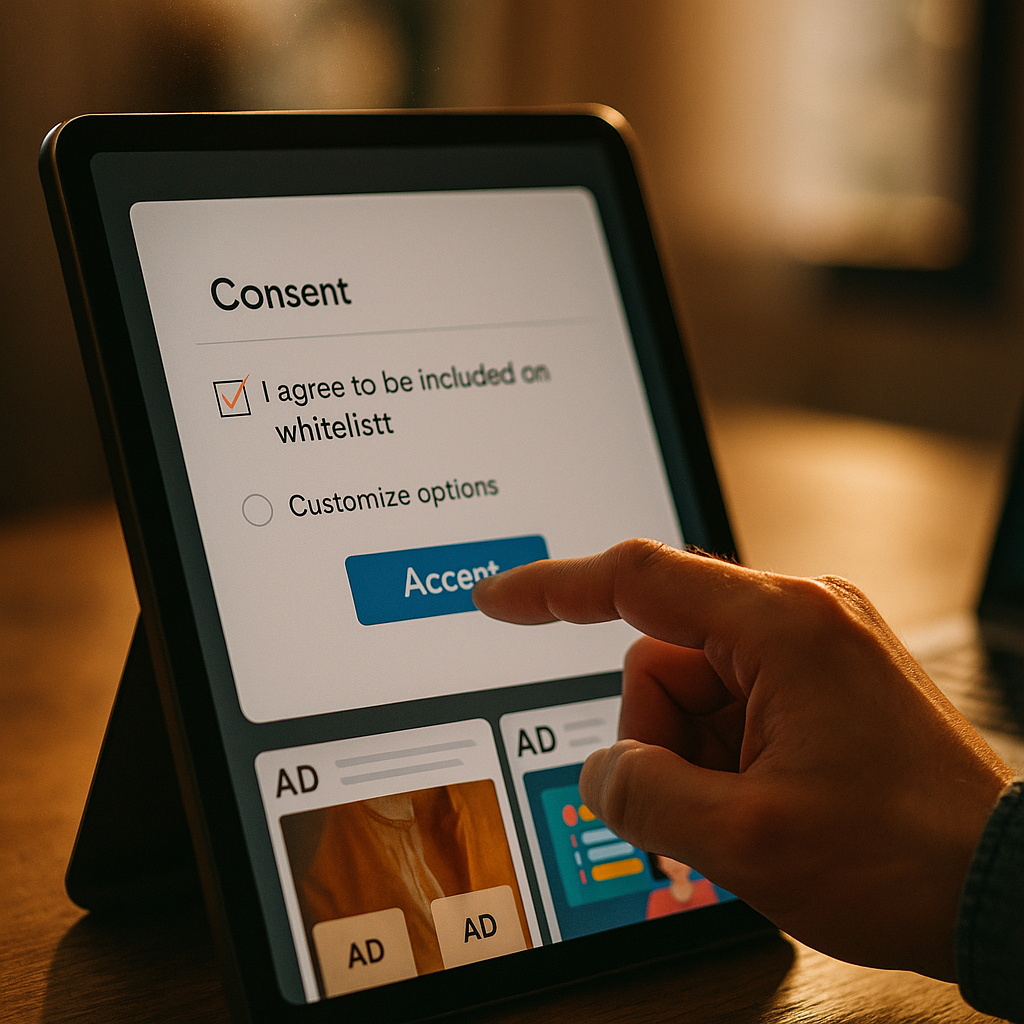
Here’s a number that should bother every brand marketer running paid social: the average performance team tests twenty to forty creative variations a month across Meta and TikTok whitelisting campaigns. Now ask your legal team how many of those variations have explicit creator consent on file. If the answer involves a shrug, you have a problem. Whitelisting consent clauses, when written correctly, can cover that entire monthly variation load without a single new contract. Most brands just never write them that way.
Why Whitelisting Breaks Traditional Consent Models
Traditional influencer contracts were built for a simpler world: one creator, one piece of content, one usage window. Whitelisting (running paid ads through a creator’s handle, often called “spark ads” on TikTok or “partnership ads” on Meta) blew that model apart. Performance marketers now run dozens of creative permutations against a single piece of whitelisted content: different hooks, different captions, different calls to action, different aspect ratios for Stories versus Reels versus feed placements.
Each of those permutations is, technically, a derivative use. If your contract only grants rights to “the content as delivered,” you’re exposed every time an editor swaps a headline or trims three seconds off the intro. Multiply that by forty variations a month across a roster of fifteen creators, and you’ve created a compliance nightmare that nobody on the media buying side even realizes exists.
A whitelisting clause that only covers the original asset, not its derivatives, leaves a brand exposed every single time the creative team iterates on an ad.
The Real Cost of Going Back for New Sign-Off
Ask any media buyer what kills campaign velocity and they’ll tell you: waiting on legal. Pausing a high-performing ad set because someone flagged that the creator never approved the “urgency” version of the caption is a direct hit to ROI. Agencies report that re-negotiating usage rights for a single creative tweak can take anywhere from three days to two weeks, depending on how fast the creator’s manager responds. In a landscape where Meta’s algorithm rewards rapid creative refresh, that lag is expensive. It’s not just friction, it’s lost spend efficiency during the exact window when a winning ad should be scaling.
What a Proper Whitelisting Consent Clause Actually Covers
A well-drafted clause does three things at once: it defines the scope of permitted variation, it caps the volume or timeframe, and it preserves the creator’s right to object to specific uses they find objectionable (think political juxtaposition or competitor placement). Here’s the structure that’s become standard among brands running high-volume paid social programs:
- Derivative rights language. Explicit permission to edit, trim, re-caption, resize, add text overlays, and combine the licensed content with other brand assets, without additional approval, provided the core message and the creator’s likeness aren’t materially distorted.
- Volume or cadence caps. A defined ceiling, say, “up to forty active ad variations per calendar month,” tied to the licensing fee already paid. This protects the creator from unlimited exploitation while giving the brand operational room.
- Platform and placement scope. Spelling out exactly which platforms (Meta, TikTok, YouTube Shorts) and placements (feed, Stories, in-stream) are included, since a clause silent on placement invites disputes later.
- Exclusion list. A short, specific list of uses the creator can veto in advance: political content, alcohol or gambling tie-ins, or juxtaposition with a named competitor.
- Audit and reporting rights. A mechanism letting the creator (or their agent) request a sample of live variations periodically, so consent isn’t a one-time blind check.
Notice what’s missing from that list: a requirement to re-sign for every single variation. That’s the entire point. You’re negotiating scope once, at the start of the relationship or campaign, instead of forty times a month.
Drafting the Clause: Language That Holds Up
Vague language is the enemy here. “Brand may use the content as it sees fit” will not survive a dispute, and it won’t satisfy a creator’s manager who’s seen horror stories about footage repurposed into something embarrassing. Instead, anchor the clause to measurable boundaries. For example: “Brand may create and distribute up to forty (40) distinct paid media variations per calendar month derived from the Licensed Content, including but not limited to edits to captions, overlays, pacing, and aspect ratio, provided such variations do not alter the substantive claims made by Creator or associate Creator with content outside the categories listed in Exhibit B.”
That single paragraph does more legal work than three pages of boilerplate. It gives your media buying team a clear operational ceiling, gives your legal team an auditable standard, and gives the creator confidence that their likeness isn’t being used as an open license.
For brands managing this across a roster of creators with varying risk tolerance, it’s worth comparing this approach to the frameworks already used in multi year creator contracts, where scope and renewal terms are negotiated once and extended rather than renegotiated project by project. The same logic applies to whitelisting rights: negotiate the ceiling, not each instance.
Does This Actually Hold Up Under FTC Scrutiny?
Good question, and one your compliance team should be asking before legal signs off. The FTC doesn’t care how many variations you run. It cares whether each variation carries proper disclosure and whether the underlying endorsement claims remain truthful and substantiated. A whitelisting clause that grants broad creative latitude does not grant latitude on disclosure. #ad or “Paid Partnership” labeling still needs to persist across every derivative, every placement, every edit.
This is where brands get tripped up. They negotiate a clean consent clause for creative flexibility, then forget that each variation still needs independent disclosure compliance checks. Pairing your whitelisting clause with a documented disclosure QA step (ideally automated through your ad platform’s partnership ad tools) closes that gap. For a deeper look at how disclosure obligations interact with paid distribution specifically, see affiliate link disclosure rules and how brands are closing similar audit gaps.
Creative flexibility and disclosure compliance are two separate obligations. A whitelisting clause solves the first. It does nothing for the second unless you build a parallel QA step.
How This Plays Out in Regulated Industries
If you’re in financial services, health, or another regulated vertical, the math gets more complicated. A forty-variation monthly cap sounds great until your compliance team realizes every variation containing a performance claim needs its own legal review trail. Brands in BFSI have already built out structured sign-off processes for exactly this reason, and the lessons translate directly. Teams working through similar bottlenecks have documented their approach in the BFSI influencer sign off framework, which is worth reviewing even if you’re outside financial services, because the underlying problem (high creative velocity colliding with slow legal review) is universal.
The practical fix most regulated brands land on: pre-approve message categories rather than individual pieces of creative. If a variation stays within an approved claim category (“save up to X,” “rated highest in Y”), it moves without new review. If it introduces a new claim type, it triggers legal. This tiered approach lets the whitelisting clause do its job for the bulk of routine creative iteration while reserving human review for the genuinely new.
Operationalizing the Clause: What Media Teams Need to Know
A perfectly drafted clause is worthless if the people running campaigns don’t know its boundaries. Build a one-page internal reference, not a legal document, that media buyers and creative editors can check before pushing a new variation live. It should answer three questions in plain language: Can we edit this? Can we add text or a new CTA? Are we within the monthly variation cap?
Track variation counts somewhere visible. A shared tracker or a tag inside your ad platform’s campaign naming convention works fine. The goal isn’t bureaucracy, it’s preventing the brand from accidentally blowing past the forty-variation ceiling and triggering a breach of the very agreement that was supposed to protect speed.
- Set the monthly cap based on actual testing velocity, not an arbitrary round number. Pull data from TikTok Ads Manager or Meta Business Suite to see your real monthly variation count before negotiating the ceiling.
- Build renewal language into the original contract so the cap adjusts automatically for recurring campaigns, avoiding the renegotiation trap covered in ambassador contract auto renewal discussions.
- Keep a time-stamped archive of every live variation. If a dispute arises six months later, you’ll want proof of what ran and when, a practice detailed further in guidance on influencer content archiving.
Industry benchmarks from eMarketer and creative testing data shared by Sprout Social both point to the same trend: paid social creative refresh rates are accelerating, not slowing down. Clauses negotiated for yesterday’s testing cadence will be obsolete within two quarters if they’re not built with headroom.
What Happens When You Exceed the Cap?
Build a clear overage mechanism into the contract rather than leaving it ambiguous. The cleanest version: additional variations beyond the monthly cap trigger a pre-agreed per-unit fee rather than a full contract renegotiation. This keeps the relationship frictionless for the brand and ensures the creator is compensated fairly for genuinely higher usage, instead of either party feeling shortchanged.
Next Step
Pull your last ninety days of whitelisted ad variations, count them against what your current contracts actually authorize, and you’ll likely find a gap worth closing before your next campaign cycle starts. Fix the clause once, at the scope level, and your media team stops waiting on legal every time a headline changes.
FAQs
What is a whitelisting consent clause?
It’s a contract provision that grants a brand pre-approved rights to create and run multiple paid ad variations from a creator’s content, within defined limits, without requiring separate sign-off for each edit.
How many ad variations should a standard clause cover?
Most high-volume paid social programs land between twenty and forty variations per month, but the right number depends on your actual testing cadence. Pull real data before setting the cap rather than guessing.
Does a whitelisting clause remove the need for FTC disclosure on every variation?
No. Creative flexibility and disclosure compliance are separate obligations. Every variation still needs proper endorsement disclosure regardless of how broad the usage rights are.
What happens if a brand exceeds the agreed variation cap?
Well-drafted clauses include an overage mechanism, typically a per-unit fee for additional variations, instead of forcing a full contract renegotiation.
Can creators revoke consent for specific ad variations mid-campaign?
Yes, if the clause includes an exclusion list and audit rights. Creators can flag specific categories of use (political content, competitor juxtaposition) as off-limits from the start, and request periodic reporting on live variations.
Should regulated industries like finance or healthcare use the same approach?
The core structure works, but regulated brands typically add a tiered review layer: routine variations within pre-approved claim categories move freely, while anything introducing a new claim triggers legal review before it goes live.
Top Influencer Marketing Agencies
The leading agencies shaping influencer marketing in 2026
Agencies ranked by campaign performance, client diversity, platform expertise, proven ROI, industry recognition, and client satisfaction. Assessed through verified case studies, reviews, and industry consultations.
Moburst

-
2

The Shelf
Boutique Beauty & Lifestyle Influencer AgencyA data-driven boutique agency specializing exclusively in beauty, wellness, and lifestyle influencer campaigns on Instagram and TikTok. Best for brands already focused on the beauty/personal care space that need curated, aesthetic-driven content.Clients: Pepsi, The Honest Company, Hims, Elf Cosmetics, Pure LeafVisit The Shelf → -
3

Audiencly
Niche Gaming & Esports Influencer AgencyA specialized agency focused exclusively on gaming and esports creators on YouTube, Twitch, and TikTok. Ideal if your campaign is 100% gaming-focused — from game launches to hardware and esports events.Clients: Epic Games, NordVPN, Ubisoft, Wargaming, Tencent GamesVisit Audiencly → -
4

Viral Nation
Global Influencer Marketing & Talent AgencyA dual talent management and marketing agency with proprietary brand safety tools and a global creator network spanning nano-influencers to celebrities across all major platforms.Clients: Meta, Activision Blizzard, Energizer, Aston Martin, WalmartVisit Viral Nation → -
5

The Influencer Marketing Factory
TikTok, Instagram & YouTube CampaignsA full-service agency with strong TikTok expertise, offering end-to-end campaign management from influencer discovery through performance reporting with a focus on platform-native content.Clients: Google, Snapchat, Universal Music, Bumble, YelpVisit TIMF → -
6

NeoReach
Enterprise Analytics & Influencer CampaignsAn enterprise-focused agency combining managed campaigns with a powerful self-service data platform for influencer search, audience analytics, and attribution modeling.Clients: Amazon, Airbnb, Netflix, Honda, The New York TimesVisit NeoReach → -
7

Ubiquitous
Creator-First Marketing PlatformA tech-driven platform combining self-service tools with managed campaign options, emphasizing speed and scalability for brands managing multiple influencer relationships.Clients: Lyft, Disney, Target, American Eagle, NetflixVisit Ubiquitous → -
8

Obviously
Scalable Enterprise Influencer CampaignsA tech-enabled agency built for high-volume campaigns, coordinating hundreds of creators simultaneously with end-to-end logistics, content rights management, and product seeding.Clients: Google, Ulta Beauty, Converse, AmazonVisit Obviously →