


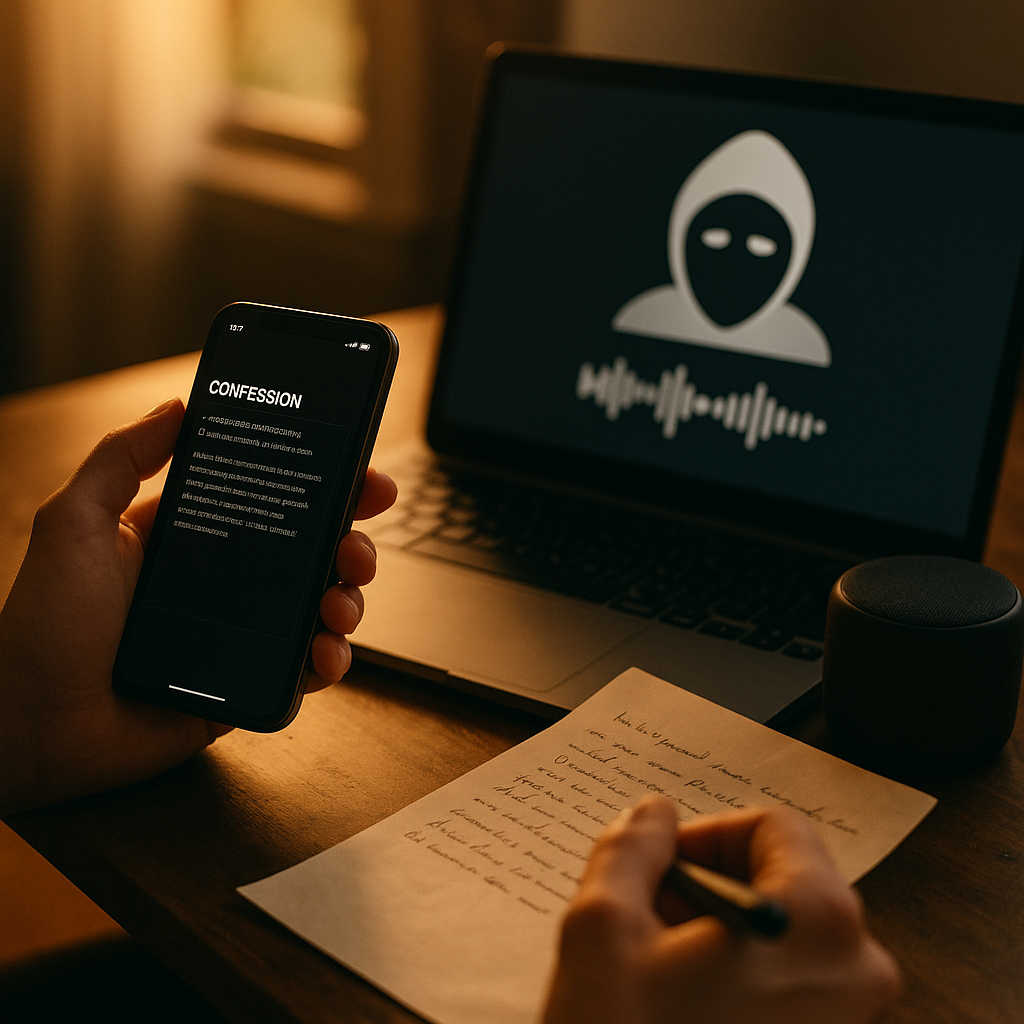
Seventy percent of consumers say they trust peer recommendations over brand messaging, yet some of the highest-performing confessional content on TikTok right now never shows a human face at all. Anonymous text-to-speech confessionals have become a quiet workhorse format: a robotic voice reads a “secret” over b-roll or a blurred face, and the comment section explodes anyway. Why does a format that hides identity still build trust? And how should brands script it without triggering platform penalties or FTC scrutiny?
Why the Faceless Confession Format Is Spreading
Scroll TikTok or Instagram Reels for ten minutes and you will hit at least one: a flat, synthesized voice narrating a workplace scandal, a skincare regret, or a “things nobody tells you about X” confession, usually over stock footage, a blurred silhouette, or a static image. The format exploded because it solves a real production problem. Creators and brands don’t need a willing on-camera talent, lighting, or even a studio. They need a script, a text-to-speech tool, and a few seconds of b-roll.
That production ease matters for budget-conscious teams, but it isn’t the whole story. The format also sidesteps the “polished ad” signal that triggers skepticism. A robotic voice reading a confession feels raw by default, almost like leaked audio. Audiences associate anonymity with risk-taking honesty, the kind of thing someone would only say if they couldn’t be identified.
Anonymity doesn’t erase trust signals, it relocates them. Viewers stop judging the messenger and start judging the message itself, which means the script has to carry 100 percent of the credibility load.
The Trust Mechanics: Why Hiding the Face Can Build Credibility
This sounds counterintuitive. Marketers have spent a decade being told that faces build trust, that UGC works because viewers see a real person with real stakes. So why does a synthetic voice over a blank screen still convert?
Because the format borrows credibility from a different place: whistleblower culture. Think r/AmITheAsshole read aloud, or anonymous workplace Glassdoor reviews turned into video. The absence of a face reads as protection, not deception, when the content is framed correctly. Viewers assume the person has something to lose by being identified, whether that is a job, a relationship, or social standing. That assumption does the trust-building work a face normally would.
This only works, though, if the content respects the convention. The moment a confession feels like a thinly veiled product pitch with a synthetic voice slapped on top, the format collapses into obvious advertising, and the trust bonus evaporates. The script has to earn its anonymity, not just borrow its aesthetic.
Scripting the Confessional: Structure That Converts
A good TTS confessional script follows a predictable arc, and skipping steps is the fastest way to kill performance.
- The hook line (0 to 2 seconds): Open mid-confession, never with a setup. “I worked in a dermatology office for six years and here’s what nobody tells you” beats “Let me tell you a story” every time.
- The stakes (2 to 8 seconds): Establish why this person is risking something by speaking. Job, reputation, relationship. This is what makes the anonymity feel earned rather than gimmicky.
- The reveal: The actual insight, complaint, or confession. This is where the product or brand mention lives, ideally positioned as incidental to the story rather than the point of it.
- The ambiguous close: Confessional formats rarely resolve neatly. A clean CTA breaks the illusion. Let the voice trail off or ask a question instead of pitching.
Pacing matters more here than in face-to-camera content because there’s no facial expression to hold attention. The voice has to do the emotional work, and most TTS engines are flat by default. Script in short clauses, use punctuation deliberately to control pacing, and avoid run-on sentences that make synthetic voices sound monotone for too long. If you’ve worked on sound-driven script formats before, the same discipline around audio pacing applies here, just with a different emotional register.
Match the Visual Layer to the Voice, Not the Product
One mistake brands make constantly: they pair an anonymous confession script with obvious product shots. It breaks the format instantly. The visual layer should feel like ambient footage, not an ad reel. This is closely related to the discipline behind silent-first editing techniques, where the visual and audio tracks are scripted almost independently but still reinforce the same emotional beat.
Where the Compliance Line Actually Sits
This is the part most teams skip, and it’s the part that will get you in trouble. Anonymous confessional content, when used to promote a product or service, is still an advertisement under FTC endorsement guidelines, even though there’s no identifiable face attached to it. The absence of a visible creator doesn’t erase the disclosure obligation. If a brand pays for, scripts, or directs the content, that material connection must be disclosed, full stop.
The harder question is attribution. If the “confession” implies a real, lived experience that didn’t actually happen to anyone (a fabricated workplace story used to sell a product, for example), that’s not a disclosure problem anymore, it’s a deceptive advertising problem. Platforms are also tightening their own rules around synthetic voice content; TikTok and Meta both require labeling for AI-generated audio and video in certain contexts, so check current TikTok ad policies and Meta’s branded content guidelines before publishing at scale.
If your legal team would blink at a face-on-camera version of the script, the TTS version has the same problem. Facelessness changes the aesthetic, not the regulatory exposure.
Practically, that means every anonymous confessional script needs the same disclosure checklist you’d apply to any sponsored content: clear #ad or #sponsored tagging, no implied personal experience that didn’t happen, and no health, financial, or safety claims that can’t be substantiated. Teams that already have a review process for comparison content that survives FTC review can adapt the same framework here with minor tweaks for the anonymity layer.
Picking the Right TTS Voice (It’s Not About Sounding Human)
Brands often assume the goal is to make the voice sound as human as possible. That’s usually wrong. A slightly synthetic cadence signals authenticity-through-distance; it tells the viewer “this is a real confession read by a machine to protect identity,” not “this is a polished ad voice.” Over-humanized AI voices can actually undercut the format because they feel like they’re trying too hard to sound like a creator, which reintroduces the skepticism anonymity was supposed to remove.
Test a few different voice engines against your target demographic. Gen Z audiences on TikTok tend to respond to flatter, faster-paced voices, while longer-form confessional content on YouTube or Instagram performs better with a slightly warmer, slower delivery. This is worth A/B testing the same way you’d test any other creative variable, and it pairs well with a broader creative refresh cadence so the format doesn’t fatigue your audience.
Measuring a Format That Hides Its Own Performance Signals
Here’s the operational challenge: a lot of standard UGC performance signals don’t apply here. There’s no creator face to track sentiment against, no personal brand lending halo credibility, and often no identifiable “talent” to attribute performance to across campaigns. That means brands need to lean harder on comment sentiment analysis, completion rate, and share rate rather than face-driven engagement metrics.
Sprout Social’s engagement benchmarking tools and native platform analytics are your best friends here, specifically watching for saves and shares, which tend to spike on confessional formats because viewers send them to friends as “is this us?” content. According to eMarketer’s creator economy research, share rate has become an increasingly reliable proxy for trust-driven content, often outperforming likes as a predictor of downstream conversion.
Treat this format the way you’d treat reaction content built for trust over reach, meaning you’re optimizing for believability metrics first and raw impressions second. A confessional that gets ten million views but zero saves hasn’t actually done its job.
Where This Fits in a Broader Content Mix
Anonymous TTS confessionals shouldn’t carry a program alone. They work best as a trust-building layer alongside more identifiable formats, like founder-led UGC or on-camera customer testimonials. The confessional format earns attention and curiosity; named, faced content converts that curiosity into purchase confidence. Running both in sequence, confessional for top-of-funnel intrigue, identifiable testimonial for bottom-of-funnel proof, tends to outperform either format in isolation.
One last operational note: brief your creators or internal scriptwriters explicitly on what counts as a “safe” fictionalized scenario versus a misleading claim. Ambiguity here is where most compliance failures start, not malice.
Next step: before you greenlight your next anonymous confessional script, run it through a two-question filter: would this disclosure hold up if the face were visible, and would this claim survive an FTC complaint if someone screenshotted it? If both answers are yes, you’ve got a format that builds trust without the overhead of casting, and without the risk of explaining yourself to a regulator later.
FAQs
What is an anonymous text-to-speech confessional in marketing?
It’s a short video format where a synthetic voice narrates a first-person “confession” or insider story, typically paired with blurred faces, stock footage, or ambient b-roll instead of an identifiable creator. Brands use it to build curiosity and trust while avoiding the cost and complexity of on-camera talent.
Do anonymous confessional videos still need FTC disclosure?
Yes. If a brand pays for, scripts, or directs the content, FTC endorsement guidelines still require clear disclosure of the material connection, regardless of whether a face or real identity is shown. Anonymity does not exempt sponsored content from disclosure rules.
Why do faceless confessional videos often outperform on-camera content?
The implied anonymity signals that the speaker has something to lose by sharing the story, which reads as risk-taking honesty rather than scripted promotion. This shifts the trust burden entirely onto the script itself, which is why pacing and framing matter more in this format than in traditional UGC.
What text-to-speech voice style works best for this format?
Slightly synthetic, flat-cadence voices generally outperform overly humanized AI voices, because they reinforce the “real confession read by a machine” framing rather than sounding like a polished ad voiceover. Voice choice should be tested against platform and demographic, since pacing preferences shift between TikTok, Instagram, and YouTube audiences.
How should brands measure success for anonymous confessional content?
Prioritize saves, shares, and comment sentiment over raw view counts, since those signals indicate the audience found the story believable enough to pass along. Standard creator-attribution metrics don’t apply well here because there’s no identifiable talent driving the halo effect.
Top Influencer Marketing Agencies
The leading agencies shaping influencer marketing in 2026
Agencies ranked by campaign performance, client diversity, platform expertise, proven ROI, industry recognition, and client satisfaction. Assessed through verified case studies, reviews, and industry consultations.
Moburst

-
2

The Shelf
Boutique Beauty & Lifestyle Influencer AgencyA data-driven boutique agency specializing exclusively in beauty, wellness, and lifestyle influencer campaigns on Instagram and TikTok. Best for brands already focused on the beauty/personal care space that need curated, aesthetic-driven content.Clients: Pepsi, The Honest Company, Hims, Elf Cosmetics, Pure LeafVisit The Shelf → -
3

Audiencly
Niche Gaming & Esports Influencer AgencyA specialized agency focused exclusively on gaming and esports creators on YouTube, Twitch, and TikTok. Ideal if your campaign is 100% gaming-focused — from game launches to hardware and esports events.Clients: Epic Games, NordVPN, Ubisoft, Wargaming, Tencent GamesVisit Audiencly → -
4

Viral Nation
Global Influencer Marketing & Talent AgencyA dual talent management and marketing agency with proprietary brand safety tools and a global creator network spanning nano-influencers to celebrities across all major platforms.Clients: Meta, Activision Blizzard, Energizer, Aston Martin, WalmartVisit Viral Nation → -
5

The Influencer Marketing Factory
TikTok, Instagram & YouTube CampaignsA full-service agency with strong TikTok expertise, offering end-to-end campaign management from influencer discovery through performance reporting with a focus on platform-native content.Clients: Google, Snapchat, Universal Music, Bumble, YelpVisit TIMF → -
6

NeoReach
Enterprise Analytics & Influencer CampaignsAn enterprise-focused agency combining managed campaigns with a powerful self-service data platform for influencer search, audience analytics, and attribution modeling.Clients: Amazon, Airbnb, Netflix, Honda, The New York TimesVisit NeoReach → -
7

Ubiquitous
Creator-First Marketing PlatformA tech-driven platform combining self-service tools with managed campaign options, emphasizing speed and scalability for brands managing multiple influencer relationships.Clients: Lyft, Disney, Target, American Eagle, NetflixVisit Ubiquitous → -
8

Obviously
Scalable Enterprise Influencer CampaignsA tech-enabled agency built for high-volume campaigns, coordinating hundreds of creators simultaneously with end-to-end logistics, content rights management, and product seeding.Clients: Google, Ulta Beauty, Converse, AmazonVisit Obviously →