


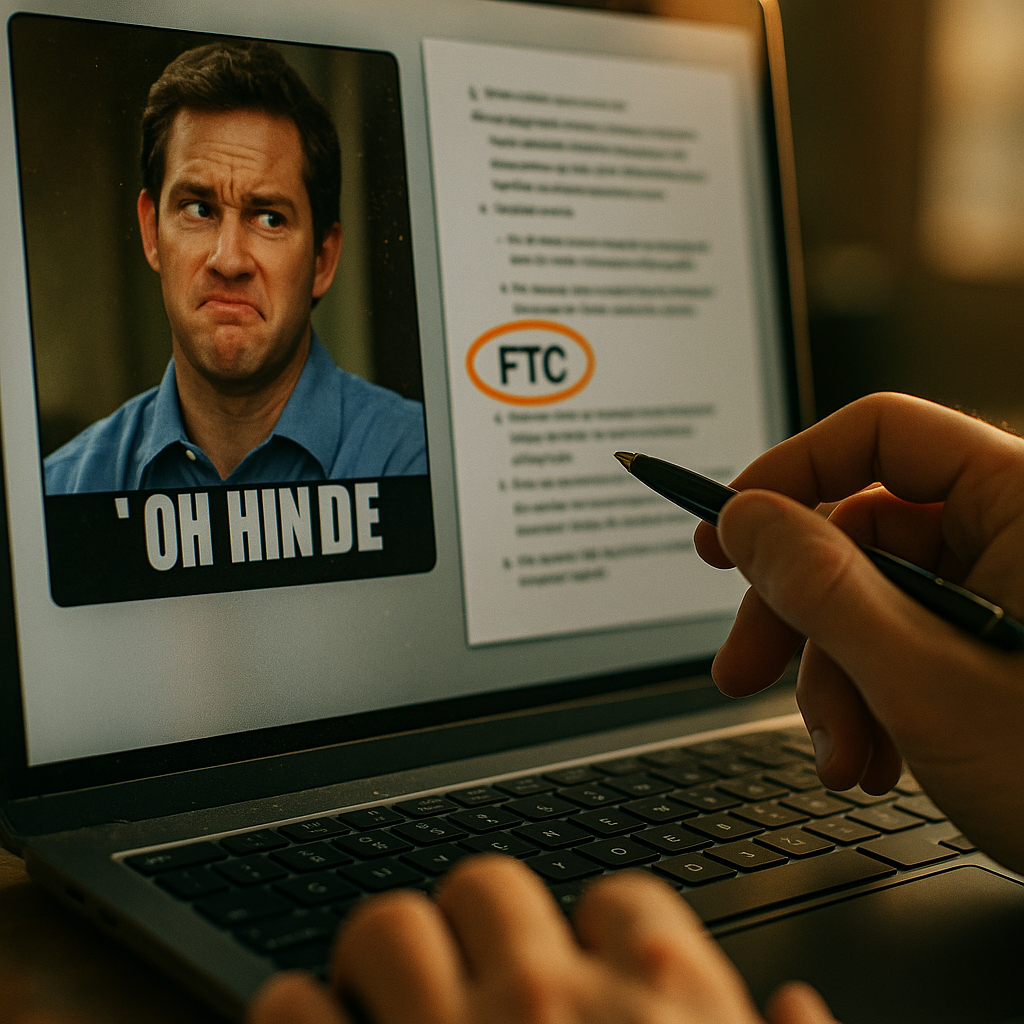
Meme accounts post faster than legal teams can review, and that’s exactly why meme format captions have become the FTC’s favorite enforcement target in influencer marketing. One mislabeled “when the product actually works” caption can erase a six-figure campaign’s goodwill overnight. The joke is never the problem. The missing disclosure is.
Why Meme Formats Are a Compliance Blind Spot
Meme templates work because they’re instantly recognizable. Drake approving/disapproving, “nobody: / me:”, distracted boyfriend, expanding brain. The format carries the joke, so creators can slot in a product reference and get a laugh without writing original comedy. That’s the appeal for brands too: low production cost, high shareability, built-in cultural fluency.
But meme formats were never designed with disclosure in mind. They’re built for irony, exaggeration, and absurdist escalation, which is precisely the tone the FTC flags as “unclear material connection” territory. When a caption reads like a joke, audiences assume it’s organic commentary, not paid promotion. That assumption is the regulatory trap.
The FTC doesn’t care whether your caption was funny. It cares whether a reasonable consumer understood the post was sponsored.
The FTC’s endorsement guidance is explicit: disclosures must be clear, conspicuous, and understood in the context the average viewer encounters it. A tiny #ad buried under six meme tags in a caption doesn’t clear that bar, no matter how clever the joke is.
The Anatomy of a Meme Caption That Clears Review
A compliant meme caption has three layers, and most scripts only nail one of them.
- The hook layer: the recognizable format itself (the template, the audio, the visual gag structure).
- The brand layer: the product reference, woven into the punchline rather than bolted onto the end.
- The disclosure layer: explicit, unmissable, placed where the eye actually lands.
Most failed scripts treat disclosure as an afterthought, a hashtag tacked onto the bottom of a caption that nobody reads past the first line. Platforms have made this easier to fix than ever. TikTok and Instagram both offer built-in paid partnership labels that sit above the content itself, not buried in text. Use them. Every time. A caption-only disclosure is the weakest option available and the one most likely to fail an audit.
Scripting the Joke Without Burying the Disclosure
Here’s a workable structure brands can hand creators:
- Lead with the format’s expected setup (so the meme reads as a meme, not an ad script).
- Deliver the punchline with the product baked into the joke’s logic, not appended after it.
- Place “#ad” or “Paid Partnership” in the first line of the caption or the platform’s native disclosure tool, not line four.
- Avoid formats that rely on irony reversal (“I would NEVER recommend this”) unless the disclosure is unmistakable, since sarcasm actively undermines clarity.
This is the same principle that governs expectation versus reality skits: the humor and the disclosure have to coexist in the same frame of attention, not compete for it.
Where Brands Actually Get Burned
It’s rarely the obvious cases. Nobody gets flagged for a straightforward “Drake format: skincare routine before vs. after this serum, #ad.” The violations cluster around subtler mistakes.
The first is format drift. A creator starts with an approved script, then riffs live during filming because the meme format rewards spontaneity. The riff drops the disclosure language entirely because it felt like it would “ruin the joke.” Brands who don’t lock disclosure into the shot list, not just the caption, lose control here.
The second is caption truncation. Instagram and TikTok both clip long captions behind a “more” button. If your disclosure sits at word 40 of an 80-word meme caption, a meaningful share of viewers never see it. Sprout Social’s platform research consistently shows steep drop-off in caption engagement after the first two lines, which means disclosure placement is not a stylistic choice. It’s a legal one.
The third, and most common in 2026, is repost laundering. A brand’s original meme post, fully disclosed, gets screen-recorded and reposted by a fan account or aggregator without the disclosure intact. The FTC has signaled that brands bear responsibility for monitoring this kind of downstream use when it’s reasonably foreseeable, particularly for content designed to be highly shareable. Meme formats are designed to be shared. That’s the whole point. Which means the compliance burden doesn’t end at publish.
Building a Meme Script Brief That Doesn’t Kill the Joke
Legal teams and creative teams fight over memes more than almost any other content format, because legal wants certainty and comedy wants ambiguity. The fix isn’t more restrictions. It’s a tighter brief.
A workable meme brief specifies the format (template name, platform, expected length), the disclosure mechanism (native label plus caption text, not either/or), and a short list of tonal guardrails: no reversed sarcasm without visible disclosure, no claims that require substantiation buried inside the joke, no comparative “better than [competitor]” gags unless the comparison is substantiated. That last point overlaps heavily with the rules governing dupe comparison videos, where the humor format tempts creators into claims they can’t back up.
Brands running meme-format campaigns at scale should also build a lightweight approval checklist rather than a full legal review for every post. Full review doesn’t scale when a creator is expected to post three memes a week. A checklist does.
Platform Rules Are Diverging, and That Matters for Scripting
TikTok, Instagram, and X each handle native disclosure tools differently, and a script that clears one platform’s review can fail another’s. TikTok’s branded content toggle auto-appends a label but doesn’t replace the need for a verbal or on-screen cue in audio-first formats. Meta’s partnership ads tools similarly require the native tag even when a caption already discloses. Brands scripting cross-platform meme campaigns need platform-specific disclosure notes baked into the brief, not a single generic disclaimer copied across every post.
This is the same logic behind partnership ad whitelisting specs: the format changes per platform, but the disclosure standard doesn’t bend.
Silent, caption-driven meme formats deserve special attention here. If the joke lives entirely in on-screen text with no voiceover, the same rules that apply to caption-only video editing apply doubly: the disclosure has to appear as text within the frame, because a viewer scrolling on mute will never hear a verbal disclaimer anyway.
When Humor Formats Overlap With Reaction Content
Meme captions increasingly bleed into duet and stitch formats, where a creator reacts to a brand’s original post using meme-style text overlays. This is where disclosure chains get murky fast: does the reacting creator need to disclose if the original post was already labeled as an ad? Generally, yes, if the reaction creator received any compensation or product for the response. The rules governing duet response scripting apply directly here, and brands running relay-style meme campaigns across multiple creators should treat each hop in the chain as its own disclosure checkpoint, not an extension of the first one.
Anonymous or voiceover-driven meme formats, like text-to-speech caption reads, carry their own disclosure logic too, closely mirroring the standards covered in anonymous TTS confessional scripting. The anonymity of the format doesn’t exempt it from the same clarity requirement.
According to eMarketer’s creator economy data, meme-adjacent humor content consistently outperforms straight product demos on shareability metrics, which is exactly why brands keep leaning into the format despite the compliance friction. The engagement upside is real. So is the exposure, if disclosure gets treated as optional creative polish instead of a hard requirement baked into the script itself.
Measuring Whether the Compliant Version Still Performs
The objection brands raise most often: won’t an obvious disclosure kill the joke’s timing? Usually, no. HubSpot’s content marketing research has found that audiences are largely numb to standard disclosure language at this point. A visible #ad or native label barely registers as friction when the content itself is genuinely entertaining. Track completion rate and share rate on disclosed meme posts versus your historical undisclosed benchmarks. In most campaign audits, the gap is within a few percentage points, not the dramatic engagement cliff creative teams fear.
The bigger performance risk isn’t the disclosure itself. It’s rushed, formulaic disclosure placement that reads like legal boilerplate dropped into an otherwise organic-feeling post. Script the disclosure into the voice of the meme, not against it.
Next step: audit your last ten meme-format posts for disclosure placement, not just presence, then rebuild your creator brief so native platform labels and caption text work together instead of one covering for the other’s gaps.
FAQs
Do meme format posts need the same FTC disclosure as regular sponsored content?
Yes. The FTC’s endorsement guidance applies to format, not tone. A joke doesn’t exempt a post from clear and conspicuous disclosure requirements.
Where should disclosure appear in a meme caption?
In the first line of the caption and, whenever available, in the platform’s native paid partnership label. Burying it below the fold or after a “more” truncation point doesn’t meet the FTC’s clarity standard.
Can sarcasm or irony in a meme caption weaken the disclosure?
It can, because sarcasm introduces ambiguity about whether a claim is genuine or a joke. If a caption uses reversed sarcasm (“never buying this again”), the disclosure needs to be even more explicit to avoid consumer confusion.
Who is responsible if a disclosed meme gets reposted without the disclosure intact?
Brands retain some responsibility for foreseeable downstream use, especially for content designed to be highly shareable. Monitoring repost and screen-record activity is part of a complete compliance program, not an optional extra.
Does a disclosed meme caption perform worse than an undisclosed one?
Not meaningfully, according to most campaign-level engagement data. Audiences have largely normalized standard disclosure language, and completion or share rate differences are usually small when the underlying content is genuinely entertaining.
Top Influencer Marketing Agencies
The leading agencies shaping influencer marketing in 2026
Agencies ranked by campaign performance, client diversity, platform expertise, proven ROI, industry recognition, and client satisfaction. Assessed through verified case studies, reviews, and industry consultations.
Moburst

-
2

The Shelf
Boutique Beauty & Lifestyle Influencer AgencyA data-driven boutique agency specializing exclusively in beauty, wellness, and lifestyle influencer campaigns on Instagram and TikTok. Best for brands already focused on the beauty/personal care space that need curated, aesthetic-driven content.Clients: Pepsi, The Honest Company, Hims, Elf Cosmetics, Pure LeafVisit The Shelf → -
3

Audiencly
Niche Gaming & Esports Influencer AgencyA specialized agency focused exclusively on gaming and esports creators on YouTube, Twitch, and TikTok. Ideal if your campaign is 100% gaming-focused — from game launches to hardware and esports events.Clients: Epic Games, NordVPN, Ubisoft, Wargaming, Tencent GamesVisit Audiencly → -
4

Viral Nation
Global Influencer Marketing & Talent AgencyA dual talent management and marketing agency with proprietary brand safety tools and a global creator network spanning nano-influencers to celebrities across all major platforms.Clients: Meta, Activision Blizzard, Energizer, Aston Martin, WalmartVisit Viral Nation → -
5

The Influencer Marketing Factory
TikTok, Instagram & YouTube CampaignsA full-service agency with strong TikTok expertise, offering end-to-end campaign management from influencer discovery through performance reporting with a focus on platform-native content.Clients: Google, Snapchat, Universal Music, Bumble, YelpVisit TIMF → -
6

NeoReach
Enterprise Analytics & Influencer CampaignsAn enterprise-focused agency combining managed campaigns with a powerful self-service data platform for influencer search, audience analytics, and attribution modeling.Clients: Amazon, Airbnb, Netflix, Honda, The New York TimesVisit NeoReach → -
7

Ubiquitous
Creator-First Marketing PlatformA tech-driven platform combining self-service tools with managed campaign options, emphasizing speed and scalability for brands managing multiple influencer relationships.Clients: Lyft, Disney, Target, American Eagle, NetflixVisit Ubiquitous → -
8

Obviously
Scalable Enterprise Influencer CampaignsA tech-enabled agency built for high-volume campaigns, coordinating hundreds of creators simultaneously with end-to-end logistics, content rights management, and product seeding.Clients: Google, Ulta Beauty, Converse, AmazonVisit Obviously →