


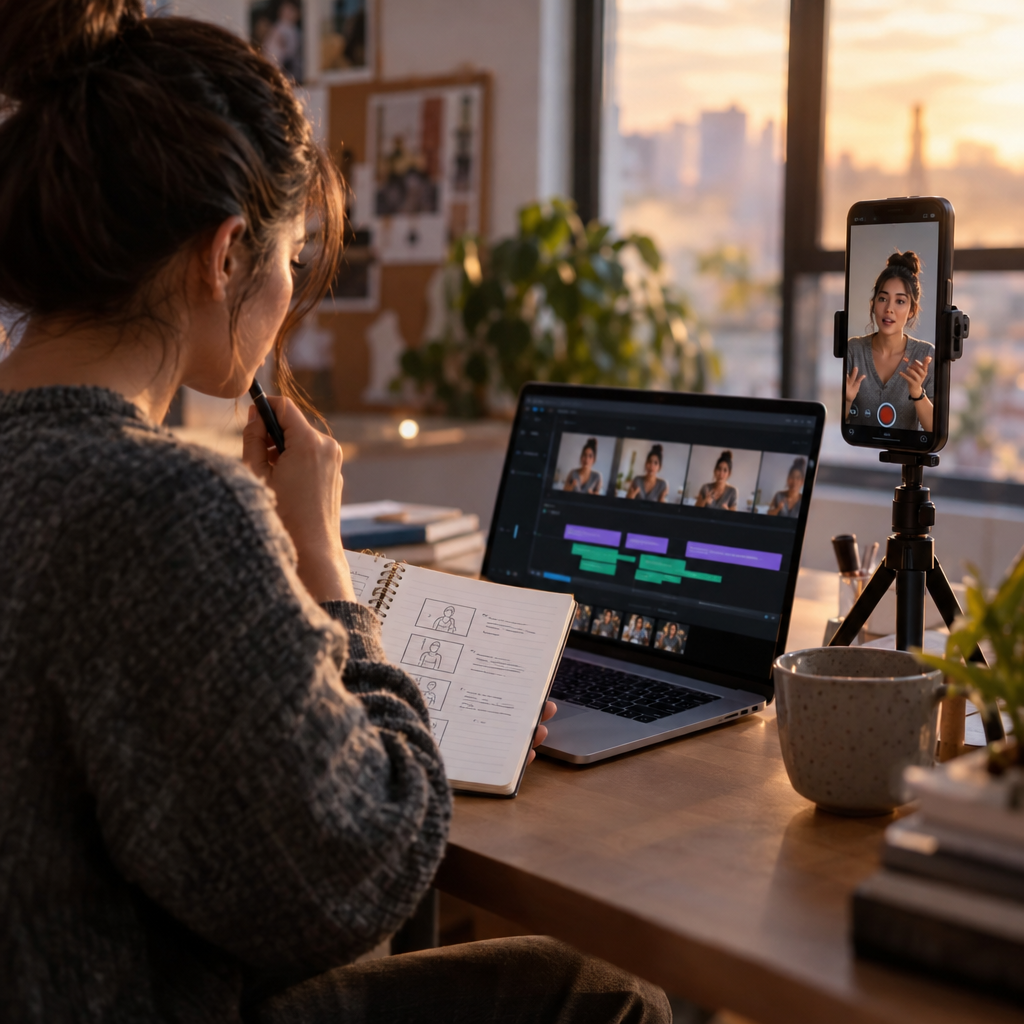
Eighty-five percent of social video gets watched with the sound off. That single number should reshape how every brand briefs a creator, scripts a hook, and edits a timeline. Yet most vertical video campaigns still treat captions as an afterthought, a compliance checkbox for accessibility rather than the primary storytelling layer. Sound off vertical video is not a format trend. It is the default viewing condition for most of your audience, and your creative needs to be built for it from frame one.
Why Silent Scrolling Became the Norm
Think about where people actually watch Reels, TikToks, and Shorts: in waiting rooms, open offices, transit, bed next to a sleeping partner. Sound isn’t just inconvenient in these contexts, it’s socially risky. Platforms know this. Meta’s business tools and TikTok’s ad platform both default to muted autoplay, which means your first two seconds of sound mean nothing until the viewer opts in. If your hook lives in a voiceover or a sound effect, it’s invisible to the majority of your reach.
This isn’t new information for media buyers. It’s old information that most creative teams still ignore. Scripts get written like radio spots, briefs get handed to creators with “say this in the first three seconds,” and then the brand wonders why watch time craters at the two second mark.
If your hook only works with sound on, you’ve built a campaign for the minority of your audience and hoped the majority would turn their volume up for you. They won’t.
What Caption Driven Formats Actually Look Like
Caption driven doesn’t mean slapping auto-generated subtitles on a talking head video and calling it done. It means the text is designed as the primary narrative device, with visuals supporting rather than leading. Formats worth studying:
- On-screen text hooks: Bold, punchy statement appears before any audio cue matters, often paired with a visual pattern interrupt.
- Caption-as-dialogue: Creator mouths words or reacts silently while text carries the actual message, common in comedic and reaction content.
- Progressive text reveal: Key information unspools across the clip in timed bursts, rewarding continued watching the way a good headline rewards continued reading.
- Subtitle-burned demos: Product walkthroughs where every spoken instruction is also burned into the frame, useful for tutorial and unboxing content.
This approach overlaps heavily with what we covered in silent first video ad scripting, where the core principle is the same: write for the eye before you write for the ear.
The ROI Case Brands Keep Missing
Here’s the uncomfortable math. If 85% of impressions are silent and your creative only performs with sound, you’re paying full CPM for an audience that can’t receive your message. That’s not a creative problem, it’s a budget leak. Agencies running performance creative at scale have found that adding strategic, legible captions lifts completion rates and, in paid environments, lowers cost per result because the algorithm rewards watch time.
HubSpot’s content marketing research and Sprout Social’s platform data both point to the same pattern: content optimized for accessibility (captions, alt text, legible contrast) consistently outperforms content that isn’t, independent of production budget. That’s a gift for lean teams. You don’t need a bigger budget to fix this, you need a better default.
There’s also a compliance angle worth flagging to legal and brand safety teams. Caption accuracy matters for FTC disclosure requirements when claims are made in video, since a muted viewer needs to see the disclosure, not just hear it. Review the FTC’s endorsement guidance if your creators make product claims on screen, because a disclosure buried in audio-only narration doesn’t satisfy “clear and conspicuous” when most viewers never hear it.
Scripting for the Eye First
Writing a caption driven script is a different skill than writing a voiceover script. The text has to do three jobs simultaneously: hook, explain, and pace the edit. A few operating rules that hold up across categories:
- Front-load the payoff word. “This fixed my skin in a week” beats “I want to tell you about something that fixed my skin.”
- Cap line length at six to eight words. Vertical screens are narrow, and dense text blocks get skipped, not read.
- Sync text timing to the cut, not the voice. If a creator talks faster than the caption can display cleanly, trim the line, don’t shrink the font.
- Use contrast, not just size. A white caption on a bright background disappears. Test against your actual B-roll, not a mockup.
Teams that already run vertical first creative briefs have an advantage here, because the aspect ratio and caption placement decisions get made before the shoot, not patched in post.
A Quick Framework: Hook, Hold, Handoff
Borrow this structure for any sound off vertical video script:
- Hook (0 to 2 seconds): A text statement or question so bold it reads like a headline, not a sentence.
- Hold (2 to 10 seconds): Progressive captions deliver the proof point, demo, or payoff, synced to visual beats.
- Handoff (final 2 to 3 seconds): A text-based CTA that doesn’t rely on a spoken “link in bio” line nobody heard.
This mirrors the discipline found in resolution reaction video scripting, where the hook has to land before any audio context is established.
Where Teams Get It Wrong
A few recurring failure modes, worth flagging in your next creator brief:
- Auto-caption laziness. Platform-generated captions are a baseline, not a finished product. Typos, misread brand names, and awkward line breaks read as low effort and hurt trust.
- Caption clutter. Burning in captions plus platform UI (likes, comments, sound sticker) plus a logo watermark creates visual noise that buries the message.
- Ignoring safe zones. Each platform reserves screen space for its own UI. A caption placed too low or too high gets clipped on certain devices.
- Treating captions as translation only. If the spoken script and the caption say the exact same thing word for word, you’re wasting the caption’s potential to carry extra context, humor, or urgency that audio alone can’t convey.
For global or multi-market campaigns, caption strategy gets more complex fast. Localizing text across markets without re-shooting is its own discipline, covered well in modular UGC asset planning, where the same visual asset carries different caption layers per region.
Testing and Measuring What Actually Works
Don’t guess. Run sound off and sound on variants of the same concept and compare completion rate, not just view count. eMarketer’s social video research has tracked completion rate as an increasingly reliable proxy for message retention, especially as platforms shift ranking signals toward watch time over raw engagement.
A simple test protocol:
- Produce one hero asset with two caption treatments: minimal (platform auto-captions, lightly cleaned) and maximal (full on-screen text script carrying the narrative).
- Run both as dark posts to a matched audience segment for 48 to 72 hours.
- Compare three second view rate, completion rate, and cost per click or conversion.
- Scale the winner, then iterate the hook line specifically, since that’s usually where the biggest lift lives.
If you’re tight on production time, pair this testing approach with one page creator briefs that specify caption requirements up front, so you’re not retrofitting text onto footage that wasn’t shot with caption space in mind.
FAQs
Frequently Asked Questions
What is sound off vertical video?
Sound off vertical video refers to short form, mobile first video content designed to communicate its full message without audio, relying on on-screen text, captions, and visual pacing to carry the hook and the payoff since most viewers watch with sound muted.
Why do most people watch social video with the sound off?
Viewing happens in public or shared spaces where audio is impractical or socially awkward, and platforms default to muted autoplay, which trains viewing habits over time and makes silent scrolling the norm rather than the exception.
Do auto-generated captions work for caption driven formats?
Auto-generated captions are a reasonable starting point but should always be reviewed and cleaned for accuracy, pacing, and brand name spelling before publishing, since unedited auto-captions often misread words and undermine credibility.
How long should on-screen text appear before it’s replaced?
A general rule is enough time for an average reader to read the line twice, roughly two to three seconds per short caption line, adjusted based on line length and the complexity of the message.
Does caption driven content hurt accessibility or help it?
Well-designed caption driven content generally improves accessibility, since it benefits viewers who are deaf or hard of hearing, non-native speakers, and anyone watching in sound-restricted environments, making it a rare case where good creative and good accessibility align.
Should brands still include voiceover if most viewers watch muted?
Yes, voiceover still matters for the audience that does enable sound and for platform algorithms that factor in audio engagement signals, but the script should never depend on audio alone to deliver the core message.
Start your next vertical video brief by writing the on-screen caption script first, then build voiceover and visuals around it. That single sequencing change forces every hook to survive the mute test before it ever reaches a timeline.
Frequently Asked Questions
What is sound off vertical video?
Sound off vertical video refers to short form, mobile first video content designed to communicate its full message without audio, relying on on-screen text, captions, and visual pacing to carry the hook and the payoff since most viewers watch with sound muted.
Why do most people watch social video with the sound off?
Viewing happens in public or shared spaces where audio is impractical or socially awkward, and platforms default to muted autoplay, which trains viewing habits over time and makes silent scrolling the norm rather than the exception.
Do auto-generated captions work for caption driven formats?
Auto-generated captions are a reasonable starting point but should always be reviewed and cleaned for accuracy, pacing, and brand name spelling before publishing, since unedited auto-captions often misread words and undermine credibility.
How long should on-screen text appear before it’s replaced?
A general rule is enough time for an average reader to read the line twice, roughly two to three seconds per short caption line, adjusted based on line length and the complexity of the message.
Does caption driven content hurt accessibility or help it?
Well-designed caption driven content generally improves accessibility, since it benefits viewers who are deaf or hard of hearing, non-native speakers, and anyone watching in sound-restricted environments, making it a rare case where good creative and good accessibility align.
Should brands still include voiceover if most viewers watch muted?
Yes, voiceover still matters for the audience that does enable sound and for platform algorithms that factor in audio engagement signals, but the script should never depend on audio alone to deliver the core message.
Top Influencer Marketing Agencies
The leading agencies shaping influencer marketing in 2026
Agencies ranked by campaign performance, client diversity, platform expertise, proven ROI, industry recognition, and client satisfaction. Assessed through verified case studies, reviews, and industry consultations.
Moburst

-
2

The Shelf
Boutique Beauty & Lifestyle Influencer AgencyA data-driven boutique agency specializing exclusively in beauty, wellness, and lifestyle influencer campaigns on Instagram and TikTok. Best for brands already focused on the beauty/personal care space that need curated, aesthetic-driven content.Clients: Pepsi, The Honest Company, Hims, Elf Cosmetics, Pure LeafVisit The Shelf → -
3

Audiencly
Niche Gaming & Esports Influencer AgencyA specialized agency focused exclusively on gaming and esports creators on YouTube, Twitch, and TikTok. Ideal if your campaign is 100% gaming-focused — from game launches to hardware and esports events.Clients: Epic Games, NordVPN, Ubisoft, Wargaming, Tencent GamesVisit Audiencly → -
4

Viral Nation
Global Influencer Marketing & Talent AgencyA dual talent management and marketing agency with proprietary brand safety tools and a global creator network spanning nano-influencers to celebrities across all major platforms.Clients: Meta, Activision Blizzard, Energizer, Aston Martin, WalmartVisit Viral Nation → -
5

The Influencer Marketing Factory
TikTok, Instagram & YouTube CampaignsA full-service agency with strong TikTok expertise, offering end-to-end campaign management from influencer discovery through performance reporting with a focus on platform-native content.Clients: Google, Snapchat, Universal Music, Bumble, YelpVisit TIMF → -
6

NeoReach
Enterprise Analytics & Influencer CampaignsAn enterprise-focused agency combining managed campaigns with a powerful self-service data platform for influencer search, audience analytics, and attribution modeling.Clients: Amazon, Airbnb, Netflix, Honda, The New York TimesVisit NeoReach → -
7

Ubiquitous
Creator-First Marketing PlatformA tech-driven platform combining self-service tools with managed campaign options, emphasizing speed and scalability for brands managing multiple influencer relationships.Clients: Lyft, Disney, Target, American Eagle, NetflixVisit Ubiquitous → -
8

Obviously
Scalable Enterprise Influencer CampaignsA tech-enabled agency built for high-volume campaigns, coordinating hundreds of creators simultaneously with end-to-end logistics, content rights management, and product seeding.Clients: Google, Ulta Beauty, Converse, AmazonVisit Obviously →