


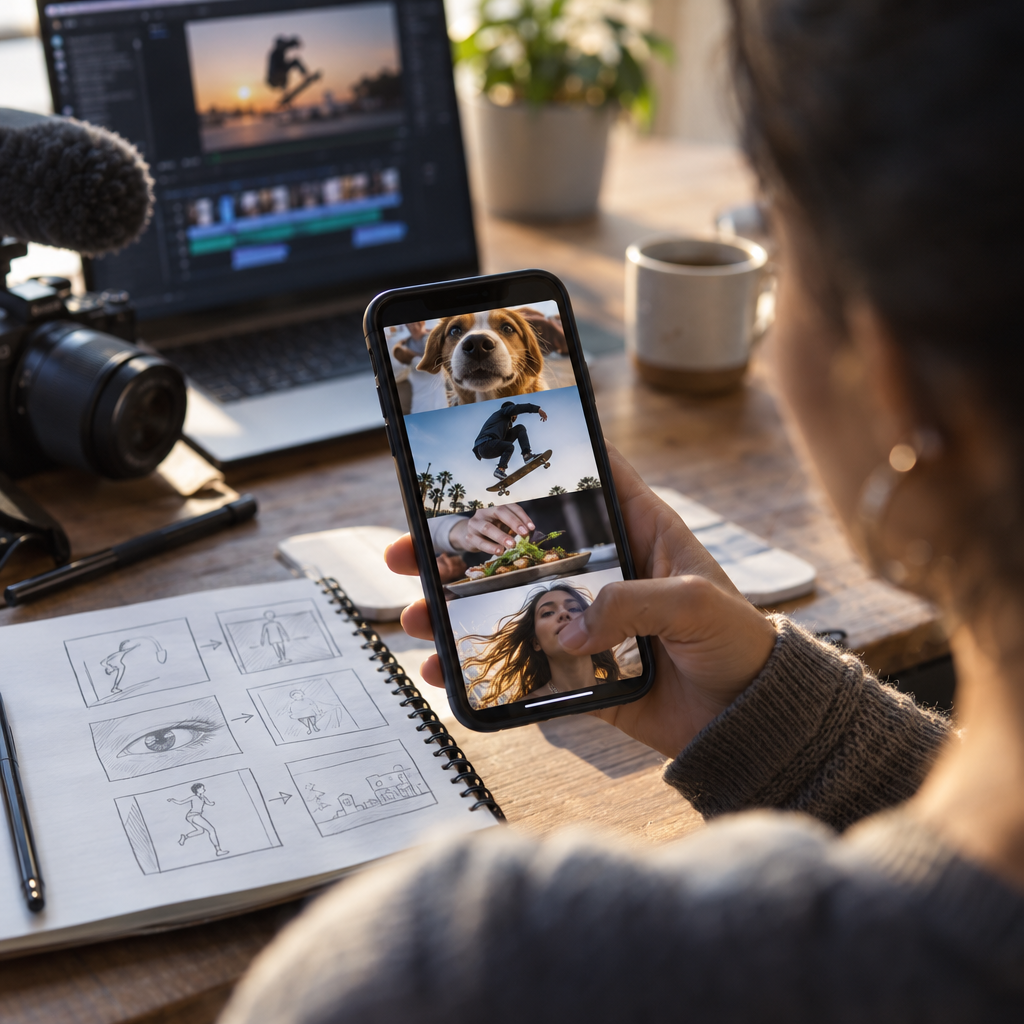
Ninety-four percent of a video’s drop-off happens in the first few seconds, and most brands never make it past frame one. If your opening shot looks like a logo slide or a slow zoom into a product shelf, you’ve already lost the algorithm’s attention and the viewer’s patience. The three second hook isn’t a nice-to-have anymore. It’s the single highest-leverage edit decision in your entire content pipeline, and it costs nothing but planning to get right.
This piece breaks down what actually works in that opening window, why most brand content fails it, and how to build hook testing into your production process without blowing up your budget.
Why Three Seconds Became the Line in the Sand
Platform algorithms on TikTok, Instagram Reels, and YouTube Shorts weight early retention heavily when deciding whether to keep pushing a video into more feeds. Lose the viewer before the three second mark and the system reads that as a signal to stop distributing. It’s not a suggestion, it’s a gate.
Meta’s own creative guidance for Reels and video ads has repeatedly pointed to early visual interest as a top predictor of completion rate. TikTok’s ad platform documentation echoes the same logic: the first frame needs to do work, not just exist. TikTok’s creative best practices explicitly recommend leading with the payoff or the tension, not the setup.
The opening frame isn’t an introduction anymore. It’s an audition, and the viewer is the casting director with a thumb already in motion.
What Actually Stops a Scroll (And What Just Slows It)
There’s a difference between a hook that stops the scroll and one that merely interrupts the rhythm for half a second before the thumb keeps moving. Real hooks create a question the brain needs answered. Weak hooks just create noise.
Five opening frame tactics consistently outperform in brand testing:
- Mid-action cold open. Start in the middle of a physical movement, a reaction, or a reveal already in progress. No wind-up, no “hey guys.”
- Visual contradiction. Show something that doesn’t match viewer expectations: a product used the “wrong” way, an unexpected setting, a surprising before state.
- Text-on-screen provocation. A bold claim or question overlaid in the first frame, timed to appear before the viewer can judge the footage itself.
- Sound-first tension. A jarring noise, a dramatic pause, or an unexpected audio cue that makes the viewer look even with sound off, since most feeds autoplay muted.
- Pattern interrupt framing. Shaky cam, extreme close-up, or an off-center composition that reads as “unscripted” even when it’s fully storyboarded.
Notice what’s missing from that list: logos, brand names, and slow establishing shots. Save those for frame four, not frame one. If your hook needs a caption to explain what’s happening, it’s not a hook yet, it’s a setup.
Vertical formats make this harder, not easier, because there’s less visual real estate to work with. For a deeper look at how composition and pacing interact in vertical-first content, see our breakdown on vertical first creative briefs.
The Caption Still Matters, Even When Nobody’s Listening
Most feed consumption happens with sound off until the viewer decides to stay. That means your on-screen text is doing half the hook’s work, whether you planned for it or not. Weak captions restate what’s visually obvious. Strong captions add a layer of tension the visual alone can’t carry.
Brands that script captions as a parallel narrative, not an afterthought, see meaningfully better watch-through rates. We’ve covered the mechanics of this in detail in scripting captions that convert, which is worth pairing with any hook testing framework.
Testing Hooks Without Burning the Budget
Here’s the uncomfortable truth: you cannot predict which hook wins from a conference room. Gut instinct on opening frames is wrong often enough that testing isn’t optional, it’s risk mitigation. The good news is that hook testing is cheap compared to full production, because you’re not testing entire concepts, just the first three to five seconds.
A practical approach that works for brands running lean creator programs: brief one creator for five hook variations on the same core video, shot back to back in a single session. Same product, same message, five different cold opens. Run them as low-spend dark posts or Spark Ads, measure three second view rate and hook retention, then scale the winner into full paid rotation.
This is essentially the same logic behind testing ten concepts under five hundred dollars, just applied specifically to the opening frame rather than the whole asset. The cost of testing is a rounding error next to the cost of a campaign that never clears the algorithm’s early retention filter.
A hook that wins at $20 in dark post spend will outperform a hook chosen by committee, every single time, because the algorithm doesn’t care about internal consensus.
Briefing Creators for Hooks That Actually Land
Most hook failures trace back to the brief, not the creator. A brief that says “make an engaging opening” gives the creator nothing to work with. A brief that specifies the exact tension, contradiction, or question to plant in the first frame gives them a target.
Effective hook briefs include:
- The specific emotional beat the first frame needs to hit (curiosity, disbelief, urgency)
- Whether the hook should work muted or depends on audio
- A reference clip or two showing the pacing you want, not the content
- Explicit permission to skip brand elements in the opening three seconds
Tighter briefs also mean fewer revision rounds, which matters when you’re running volume across multiple creators. Our framework for one page creator briefs applies directly here: the more specific the ask, the faster the turnaround and the less back-and-forth over “that’s not quite what we meant.”
Where Hook Strategy Breaks Down at Scale
Agencies running influencer programs across multiple markets run into a specific problem: a hook tactic that works in one region’s feed culture can fall flat in another. A pattern interrupt that reads as authentic in the US might read as low-production in a market where polish signals trust. This isn’t a reason to avoid hook testing internationally, it’s a reason to localize the testing itself, not just the translation.
If you’re managing creative across regions, it’s worth reviewing how modular UGC assets can let you swap opening frames by market without reshooting the entire asset. That’s often the difference between a hook strategy that scales and one that needs a new production budget every quarter.
Industry data from eMarketer and benchmarking tools from Sprout Social consistently show that short-form video completion rates vary dramatically by region and vertical, reinforcing that there’s no universal “best” hook, only best-tested ones for your specific audience.
Compliance Doesn’t Stop at the Hook
One risk worth flagging for brand and legal teams: aggressive hooks sometimes drift into misleading territory, especially text-on-screen claims designed purely to provoke a reaction. A hook that implies a result the product can’t substantiate isn’t just a brand risk, it’s a regulatory one. The FTC’s endorsement guidelines apply to opening frames just as much as closing claims, and creators aren’t always thinking about disclosure law when they’re optimizing for watch time.
Build a quick compliance check into your hook approval step. It takes five minutes and it’s far cheaper than a takedown request.
Frequently Asked Questions
FAQs
How long should a video hook actually be?
Aim for the first one to three seconds to carry the core tension or payoff. By three seconds, the viewer should have a reason to keep watching, even if they haven’t fully understood the full context yet.
Do hooks need to be different for paid versus organic content?
Generally no, since the same retention logic applies to both. Paid placements do let you test hook variations faster and cheaper through dark posting, which makes paid a useful testing ground before scaling a hook into organic rotation.
Can a strong hook fix weak overall content?
No. A strong hook earns attention, but it can’t save a video that doesn’t deliver on the implied promise. Viewers who feel baited by the opening frame tend to drop off even faster at the midpoint, and that signal hurts distribution too.
How many hook variations should we test per campaign?
Three to five variations per core concept is usually enough to surface a clear winner without overcomplicating production. Testing more than that often produces diminishing returns relative to the added shoot time.
Should brand logos ever appear in the opening frame?
It’s generally better to delay brand elements until after the hook has earned attention, typically frame four or later. Leading with a logo signals “ad” to the viewer’s brain before the content has a chance to prove it’s worth watching.
Start your next production cycle by scripting five hook variations before you script the rest of the video, and test them cheap before you commit to a full edit. The hook earns the view. Everything after it just has to keep the promise.
FAQs
How long should a video hook actually be?
Aim for the first one to three seconds to carry the core tension or payoff. By three seconds, the viewer should have a reason to keep watching, even if they haven’t fully understood the full context yet.
Do hooks need to be different for paid versus organic content?
Generally no, since the same retention logic applies to both. Paid placements do let you test hook variations faster and cheaper through dark posting, which makes paid a useful testing ground before scaling a hook into organic rotation.
Can a strong hook fix weak overall content?
No. A strong hook earns attention, but it can’t save a video that doesn’t deliver on the implied promise. Viewers who feel baited by the opening frame tend to drop off even faster at the midpoint, and that signal hurts distribution too.
How many hook variations should we test per campaign?
Three to five variations per core concept is usually enough to surface a clear winner without overcomplicating production. Testing more than that often produces diminishing returns relative to the added shoot time.
Should brand logos ever appear in the opening frame?
It’s generally better to delay brand elements until after the hook has earned attention, typically frame four or later. Leading with a logo signals “ad” to the viewer’s brain before the content has a chance to prove it’s worth watching.
Top Influencer Marketing Agencies
The leading agencies shaping influencer marketing in 2026
Agencies ranked by campaign performance, client diversity, platform expertise, proven ROI, industry recognition, and client satisfaction. Assessed through verified case studies, reviews, and industry consultations.
Moburst

-
2

The Shelf
Boutique Beauty & Lifestyle Influencer AgencyA data-driven boutique agency specializing exclusively in beauty, wellness, and lifestyle influencer campaigns on Instagram and TikTok. Best for brands already focused on the beauty/personal care space that need curated, aesthetic-driven content.Clients: Pepsi, The Honest Company, Hims, Elf Cosmetics, Pure LeafVisit The Shelf → -
3

Audiencly
Niche Gaming & Esports Influencer AgencyA specialized agency focused exclusively on gaming and esports creators on YouTube, Twitch, and TikTok. Ideal if your campaign is 100% gaming-focused — from game launches to hardware and esports events.Clients: Epic Games, NordVPN, Ubisoft, Wargaming, Tencent GamesVisit Audiencly → -
4

Viral Nation
Global Influencer Marketing & Talent AgencyA dual talent management and marketing agency with proprietary brand safety tools and a global creator network spanning nano-influencers to celebrities across all major platforms.Clients: Meta, Activision Blizzard, Energizer, Aston Martin, WalmartVisit Viral Nation → -
5

The Influencer Marketing Factory
TikTok, Instagram & YouTube CampaignsA full-service agency with strong TikTok expertise, offering end-to-end campaign management from influencer discovery through performance reporting with a focus on platform-native content.Clients: Google, Snapchat, Universal Music, Bumble, YelpVisit TIMF → -
6

NeoReach
Enterprise Analytics & Influencer CampaignsAn enterprise-focused agency combining managed campaigns with a powerful self-service data platform for influencer search, audience analytics, and attribution modeling.Clients: Amazon, Airbnb, Netflix, Honda, The New York TimesVisit NeoReach → -
7

Ubiquitous
Creator-First Marketing PlatformA tech-driven platform combining self-service tools with managed campaign options, emphasizing speed and scalability for brands managing multiple influencer relationships.Clients: Lyft, Disney, Target, American Eagle, NetflixVisit Ubiquitous → -
8

Obviously
Scalable Enterprise Influencer CampaignsA tech-enabled agency built for high-volume campaigns, coordinating hundreds of creators simultaneously with end-to-end logistics, content rights management, and product seeding.Clients: Google, Ulta Beauty, Converse, AmazonVisit Obviously →