


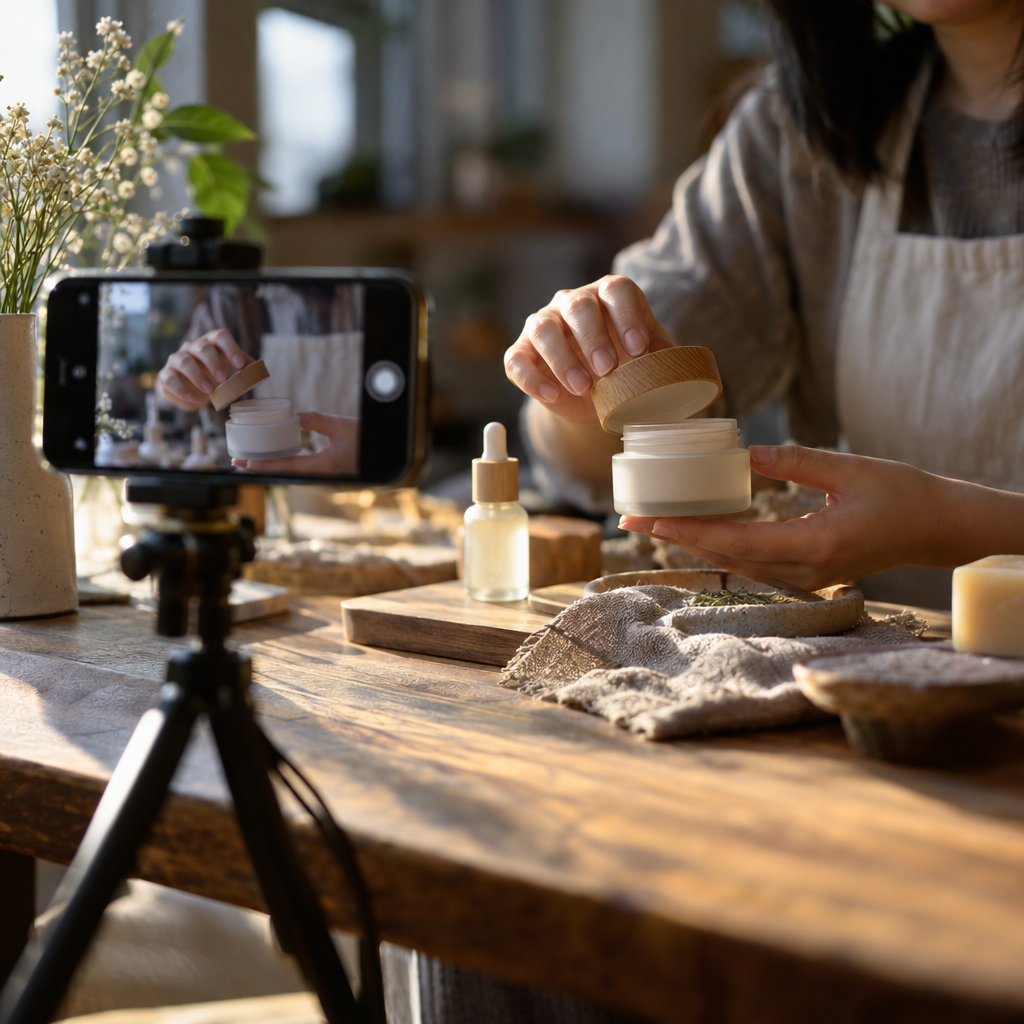
A growing share of top-performing product videos on TikTok and Instagram now have zero spoken dialogue, just hands, text overlays, and ambient sound. Scroll through any “what’s in my bag” or skincare shelfie trend and you’ll notice it: no narration, no talking head, just quiet competence. The silent vlog trend isn’t a gimmick. It’s converting better than voiceover-heavy content for a growing list of brands, and the reasons come down to trust, accessibility, and sheer scroll behavior.
What Is a Silent Vlog, Exactly?
Silent vlogs are exactly what they sound like: first-person or over-the-shoulder video content with no voiceover and often no music vocals, just ambient noise (the click of a cap, the swish of a brush, the rustle of packaging) paired with on-screen text. Think ASMR’s quieter, more commercial cousin. The creator doesn’t explain the product. They just use it, slowly and deliberately, while captions do the selling.
This isn’t new behavior exactly. Beauty creators have used silent “get ready with me” formats for years. What’s changed is the scale and the intentionality. Brands are now briefing for silence, not defaulting to it because a creator forgot to record VO.
Why It Converts: The Psychology Behind the Quiet
Three things are happening simultaneously when a viewer watches a silent product video, and all three nudge toward conversion.
- Reduced cognitive load. No voice means no need to process speech while also reading captions or watching product demonstration. The viewer’s attention goes entirely to the visual proof.
- Implied confidence. A product that doesn’t need a hard sell pitch feels more credible. The format itself signals “this speaks for itself,” which is a subtle but powerful trust cue.
- Frictionless consumption anywhere. Silent content works on mute in a waiting room, on a commute, in a meeting. It doesn’t ask permission to be watched. That alone expands the viewable audience dramatically.
This is close cousin territory to what we covered in silent-first video ads, where captions do the heavy lifting instead of a voiceover track. The silent vlog trend takes that same mute-first logic and applies it to long-form, slower-paced product content rather than punchy ad creative.
Social platforms report that the overwhelming majority of mobile video is watched with sound off by default, which means your “voiceover strategy” might be silently failing before a single word lands.
The Data Point Brands Keep Ignoring
According to research widely cited by Sprout Social, a majority of short-form video consumption happens with sound muted, particularly in public or work settings. Meta’s own advertiser guidance has pushed captioning and visual storytelling for years precisely because of this behavior. If your product video relies on narration to land the value proposition, you’re losing a meaningful chunk of your audience before the message even registers.
Silent vlogs sidestep this entirely. There’s nothing to miss. The product demonstration, the texture, the before-and-after, it’s all visual. Captions supplement rather than carry the message, which means the content performs identically whether sound is on or off.
What Makes a Silent Vlog Actually Work (Not Just Quiet)
Stripping out dialogue doesn’t automatically make a video good. Plenty of silent content flops because it mistakes “no talking” for “no structure.” The ones that convert follow a tight, if unspoken, formula.
- A hook in the first beat. Even without words, the first second or two needs to earn attention, a surprising texture, a satisfying unboxing moment, an unexpected result. This is the same principle covered in three second video hooks, just executed visually instead of verbally.
- Deliberate pacing. Silent vlogs tend to move slower than voiceover content. The absence of narration gives the viewer permission to actually look at the product, so cuts are longer and movements are more intentional.
- Caption scaffolding, not caption overload. The best silent vlogs use sparse, well-timed text, a product name here, a price point there, maybe a one-word reaction (“obsessed”). This mirrors the discipline we outlined in sound off vertical video scripting, where captions carry narrative weight without cluttering the frame.
- ASMR-adjacent sound design. Ambient product sounds (the snap of a compact, the pour of a serum) aren’t filler. They’re doing emotional work that silence alone can’t, adding a sensory layer that feels tactile and real.
Where Silent Vlogs Outperform Talking Head Content
Not every category benefits equally. Silent product content tends to overperform in verticals where the visual demonstration is inherently satisfying: beauty, skincare, home organization, cooking, unboxing, and fashion try-ons. These are categories where watching is the point. Nobody needs a voiceover to explain why a satisfying drawer organization reveal is compelling.
It performs less well for complex B2B products, software demos, or anything requiring verbal context to understand value. If your product’s benefit isn’t visually self-evident, silence can actually hurt comprehension rather than help it. Know your category before you brief a silent format.
Operational Upside: Why Brands Should Care Beyond Engagement
Here’s the part that should interest anyone managing a creator budget: silent vlogs are cheaper and faster to produce at scale.
No voiceover means no script approval cycles for dialogue, no re-recording when a creator flubs a line, and no translation headaches when you’re running the same creative across markets. A silent vlog with text overlays can be localized by swapping captions, nothing else. That’s a direct line to the efficiency gains we detailed in localized UGC frameworks, where avoiding reshoots is the whole game.
It also simplifies legal and compliance review. Voiceover claims are where most FTC scrutiny lands, because spoken claims (“this cleared my skin in three days”) are easy to flag and hard to walk back. Silent, visually-driven content with minimal on-screen text carries lower disclosure risk, though it doesn’t eliminate the need for proper FTC disclosure guidance on sponsorship and material connections. Less spoken claim density generally means a cleaner compliance review, not a free pass.
Cutting voiceover from your creator briefs can shrink production timelines and review cycles simultaneously, because there’s simply less to approve, translate, and fact-check.
Briefing Creators for Silence Without Making It Feel Awkward
The biggest mistake brands make when briefing silent content is over-directing it. Creators who are used to talking through a product suddenly feel self-conscious filming quietly, and it shows, stiff movements, unnatural pacing, obvious performance for camera.
The fix is giving creators a structural brief rather than a scripted one. Tell them the beats (unboxing moment, first use, texture close-up, result reveal) and let them fill in the physical performance naturally. This is the same lean-brief philosophy behind one page creator briefs: less prescriptive language, more creative latitude within a clear framework.
Also worth testing: silent and voiceover versions of the same core content as an A/B split. You’ll often find the silent cut gets more saves and shares, while the voiceover version drives slightly higher comment engagement because viewers respond to the personality. Different KPIs, different formats. Know which one you’re optimizing for before you brief.
Measuring Success: What to Actually Track
Standard view counts won’t tell you if silent vlogs are working. Watch for these signals instead:
- Average watch time versus video length. Silent content that’s paced well tends to hold viewers longer because there’s no filler chatter to skip past.
- Save and share rate. Silent, aesthetically satisfying content gets bookmarked for later reference far more than talking content, particularly in beauty and home categories.
- Sound-on versus sound-off completion rates, where platform data allows it. If completion rates barely shift between the two, your silent format is doing its job.
- Click-through on product tags, especially if you’re running shoppable formats. Combine silent pacing with tappable product tags using the structure in shoppable vertical video tagging to close the loop between watching and buying.
If you’re seeing strong watch time and save rates but soft click-through, the issue usually isn’t the silence, it’s a missing or buried CTA. Silent doesn’t mean passive. You still need a clear visual or text prompt telling the viewer what to do next.
A Quick Reality Check
Silent vlogs aren’t a replacement for every format in your content mix. They’re a specific tool for specific jobs: building trust through demonstration, reaching sound-off audiences, and producing scalable, low-friction creative across markets. Pair them with other formats, hook-driven voiceover content, creator storytelling, documentary-style brand pieces, and you get a portfolio that covers both the browse state and the consideration state of the funnel.
What’s clear from the data piling up across Meta’s advertiser resources and platform-level engagement reports from eMarketer is that attention is getting harder to earn with noise. Quiet, confident product content is filling that gap, and it’s doing it at a lower production cost than most teams expect.
FAQs
Frequently Asked Questions
What is the silent vlog trend in influencer marketing?
It refers to product content filmed with no spoken dialogue or voiceover, relying instead on ambient sound, visual demonstration, and text captions to communicate the message. It’s commonly used in beauty, home, and unboxing content.
Why does silent product content convert better than voiceover content?
Most short-form video is watched on mute, so silent formats remove friction entirely. They also reduce cognitive load on the viewer and often signal product confidence, since nothing needs to be explained verbally.
Does silent content work for every product category?
No. It performs best when the product benefit is visually obvious, like skincare texture or home organization. Complex products that require explanation, such as software or technical tools, generally need some verbal or written context to land.
How do brands brief creators for silent vlog content?
The most effective approach is a structural brief that outlines key beats (unboxing, first use, result) without scripting dialogue. This lets creators move naturally instead of performing silence, which tends to look stiff on camera.
Are silent vlogs cheaper to produce than voiceover content?
Generally yes. There’s no voiceover recording, no script approval for spoken lines, and localization only requires swapping on-screen captions rather than re-recording or dubbing audio.
What metrics should brands track for silent vlog performance?
Watch time relative to video length, save and share rates, and click-through on product tags matter more than raw views. Comparing sound-on and sound-off completion rates, where available, also helps confirm the format is working as intended.
If your next creator brief still opens with “VO script attached,” try cutting it. Swap narration for structure, let the product do the talking, and measure saves before you measure views.
Top Influencer Marketing Agencies
The leading agencies shaping influencer marketing in 2026
Agencies ranked by campaign performance, client diversity, platform expertise, proven ROI, industry recognition, and client satisfaction. Assessed through verified case studies, reviews, and industry consultations.
Moburst

-
2

The Shelf
Boutique Beauty & Lifestyle Influencer AgencyA data-driven boutique agency specializing exclusively in beauty, wellness, and lifestyle influencer campaigns on Instagram and TikTok. Best for brands already focused on the beauty/personal care space that need curated, aesthetic-driven content.Clients: Pepsi, The Honest Company, Hims, Elf Cosmetics, Pure LeafVisit The Shelf → -
3

Audiencly
Niche Gaming & Esports Influencer AgencyA specialized agency focused exclusively on gaming and esports creators on YouTube, Twitch, and TikTok. Ideal if your campaign is 100% gaming-focused — from game launches to hardware and esports events.Clients: Epic Games, NordVPN, Ubisoft, Wargaming, Tencent GamesVisit Audiencly → -
4

Viral Nation
Global Influencer Marketing & Talent AgencyA dual talent management and marketing agency with proprietary brand safety tools and a global creator network spanning nano-influencers to celebrities across all major platforms.Clients: Meta, Activision Blizzard, Energizer, Aston Martin, WalmartVisit Viral Nation → -
5

The Influencer Marketing Factory
TikTok, Instagram & YouTube CampaignsA full-service agency with strong TikTok expertise, offering end-to-end campaign management from influencer discovery through performance reporting with a focus on platform-native content.Clients: Google, Snapchat, Universal Music, Bumble, YelpVisit TIMF → -
6

NeoReach
Enterprise Analytics & Influencer CampaignsAn enterprise-focused agency combining managed campaigns with a powerful self-service data platform for influencer search, audience analytics, and attribution modeling.Clients: Amazon, Airbnb, Netflix, Honda, The New York TimesVisit NeoReach → -
7

Ubiquitous
Creator-First Marketing PlatformA tech-driven platform combining self-service tools with managed campaign options, emphasizing speed and scalability for brands managing multiple influencer relationships.Clients: Lyft, Disney, Target, American Eagle, NetflixVisit Ubiquitous → -
8

Obviously
Scalable Enterprise Influencer CampaignsA tech-enabled agency built for high-volume campaigns, coordinating hundreds of creators simultaneously with end-to-end logistics, content rights management, and product seeding.Clients: Google, Ulta Beauty, Converse, AmazonVisit Obviously →