


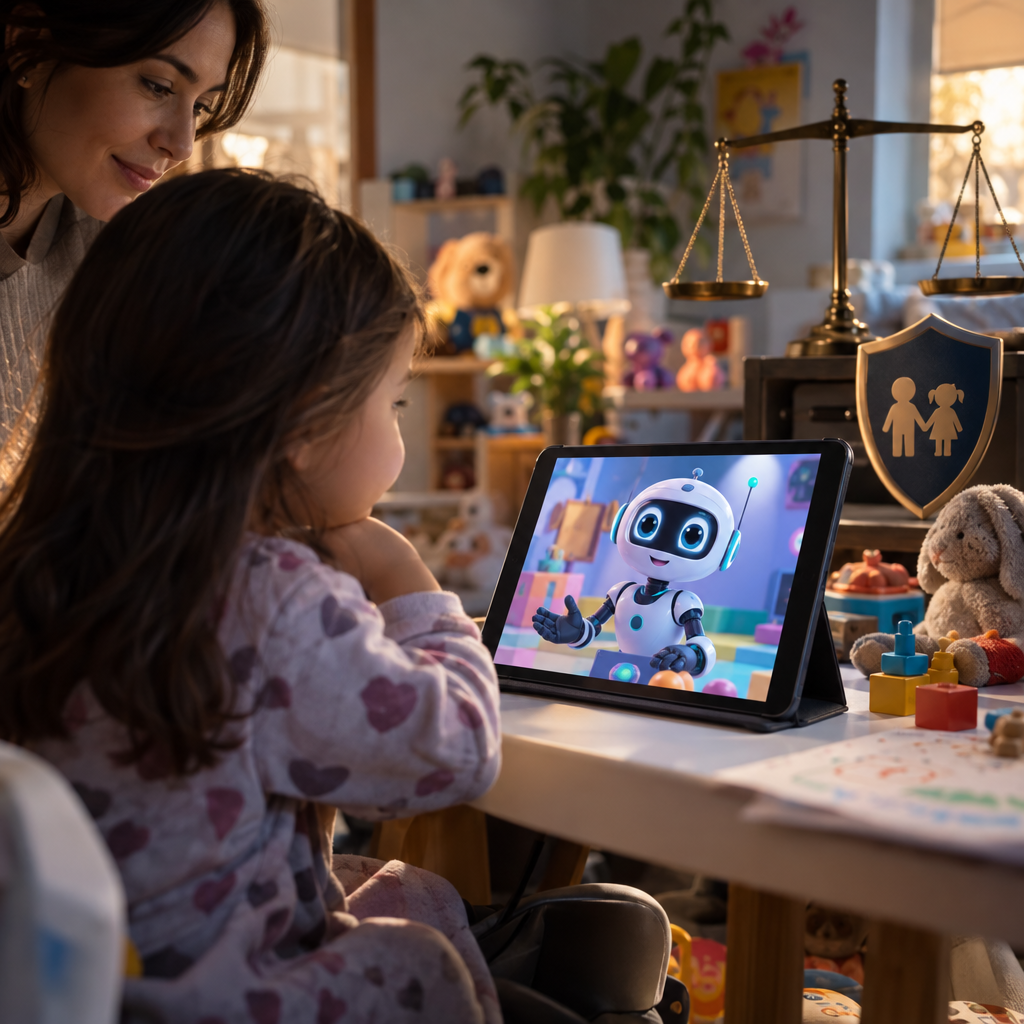
Roughly 40% of YouTube’s most-watched kids’ channels now use AI-generated voiceovers, thumbnails, or scripts, according to creator economy trackers. That number should make every brand marketing team nervous. The FTC’s updated guidance folds AI-made content squarely into existing child privacy rules, and “the bot wrote it” is not a defense anyone wants to test in an enforcement action.
The Rule Change Nobody Budgeted For
COPPA (the Children’s Online Privacy Protection Act) was written in 1998 for websites with cookie trackers, not for generative AI tools that can spin up a children’s character, voice clone a narrator, and personalize a video thumbnail in under a minute. The FTC closed that gap. Its updated interpretation now treats AI-generated content directed at children the same way it treats human-produced content: if it collects data from or targets users under 13, COPPA applies, full stop.
That means the AI vendor, the agency, and the brand funding the campaign all sit inside the compliance perimeter. There’s no carve-out for “the model generated it automatically.” Regulators have made clear that automation doesn’t dilute liability, it just adds another party to the chain of responsibility.
If your content targets kids and an algorithm touched any part of the production pipeline, you now have two compliance checklists to run instead of one: child privacy and AI disclosure.
Why Brands Carry More Risk Than Creators Here
Creators get the headlines when a kids’ channel gets flagged. But the FTC’s enforcement pattern (see its ongoing COPPA actions) consistently names the brand or advertiser as a co-respondent when sponsored content is involved. Why? Because brands typically hold the budget, the creative brief, and the final approval. Regulators follow the money.
If your agency used an AI video tool to localize a toy commercial into five languages, and that tool pulled viewer data to personalize delivery, your brand is exposed even if you never touched the software yourself. This is the same liability logic covered in our breakdown of child influencer trust laws: the brand’s name on the invoice is the brand’s name on the compliance file.
And unlike adult-targeted content, there’s no “reasonable person” wiggle room. COPPA uses an actual knowledge standard plus a “directed to children” test based on subject matter, visual style, and audience data. AI doesn’t get you out of either test.
What Counts as “Made for Kids” When a Machine Is Involved?
This is where most marketing teams get tripped up. The FTC doesn’t care whether a human or an AI model generated the asset. It cares about three things:
- Audience targeting signals. Did the AI tool use age, interest, or behavioral data that skews under-13?
- Content characteristics. Bright colors, cartoon characters, simplified language, toy or game subject matter all trigger the “directed to children” presumption, regardless of who or what created it.
- Data collection during generation. Many AI personalization tools scrape viewing history or device data to tailor outputs. If that data comes from a child-facing property, COPPA’s parental consent requirements kick in immediately.
Worth noting: this overlaps heavily with the broader AI disclosure landscape we’ve tracked in AI content labeling rules. A kids’ campaign using synthetic voiceover now needs both an AI disclosure label and COPPA-compliant data handling. Miss either one and you’ve got a two-front compliance problem.
The Patchwork Problem Just Got Messier
Federal rules are only half the picture. States have been racing ahead with their own child safety and AI provisions, and they don’t always align with FTC guidance. California’s kids’ privacy provisions, for instance, layer additional design requirements on top of COPPA. Add the general state-level AI marketing rules we covered in this state AI rules breakdown, and brands running national campaigns are now reconciling federal, state, and platform policies simultaneously.
This mirrors the broader fragmentation documented in our state privacy patchwork analysis. Compliance teams that built their playbook around CCPA alone are going to find serious gaps the moment AI and children’s content intersect.
A Practical Compliance Check Before Your Next Campaign
Here’s the audit sequence we’d recommend running before any AI tool touches content aimed at a kids’ or family audience:
- Map the AI tools in your production chain. Script generation, voice cloning, thumbnail creation, dubbing, personalization engines: each one is a potential data collection point.
- Confirm the vendor’s COPPA posture. Ask directly whether their tool collects, stores, or processes data from users under 13, and get it in writing.
- Check audience targeting parameters. If your media buy includes interest categories or lookalike audiences skewing young, flag it for legal review regardless of the content’s intended demo.
- Document AI involvement at every stage. This is where having a structured record matters. Our piece on AI approval audit trails covers how to build the sign-off documentation regulators expect to see.
- Verify disclosure labeling matches both AI and advertising rules. A sponsored post using an AI-generated kids’ character needs ad disclosure and AI-generation labeling, not one or the other.
Run this checklist like a pre-flight list, not a one-time audit. AI tools update their data handling practices constantly, and a vendor that was COPPA-compliant last quarter might have shipped a new personalization feature that changes the calculus entirely.
Where Brands Keep Getting This Wrong
Three recurring mistakes show up across the campaigns we’ve reviewed:
- Treating AI tools as “internal” and exempt from vendor vetting. If the tool touches data or generates audience-facing content, it needs the same scrutiny as any outside production partner. See our analysis of AI video vendor vetting gaps for the standard vetting framework.
- Assuming influencer-side disclosure covers the brand. It doesn’t. Brand liability and creator liability are separate tracks, and relying on a creator’s disclosure language to satisfy your own compliance obligations is a documented enforcement weakness.
- Skipping the data trail on personalization features. Marketing teams love AI personalization for lift metrics. Legal teams need to know exactly what data powers that lift, especially when the audience skews young.
According to industry data tracked by eMarketer, family and kids’ content categories are among the fastest adopters of AI production tools, precisely because budgets are tight and output demands are high. That adoption curve is exactly why regulators moved now rather than waiting for a high-profile incident.
For a sense of how enforcement actually plays out, the FTC’s own COPPA enforcement resources are worth bookmarking, and UK-facing brands should cross-reference guidance from the Information Commissioner’s Office, which has its own age-appropriate design code running in parallel.
What This Means for Contracts and Agency Briefs
If your agency agreements don’t currently specify which party bears liability for AI-tool data practices in kids’-adjacent content, that’s a gap to close this quarter. This is the same contract-tightening trend we’ve seen across other compliance areas, including the shift documented in data transparency rules rewriting contracts. Expect child privacy clauses to become standard in any brief involving family, education, gaming, or toy categories, whether or not a human creator is attached to the content.
Brand legal teams should also loop in procurement. AI tool licensing agreements rarely spell out COPPA compliance in plain terms, and a generic SaaS contract won’t cut it when children’s data is in scope.
Next step: pull your current AI production stack, run it against the five-point checklist above, and get written COPPA confirmation from every vendor touching kids’-adjacent content before your next campaign goes live. Waiting for an FTC inquiry to find the gap is the one compliance strategy nobody can afford.
FAQs
Does COPPA apply to AI-generated content even if no human reviewed it before publishing?
Yes. The FTC’s updated guidance makes clear that liability attaches based on the content’s audience and data practices, not on whether a human or an AI tool produced it. Unreviewed AI output aimed at children still triggers COPPA obligations.
Who is legally responsible when an AI vendor’s tool collects data from child viewers?
Responsibility typically extends to the brand, the agency, and the vendor. Regulators have shown a pattern of naming the party that funded or directed the campaign, so brands cannot assume vendor contracts alone shield them from liability.
How do I know if my content is “directed to children” under current rules?
The FTC looks at subject matter, visual style, use of child-oriented characters, language simplicity, and audience data. If several of these factors are present, the presumption shifts toward “directed to children” regardless of your intended target demo.
Does this apply only to kids’ YouTube or TikTok content, or does it cover broader marketing?
It covers any digital property, including branded apps, websites, email campaigns, and social content, where AI tools generate or personalize material likely to reach users under 13. Platform doesn’t limit the scope; audience and content characteristics do.
What’s the fastest way to audit current AI tools for COPPA exposure?
Start by mapping every AI tool touching production or personalization, request written data-handling disclosures from each vendor, and cross-reference against your audience targeting parameters. Document everything for an audit trail in case of regulatory inquiry.
Top Influencer Marketing Agencies
The leading agencies shaping influencer marketing in 2026
Agencies ranked by campaign performance, client diversity, platform expertise, proven ROI, industry recognition, and client satisfaction. Assessed through verified case studies, reviews, and industry consultations.
Moburst

-
2

The Shelf
Boutique Beauty & Lifestyle Influencer AgencyA data-driven boutique agency specializing exclusively in beauty, wellness, and lifestyle influencer campaigns on Instagram and TikTok. Best for brands already focused on the beauty/personal care space that need curated, aesthetic-driven content.Clients: Pepsi, The Honest Company, Hims, Elf Cosmetics, Pure LeafVisit The Shelf → -
3

Audiencly
Niche Gaming & Esports Influencer AgencyA specialized agency focused exclusively on gaming and esports creators on YouTube, Twitch, and TikTok. Ideal if your campaign is 100% gaming-focused — from game launches to hardware and esports events.Clients: Epic Games, NordVPN, Ubisoft, Wargaming, Tencent GamesVisit Audiencly → -
4

Viral Nation
Global Influencer Marketing & Talent AgencyA dual talent management and marketing agency with proprietary brand safety tools and a global creator network spanning nano-influencers to celebrities across all major platforms.Clients: Meta, Activision Blizzard, Energizer, Aston Martin, WalmartVisit Viral Nation → -
5

The Influencer Marketing Factory
TikTok, Instagram & YouTube CampaignsA full-service agency with strong TikTok expertise, offering end-to-end campaign management from influencer discovery through performance reporting with a focus on platform-native content.Clients: Google, Snapchat, Universal Music, Bumble, YelpVisit TIMF → -
6

NeoReach
Enterprise Analytics & Influencer CampaignsAn enterprise-focused agency combining managed campaigns with a powerful self-service data platform for influencer search, audience analytics, and attribution modeling.Clients: Amazon, Airbnb, Netflix, Honda, The New York TimesVisit NeoReach → -
7

Ubiquitous
Creator-First Marketing PlatformA tech-driven platform combining self-service tools with managed campaign options, emphasizing speed and scalability for brands managing multiple influencer relationships.Clients: Lyft, Disney, Target, American Eagle, NetflixVisit Ubiquitous → -
8

Obviously
Scalable Enterprise Influencer CampaignsA tech-enabled agency built for high-volume campaigns, coordinating hundreds of creators simultaneously with end-to-end logistics, content rights management, and product seeding.Clients: Google, Ulta Beauty, Converse, AmazonVisit Obviously →