


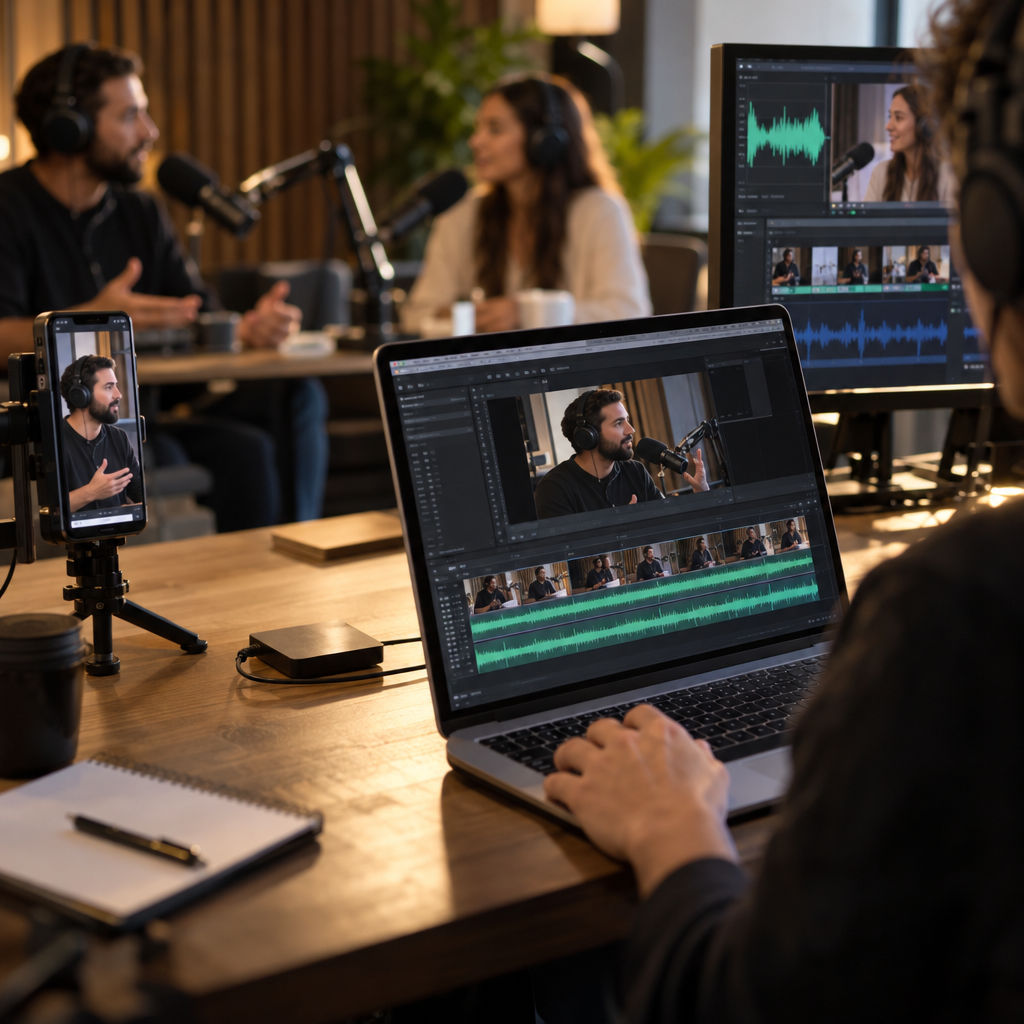
Podcasters release over four million episodes a year, and the average listener finishes maybe twenty minutes of a sixty minute conversation. The rest? Buried. Brands sitting on long form audio are sitting on unmined gold, and clipped podcast moments are how you dig it out. Done right, a single episode can feed a month of Shorts, Reels, and TikToks that actually convert, not just rack up passive views.
The problem is most clipping workflows are reactive. Someone skims a transcript, grabs whatever sounds funny, slaps a caption on it, and ships it. That approach fills a content calendar. It doesn’t build a pipeline. If you’re running influencer or branded podcast programs with real budget behind them, you need a scripting system, not a highlight reel habit.
Why Most Podcast Clips Die on Arrival
Here’s the uncomfortable truth: a great podcast moment and a great short form clip are not the same asset. A 40 minute conversation builds context slowly. The guest sets up a story, meanders, circles back, lands the punchline twelve minutes later. That pacing works when someone chose to listen for an hour. It fails in a feed where the average scroll decision happens in under two seconds, according to data cited by Sprout Social on short form video attention spans.
Most clipping tools, including AI ones, optimize for “interesting sounding” segments based on audio energy or sentiment spikes. That’s a start, not a strategy. A moment can be emotionally charged and still make zero sense without thirty seconds of setup that got cut. The result: clips that confuse new viewers and convert nobody.
A podcast clip without a scripted hook and payoff structure is just a shorter version of a long problem: it still asks the viewer to do the work of finding the point.
The Fix Is Treating Clips as Scripts, Not Extracts
Think of your podcast archive as raw footage, not finished content. The clip itself needs a script layer on top: a text overlay hook, a reframed opening line, maybe a jump cut that removes the throat clearing. This is the same discipline behind scripting the first three seconds in storytime formats. The podcast gave you the material. Your job is to re-author it for a feed that owes you nothing.
Building a Clip Scripting Framework That Actually Converts
Forget “find the best soundbite.” Build a repeatable structure you can apply to every episode, regardless of topic or guest. Here’s the four part framework we see working across B2B and DTC podcast programs right now:
- Cold open claim: Start mid sentence on the most provocative or counterintuitive statement in the segment. Skip the “so I was saying” wind up entirely.
- Text reinforced stakes: Add an on screen caption in the first two seconds that restates the claim in plain language, so sound off viewers (still the majority on mobile) get the hook instantly.
- Compressed proof: Cut ruthlessly. If the guest takes 90 seconds to make a point that fits in 25, cut it. Nobody is grading you on completeness.
- CTA or cliffhanger close: End on a question, a tease for the full episode, or a direct link in bio. A clip with no destination is a dead end dressed up as content.
This isn’t theoretical. It’s the same beat structure used in text thread storytelling formats that convert, just applied to spoken audio instead of screenshots.
Where to Find the Moments Worth Scripting
You don’t need to listen to every minute of every episode. You need a tagging system during recording or post production that flags segments by conversion potential, not just entertainment value. Categories worth tagging:
- Objection handling moments (guest addresses a doubt the audience likely holds)
- Specific numbers or results (dollar figures, percentages, timeframes always outperform vague claims)
- Disagreement or tension (two hosts or a host and guest pushing back on each other)
- Unscripted tangents that reveal personality (these build trust faster than polished talking points)
Transcription tools with speaker diarization make this tagging workflow dramatically faster than manual scrubbing. Run the raw transcript through a keyword flag pass first, then have a human producer confirm which flagged moments actually have standalone narrative shape. AI can find candidates. It still can’t reliably judge whether a 20 second clip will make sense to a stranger scrolling at 11pm.
The Founder and Guest Interview Overlap
If your podcast features founders or executives, you’re sitting on material that doubles as trust building content beyond the clip itself. The same instinct that drives founder story content that builds trust over ads applies here: audiences respond to unscripted candor more than polished pitch language. Mine for the moments where a guest stops sounding like they’re on a podcast and starts sounding like they’re talking to a friend.
Compliance Doesn’t Disappear Because the Clip Is Short
This is where a lot of brand teams get sloppy. If the original podcast episode included a sponsored segment, paid placement, or affiliate mention, that disclosure obligation travels with every clip pulled from it. A 15 second clip that strips out the “this episode is brought to you by” framing but keeps the product endorsement is a disclosure problem waiting to surface, and the FTC has made clear that context matters less than clarity: if a reasonable viewer wouldn’t know there’s a material connection, the clip is noncompliant regardless of what the full episode disclosed.
Build disclosure language into the clip template itself, not as an afterthought bolted on before publishing. This mirrors the guardrails covered in before and after disclosure compliance work, and it’s just as relevant for AI generated avatar recaps of episodes, a growing format worth scripting carefully, as outlined in AI avatar host disclosure practices.
If a clip can survive on its own as a standalone ad and the sponsor relationship isn’t obvious within the first five seconds, it needs a disclosure overlay. No exceptions, no “it was in the full episode” defense.
Measuring Clips Like Acquisition Assets, Not Social Proof
Views and likes tell you almost nothing about whether a clip is doing its job. What matters: watch time to completion, click through to the full episode or landing page, and downstream conversion if there’s a product or offer attached. Treat every clip like a funnel entry point, and score it accordingly.
A useful benchmark: if your clip’s three second retention rate falls below 70%, the hook failed before the content even had a chance. This is the exact diagnostic approach covered in thumb stop metrics for hook testing, and it applies just as directly to podcast clips as it does to native UGC. Don’t scale spend behind a clip format until you’ve validated the hook independent of the payoff.
Platforms like TikTok Ads Manager and Meta’s Meta Business Suite both expose retention curve data per clip, not just aggregate view counts. Pull that data weekly. If three consecutive clips from the same episode underperform on three second retention, the problem probably isn’t the podcast content. It’s your scripting layer.
One Episode, Multiple Native Cuts
The same raw segment should get re-scripted differently for each platform rather than reposted identically. A clip that opens with a bold claim text overlay for TikTok might need a question based hook for YouTube Shorts, where search intent behaves differently. This native adaptation principle is the same one behind cutting one script into three native edits to reduce production overhead while improving platform fit. Clipping isn’t copy paste. It’s re-authoring for context.
Building the Workflow Into Your Production Pipeline
The brands getting real ROI from podcast clipping aren’t treating it as a separate project after the episode drops. They’re scripting for clips during the recording itself, briefing hosts to occasionally restate key points in punchier, more quotable language, almost like planting soundbites on purpose. It feels unnatural at first. It saves enormous editing time later, and it mirrors the discipline behind turning one livestream into dozens of usable assets, where the source content is produced with downstream clipping already in mind.
Data from eMarketer shows short form video consumption continuing to outpace long form growth across nearly every demographic, which means the clip, not the full episode, is increasingly the first touchpoint a prospective listener or customer has with your brand. Treat that touchpoint with the same scripting rigor you’d apply to a paid ad, because functionally, that’s what it is.
Takeaway
Stop treating podcast clipping as a highlight reel exercise and start treating it as a scripting discipline with its own hook, payoff, and compliance checklist. Pick your next episode, tag three moments using the objection, proof, and tension categories above, and script each one as a standalone asset before you touch the editing timeline.
FAQs
How long should a clipped podcast moment be for short form platforms?
Most converting clips land between 15 and 45 seconds. Shorter clips tend to perform better for pure hook testing, while slightly longer ones work when the payoff requires more setup, such as a data point or a multi step explanation.
Do I need separate disclosure language for clips versus the full podcast episode?
Yes. If the clip can stand alone and a viewer wouldn’t otherwise know about a sponsorship or material connection, you need a disclosure overlay on the clip itself, not just in the original episode’s description.
What’s the biggest mistake brands make when clipping podcast content?
Pulling segments based purely on how interesting they sound in context, without rescripting the opening for a cold viewer. A clip needs its own hook; it can’t rely on the setup from minutes earlier in the full episode.
Should the same clip be posted identically across TikTok, Instagram, and YouTube Shorts?
No. Each platform rewards slightly different hook styles and pacing. Re-scripting the opening line or text overlay for each platform’s audience behavior improves retention more than reposting one version everywhere.
How do I measure whether a podcast clip is actually working?
Track three second retention, completion rate, and any downstream click or conversion action, not just views or likes. A clip with high views but low retention usually has a weak hook that happened to get algorithmic reach.
Top Influencer Marketing Agencies
The leading agencies shaping influencer marketing in 2026
Agencies ranked by campaign performance, client diversity, platform expertise, proven ROI, industry recognition, and client satisfaction. Assessed through verified case studies, reviews, and industry consultations.
Moburst

-
2

The Shelf
Boutique Beauty & Lifestyle Influencer AgencyA data-driven boutique agency specializing exclusively in beauty, wellness, and lifestyle influencer campaigns on Instagram and TikTok. Best for brands already focused on the beauty/personal care space that need curated, aesthetic-driven content.Clients: Pepsi, The Honest Company, Hims, Elf Cosmetics, Pure LeafVisit The Shelf → -
3

Audiencly
Niche Gaming & Esports Influencer AgencyA specialized agency focused exclusively on gaming and esports creators on YouTube, Twitch, and TikTok. Ideal if your campaign is 100% gaming-focused — from game launches to hardware and esports events.Clients: Epic Games, NordVPN, Ubisoft, Wargaming, Tencent GamesVisit Audiencly → -
4

Viral Nation
Global Influencer Marketing & Talent AgencyA dual talent management and marketing agency with proprietary brand safety tools and a global creator network spanning nano-influencers to celebrities across all major platforms.Clients: Meta, Activision Blizzard, Energizer, Aston Martin, WalmartVisit Viral Nation → -
5

The Influencer Marketing Factory
TikTok, Instagram & YouTube CampaignsA full-service agency with strong TikTok expertise, offering end-to-end campaign management from influencer discovery through performance reporting with a focus on platform-native content.Clients: Google, Snapchat, Universal Music, Bumble, YelpVisit TIMF → -
6

NeoReach
Enterprise Analytics & Influencer CampaignsAn enterprise-focused agency combining managed campaigns with a powerful self-service data platform for influencer search, audience analytics, and attribution modeling.Clients: Amazon, Airbnb, Netflix, Honda, The New York TimesVisit NeoReach → -
7

Ubiquitous
Creator-First Marketing PlatformA tech-driven platform combining self-service tools with managed campaign options, emphasizing speed and scalability for brands managing multiple influencer relationships.Clients: Lyft, Disney, Target, American Eagle, NetflixVisit Ubiquitous → -
8

Obviously
Scalable Enterprise Influencer CampaignsA tech-enabled agency built for high-volume campaigns, coordinating hundreds of creators simultaneously with end-to-end logistics, content rights management, and product seeding.Clients: Google, Ulta Beauty, Converse, AmazonVisit Obviously →