


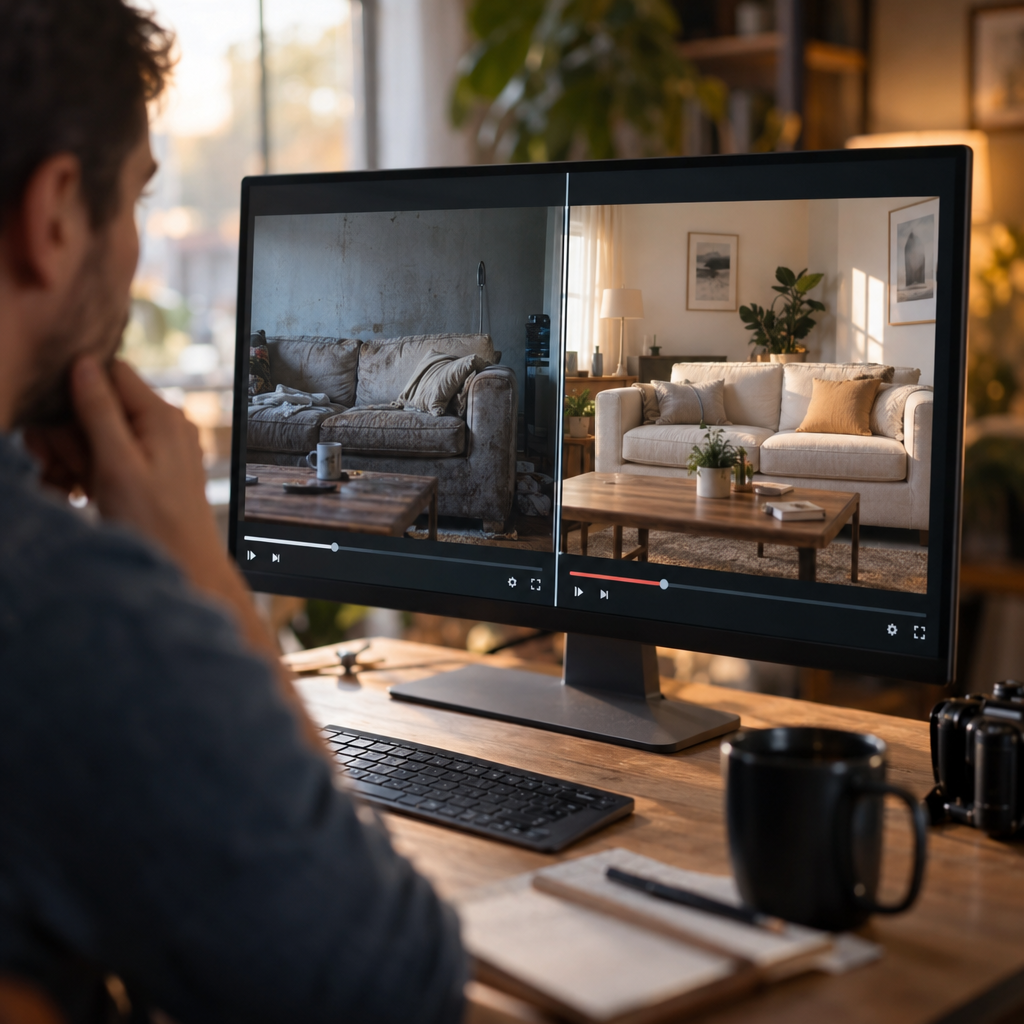
Static before-and-after posts convert at a fraction of the rate of split-screen comparison videos, according to internal benchmarks shared by multiple UGC agencies tracking paid social performance. Why? Because a single swipe between two photos asks viewers to trust your editing software. A split-screen comparison video asks viewers to trust their own eyes, in real time, with no cuts to hide behind. If your influencer program still leans on static before-and-afters, you’re leaving conversion lift on the table.
The Problem With Static Proof
Before-and-after photos have been a direct response staple since the first weight-loss ad ran in a newspaper. They’re cheap, fast, and easy to brief. But audiences have gotten sharper. Filters, lighting tricks, and selective angles have trained viewers to treat any single-frame comparison as suspect. A skincare brand posting a glowing “day 1 vs day 30” photo now triggers the same skepticism as an unboxed infomercial.
Split-screen comparison videos solve this by compressing the gap between claim and verification. Both states exist in the same frame, often recorded in the same continuous take, which makes manipulation far harder to pull off convincingly. The format forces a kind of honesty by design.
When two outcomes play simultaneously on screen, viewers stop asking “is this real” and start asking “does this apply to me,” which is the exact psychological shift that drives conversion.
Why Side-by-Side Beats Sequential Every Time
Sequential content, whether that’s a swipe post or a before/after cut, requires memory work. The viewer has to hold the “before” image in their head while evaluating the “after.” That’s cognitive load, and cognitive load kills completion rates. Split-screen removes the memory tax entirely. Both references sit in the viewer’s visual field at once, so comparison happens instantly and subconsciously.
This matters more on mobile, where attention spans are measured in single-digit seconds. Sprout Social’s engagement research consistently shows that formats requiring less interpretive effort hold watch time longer, and split-screen comparisons are about as low-effort-to-parse as video gets.
There’s also a trust dimension specific to the creator economy. Audiences following a creator expect a point of view, not a polished ad. Split-screen format reads as documentation rather than persuasion, even though the persuasion is baked into the structure. That’s the quiet genius of it.
The Three Split-Screen Structures That Actually Convert
Not all side-by-side edits are created equal. Brands briefing creators should pick one of three proven structures rather than leaving the layout to chance.
- Synchronous real-time split: Both sides play live and simultaneously, usually used for product performance claims (a competitor’s product vs yours, applied at the same moment).
- Time-shifted parallel split: The left side shows “before” footage and the right side shows “after” footage, both moving at the same pace so the viewer can track change without rewinding.
- Reveal-triggered split: The screen starts as one panel and splits open at a scripted beat, usually timed to a voiceover cue or on-screen text drop, which adds a pattern interrupt mid-video.
Reveal-triggered splits tend to perform best for top-of-funnel awareness content because the split itself functions as a hook. Synchronous splits work better for bottom-funnel conversion content, since they’re built for direct comparison claims that need to survive scrutiny.
Scripting the Script: What Goes Where
Here’s where most briefs fall apart. Teams hand creators a vague instruction like “show before and after side by side” without specifying pacing, caption timing, or what claim each half is actually proving. A tight script for split-screen comparison video should map out:
- The exact claim being tested (not “our product works better,” but a specific, measurable outcome)
- What happens on the left panel, second by second
- What happens on the right panel, second by second, and how it must stay in sync
- The on-screen text or caption overlay that names what viewers are seeing, since ambiguity kills credibility
- A closing beat that states the comparison plainly, because viewers shouldn’t have to guess the conclusion
This level of detail isn’t about micromanaging creators. It’s about protecting the brand from a comparison that reads as misleading or, worse, triggers regulatory attention. If you’ve worked through split-screen videos that survive compliance review, you already know how fast a sloppy comparison claim can become a legal headache.
Compliance Isn’t Optional, It’s Structural
This is the section brand compliance teams will want bookmarked. The FTC’s endorsement guidance treats comparison content as a heightened-scrutiny category, precisely because side-by-side formats imply measurable, verifiable claims. A static before-and-after photo can get away with vague framing. A split-screen video that shows two products performing differently in real time is making an explicit performance claim, whether the brand intended it or not.
Three guardrails matter most:
- Disclose material connections clearly, on-screen, not buried in a caption
- Avoid cherry-picked conditions (different lighting, different product batches, different usage duration) that create a misleading comparison
- Keep documentation of the actual test conditions in case a platform or regulator asks for substantiation
Brands that have already built review workflows around before-and-after disclosure rules have a head start here, since the same documentation habits transfer directly to split-screen formats. The format changes, the compliance discipline doesn’t.
A split-screen comparison that can’t be substantiated with documented test conditions isn’t proof content, it’s a liability waiting for a platform audit.
Casting the Right Creator for the Comparison
Not every creator can pull off split-screen convincingly. The format rewards performers who are comfortable with deadpan delivery and precise timing, since the split only works if both panels feel equally “lived in” rather than one side looking staged. Look for creators who’ve already demonstrated range in split-screen reaction formats, since the technical muscle memory (framing, sync, pacing) carries over directly.
It’s also worth testing creators against a control group. Run the same comparison script with two or three creators and measure completion rate and save rate separately. Split-screen format tends to produce more variance between creators than straightforward talking-head content, because small timing mismatches between panels are glaringly obvious to viewers in a way they aren’t in single-frame video.
Where This Format Fits in the Broader Content Mix
Split-screen comparison shouldn’t be a standalone tactic. It performs best as a mid-funnel asset, after a strong top-of-funnel hook has earned attention and before a receipts-style trust asset closes the loop. Treat it as the proof layer in a three-part funnel: hook, comparison, receipt.
Brands running always-on UGC pipelines should slot split-screen comparisons into their regular production cadence rather than treating them as a one-off campaign stunt. If you’re already managing a weekly UGC content cadence, split-screen formats can rotate in alongside other proof formats to prevent creative fatigue, which is one of the fastest ways paid social CPMs climb quietly over a quarter.
Performance marketing teams clipping long-form creator content into ad assets should also take note. Split-screen comparisons clip exceptionally well into 6 and 15-second cutdowns, since the core proof point is visible within the first second or two. If your team is already running long-form video into paid ad assets, add split-screen source footage to the shot list specifically because it survives aggressive clipping better than narrative-driven formats.
Measuring What Actually Matters
Vanity metrics mislead here more than usual. A split-screen video can rack up views purely because the visual format is novel, without driving any actual purchase intent. Track these instead:
- Completion rate specifically past the comparison reveal moment, not just overall video completion
- Save rate, since viewers save comparison content to revisit before a purchase decision
- Click-through on the specific claim being tested, if you’re running paid amplification with multiple comparison variants
- Comment sentiment flagged for skepticism keywords (“fake,” “staged,” “edited”), which signal a comparison isn’t landing as credible
Platforms like HubSpot’s marketing analytics tools and native platform insights (via Meta Business Suite or TikTok Ads Manager) can surface completion-rate drop-off at the specific timestamp, which is the single most useful diagnostic for whether your split-screen structure is actually working or just looks good on paper.
FAQs
What makes split-screen comparison videos more credible than before-and-after photos?
Split-screen videos show both states simultaneously in a continuous frame, which makes selective editing or staged lighting far more obvious to viewers. Static before-and-after photos can be shot under different conditions without the audience ever knowing, which is why skepticism runs higher for that format.
How long should a split-screen comparison video be?
Most high-performing split-screen comparisons run between 15 and 30 seconds. Long enough to let the comparison play out clearly, short enough to survive clipping into shorter paid ad formats without losing the core proof point.
Do split-screen comparisons need FTC disclosure?
Yes. Any sponsored comparison content, including split-screen formats, requires clear on-screen disclosure of material connections per FTC endorsement guidance. Comparative performance claims also need to be substantiated with documented test conditions.
Can split-screen format work for service businesses, not just physical products?
Yes, though it requires more creative framing. Service-based comparisons often split screen based on time elapsed (before using a tool vs after) or process efficiency (manual workflow vs automated workflow) rather than a visual product transformation.
What’s the biggest mistake brands make when briefing this format?
Leaving the panel-by-panel script vague. Creators left to improvise the sync between both sides often produce mismatched timing that undermines the credibility the format is supposed to deliver.
FAQPage Schema
Next step: Pull your last five before-and-after creator briefs, pick the one with the strongest underlying claim, and rebuild it as a scripted split-screen comparison with a documented test condition. Run it against the original static version for two weeks and compare completion rate past the midpoint, that single number will tell you whether this format deserves a permanent slot in your content mix.
Top Influencer Marketing Agencies
The leading agencies shaping influencer marketing in 2026
Agencies ranked by campaign performance, client diversity, platform expertise, proven ROI, industry recognition, and client satisfaction. Assessed through verified case studies, reviews, and industry consultations.
Moburst

-
2

The Shelf
Boutique Beauty & Lifestyle Influencer AgencyA data-driven boutique agency specializing exclusively in beauty, wellness, and lifestyle influencer campaigns on Instagram and TikTok. Best for brands already focused on the beauty/personal care space that need curated, aesthetic-driven content.Clients: Pepsi, The Honest Company, Hims, Elf Cosmetics, Pure LeafVisit The Shelf → -
3

Audiencly
Niche Gaming & Esports Influencer AgencyA specialized agency focused exclusively on gaming and esports creators on YouTube, Twitch, and TikTok. Ideal if your campaign is 100% gaming-focused — from game launches to hardware and esports events.Clients: Epic Games, NordVPN, Ubisoft, Wargaming, Tencent GamesVisit Audiencly → -
4

Viral Nation
Global Influencer Marketing & Talent AgencyA dual talent management and marketing agency with proprietary brand safety tools and a global creator network spanning nano-influencers to celebrities across all major platforms.Clients: Meta, Activision Blizzard, Energizer, Aston Martin, WalmartVisit Viral Nation → -
5

The Influencer Marketing Factory
TikTok, Instagram & YouTube CampaignsA full-service agency with strong TikTok expertise, offering end-to-end campaign management from influencer discovery through performance reporting with a focus on platform-native content.Clients: Google, Snapchat, Universal Music, Bumble, YelpVisit TIMF → -
6

NeoReach
Enterprise Analytics & Influencer CampaignsAn enterprise-focused agency combining managed campaigns with a powerful self-service data platform for influencer search, audience analytics, and attribution modeling.Clients: Amazon, Airbnb, Netflix, Honda, The New York TimesVisit NeoReach → -
7

Ubiquitous
Creator-First Marketing PlatformA tech-driven platform combining self-service tools with managed campaign options, emphasizing speed and scalability for brands managing multiple influencer relationships.Clients: Lyft, Disney, Target, American Eagle, NetflixVisit Ubiquitous → -
8

Obviously
Scalable Enterprise Influencer CampaignsA tech-enabled agency built for high-volume campaigns, coordinating hundreds of creators simultaneously with end-to-end logistics, content rights management, and product seeding.Clients: Google, Ulta Beauty, Converse, AmazonVisit Obviously →