


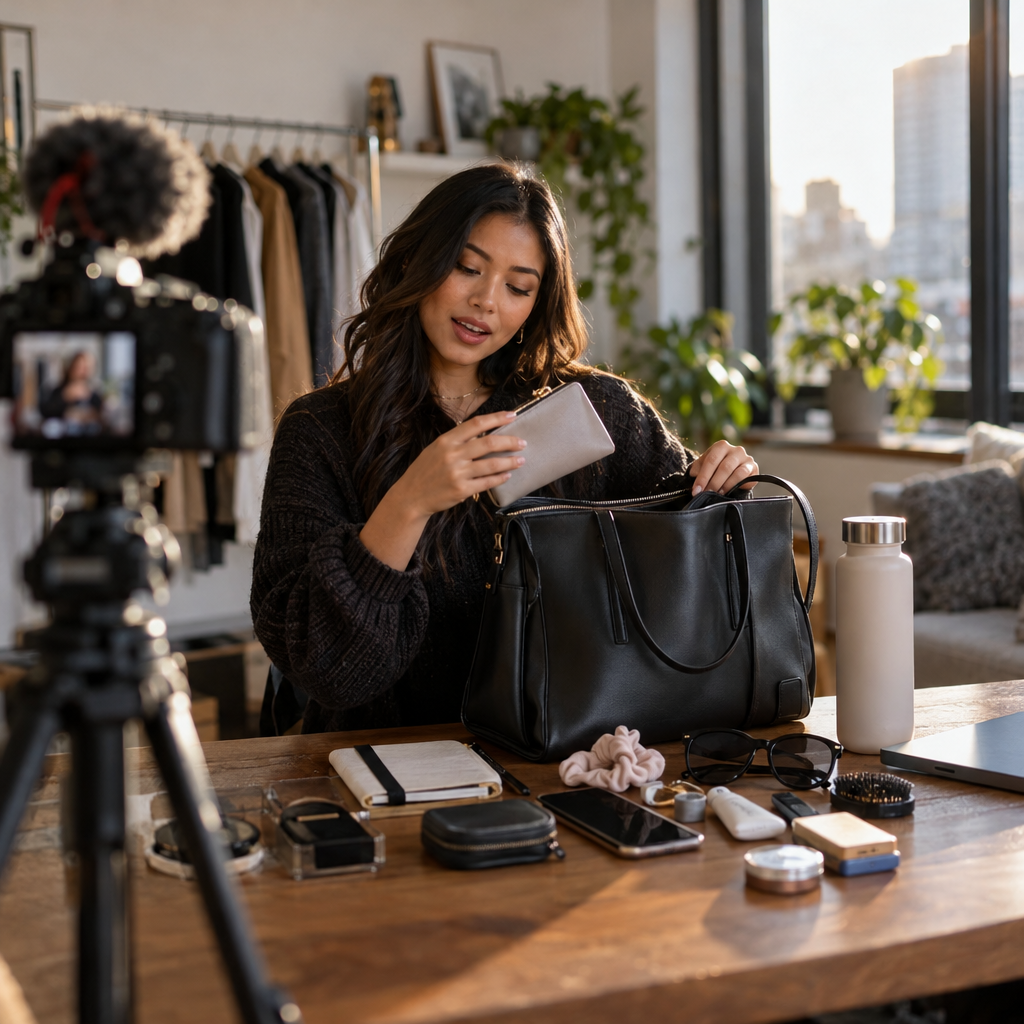
Seventy three percent of consumers say they trust product recommendations from creators more than branded ads, according to eMarketer research on influencer purchase behavior. Yet most brands still treat the “what’s in my bag” format as a free pass, hoping a creator will mention the product warmly and move on. That’s a wasted placement. The what’s in my bag format only works when it’s scripted with the same rigor as a thirty second TV spot, minus the stiffness that makes TV spots feel fake.
Why This Format Still Outperforms Overt Ads
The appeal is structural. A bag reveal gives viewers permission to be nosy. They’re not watching an ad, they’re watching someone else’s life get unpacked item by item, and that voyeuristic pull keeps watch time high. Sephora, Away, and a long list of skincare and tech brands have leaned into this because it converts without triggering the skepticism that straight product demos invite.
But the format has a ceiling problem. Once a creator pulls out fifteen items in a row with the same flat enthusiasm, viewers tune out by item eight. That’s where scripting earns its keep, not by scripting words verbatim, but by scripting structure: pacing, placement order, and the emotional beat each product gets.
A bag reveal without a scripted hierarchy is just inventory. A bag reveal with one is a conversion funnel disguised as a vlog.
Scripting the Reveal Order, Not Just the Lines
The single biggest lever brands overlook is sequencing. Most unscripted reveals go chronological, whatever the creator grabs first. That’s a mistake if your product isn’t the most visually interesting item in the bag.
- Open with a hook item. Something visually or emotionally interesting goes first to anchor retention, even if it’s not the sponsored product.
- Place the sponsored item at the second or third slot. Data from short form platforms consistently shows drop off accelerates after the thirty second mark, so your paid placement needs airtime before fatigue sets in.
- Follow with a contrast item. A cheap or funny object right after the sponsored product resets attention and avoids the “ad fatigue” cliff.
- Close with a personal item. Lip balm, a worn wallet, a kid’s toy. This re-humanizes the creator and makes the whole video read as authentic rather than a product lineup.
Brief creators on this order, not word for word dialogue. Give them a placement slot and a reason, and let them riff naturally within it. This is the same philosophy covered in lo fi aesthetic scripting, where structure matters more than polish.
The Disclosure Line Nobody Scripts, But Should
Here’s where brand legal teams and creators tend to clash. Bag reveals feel casual, so disclosure often gets an afterthought mumble or a tiny on screen tag that violates FTC endorsement guidelines. That’s a compliance risk hiding inside a lifestyle format.
The fix is simple: script the disclosure as part of the item’s intro, not as a disclaimer tacked on after. “This ended up in my bag because [Brand] sent it over” does the job naturally and satisfies the clear and conspicuous standard regulators expect. Brands running influencer programs at scale should treat this the same way they’d treat any paid endorsement, with written disclosure language baked into the creator brief. For a deeper look at how disclosure scripting holds up under scrutiny, see disclosure scripting that survives FTC scrutiny.
Disclosure that feels bolted on reads as an ad. Disclosure woven into the reveal reads as context, and it still satisfies regulators.
Picking Creators Who Actually Carry Your Product Category
Not every creator should get a bag reveal brief. The format depends on believability of the bag’s contents. A gaming laptop in a minimalist beauty creator’s tote reads as an obvious plant, no matter how well it’s scripted. Brands should match product category to creator vertical first, then worry about script quality.
This is also where mid tier and micro creators tend to outperform mega influencers. A creator with 40,000 engaged followers in a tight niche has a bag that audiences find plausible. A creator with two million followers across five brand deals a week has a bag audiences have learned to distrust. Sprout Social’s creator trust research backs this up repeatedly: smaller, niche accounts consistently post higher engagement rates on sponsored content than top tier accounts.
Measuring What Actually Happened Inside the Bag
Most brands measure bag reveal performance the same way they measure everything else: views, likes, maybe a swipe up rate if there’s a link. That misses the point of the format.
Track watch time retention at the specific timestamp where your product appears. Platforms like TikTok and Instagram give creators (and by extension, brands with access) retention graphs. If viewers are dropping off right before your product’s slot, the sequencing failed, not the product. Pair that with a trackable promo code or quiz funnel scripting to connect the reveal to actual purchase intent rather than vanity metrics.
- Retention percentage at your product’s timestamp
- Comment sentiment specifically mentioning the product (not just the creator)
- Code redemption or link click rate segmented by creator tier
- Repeat mention rate: did the creator bring the product back in future bag reveals unprompted
That last metric is underrated. Unprompted repeat mentions signal the product genuinely earned a spot in the creator’s rotation, which is the strongest organic proof point a brand can get.
Where This Format Breaks Down
Overloading the bag is the most common failure. Brands pay for multiple SKUs in one reveal, assuming more exposure equals more value. It usually dilutes everything. One well placed item with a clear reason for being there beats three items competing for the same fifteen seconds of attention.
The second failure is over scripting dialogue. When a creator’s cadence suddenly shifts into brand voice for one sentence, audiences notice instantly. It’s the same uncanny valley problem seen in narrated UGC formats. Keep scripted elements to structure and disclosure, and let language stay in the creator’s voice.
Third, don’t ignore seasonality and category fit drift. A bag reveal filmed for back to school season won’t perform the same when repurposed for a holiday gifting push without a re-shoot or at minimum a re-edit of the hook. Treat each reveal as a living asset tied to a moment, not an evergreen video you can run indefinitely.
Briefing Creators Without Killing the Vibe
The best bag reveal briefs are short. One page, maybe two. Include the placement slot, the disclosure requirement, a one line reason the product belongs in the bag, and any legal must haves around claims (especially relevant if the product makes a performance or efficacy claim, see scripting claims that pass legal review for more on that process). Everything else stays in the creator’s hands.
Brands that over brief this format end up with content that looks like every other over briefed format: stiff, repetitive, and easy for audiences to spot as paid. The entire value of “what’s in my bag” content is its perceived spontaneity. Protect that, and the placement does the selling for you.
Next Step
Before your next bag reveal campaign, build a one page placement brief that locks down reveal order, disclosure language, and the single retention metric you’ll track at the product’s timestamp. That’s the difference between a cute video and a format you can scale across your next ten creator partnerships.
FAQs
What makes a “what’s in my bag” video effective for brand placement?
Effectiveness comes from sequencing, not scripting word for word. Placing the sponsored product early enough to beat typical drop off points, surrounding it with contrast items, and keeping disclosure natural all drive stronger retention and trust than a word perfect script.
How do I disclose sponsorship in a lifestyle reveal without breaking the vibe?
Weave the disclosure into the product’s intro line rather than adding a separate disclaimer. A phrase like “this one was sent over by [Brand]” satisfies FTC clear and conspicuous requirements while staying in the creator’s natural voice.
Should mega influencers or micro creators handle bag reveal content?
Micro and mid tier creators generally perform better for this format because their bag contents read as more believable. Audiences have grown skeptical of mega influencers whose bags are visibly full of sponsored items.
How many sponsored products should appear in one bag reveal?
One is ideal. Two is manageable if the products are clearly differentiated in use case. Three or more typically dilutes attention and makes the reveal feel like an ad reel instead of a lifestyle video.
What metrics actually prove a bag reveal worked?
Watch time retention at the product’s specific timestamp, comment sentiment naming the product, code or link redemption by creator tier, and whether the creator mentions the product again unprompted in future content.
Top Influencer Marketing Agencies
The leading agencies shaping influencer marketing in 2026
Agencies ranked by campaign performance, client diversity, platform expertise, proven ROI, industry recognition, and client satisfaction. Assessed through verified case studies, reviews, and industry consultations.
Moburst

-
2

The Shelf
Boutique Beauty & Lifestyle Influencer AgencyA data-driven boutique agency specializing exclusively in beauty, wellness, and lifestyle influencer campaigns on Instagram and TikTok. Best for brands already focused on the beauty/personal care space that need curated, aesthetic-driven content.Clients: Pepsi, The Honest Company, Hims, Elf Cosmetics, Pure LeafVisit The Shelf → -
3

Audiencly
Niche Gaming & Esports Influencer AgencyA specialized agency focused exclusively on gaming and esports creators on YouTube, Twitch, and TikTok. Ideal if your campaign is 100% gaming-focused — from game launches to hardware and esports events.Clients: Epic Games, NordVPN, Ubisoft, Wargaming, Tencent GamesVisit Audiencly → -
4

Viral Nation
Global Influencer Marketing & Talent AgencyA dual talent management and marketing agency with proprietary brand safety tools and a global creator network spanning nano-influencers to celebrities across all major platforms.Clients: Meta, Activision Blizzard, Energizer, Aston Martin, WalmartVisit Viral Nation → -
5

The Influencer Marketing Factory
TikTok, Instagram & YouTube CampaignsA full-service agency with strong TikTok expertise, offering end-to-end campaign management from influencer discovery through performance reporting with a focus on platform-native content.Clients: Google, Snapchat, Universal Music, Bumble, YelpVisit TIMF → -
6

NeoReach
Enterprise Analytics & Influencer CampaignsAn enterprise-focused agency combining managed campaigns with a powerful self-service data platform for influencer search, audience analytics, and attribution modeling.Clients: Amazon, Airbnb, Netflix, Honda, The New York TimesVisit NeoReach → -
7

Ubiquitous
Creator-First Marketing PlatformA tech-driven platform combining self-service tools with managed campaign options, emphasizing speed and scalability for brands managing multiple influencer relationships.Clients: Lyft, Disney, Target, American Eagle, NetflixVisit Ubiquitous → -
8

Obviously
Scalable Enterprise Influencer CampaignsA tech-enabled agency built for high-volume campaigns, coordinating hundreds of creators simultaneously with end-to-end logistics, content rights management, and product seeding.Clients: Google, Ulta Beauty, Converse, AmazonVisit Obviously →