


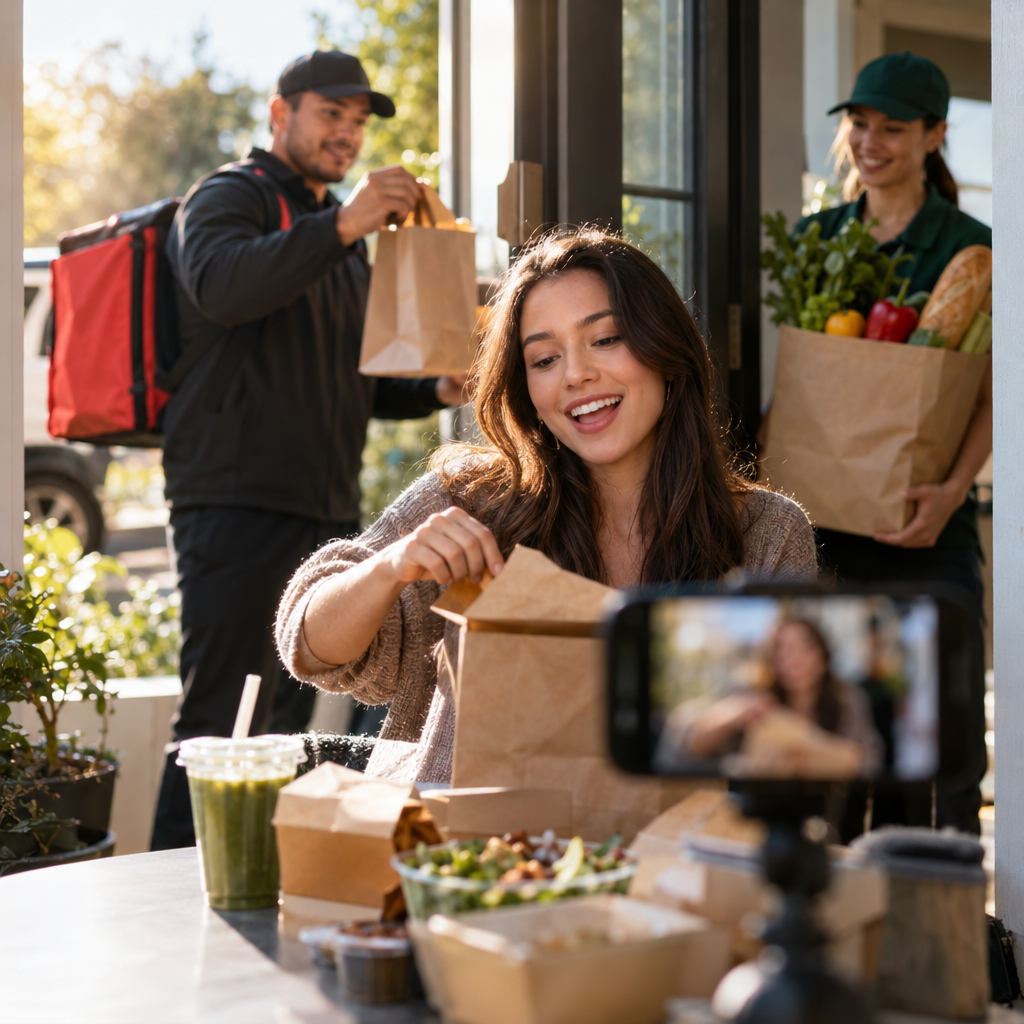
508 creators posted sponsored content for DoorDash in a single year, and Instacart’s own recruiters are now hiring full time to manage a “6 to 12 creator partnerships per month” pipeline. That is not an influencer side hustle anymore. DoorDash and Instacart creator partnerships have become a structural part of how both companies sell ads, and that shift is forcing brands and agencies to treat delivery and grocery apps as legitimate commerce media channels, not just distribution rails for a coupon code.
What Commerce Media Actually Means Here
Commerce media is the fusion of retail media (ads bought inside a platform where someone is already shopping) with content built to move that shopper from scroll to checkout. DoorDash and Instacart both sit on enormous first party purchase data sets, and for years they sold that data as straightforward sponsored placements. The new move is layering creator content on top of that infrastructure so the “ad” looks like a recipe video or a restaurant review instead of a banner.
That matters for brand strategists because it collapses two budget lines that used to live in different departments: influencer marketing and retail media. If your organization still treats those as separate spreadsheets, you are already behind the brands building one funnel out of both.
DoorDash’s Playbook: Paying Creators To Sell Dinner
DoorDash for Creators officially runs two tracks. creator vetting matters here because the program splits creators into two very different compensation models: an In-app Creator track that earns a flat fee for producing restaurant videos featured in the DoorDash app, and an Affiliate Creator track that earns commission when followers order through shared links.
The in-app program launched with real operational specifics. DoorDash debuted a creator program allowing influencers to apply to partner with the company to post videos and social content on restaurants that appear on users’ feeds, with creators earning money for each approved submission, available in 20 U.S. cities. Pair that with the platform’s broader strategy, which DoorDash’s own marketing leadership has described bluntly at industry events.
“Everyone has the potential to be a creator,” said Kofi Amoo-Gottfried, vice president of marketing at DoorDash, reflecting the delivery service’s search-and-amplify approach to creatorship.
That philosophy explains why DoorDash considers both its merchants and delivery workers, or dashers, to be creators, not just professional talent. For brands advertising on DoorDash, that means creator content opportunities exist across restaurant partners, dashers, and paid affiliates simultaneously, each with a different cost structure and a different disclosure obligation.
Instacart’s Comment-to-Cart Economy
Instacart’s approach leans harder on the shoppable mechanic than DoorDash’s does. The earliest and still most cited example is a curated cart built around a celebrity’s actual grocery habits. Lizzo is a famous pop singer with a hilarious and engaging TikTok presence, and because she is so universally loved and candid about her favorite recipes, Instacart started its curated carts with her.
Smaller creators replicate the same mechanic at scale. Food and nutrition creators routinely use the TikTok and Instacart integration so viewers can hop over to the app and add ingredients to their cart, hashtagging the partnership to disclose it. That hand-off from content to cart is the entire value proposition of commerce media: the viewer never has to remember the brand name three days later at the store, because the cart is already built for them.
Instacart has since formalized that hand-off at the infrastructure level. Instacart is now the first retail media partner to offer end-to-end capabilities within TikTok Ads Manager, letting advertisers enhance TikTok commerce experiences by leveraging Instacart audiences, shoppable product ads, and closed-loop measurement. The company has pursued similar deals elsewhere in the industry, with Instacart and DoorDash Ads setting up pop-ups at Cannes Lions to court advertisers directly, and with Instacart collaborating with Pinterest to tie that platform’s ads to campaigns on Instacart Marketplace.
A second phase of the Instacart and Pinterest deal is expected to introduce closed-loop measurement, tying ads to actual product sales across Instacart’s marketplace of over 1,800 retailers to help prove campaign impact with real purchase data.
That is the headline brands should care about. Closed-loop measurement is the thing retail media has promised for years and rarely delivered cleanly when creator content was involved. Instacart is building the plumbing to make it real.
The Off-Platform Expansion Changes the Budget Math
Neither company is keeping this inside its own app. Instacart’s own ad documentation lists a growing bench of off-platform partners. With NBCUniversal, brands can reach purchase-minded viewers across premium video content paired with Instacart first-party audiences, using shoppable ads that drive consumers directly to Instacart with closed-loop measurement. With Pinterest, brands can pair Instacart first-party audiences with Pinterest creative to reach relevant Pinners and receive closed-loop measurement.
Instacart has also started licensing the underlying technology to other retailers, which multiplies the number of storefronts a single piece of creator content can theoretically influence. Thrive Market, after growing to more than 1.5 million members, partnered with Instacart to leverage its Carrot Ads solution, with brands soon able to run sponsored product and display campaigns on Thrive Market’s own website and app. Instacart’s chief business officer framed the ambition plainly: the goal is to extend Instacart’s ad technology and bring the vision of a retail media network to life for retail partners, offering brands a scaled ad platform to connect with engaged audiences.
For a brand media planner, this means a single creator asset filmed for an Instacart campaign could theoretically be repurposed into a Pinterest buy, an NBCUniversal CTV placement, or a Thrive Market sponsored listing, each with its own measurement loop. That is a very different planning exercise than the old model of one influencer post on one feed.
Where Brands Get This Wrong
The biggest risk in this space is not creative quality, it is disclosure discipline. DoorDash and Instacart affiliate programs run heavily on promo codes and discount links, and the FTC treats those exactly like any other paid endorsement. If an endorsement appears in a video, the disclosure needs to be in the video itself and not just in the uploaded description, since viewers are more likely to notice disclosures made in both audio and video.
Brands running affiliate-heavy commerce media campaigns should treat this as a contract term, not a creator’s personal judgment call. If your team is already auditing personalized pricing and disclosure exposure on other shoppable platforms, the same framework applies here; see our FTC audit approach for a model brands can adapt to grocery and delivery affiliate codes.
Building Your Own Commerce Media Playbook
A workable brand playbook for DoorDash and Instacart creator partnerships needs three moving parts working together instead of three separate owners.
- Vetting tied to purchase intent, not follower count. A food creator with a loyal cooking audience will likely drive more cart adds than a lifestyle influencer with triple the reach. Apply the same discipline here that works for other repost-sensitive platforms; our creator vetting checklist is a useful starting template.
- Tiered budgets across compensation models. Flat-fee in-app content, affiliate commission deals, and traditional paid partnerships all carry different risk and reporting profiles, similar to the tiered structures brands already use for whitelisted paid social; the logic in our tiered budget guide transfers cleanly.
- Measurement that ties creator spend to retail lift. If your reporting still stops at impressions and engagement rate, you are not actually measuring commerce media. Borrow the ROI reframing from our ROI measurement guide and apply it to cart adds instead of clicks.
Agencies are already building specialized practices around this exact gap between creator content and retail outcomes. Moburst, a global growth agency that has worked with over 900 clients and won 45+ international awards, structures its influencer marketing partners work around repurposing creator content into paid media assets rather than letting an organic post expire after one scroll, which is the same operational habit brands need to adopt if they want commerce media spend to outlast a single campaign flight.
The Next Move
Stop budgeting DoorDash and Instacart creator content as a vanity influencer line item. Build the vetting, tiered compensation, and cart-level measurement into one owned playbook before your next quarterly planning cycle, because both platforms are already selling the off-platform distribution to connect that content straight to a sale.
FAQs
Do DoorDash and Instacart pay creators directly, or only through affiliate commissions?
Both. DoorDash runs an in-app flat-fee track for restaurant video content alongside a separate commission-based affiliate track, while Instacart’s creator relationships are managed more centrally through its influencer marketing team, which builds ongoing partnerships across Instagram, TikTok, and YouTube Shorts rather than a single public affiliate portal.
Is sponsored DoorDash or Instacart content subject to FTC disclosure rules?
Yes. Any creator receiving payment, free product, or affiliate commission from either platform has a material connection that must be clearly and conspicuously disclosed, and video disclosures must appear in the video itself rather than only in the caption.
How is this different from a normal influencer campaign?
The defining difference is closed-loop measurement. Traditional influencer campaigns stop at impressions and engagement, while DoorDash and Instacart creator partnerships are increasingly built to connect directly to a cart add or completed order, which is why retail media and influencer marketing budgets are converging.
Should CPG brands prioritize DoorDash or Instacart for creator partnerships?
It depends on the category. Instacart’s grocery-focused audience and recipe-driven content format suit CPG and food brands with SKUs sold at retail, while DoorDash’s restaurant-first model fits brands with a presence inside quick-service or casual dining menus rather than packaged goods on a shelf.
What is the biggest operational risk in scaling these partnerships?
Disclosure consistency across affiliate codes and discount links, since these programs generate a high volume of promo-code-driven content where creators may not fully understand that a commission still triggers an FTC disclosure requirement.
Top Influencer Marketing Agencies
The leading agencies shaping influencer marketing in 2026
Agencies ranked by campaign performance, client diversity, platform expertise, proven ROI, industry recognition, and client satisfaction. Assessed through verified case studies, reviews, and industry consultations.
Moburst

-
2

The Shelf
Boutique Beauty & Lifestyle Influencer AgencyA data-driven boutique agency specializing exclusively in beauty, wellness, and lifestyle influencer campaigns on Instagram and TikTok. Best for brands already focused on the beauty/personal care space that need curated, aesthetic-driven content.Clients: Pepsi, The Honest Company, Hims, Elf Cosmetics, Pure LeafVisit The Shelf → -
3

Audiencly
Niche Gaming & Esports Influencer AgencyA specialized agency focused exclusively on gaming and esports creators on YouTube, Twitch, and TikTok. Ideal if your campaign is 100% gaming-focused — from game launches to hardware and esports events.Clients: Epic Games, NordVPN, Ubisoft, Wargaming, Tencent GamesVisit Audiencly → -
4

Viral Nation
Global Influencer Marketing & Talent AgencyA dual talent management and marketing agency with proprietary brand safety tools and a global creator network spanning nano-influencers to celebrities across all major platforms.Clients: Meta, Activision Blizzard, Energizer, Aston Martin, WalmartVisit Viral Nation → -
5

The Influencer Marketing Factory
TikTok, Instagram & YouTube CampaignsA full-service agency with strong TikTok expertise, offering end-to-end campaign management from influencer discovery through performance reporting with a focus on platform-native content.Clients: Google, Snapchat, Universal Music, Bumble, YelpVisit TIMF → -
6

NeoReach
Enterprise Analytics & Influencer CampaignsAn enterprise-focused agency combining managed campaigns with a powerful self-service data platform for influencer search, audience analytics, and attribution modeling.Clients: Amazon, Airbnb, Netflix, Honda, The New York TimesVisit NeoReach → -
7

Ubiquitous
Creator-First Marketing PlatformA tech-driven platform combining self-service tools with managed campaign options, emphasizing speed and scalability for brands managing multiple influencer relationships.Clients: Lyft, Disney, Target, American Eagle, NetflixVisit Ubiquitous → -
8

Obviously
Scalable Enterprise Influencer CampaignsA tech-enabled agency built for high-volume campaigns, coordinating hundreds of creators simultaneously with end-to-end logistics, content rights management, and product seeding.Clients: Google, Ulta Beauty, Converse, AmazonVisit Obviously →