


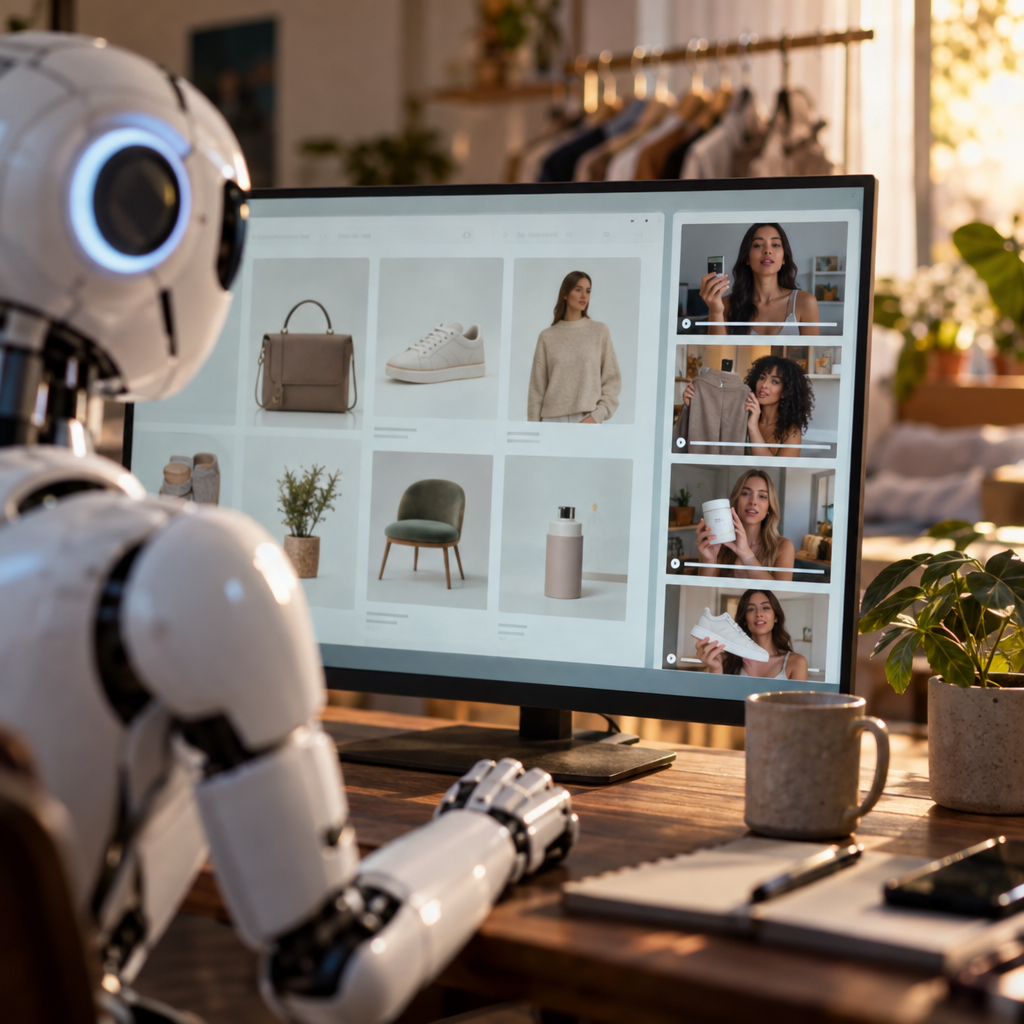
AI engines are now pulling product answers from creator videos that brands rarely commission, and the Sundogs study found that in CPG and auto, roughly 60% of AI-cited videos came from creators. Brands themselves accounted for only about 10% of those citations, according to the same research. That split, from a Sundogs study, should worry anyone who owns an influencer budget. Conversational commerce agents are already answering “what should I buy?” with creator content you may never have briefed, approved, or paid for. This is what brands must monitor, and how.
The shelf moved, and nobody told the brand team
Conversational agents do not browse like shoppers. ChatGPT’s shopping research, for example, asks follow-up questions, then runs a multi-step discovery process. OpenAI’s documentation says it may draw on merchant data supplied through the Agentic Commerce Protocol, publicly available product information, and other retail sources. It then returns a buyer’s guide with top picks, tradeoffs, and merchant links.
Notice what that means. The agent assembles an opinion. Creator reviews, comparison videos, and forum threads become raw material for that opinion.
We covered the broader mechanics in our piece on AI shopping assistants. The creator layer adds a new problem: you are now exposed to content you did not commission.
What the research says about creator citations
The Sundogs analysis, reported by Net Influencer, compared 400 AI-cited videos with 3,500 non-cited videos from the same creators across U.S. CPG and automotive. Several findings cut against standard influencer KPIs:
- Views did not predict citation. Some cited videos had fewer than 1,000 views, while higher-traffic videos from the same creator went uncited, per the Net Influencer report.
- Recency carried little weight. Many cited videos were one to two years old or older.
- Production polish was irrelevant. AI voiceovers and stock footage appeared frequently in cited content.
- Substance won. The research found that formal reviews and physical demonstrations appeared in 77% of cited videos, a 29-percentage-point lift over non-cited ones.
Comparisons mattered too. Comparisons between brands appeared in 71% of cited content, the report says.
AI engines are not measuring influence. They are measuring contextual accuracy, which means your most-cited creator content may come from the least-controlled source.
One caveat before you rebuild your strategy. This is a single study of two verticals, and the report notes food, beverage, and retail look more mixed. Treat it as a strong signal, not a law.
Monitor these five things
Most brands track impressions and affiliate sales. Agent-era monitoring needs a different dashboard.
1. Which creator videos get cited for your category
Start with the prompts a buyer would actually type. “Best moisturizer for dry skin on a modest budget.” “Compare these two SUVs for a family of four.” Run them across ChatGPT, Gemini, Perplexity, and Google AI Overviews, then log every cited source. Our AI visibility audit checklist shows how to separate real tracking from vendor theater.
Expect surprises. A creator you never worked with may be your category’s most-cited voice. Another may be citing you favorably in a video you never saw.
2. Whether the claims are accurate
Here is the risk nobody budgets for. If an agent summarizes a creator’s outdated claim (old pricing, a reformulated ingredient, a discontinued feature), the error lands in front of a buyer with your brand name attached. OpenAI itself warns that prices, stock, and discounts change frequently and may not match the retailer’s page.
Build a claims register. For each priority SKU, list the facts that must be right: price tier, ingredients, specs, warranty terms. Then check whether cited content and agent summaries match.
3. Sentiment and framing
Research from the University of Illinois Urbana-Champaign found something relevant here. In their study of 11,000 queries, the authors report that cited social media content and negatively framed sources were substantially underrepresented in AI-generated summaries.
Read that carefully. Summaries can sound more confident than the underlying sources, and critical creator takes may get filtered out. You need to know both what the agent says and how sure it sounds. Pairing agent audits with sentiment analysis on the creators themselves gives you an early read on tone drift.
4. Disclosure integrity
A sponsored review can be cited by an agent with the sponsorship context stripped out. The disclosure lived in the video description or a spoken line. The buyer sees a clean recommendation.
That is a compliance exposure for you, and a trust problem for the creator. Audit whether paid partners disclose inside the video itself (spoken and on-screen), not only in captions that a model may never surface. Check your contracts with counsel, because disclosure obligations vary by market and I am not offering legal advice here.
5. Traffic you cannot see
When an agent sends a buyer to your site, referral data often arrives muddy. Some of it hides in direct. Our look at dark AI traffic explains why GA4 undercounts it, which means creator influence on agent-driven sales will look smaller than it is.
Should brands just brief creators to chase citations?
Tempting. Mostly wrong.
The Sundogs findings suggest citation-friendly content is specific, comparative, and honest. It frames the problem, names ingredients or specs, and compares alternatives, including competitors. Ben Jones, Sundogs’ CEO, says that makes brands uncomfortable. He argues that brands insisting on controlling the message are producing only the small share of cited content that comes from brand-owned video.
So the practical move is not scripting. It is loosening. Give creators accurate fact sheets, early access, and room to say that a rival suits a different need better. Then protect yourself with a pre-publication accuracy check on facts, not opinions.
This also changes how you pay. Jones argues creators are earning brands citation value that has not been priced. Expect that argument at the negotiating table, and prepare for it. If you use automation in those talks, keep a human in the loop, as we outline in our guide to negotiation agents.
A monthly audit that fits a small team
- Build a prompt set. Pick 25 to 40 buyer-intent prompts per product line, including competitor comparisons.
- Run and log. Record the agent, the date, the cited sources, and whether your brand appears.
- Tag creator sources. Mark which cited videos are paid, gifted, or organic.
- Score accuracy. Compare claims against your register. Flag errors by severity.
- Act. Request corrections from creators, update your own product pages, and brief partners with better fact sheets.
- Test lift. Compare exposed and unexposed markets to see whether citation gains move sales. Incrementality testing beats last-click here.
Agent outputs vary run to run, so treat results as directional. Repeat prompts several times before drawing conclusions.
What should you not do?
Do not pay for fake or synthetic review volume to game citations. Do not assume view counts will protect you. And do not wait for a platform to hand you a dashboard. None of the sources I reviewed describe a native tool that shows brands which creator videos feed an agent’s recommendation.
Next step: this week, run 25 buyer prompts for your top product across three agents, list every creator source they cite, and check each one against your product facts.
FAQs
What is conversational commerce?
It is shopping through a dialogue with an AI agent, which asks clarifying questions, researches options, and recommends products. ChatGPT’s shopping research is one example, returning a buyer’s guide with picks, tradeoffs, and merchant links.
Why do AI agents cite creator content?
Creator videos often contain detailed demonstrations, comparisons, and use cases. In the Sundogs study of CPG and auto, creators produced the largest share of AI-cited videos, which suggests that depth of product detail matters more than brand authorship.
Does a higher view count make a video more likely to be cited?
Not reliably. The Sundogs research found cited videos with very low view counts, while higher-traffic videos from the same creators were not cited. Substance and specificity appeared to matter more.
Are short-form videos cited as often as long-form?
According to Sundogs’ CEO, high volumes of Shorts do not produce citations at a comparable rate to long-form video. Brands relying on short clips alone may be less visible to agents.
What is the biggest risk for brands?
Inaccurate or stale claims repeated confidently under your brand name. Add disclosure gaps, where sponsorship context is lost in summaries, and you have both reputational and compliance exposure.
How often should brands audit agent citations?
Monthly is a reasonable baseline for most teams, with extra checks around launches, reformulations, and pricing changes. Run each prompt multiple times, since outputs vary.
Can brands control which creator videos agents cite?
Not directly. You can influence it by partnering with creators who produce specific, comparative, fact-dense content, and by keeping product information accurate across your own pages and retailer feeds.
Top Influencer Marketing Agencies
The leading agencies shaping influencer marketing in 2026
Agencies ranked by campaign performance, client diversity, platform expertise, proven ROI, industry recognition, and client satisfaction. Assessed through verified case studies, reviews, and industry consultations.
Moburst

-
2

The Shelf
Boutique Beauty & Lifestyle Influencer AgencyA data-driven boutique agency specializing exclusively in beauty, wellness, and lifestyle influencer campaigns on Instagram and TikTok. Best for brands already focused on the beauty/personal care space that need curated, aesthetic-driven content.Clients: Pepsi, The Honest Company, Hims, Elf Cosmetics, Pure LeafVisit The Shelf → -
3

Audiencly
Niche Gaming & Esports Influencer AgencyA specialized agency focused exclusively on gaming and esports creators on YouTube, Twitch, and TikTok. Ideal if your campaign is 100% gaming-focused — from game launches to hardware and esports events.Clients: Epic Games, NordVPN, Ubisoft, Wargaming, Tencent GamesVisit Audiencly → -
4

Viral Nation
Global Influencer Marketing & Talent AgencyA dual talent management and marketing agency with proprietary brand safety tools and a global creator network spanning nano-influencers to celebrities across all major platforms.Clients: Meta, Activision Blizzard, Energizer, Aston Martin, WalmartVisit Viral Nation → -
5

The Influencer Marketing Factory
TikTok, Instagram & YouTube CampaignsA full-service agency with strong TikTok expertise, offering end-to-end campaign management from influencer discovery through performance reporting with a focus on platform-native content.Clients: Google, Snapchat, Universal Music, Bumble, YelpVisit TIMF → -
6

NeoReach
Enterprise Analytics & Influencer CampaignsAn enterprise-focused agency combining managed campaigns with a powerful self-service data platform for influencer search, audience analytics, and attribution modeling.Clients: Amazon, Airbnb, Netflix, Honda, The New York TimesVisit NeoReach → -
7

Ubiquitous
Creator-First Marketing PlatformA tech-driven platform combining self-service tools with managed campaign options, emphasizing speed and scalability for brands managing multiple influencer relationships.Clients: Lyft, Disney, Target, American Eagle, NetflixVisit Ubiquitous → -
8

Obviously
Scalable Enterprise Influencer CampaignsA tech-enabled agency built for high-volume campaigns, coordinating hundreds of creators simultaneously with end-to-end logistics, content rights management, and product seeding.Clients: Google, Ulta Beauty, Converse, AmazonVisit Obviously →