


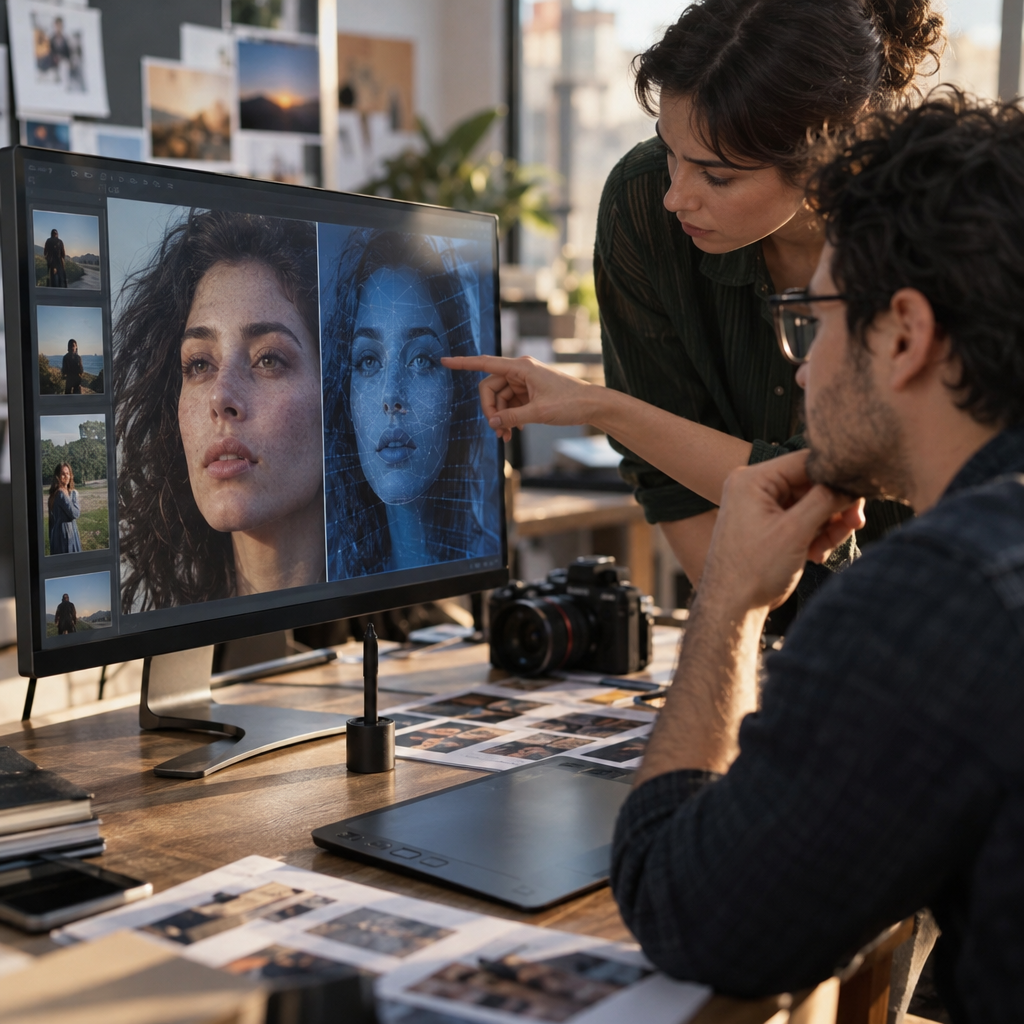
In Adobe’s 2026 Creators’ Toolkit Report, 75% of creators call creative AI integrated or essential to how they work, yet only 49% say they always or often disclose using it. That gap is the real story in Adobe’s latest survey, and it points to a new brand content review standard. If your approval process still assumes a human shot, edited, and posted every frame, it is out of date.
What Adobe’s survey actually found
Adobe partnered with The Harris Poll on the 2026 Creators’ Toolkit Report, which surveyed more than 16,000 creators across eight countries in May 2026. The 2026 Creators’ Toolkit Report found that 87% of creators using creative AI say it has accelerated the growth of their business or audience.
A year earlier, the inaugural report showed 86% of creators actively using creative generative AI. So adoption was already high. What changed is the framing: AI has moved from experiment to infrastructure.
One caveat before you act on any of this. The survey is self-reported, and Adobe sells the tools being discussed. Treat the numbers as a credible read on creator behavior, not as proof that AI-assisted content performs better for brands. (Forty percent of creators say AI-assisted content consistently performs better. That is a perception, not a campaign result.)
Three numbers that matter more to brands than the headline
The growth stats make good conference slides. Three other findings change how a brand team should work.
- Drafts are not finished work: 57% say their AI outputs typically need moderate or extensive editing before they are ready to share. Raw AI output is a draft, and the quality of the edit varies by creator.
- Disclosure is inconsistent: 49% say they always or often disclose AI use, while 18% say they rarely or never do.
- Ownership matters to creators: 90% say it is important to be able to obtain copyright protection for work created with AI assistance. Creators care about ownership, and so should the brand paying for usage rights.
Add a fourth from Adobe’s 2025 report: 69% of creators are concerned about their content being used to train AI without permission. Creators are protective of their own work while using the same class of tools you worry about.
Creators have told us their AI use is near-universal, their editing is uneven, and their disclosure is inconsistent. That is a description of a process that needs a review gate.
Why the old approval flow breaks
Most influencer approval flows were built for a simple question: does this post match the brief and the brand guidelines? Legal checks the claims, someone checks the tag, and the post goes live.
That flow says nothing about how the asset was made. Was the product shot generated? Was the voiceover synthetic? Did the creator use a tool whose terms claim rights over the output? None of those questions appear on a standard checklist.
Speed makes it worse. Adobe’s 2026 report shows 93% of creators saying creative AI helps them produce content faster. Faster production means more drafts per approval cycle, and reviewers tend to skim when volume rises. If you have already seen what happens when AI pitch floods hit your inbox, you know the pattern.
What a brand content review standard should include
Here is a practical standard, built from the survey findings and existing disclosure rules. It is my recommended framework, not an industry norm. Adapt it to your risk tolerance.
- Process disclosure to the brand. Require creators to state whether generative tools were used, which ones, and for what (ideation, editing, asset generation, voice, likeness). This is a private disclosure to you, separate from what the audience sees.
- Audience disclosure rules. Decide when AI involvement must be labeled publicly, and put the rule in the brief. Do not leave it to each creator’s personal habits.
- Rights and ownership check. Confirm the creator has the right to license the output. Creators clearly care about copyright protection for AI-assisted work, which suggests ownership is not settled in their minds. Our rights clearance checklist covers the product imagery side.
- Human edit confirmation. Ask for confirmation that a person reviewed claims, product accuracy, and tone. Since many creators report needing meaningful edits, the edit is where quality gets made or lost.
- Bias and accuracy pass. Generated people, voices, and scenes can carry skew. A bias audit before launch is cheap compared with a public correction.
Put it in the contract, not just the checklist
A checklist only helps if the creator agreed to it. The cleanest way is contract language. We covered this in AI clauses for creative briefs, including what to ask for and where creators tend to push back.
Is disclosure a legal issue or a brand issue?
Both, and they are different questions.
The legal baseline for sponsored content is the relationship between creator and brand. The FTC’s Disclosures 101 for Social Media Influencers says a disclosure should be placed where people will notice it, not mixed into a group of hashtags or links. It also warns against vague terms like “collab” or “spon.” That guidance covers material connections to a brand. It does not, in that document, set rules for labeling AI use.
AI labeling sits in a patchier space: platform policies, regional regulation, and brand preference. I am not a lawyer, and requirements vary by market, so have counsel confirm what applies to each campaign. What you can control is your own standard. If your brand would be embarrassed to have an AI-generated element discovered, label it.
Audiences may notice anyway. In the Adobe survey, 75% of creators believe their audience can already tell when creative AI was meaningfully involved. Discovery is more costly than disclosure.
The question is not whether creators use AI. It is whether your review process can tell you how, and what you are responsible for once you approve it.
Where this fits with the rest of your AI governance
Content review is one gate among several. Brands testing at volume already know the problem: more variants do not equal better decisions. Our pieces on variant testing with rights and disclosure built in and governance gates for ad copy apply the same logic to paid creative. Creator content deserves the same discipline.
Two other notes from the data are worth acting on.
First, 85% of creators say the final creative decision should always remain with the creator, whether they use generative or agentic AI. On giving agents more independence, 44% want the ability to review, edit, or undo at any point. That is a useful model for your own side: any AI step in your workflow should be reversible and reviewable by a person.
Second, creators say it is harder to stand out. Among those who feel that, 53% point to sheer content volume and 42% say AI-generated content is making it harder for unique voices to stand out. For brands, that argues for choosing creators on point of view, not output rate. A creator who ships ten polished AI posts a day is not necessarily the one who moves your audience.
How to roll it out without slowing every campaign
Do not apply the full standard to every post. Tier it.
- Low risk: AI used for editing, captions, or ideation. Require process disclosure only.
- Medium risk: AI-generated backgrounds, b-roll, or voice. Add rights confirmation and audience labeling.
- High risk: synthetic likeness, product demonstrations, or health, finance, and other regulated claims. Require full review and legal sign-off.
Start with your next ten creator briefs. Add the disclosure questions, track how many creators answer them cleanly, and see where reviews slow down. Then adjust the tiers. You will learn more from ten real briefs than from a month of policy drafting.
FAQs
What is a brand content review standard for AI-assisted creator content?
It is a documented set of checks applied before approval that covers how an asset was made, not just what it says. Typical elements include process disclosure to the brand, audience labeling rules, rights confirmation, human edit confirmation, and a bias and accuracy pass.
What did Adobe’s 2026 Creators’ Toolkit Report find?
The report draws on a survey of more than 16,000 creators in eight countries. It found that 87% of creators using creative AI say it accelerated their business or audience growth, and 75% describe it as integrated or essential. On transparency, 49% say they always or often disclose AI use, while 18% say they rarely or never do.
Should brands require creators to disclose AI use?
Yes, at least privately to the brand. Public labeling is a separate decision that depends on platform rules, local law, and your risk tolerance. Spell out both in the brief and the contract so the creator is not guessing.
Does the FTC require AI disclosure in influencer posts?
The FTC’s influencer guidance focuses on disclosing material connections between a creator and a brand, such as payment or free products. The guidance linked above does not set an AI labeling rule. Ask counsel what applies in each market where you run campaigns.
Does AI-assisted content perform better?
Adobe reports that 40% of creators say AI-assisted content consistently performs better, but that is perception from a vendor-run survey. Test it yourself with holdouts or incrementality tests before you build budgets around it.
How do I add AI requirements without slowing campaigns?
Tier your review by risk. Light-touch disclosure for editing and ideation, and full review only for synthetic likeness, product claims, and regulated categories.
Next step: take your current creator brief template and add three questions this week: which AI tools were used, for what, and who edited the result. Run it on your next ten briefs and use the answers to set your review tiers.
Top Influencer Marketing Agencies
The leading agencies shaping influencer marketing in 2026
Agencies ranked by campaign performance, client diversity, platform expertise, proven ROI, industry recognition, and client satisfaction. Assessed through verified case studies, reviews, and industry consultations.
Moburst

-
2

The Shelf
Boutique Beauty & Lifestyle Influencer AgencyA data-driven boutique agency specializing exclusively in beauty, wellness, and lifestyle influencer campaigns on Instagram and TikTok. Best for brands already focused on the beauty/personal care space that need curated, aesthetic-driven content.Clients: Pepsi, The Honest Company, Hims, Elf Cosmetics, Pure LeafVisit The Shelf → -
3

Audiencly
Niche Gaming & Esports Influencer AgencyA specialized agency focused exclusively on gaming and esports creators on YouTube, Twitch, and TikTok. Ideal if your campaign is 100% gaming-focused — from game launches to hardware and esports events.Clients: Epic Games, NordVPN, Ubisoft, Wargaming, Tencent GamesVisit Audiencly → -
4

Viral Nation
Global Influencer Marketing & Talent AgencyA dual talent management and marketing agency with proprietary brand safety tools and a global creator network spanning nano-influencers to celebrities across all major platforms.Clients: Meta, Activision Blizzard, Energizer, Aston Martin, WalmartVisit Viral Nation → -
5

The Influencer Marketing Factory
TikTok, Instagram & YouTube CampaignsA full-service agency with strong TikTok expertise, offering end-to-end campaign management from influencer discovery through performance reporting with a focus on platform-native content.Clients: Google, Snapchat, Universal Music, Bumble, YelpVisit TIMF → -
6

NeoReach
Enterprise Analytics & Influencer CampaignsAn enterprise-focused agency combining managed campaigns with a powerful self-service data platform for influencer search, audience analytics, and attribution modeling.Clients: Amazon, Airbnb, Netflix, Honda, The New York TimesVisit NeoReach → -
7

Ubiquitous
Creator-First Marketing PlatformA tech-driven platform combining self-service tools with managed campaign options, emphasizing speed and scalability for brands managing multiple influencer relationships.Clients: Lyft, Disney, Target, American Eagle, NetflixVisit Ubiquitous → -
8

Obviously
Scalable Enterprise Influencer CampaignsA tech-enabled agency built for high-volume campaigns, coordinating hundreds of creators simultaneously with end-to-end logistics, content rights management, and product seeding.Clients: Google, Ulta Beauty, Converse, AmazonVisit Obviously →