



Your creator lives in Oregon, shoots in Los Angeles, and gets paid monthly from your Texas entity. Who owes what tax, and who has to collect it? For state by state creator tax withholding in domestic always on programs, the answer is often “you do, and you may not know it yet.”
Why always on programs create the exposure
One-off campaigns produce a single payment and a single tax form. Always on programs produce twelve or more payments per creator, across several states, with content produced wherever the creator happens to be traveling. That volume is what turns a minor tax footnote into a systemic risk.
Most marketers assume the federal information return settles everything. It doesn’t. Federal reporting tells the IRS what you paid. State rules decide whether you had to hold something back, where you had to report it, and who gets penalized if you didn’t.
The payer is the “withholding agent.” That is the brand or agency cutting the check, not the creator. If you skip a required withholding, the state can come to you for the tax you should have remitted.
The federal baseline you cannot skip
Start here, because state rules often key off it. The IRS says you must withhold 24% backup withholding from reportable nonemployee compensation to a U.S. person when they haven’t provided a taxpayer identification number in the required manner, or the IRS notifies you the TIN is wrong.
That’s why collecting a W-9 before the first payout is non-negotiable. Our guide to creator tax reporting covers the intake mechanics. If you’re scaling payouts through a platform, the backup withholding gap is where programs most often break.
Backup withholding is the one withholding rule with no discretion. If the TIN is missing or flagged, the money comes out of the payment, and some states layer their own backup withholding on top.
California: the strictest rulebook most brands will meet
California is the state to model your process on, because it is explicit and enforced. Its Franchise Tax Board instructions for Form 592 say the withholding rate is 7 percent of the payment, or a reduced amount authorized in writing by the FTB.
Three details matter for creator programs:
- Threshold. Per the same FTB instructions, withholding is optional on the first $1,500 of payments in a calendar year, but must begin once California source income exceeds $1,500.
- Who counts as a nonresident. It includes individuals who aren’t California residents, but also out-of-state corporations, partnerships, and LLCs without a permanent place of business in the state. A creator’s S corp or LLC doesn’t automatically get you out of it.
- Backup withholding. California runs its own when federal backup withholding applies, and the FTB sets that rate at 7 percent. The FTB states there are no reductions or waivers and no set minimum threshold, and that it supersedes all other withholding types.
The trigger is California source income. A nonresident creator filming a three-day shoot in Los Angeles for your brand has potentially generated it, even if they live in Nevada and have never filed in California. Payments are reported on Form 592 and remitted with Form 592-V. A creator who expects to owe less can request reduced withholding through Form 589.
Pennsylvania and the “source income” question
Other states use the same logic with different numbers. The Pennsylvania Department of Revenue says state law requires withholding at 3.07 percent on non-wage Pennsylvania source income paid to nonresidents.
Notice the pattern. Notice the pattern: California’s rate is 7 percent per the FTB, while Pennsylvania’s is 3.07 percent per its Department of Revenue. Thresholds, exemptions, and forms differ everywhere. A single “state withholding” setting in your payout tool won’t cover it.
I’d be wary of any chart claiming to give you a clean 50-state answer. Rates change, thresholds move, and whether a creator’s work counts as services performed in a state, or income from licensing content, can change the outcome. Treat any summary as a starting point and confirm against the state revenue department’s current guidance before you build rules into your system.
State 1099 filing is a separate obligation
Withholding is one question. Reporting is another. Many states take federal information returns through the IRS Combined Federal/State Filing program, but a state that collects withholding may still expect its own filing, so confirm with each revenue department. Some states skip the program entirely and want their own filings.
So a clean always on program needs two tracks: withholding where required, and the right state filings after year end. Miss either and the audit trail gets ugly fast.
A practical operating model for always on programs
You don’t need a tax department. You need a repeatable process.
- Collect at onboarding. Get a W-9 with the creator’s legal name, entity type, and state of residence. Flag any creator who works from a second state.
- Capture work location. Add a field to your brief or SOW asking where content will be produced. Travel shoots, live events, and brand trips create source income in new states.
- Set a state rules table. For each state where you commonly pay creators, record the rate, the threshold, the form, and the filing deadline. Have your tax advisor sign off.
- Apply rules at payout, not at year end. Withholding you forget in March is a liability in January.
- Document exemptions. If a creator qualifies for reduced or waived withholding, keep the signed state certificate on file.
Contract language matters too. Spell out that payments are net of required withholding, and that creators must supply accurate residency and tax details. Tight clauses here sit alongside the points in our piece on agency fee transparency, since agencies passing through payments need clarity on who acts as the withholding agent.
What about agencies, networks, and international creators?
If an agency pays creators on your behalf, ask in writing who is responsible for withholding and filing. Don’t assume. Paying through a platform doesn’t automatically shift the legal obligation, and you should read the platform’s terms carefully.
Non-U.S. creators are a different track. The IRS page on contractor forms covers withholding on nonresident aliens under IRC 1441, which sits outside the domestic state-by-state rules above. See our coverage of cross border creator payments if your roster extends beyond U.S. borders.
FAQs
Do brands have to withhold state tax from creator payments?
Sometimes. It depends on the state, whether the creator is a nonresident, and whether the payment is state source income. California and Pennsylvania both require withholding on certain nonresident non-wage payments. Your tax advisor should confirm rules for each state where you pay creators.
Is the federal 1099-NEC enough for state compliance?
Not always. Many states receive data through the Combined Federal/State Filing program, but a separate state filing is often still needed when state withholding was deducted, and some states don’t participate at all.
What is the difference between state withholding and backup withholding?
Backup withholding is triggered by a missing or incorrect TIN. Federally, the backup withholding rate is 24%. State nonresident withholding is triggered by where the income is sourced and where the creator lives. California applies both, and says backup withholding supersedes other withholding types.
Does a creator’s LLC avoid nonresident withholding?
Not by default. California’s rules, for example, treat LLCs and partnerships without a permanent place of business in the state as nonresidents for withholding purposes.
Can a creator reduce the amount withheld?
In California, yes, if the FTB authorizes a reduced amount in writing, typically after the payee submits a Form 589 request. Keep the written authorization on file before you adjust a payout.
When should brands start tracking this?
At onboarding. Collect the W-9 and work location before the first payment, because retroactively fixing withholding across a year of payouts is far harder than building the check into the workflow.
This week, pull your last twelve months of creator payouts, sort them by creator state and production state, and send the list to your tax advisor with one question: where did we owe withholding?
Top Influencer Marketing Agencies
The leading agencies shaping influencer marketing in 2026
Agencies ranked by campaign performance, client diversity, platform expertise, proven ROI, industry recognition, and client satisfaction. Assessed through verified case studies, reviews, and industry consultations.
Moburst

-
2

The Shelf
Boutique Beauty & Lifestyle Influencer AgencyA data-driven boutique agency specializing exclusively in beauty, wellness, and lifestyle influencer campaigns on Instagram and TikTok. Best for brands already focused on the beauty/personal care space that need curated, aesthetic-driven content.Clients: Pepsi, The Honest Company, Hims, Elf Cosmetics, Pure LeafVisit The Shelf → -
3
Audiencly
Niche Gaming & Esports Influencer AgencyA specialized agency focused exclusively on gaming and esports creators on YouTube, Twitch, and TikTok. Ideal if your campaign is 100% gaming-focused — from game launches to hardware and esports events.Clients: Epic Games, NordVPN, Ubisoft, Wargaming, Tencent GamesVisit Audiencly → -
4
Viral Nation
Global Influencer Marketing & Talent AgencyA dual talent management and marketing agency with proprietary brand safety tools and a global creator network spanning nano-influencers to celebrities across all major platforms.Clients: Meta, Activision Blizzard, Energizer, Aston Martin, WalmartVisit Viral Nation → -
5
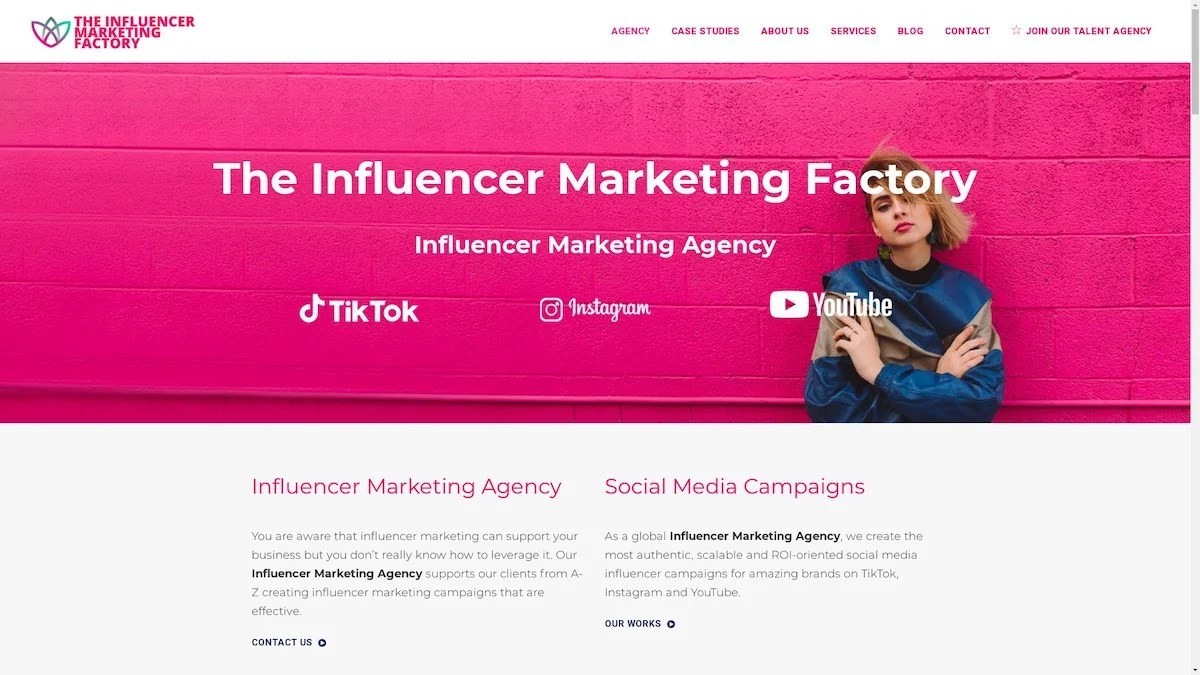
The Influencer Marketing Factory
TikTok, Instagram & YouTube CampaignsA full-service agency with strong TikTok expertise, offering end-to-end campaign management from influencer discovery through performance reporting with a focus on platform-native content.Clients: Google, Snapchat, Universal Music, Bumble, YelpVisit TIMF → -
6
NeoReach
Enterprise Analytics & Influencer CampaignsAn enterprise-focused agency combining managed campaigns with a powerful self-service data platform for influencer search, audience analytics, and attribution modeling.Clients: Amazon, Airbnb, Netflix, Honda, The New York TimesVisit NeoReach → -
7
Ubiquitous
Creator-First Marketing PlatformA tech-driven platform combining self-service tools with managed campaign options, emphasizing speed and scalability for brands managing multiple influencer relationships.Clients: Lyft, Disney, Target, American Eagle, NetflixVisit Ubiquitous → -
8
Obviously
Scalable Enterprise Influencer CampaignsA tech-enabled agency built for high-volume campaigns, coordinating hundreds of creators simultaneously with end-to-end logistics, content rights management, and product seeding.Clients: Google, Ulta Beauty, Converse, AmazonVisit Obviously →