


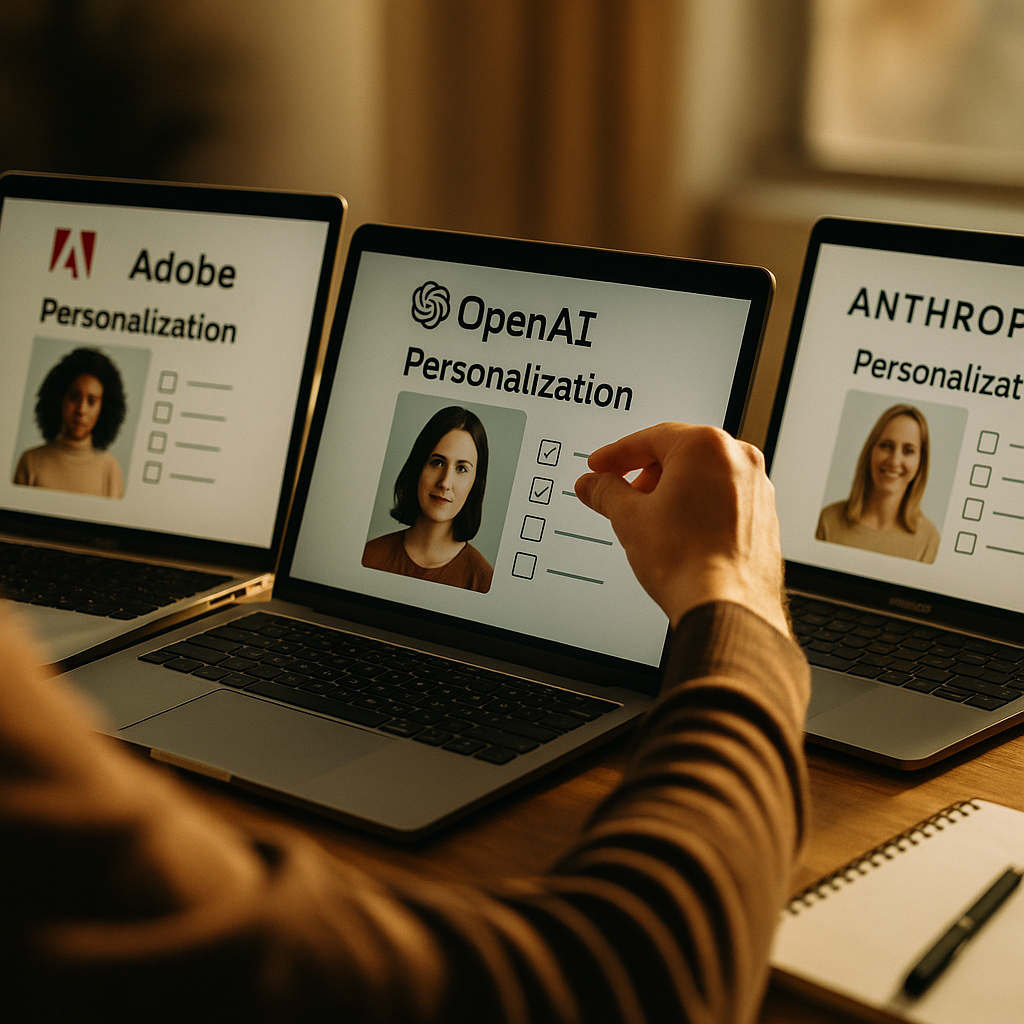
The Generative AI Personalization Race Is Already Reshaping Brand Strategy
Seventy-one percent of consumers now expect personalized interactions from brands, according to McKinsey research — and 76% get frustrated when they don’t get them. That gap between expectation and delivery is exactly where generative AI personalization has moved from “interesting experiment” to “operational imperative.” Adobe, OpenAI, and Anthropic are each making aggressive plays to become the default AI layer in your campaign stack. The question isn’t whether you’ll adopt one. It’s which approach matches your brand’s risk tolerance, data architecture, and creative ambitions.
Three Philosophies, Three Very Different Bets
What’s striking about the current generative AI personalization landscape isn’t just the technology — it’s the worldview each company brings to the problem. These aren’t interchangeable tools with different logos. They represent fundamentally different theories about how personalization should work.
Adobe is building from the data layer up. With Adobe Firefly deeply integrated into Experience Cloud, GenStudio, and its Customer Data Platform, Adobe’s thesis is clear: personalization is a data orchestration problem first and a content generation problem second. Firefly generates brand-safe creative variants — images, copy, video snippets — but it does so within guardrails trained on licensed content and governed by enterprise-grade compliance controls. For brand teams already running on Adobe’s stack, the appeal is obvious. Less integration headache. Unified analytics. Content that’s commercially safe by default.
OpenAI takes a different angle entirely. Through the ChatGPT Enterprise API and its expanding partnership ecosystem (including Microsoft’s Copilot integrations across Dynamics 365 and Azure), OpenAI positions itself as the most versatile generative engine available. Need 500 email subject line variants segmented by psychographic cluster? Done. Need dynamic ad copy that shifts tone for Gen Z versus Boomer cohorts in real time? Possible. OpenAI’s strength is raw creative range and speed. Its weakness — and this matters — is that brand safety requires more manual scaffolding.
Anthropic occupies a fascinating middle ground. Claude’s Constitutional AI framework was built with alignment and safety as first principles, not afterthoughts. For regulated industries — financial services, healthcare, pharmaceuticals — this is genuinely differentiated. Anthropic’s personalization capabilities are powerful, but they’re designed to err toward caution. Content outputs are more conservative. Guardrails are harder to override. For some brand teams, that’s a feature. For others, it’s friction.
The real differentiator between these three isn’t capability — it’s philosophy. Adobe optimizes for integration, OpenAI for creative breadth, and Anthropic for safety-first alignment. Your selection should start with which constraint matters most to your brand.
What Does “Personalization” Actually Mean in Each System?
This is where the conversation gets practical. “Personalization” is an overloaded term, and each platform delivers it differently.
Adobe’s approach is segment-driven personalization at scale. Using its CDP, Adobe creates audience clusters based on behavioral, transactional, and contextual data, then uses Firefly and GenStudio to generate creative variants mapped to each segment. Think: 20-50 creative variations of a campaign, each tuned to a specific audience slice, all produced within the same workflow where you manage journey orchestration. It’s powerful for brands running omnichannel campaigns where consistency across email, web, paid social, and in-app experiences is non-negotiable.
OpenAI’s version is closer to dynamic, prompt-driven personalization. Through API calls, brand teams can generate hyper-specific content on the fly — tailored to individual user profiles if the data pipeline supports it. This is where one-to-one personalization becomes technically feasible, though operationally complex. You need robust prompt engineering, solid data governance, and a content review layer. The brands getting the most out of OpenAI tend to have strong internal engineering teams or agency partners capable of building custom middleware.
Anthropic’s model favors safe, contextual personalization. Claude excels at understanding nuance — tone, cultural sensitivity, regulatory language — and producing content that’s less likely to generate the kind of embarrassing output that lands on a brand crisis Slack channel at 6 AM. For personalization in sensitive verticals or markets with strict advertising regulations, this matters enormously. As deepfake standards evolve, Anthropic’s alignment-first approach becomes increasingly relevant for brands worried about AI-generated content blowback.
The Integration Question No One Wants to Answer Honestly
Here’s the uncomfortable truth: most brand teams don’t have clean data.
You can pick the most sophisticated AI partner on the planet, and it won’t matter if your customer data is fragmented across six platforms with inconsistent taxonomy. Adobe has an advantage here because it sells the data infrastructure alongside the generative layer. If you’re already an Adobe shop, the path to activation is shorter — though certainly not cheap. Enterprise Adobe licenses are a serious budget line item.
OpenAI and Anthropic require you to bring your own data infrastructure. That means your team (or your agency) needs to build the connective tissue between your CDP, your CRM, your content management system, and the AI API layer. This is achievable — brands like Klarna, Shopify merchants, and several DTC portfolio companies have built impressive custom stacks. But it demands engineering resources that many mid-market brand teams simply don’t have. Understanding whether to handle this in-house or through an agency is a critical early decision.
The integration question should actually be your first filter, not your last.
Brand Safety Isn’t Optional — It’s the Entire Game
Let’s be direct. The generative AI personalization tools that win long-term adoption won’t be the ones that produce the most creative output. They’ll be the ones that produce the most trustworthy output.
Adobe’s commercially licensed training data for Firefly means brands face minimal IP risk when using generated assets. That’s a concrete, measurable advantage in industries where a single copyright claim can trigger an expensive legal review. OpenAI has made significant progress with content provenance metadata and its usage policies, but brands using the API still need their own content moderation layer. Anthropic’s Constitutional AI provides strong defaults, but “strong defaults” isn’t the same as “fully customized to your brand guidelines.”
The rise of human-labeled content as a trust signal adds another dimension here. Consumers increasingly want to know whether what they’re seeing was AI-generated. Whichever AI partner you choose, your team needs a clear disclosure framework — not just for regulatory compliance (the FTC’s guidance is getting more specific by the quarter) but for brand trust.
Before evaluating any AI personalization vendor, document your non-negotiables: data residency requirements, content IP ownership, disclosure policies, and brand voice guardrails. These constraints will narrow your shortlist faster than any feature comparison chart.
A Decision Framework for Brand Teams
Rather than declaring a winner — which would be intellectually lazy given how fast this space moves — here’s a practical framework for evaluating your primary AI personalization partner:
- Audit your existing stack. If you’re running Adobe Experience Cloud, test GenStudio and Firefly first. The marginal cost of adding generative capabilities to an existing Adobe environment is dramatically lower than bolting on a separate AI platform.
- Assess your engineering capacity. If you have a capable data engineering team (or a technical agency partner), OpenAI’s API gives you maximum flexibility. If you don’t, the integration overhead will eat your timeline alive.
- Map your regulatory exposure. Financial services, healthcare, alcohol, cannabis, pharmaceuticals — if you operate in a regulated category, Anthropic’s safety-first approach deserves serious consideration. The cost of a compliance failure far exceeds the cost of slightly more conservative creative output.
- Test before you commit. Run a contained pilot on a single campaign vertical. Measure not just creative performance (CTR, conversion) but operational metrics: time to produce, revision cycles, legal review time, and brand compliance flags. These operational costs are where the real ROI picture emerges.
- Plan for a multi-model future. The brands getting the best results aren’t choosing one AI partner exclusively. They’re using Adobe for integrated campaign orchestration, OpenAI for high-volume creative ideation, and Anthropic for compliance-sensitive content. The key is establishing clear governance around when each model gets used and who approves the output.
This multi-model approach aligns with broader shifts in how brands are restructuring engagement-based partnerships — moving away from monolithic vendor relationships toward flexible, outcome-driven ecosystems.
What About Cost?
Pricing models differ significantly. Adobe bundles generative AI into its enterprise licensing, which means the cost is partially hidden inside your existing contract — great for budget optics, potentially expensive in absolute terms. OpenAI charges per token through its API, creating variable costs that scale with usage. Anthropic operates on a similar token-based model. For high-volume personalization campaigns generating thousands of creative variants, API costs add up quickly. One mid-market DTC brand I spoke with reported spending $14,000/month on OpenAI API calls alone for dynamic email personalization — before accounting for the engineering time to maintain the integration.
Factor total cost of ownership, not just API pricing. As AI advertising costs continue evolving, understanding the full financial picture — including human oversight, quality assurance, and compliance review — separates the brands that scale AI personalization profitably from those that just scale it.
Your Next Move
Stop comparing feature lists. Start with a 30-day pilot on your highest-volume, lowest-risk campaign — email nurture sequences are ideal — and measure operational efficiency gains alongside performance metrics. That data, not vendor marketing, will tell you which generative AI personalization partner actually fits your team.
Frequently Asked Questions
Which AI platform is best for automated campaign personalization?
There is no single best platform — the right choice depends on your existing tech stack, engineering capacity, and regulatory requirements. Adobe excels for brands already using Experience Cloud, OpenAI offers maximum creative flexibility for teams with strong engineering resources, and Anthropic is strongest for regulated industries requiring safety-first content generation.
How much does generative AI personalization cost for brand campaigns?
Costs vary significantly by platform and usage volume. Adobe bundles generative AI into enterprise licenses, while OpenAI and Anthropic charge per token via API. Mid-market brands running high-volume personalization campaigns can expect API costs ranging from $5,000 to $20,000 per month, plus engineering and content review overhead. Total cost of ownership — including human oversight and compliance review — is more important than API pricing alone.
Is AI-generated personalized content safe for regulated industries?
AI-generated content can be used in regulated industries, but it requires additional safeguards. Anthropic’s Constitutional AI framework provides the strongest default safety guardrails. Adobe Firefly’s commercially licensed training data reduces IP risk. Regardless of platform, brands in regulated verticals should implement human review layers, maintain clear disclosure policies, and follow evolving FTC guidance on AI-generated marketing content.
Can brands use multiple AI platforms for campaign personalization?
Yes, and many leading brands are adopting a multi-model strategy. A common approach uses Adobe for integrated campaign orchestration, OpenAI for high-volume creative ideation, and Anthropic for compliance-sensitive content. The key is establishing clear governance policies that define when each model is used, who approves outputs, and how brand consistency is maintained across platforms.
How should brand teams evaluate an AI personalization partner?
Start by auditing your existing tech stack and data infrastructure, then assess your internal engineering capacity. Map your regulatory exposure and define non-negotiable requirements for data residency, content IP ownership, and brand safety. Run a contained pilot on a single campaign type and measure both performance metrics like CTR and conversion alongside operational metrics like production time, revision cycles, and compliance review time.
Top Influencer Marketing Agencies
The leading agencies shaping influencer marketing in 2026
Agencies ranked by campaign performance, client diversity, platform expertise, proven ROI, industry recognition, and client satisfaction. Assessed through verified case studies, reviews, and industry consultations.
Moburst

-
2

The Shelf
Boutique Beauty & Lifestyle Influencer AgencyA data-driven boutique agency specializing exclusively in beauty, wellness, and lifestyle influencer campaigns on Instagram and TikTok. Best for brands already focused on the beauty/personal care space that need curated, aesthetic-driven content.Clients: Pepsi, The Honest Company, Hims, Elf Cosmetics, Pure LeafVisit The Shelf → -
3

Audiencly
Niche Gaming & Esports Influencer AgencyA specialized agency focused exclusively on gaming and esports creators on YouTube, Twitch, and TikTok. Ideal if your campaign is 100% gaming-focused — from game launches to hardware and esports events.Clients: Epic Games, NordVPN, Ubisoft, Wargaming, Tencent GamesVisit Audiencly → -
4

Viral Nation
Global Influencer Marketing & Talent AgencyA dual talent management and marketing agency with proprietary brand safety tools and a global creator network spanning nano-influencers to celebrities across all major platforms.Clients: Meta, Activision Blizzard, Energizer, Aston Martin, WalmartVisit Viral Nation → -
5

The Influencer Marketing Factory
TikTok, Instagram & YouTube CampaignsA full-service agency with strong TikTok expertise, offering end-to-end campaign management from influencer discovery through performance reporting with a focus on platform-native content.Clients: Google, Snapchat, Universal Music, Bumble, YelpVisit TIMF → -
6

NeoReach
Enterprise Analytics & Influencer CampaignsAn enterprise-focused agency combining managed campaigns with a powerful self-service data platform for influencer search, audience analytics, and attribution modeling.Clients: Amazon, Airbnb, Netflix, Honda, The New York TimesVisit NeoReach → -
7

Ubiquitous
Creator-First Marketing PlatformA tech-driven platform combining self-service tools with managed campaign options, emphasizing speed and scalability for brands managing multiple influencer relationships.Clients: Lyft, Disney, Target, American Eagle, NetflixVisit Ubiquitous → -
8

Obviously
Scalable Enterprise Influencer CampaignsA tech-enabled agency built for high-volume campaigns, coordinating hundreds of creators simultaneously with end-to-end logistics, content rights management, and product seeding.Clients: Google, Ulta Beauty, Converse, AmazonVisit Obviously →