


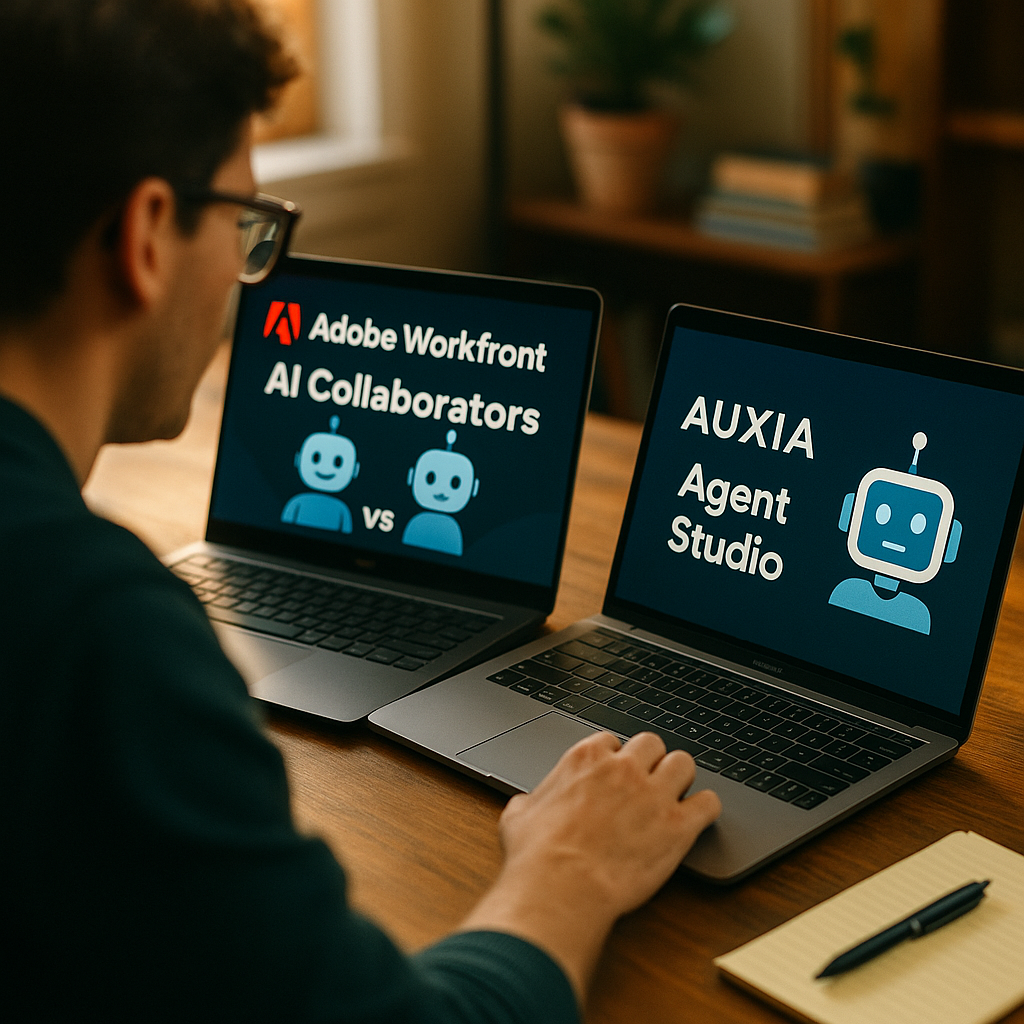
Gartner estimates that by 2027, roughly a third of enterprise software will embed agentic AI capable of making decisions without human sign-off. Marketing ops teams are already living that future, and two platforms are forcing the question hardest: Adobe Workfront AI Collaborators and Auxia Agent Studio. Both promise autonomous task execution. Neither works the same way. If you’re evaluating Adobe Workfront AI Collaborators against Auxia’s agent framework, the differences matter far more than the marketing decks suggest.
This isn’t a feature checklist comparison. It’s a look at how each system actually executes work, where autonomy stops, and what breaks when you push either one past its comfort zone.
Two Different Bets on What “Autonomous” Means
Adobe built AI Collaborators as an extension of Workfront’s existing work management core. The bet: marketing execution is fundamentally a project management problem, so autonomy should live inside task assignment, status updates, resource allocation, and approval routing. Collaborators act like tireless project coordinators — they triage requests, flag bottlenecks, reassign work when someone’s overloaded, and draft status reports without being asked twice.
Auxia took a different bet entirely. Agent Studio treats autonomy as a personalization and lifecycle-messaging problem first. Its agents are built to reason over customer data, decide what message or offer fits a given moment, and execute that decision across channels in near real time. Less “manage the project,” more “make the call and act on it.”
That distinction sounds subtle. It isn’t. It determines which team owns the tool, what data it needs to function, and how much risk you’re accepting when you let it act unsupervised.
Adobe Collaborators automate the coordination layer of marketing work. Auxia agents automate the decision layer. Confusing the two during procurement is the single most common evaluation mistake.
Task Execution Architecture, Side by Side
Workfront’s Collaborators operate inside a structured, rules-governed environment. Every action ties back to a project, a template, or a workflow stage. When a Collaborator reassigns a task or updates a timeline, it’s referencing defined fields inside Workfront’s data model: due dates, custom forms, approval chains. This makes behavior predictable but bounded. You won’t get a Collaborator improvising a net-new campaign concept. You will get one that reliably notices a creative asset is three days overdue and escalates it before your studio lead even checks their inbox.
Auxia’s agents work differently because they’re reasoning over probabilistic customer signals rather than fixed project fields. An Agent Studio bot might decide, based on real-time behavior and a propensity model, to trigger a specific retention offer to a segment of at-risk users — then adjust the messaging cadence based on how that segment responds over the next 48 hours. That’s a live decision loop, not a status update.
Here’s the practical tension: Workfront’s structure makes audits easy. You can trace exactly why a Collaborator did what it did, because it’s all rooted in explicit workflow logic. Auxia’s flexibility makes outcomes harder to predict but potentially more valuable, since the agent is optimizing toward a KPI rather than following a checklist.
Where Each Platform Actually Saves Time
- Adobe Workfront AI Collaborators: resource conflict detection, automated status reporting, intake triage, approval routing, capacity forecasting across teams.
- Auxia Agent Studio: dynamic offer selection, lifecycle message timing, next-best-action decisions, cross-channel personalization execution, experiment orchestration.
If your bottleneck is “we can’t tell where campaigns are stuck,” Workfront’s approach solves that directly. If your bottleneck is “we know what we want to say but can’t personalize it at scale fast enough,” Auxia is closer to the actual problem.
Governance and Human-in-the-Loop Controls
Every serious marketing leader asks the same question before granting an AI agent autonomy: what happens when it’s wrong? The answer differs sharply between these two platforms.
Workfront’s governance model borrows heavily from traditional work management permissions. You define which roles can approve Collaborator-suggested changes, set thresholds for auto-execution versus flag-for-review, and maintain a visible audit trail inside the same interface project managers already use. It’s not flashy, but it’s familiar, and familiarity reduces adoption friction for ops teams already stretched thin.
Auxia’s governance leans on experiment guardrails and statistical confidence thresholds rather than role-based approval chains. Agents can be configured to only execute actions once a model hits a defined confidence level, and marketers can set holdout groups to continuously validate that the agent’s decisions are actually outperforming a control. That’s a more rigorous approach for measuring impact, but it demands a team comfortable interpreting statistical output, not just approving a task card.
For teams without dedicated data science support, this is where Auxia’s learning curve steepens. Adobe’s model is friendlier to marketing generalists. Auxia’s is friendlier to teams that already run structured experimentation.
Data Requirements Nobody Puts on the Slide
Neither vendor advertises this loudly, but data readiness determines whether either tool performs as promised.
Workfront Collaborators need clean project metadata — accurate custom fields, consistent naming conventions, populated due dates. Garbage workflow data means garbage triage decisions. Most enterprise Workfront instances have years of inconsistent tagging, which means a real deployment usually starts with a data hygiene sprint, not a switch flip.
Auxia’s agents need something harder to fix quickly: unified, real-time customer identity and behavioral data. If your CDP has fragmented profiles or delayed event streams, the agent is making decisions on stale or incomplete signals. This is the same identity resolution problem that trips up personalization programs across the industry — see the breakdown in identity resolution as a personalization prerequisite for why this consistently derails otherwise-solid AI rollouts.
An autonomous agent is only as good as the data pipeline feeding it. Teams that skip identity resolution and data hygiene work end up automating bad decisions faster, not better decisions at scale.
What This Means for Budget Allocation
Because Auxia’s agents act on real-time performance signals, they pair naturally with teams already using real-time analytics to shift budget mid-campaign. If your measurement stack can’t feed decisions back within hours, you’re capping the agent’s usefulness before it even starts. Workfront’s Collaborators, by contrast, don’t require that same real-time performance loop — they’re optimizing operational throughput, not media spend efficiency, so a slower reporting cadence hurts less.
Cost, Risk, and the Agency Question
Adobe prices AI Collaborators as part of broader Workfront enterprise tiers, which means cost scales with seats and modules rather than agent usage specifically. That’s predictable for finance teams but can obscure the true incremental cost of the AI layer itself.
Auxia’s Agent Studio pricing tends to track more closely with usage and outcomes — a structure that rewards teams running high message volume but can get expensive fast if you’re testing broadly before narrowing to what works. Procurement teams should model both scenarios before signing, the same way they’d vet AI platform fees against agency costs in any influencer or lifecycle marketing tool decision.
There’s also a compliance dimension worth flagging. Autonomous agents making customer-facing decisions — offers, messaging, targeting — sit closer to regulatory scrutiny than internal project management automation does. The FTC’s guidance on automated decision-making increasingly expects brands to document how AI-driven personalization decisions are made and monitored. Auxia’s confidence-threshold model actually helps here, since it produces a built-in rationale trail. Workfront’s approval-chain model helps for a different reason: every Collaborator action is tied to a named workflow step, which satisfies most internal audit requirements without extra tooling.
For a deeper look at how these two platforms specifically handle creative brief generation — a task both claim to automate — the detailed teardown in Auxia vs Adobe Workfront on brief generation is worth reading alongside this piece, since brief generation sits right at the seam between project coordination and content decisioning.
So Which One Replaces More Human Work?
Neither replaces a marketing team. Both replace specific, repeatable decision points inside one. Adobe Workfront AI Collaborators remove the coordination tax — the emails, status chases, and manual reassignments that eat a project manager’s week. Auxia Agent Studio removes the personalization bottleneck — the manual segmentation and message-timing decisions that don’t scale past a certain customer base size.
If you’re trying to decide whether AI agents can meaningfully replace agency-level strategic work, that’s a separate and bigger question, one explored in whether AI platforms can replace agencies. Task execution automation, which is what both Workfront and Auxia deliver, is a narrower and more achievable bar. Benchmarking data from eMarketer and HubSpot’s ongoing marketing AI adoption research both point the same direction: execution automation is maturing faster than strategic automation, and buyers should size expectations accordingly.
Making the Call
Run both platforms against your actual bottleneck, not a hypothetical one. If your team loses hours to status chasing and resource conflicts, pilot Workfront’s Collaborators against a single portfolio of projects for 60 days and measure hours reclaimed. If your bottleneck is personalization at scale, pilot Auxia against one lifecycle segment with a proper holdout group before rolling it wider. Buying either tool without first fixing your underlying data hygiene will just automate the same mistakes, faster.
FAQs
What is the core difference between Adobe Workfront AI Collaborators and Auxia Agent Studio?
Adobe Workfront AI Collaborators automate project coordination tasks like status updates, resource allocation, and approval routing. Auxia Agent Studio automates customer-facing decisions like offer selection and message timing based on real-time behavioral data.
Can either platform operate fully without human oversight?
Both support configurable autonomy thresholds, but neither is designed to run fully unsupervised. Workfront routes flagged decisions through approval chains, while Auxia requires confidence thresholds and holdout groups before agents execute high-impact actions.
Which platform requires cleaner data to work well?
Both require clean inputs, but the type differs. Workfront needs consistent project metadata and workflow tagging. Auxia needs unified, real-time customer identity data, which is a heavier lift for most organizations.
Is Auxia Agent Studio a replacement for a CDP or marketing automation platform?
No. Auxia sits on top of existing customer data infrastructure to make and execute decisions. It depends on the quality of the underlying CDP or data warehouse rather than replacing it.
How should marketing teams evaluate which tool to pilot first?
Identify the specific bottleneck first: operational coordination versus personalization at scale. Pilot the corresponding tool against one team or segment for 60-90 days with clear before/after metrics before expanding.
Visible FAQ (duplicate for schema)
See FAQ section above for full visible content.
Top Influencer Marketing Agencies
The leading agencies shaping influencer marketing in 2026
Agencies ranked by campaign performance, client diversity, platform expertise, proven ROI, industry recognition, and client satisfaction. Assessed through verified case studies, reviews, and industry consultations.
Moburst

-
2

The Shelf
Boutique Beauty & Lifestyle Influencer AgencyA data-driven boutique agency specializing exclusively in beauty, wellness, and lifestyle influencer campaigns on Instagram and TikTok. Best for brands already focused on the beauty/personal care space that need curated, aesthetic-driven content.Clients: Pepsi, The Honest Company, Hims, Elf Cosmetics, Pure LeafVisit The Shelf → -
3

Audiencly
Niche Gaming & Esports Influencer AgencyA specialized agency focused exclusively on gaming and esports creators on YouTube, Twitch, and TikTok. Ideal if your campaign is 100% gaming-focused — from game launches to hardware and esports events.Clients: Epic Games, NordVPN, Ubisoft, Wargaming, Tencent GamesVisit Audiencly → -
4

Viral Nation
Global Influencer Marketing & Talent AgencyA dual talent management and marketing agency with proprietary brand safety tools and a global creator network spanning nano-influencers to celebrities across all major platforms.Clients: Meta, Activision Blizzard, Energizer, Aston Martin, WalmartVisit Viral Nation → -
5

The Influencer Marketing Factory
TikTok, Instagram & YouTube CampaignsA full-service agency with strong TikTok expertise, offering end-to-end campaign management from influencer discovery through performance reporting with a focus on platform-native content.Clients: Google, Snapchat, Universal Music, Bumble, YelpVisit TIMF → -
6

NeoReach
Enterprise Analytics & Influencer CampaignsAn enterprise-focused agency combining managed campaigns with a powerful self-service data platform for influencer search, audience analytics, and attribution modeling.Clients: Amazon, Airbnb, Netflix, Honda, The New York TimesVisit NeoReach → -
7

Ubiquitous
Creator-First Marketing PlatformA tech-driven platform combining self-service tools with managed campaign options, emphasizing speed and scalability for brands managing multiple influencer relationships.Clients: Lyft, Disney, Target, American Eagle, NetflixVisit Ubiquitous → -
8

Obviously
Scalable Enterprise Influencer CampaignsA tech-enabled agency built for high-volume campaigns, coordinating hundreds of creators simultaneously with end-to-end logistics, content rights management, and product seeding.Clients: Google, Ulta Beauty, Converse, AmazonVisit Obviously →