


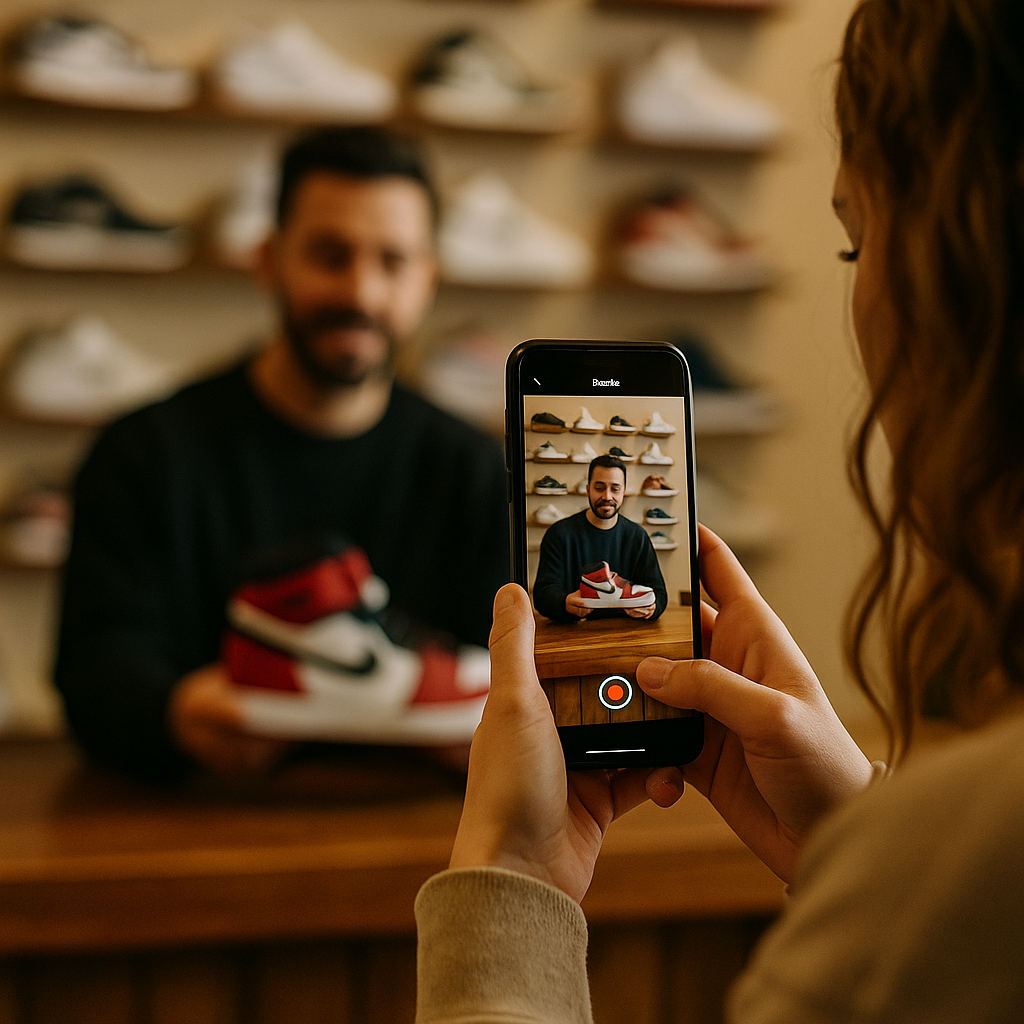
National sneaker chains outspend local boutiques on media by orders of magnitude. So how did a single-location shop in a mid-sized metro grow walk-in traffic 34% while Foot Locker and Champs ran regional promotions next door? Instagram Reels lifestyle content — not product drops, not discount codes, just relentless local storytelling.
This case study breaks down what the shop actually did, why it worked, and what any independent retailer can steal from the playbook without a national ad budget.
The Setup: A Boutique Squeezed From Every Direction
The retailer in question — we’ll call it Heel Turn, since the owner asked for anonymity given ongoing brand partnerships — operates one store in a college town of roughly 120,000 people. Two national chains and a big-box sporting goods store sit within a 15-minute drive. Same sneaker releases, often the same allocation dates, and pricing the boutique can’t undercut.
Foot traffic had been sliding for two years before the pivot. Release-day lines, once the store’s bread and butter, thinned out as customers realized they could get the same shoe at the mall with a loyalty app and a coupon. The owner’s diagnosis was blunt: “We were competing on inventory we didn’t control, against companies with better logistics. That’s a losing game.”
The fix wasn’t a new POS system or a loyalty program. It was a content strategy built almost entirely on Instagram Reels, treating the store less like a retailer and more like a local media brand.
When you can’t win on price or exclusivity, the only remaining lever is relationship — and short-form video is the cheapest way to build one at scale.
Why Reels, Not Discounts?
The owner’s team ran the math on customer acquisition cost for paid promotions versus organic content and found paid social wasn’t sustainable for a single-location business. Meta’s ad platform rewards budget, and national chains simply have more of it. Organic Reels, by contrast, rewards consistency and relevance to a local audience — something a boutique can actually win.
Instagram’s algorithm has also been increasingly generous to Reels with strong completion rates, per Meta’s own business guidance, which favors watch-through over follower count. That’s a meaningful equalizer for a small account competing against chains with six-figure follower totals but generic, corporate content.
So the strategy shifted entirely: stop selling shoes in the content, and start selling the neighborhood.
The Content Formula
Three Reels formats made up roughly 80% of the account’s output over the campaign window:
- “Fit checks” filmed on actual local streets — outside the campus library, the farmers market, the skate park two blocks away — rather than in-store on a plain backdrop.
- Staff personality content, including a recurring “new hire tries to guess the price” bit that consistently outperformed product-focused posts by 3-4x on watch time.
- Community tie-ins: local basketball league highlights, sponsorship of a high school track team, and cameos from regulars who’d become semi-recognizable in the feed.
None of this required a production budget. Most Reels were shot on an iPhone in under 20 minutes and edited using CapCut. The constraint wasn’t equipment — it was discipline. The team posted four to five times a week for eleven straight months without a break, even during slow sales periods.
The Numbers That Mattered
Over the eleven-month run, the account grew from roughly 4,200 followers to just under 19,000. But the owner is quick to point out that follower count wasn’t the metric that mattered to the business.
The metrics that tied back to revenue:
- Walk-in traffic on non-release days rose 34% year-over-year, measured through door-counter hardware already installed for loss prevention.
- “Saw you on Instagram” mentions at checkout, tracked informally by staff, became the single most cited discovery source, ahead of Google Search and word of mouth combined.
- Average basket size on Reels-driven visits was 18% higher than baseline, likely because customers arrived already primed on apparel and accessories featured in lifestyle content, not just the sneaker itself.
Engagement rate on Reels averaged around 6.8%, well above the low single-digit benchmarks Sprout Social’s industry benchmarking data typically reports for retail accounts of similar size. That gap is the entire thesis: hyperlocal specificity beats generic brand polish when your audience is geographically concentrated.
What Actually Drove the Retention, Not Just the Reach
Reach is vanity if it doesn’t convert to repeat visits. Three structural choices kept people coming back rather than just watching and scrolling past.
First, faces over products. The store’s three-person staff appeared in nearly every Reel. Customers started recognizing employees by name before ever setting foot in the store — a dynamic close to what independent creators build with subscribers, except applied to a physical retail location. It’s the same principle behind why unretouched, personality-driven content tends to outperform polished brand campaigns: audiences trust people, not logos.
Second, geographic specificity. Every location tag, every background landmark, every mention of a nearby event was intentional. This wasn’t lifestyle content that could have been filmed anywhere — it was content that could only have come from that town, which made it nearly impossible for a national chain’s marketing team to replicate authentically.
Third, a posting cadence with zero gaps. The owner credits sheer consistency more than any single viral moment. No individual Reel broke 100,000 views. The compounding effect of showing up daily, in the same recognizable style, is what built the habit loop. This mirrors a pattern seen across creator-led retail strategies more broadly — for instance, the nano-creator seeding approach Stanley used to avoid the viral trap, favoring steady, repeatable exposure over one-off spikes.
Where Paid Spend Actually Helped
The store didn’t go fully organic. Roughly $600 a month went toward boosting the highest-performing organic Reels to a hyperlocal radius audience, rather than building new ad creative from scratch. That’s a meaningfully different approach than the always-produce-new-ads model many brands default to, and it’s closer to the logic behind rapid ad testing frameworks that prioritize amplifying proven content over guessing at new creative.
The team also experimented briefly with paying two local micro-influencers (under 8,000 followers each) for sneaker styling content, a tactic that echoes the broader shift toward micro-influencer programs driving outsized returns relative to their cost. Results were mixed — one creator’s audience overlapped almost entirely with the store’s existing customer base, delivering little incremental reach.
Where It Could Have Gone Wrong
A few risk factors are worth naming plainly, because they’re the reason most local retailers abandon Reels strategies within a few months.
Burnout. Posting five times a week with a three-person staff is not sustainable indefinitely without a content calendar and batching system. The owner eventually moved to filming a week’s worth of content in a single Sunday session, which cut production time by roughly 60%.
Disclosure and compliance drift. Once paid partnerships with micro-influencers entered the mix, the store had to get serious about disclosure practices to stay aligned with FTC endorsement guidelines. Even at the local level, an unlabeled paid post creates real regulatory exposure, and it’s a mistake bigger brands have made publicly and expensively.
Platform dependency. Building an entire local marketing strategy on one algorithm is inherently risky. If Instagram deprioritizes Reels or changes distribution logic tomorrow, foot traffic tied to that channel takes an immediate hit. The store has since started repurposing top Reels to TikTok and YouTube Shorts as a hedge, a diversification move similar to what’s discussed in Duolingo’s cross-platform repurposing approach.
What This Means for Brands and Agencies Managing Local Retail Clients
If you’re an agency handling a multi-location or franchise retail client, the temptation is to standardize content across every store. This case argues against that instinct. The Reels that performed best were the ones that could not have come from any other location — and that specificity is exactly what national competitors structurally cannot copy at scale.
For brand strategists evaluating budget allocation between paid media and organic creator-style content, the ROI math here is instructive: <$10,000 in total spend over eleven months produced measurable, attributable foot traffic gains that a comparable paid campaign at national chain volume would have cost many multiples more to achieve.
FAQs
How much budget does a local retailer need to run a strategy like this?
This case study ran on roughly $600 a month in boosted post spend, plus staff time for filming and editing. The core investment was consistency, not cash — most Reels cost nothing beyond a phone and 20 minutes of staff time.
Can this approach work for retailers without a distinct local identity to lean on?
Yes, but it requires more deliberate effort to manufacture local relevance — partnering with nearby events, sports teams, schools, or other businesses to create the geographic specificity that made this strategy effective.
How do you measure ROI from Reels when there’s no direct e-commerce link?
Track it through proxies: door-counter traffic on non-promotional days, staff-logged discovery mentions at checkout, and basket size comparisons between Reels-attributed visits and baseline foot traffic.
Is Instagram Reels still the best platform for this kind of local retail strategy?
It performed best in this case due to the store’s existing audience demographics, but the underlying strategy — consistent, hyperlocal, personality-driven short-form video — transfers to TikTok and YouTube Shorts with minimal adjustment.
What’s the biggest mistake local retailers make when trying to copy this playbook?
Treating it as a short-term campaign instead of a sustained habit. The compounding effect only shows up after months of consistent posting, not weeks.
FAQs
How much budget does a local retailer need to run a strategy like this?
This case study ran on roughly $600 a month in boosted post spend, plus staff time for filming and editing. The core investment was consistency, not cash — most Reels cost nothing beyond a phone and 20 minutes of staff time.
Can this approach work for retailers without a distinct local identity to lean on?
Yes, but it requires more deliberate effort to manufacture local relevance — partnering with nearby events, sports teams, schools, or other businesses to create the geographic specificity that made this strategy effective.
How do you measure ROI from Reels when there’s no direct e-commerce link?
Track it through proxies: door-counter traffic on non-promotional days, staff-logged discovery mentions at checkout, and basket size comparisons between Reels-attributed visits and baseline foot traffic.
Is Instagram Reels still the best platform for this kind of local retail strategy?
It performed best in this case due to the store’s existing audience demographics, but the underlying strategy — consistent, hyperlocal, personality-driven short-form video — transfers to TikTok and YouTube Shorts with minimal adjustment.
What’s the biggest mistake local retailers make when trying to copy this playbook?
Treating it as a short-term campaign instead of a sustained habit. The compounding effect only shows up after months of consistent posting, not weeks.
The lesson for any independent retailer watching national chains encroach: you don’t need their budget, you need their attention span. Pick a cadence you can sustain for a full year, film where your customers actually live their lives, and let consistency do the compounding work that ad spend can’t buy.
Top Influencer Marketing Agencies
The leading agencies shaping influencer marketing in 2026
Agencies ranked by campaign performance, client diversity, platform expertise, proven ROI, industry recognition, and client satisfaction. Assessed through verified case studies, reviews, and industry consultations.
Moburst

-
2

The Shelf
Boutique Beauty & Lifestyle Influencer AgencyA data-driven boutique agency specializing exclusively in beauty, wellness, and lifestyle influencer campaigns on Instagram and TikTok. Best for brands already focused on the beauty/personal care space that need curated, aesthetic-driven content.Clients: Pepsi, The Honest Company, Hims, Elf Cosmetics, Pure LeafVisit The Shelf → -
3

Audiencly
Niche Gaming & Esports Influencer AgencyA specialized agency focused exclusively on gaming and esports creators on YouTube, Twitch, and TikTok. Ideal if your campaign is 100% gaming-focused — from game launches to hardware and esports events.Clients: Epic Games, NordVPN, Ubisoft, Wargaming, Tencent GamesVisit Audiencly → -
4

Viral Nation
Global Influencer Marketing & Talent AgencyA dual talent management and marketing agency with proprietary brand safety tools and a global creator network spanning nano-influencers to celebrities across all major platforms.Clients: Meta, Activision Blizzard, Energizer, Aston Martin, WalmartVisit Viral Nation → -
5

The Influencer Marketing Factory
TikTok, Instagram & YouTube CampaignsA full-service agency with strong TikTok expertise, offering end-to-end campaign management from influencer discovery through performance reporting with a focus on platform-native content.Clients: Google, Snapchat, Universal Music, Bumble, YelpVisit TIMF → -
6

NeoReach
Enterprise Analytics & Influencer CampaignsAn enterprise-focused agency combining managed campaigns with a powerful self-service data platform for influencer search, audience analytics, and attribution modeling.Clients: Amazon, Airbnb, Netflix, Honda, The New York TimesVisit NeoReach → -
7

Ubiquitous
Creator-First Marketing PlatformA tech-driven platform combining self-service tools with managed campaign options, emphasizing speed and scalability for brands managing multiple influencer relationships.Clients: Lyft, Disney, Target, American Eagle, NetflixVisit Ubiquitous → -
8

Obviously
Scalable Enterprise Influencer CampaignsA tech-enabled agency built for high-volume campaigns, coordinating hundreds of creators simultaneously with end-to-end logistics, content rights management, and product seeding.Clients: Google, Ulta Beauty, Converse, AmazonVisit Obviously →