


Nearly 60% of product searches now end without a click, according to Sprout Social research on zero-click search behavior. If your brand isn’t showing up inside ChatGPT, Perplexity, or Google’s AI Overviews, you’re invisible to a growing share of buyers. That’s why Answer Engine Optimization vendors have multiplied overnight, and why picking the wrong one wastes budget you don’t have to burn twice.
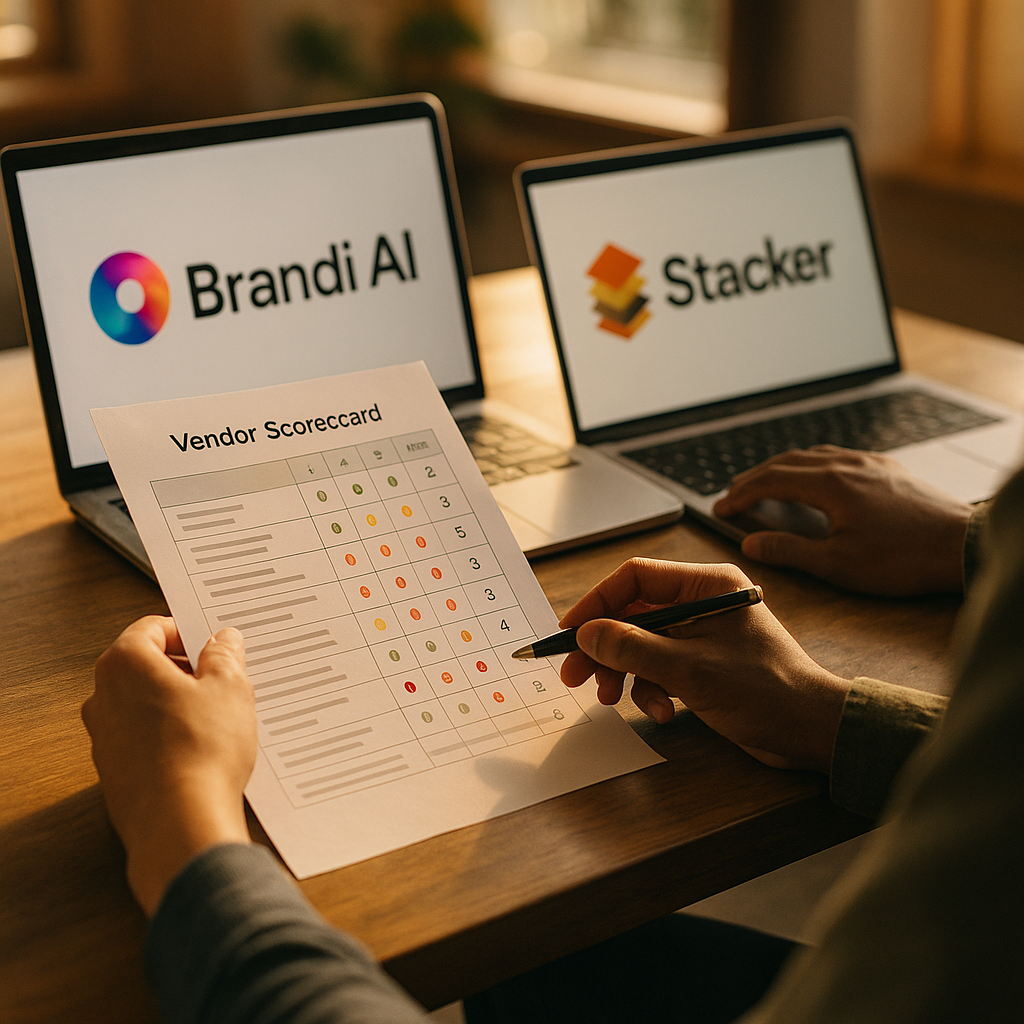
This isn’t a hype piece about AEO being “the new SEO.” It’s a scorecard. Use it before you sign a contract with Brandi AI, Stacker, or any of the dozen newcomers pitching your CMO this quarter.
Why AEO Vendor Selection Is Suddenly a Board-Level Question
Six months ago, most marketing leaders hadn’t heard the term “answer engine optimization.” Now it’s showing up in budget decks next to paid search and SEO line items. The shift makes sense: large language models are answering questions that used to drive traffic to your site, and if your brand isn’t cited, quoted, or recommended in that answer, you lose the impression entirely.
Vendors sensed the opportunity fast. Brandi AI built its pitch around brand-visibility tracking across multiple LLMs. Stacker leaned into content structuring and schema optimization for machine readability. A wave of smaller players — some spun out of traditional SEO agencies, others venture-backed startups with no search pedigree at all — now claim they can get your brand “cited by ChatGPT.” Some can. Many can’t prove it.
The core problem: there’s no industry-standard measurement framework for AEO yet, which means every vendor is grading its own homework.
That’s the risk brand teams need to manage. Without agreed-upon metrics, a vendor can show you a dashboard full of green checkmarks that means almost nothing. This scorecard exists to give you your own yardstick, independent of whatever the vendor’s sales deck says.
The Seven Criteria That Actually Matter
Forget feature lists. Most AEO tools look similar on a demo call — dashboards, citation trackers, “share of voice” scores. What separates a vendor worth paying from one worth walking away from comes down to seven operational questions.
- Model coverage. Does the vendor track visibility across ChatGPT, Perplexity, Gemini, Copilot, and Google AI Overviews, or just one or two? A tool that only monitors ChatGPT is measuring maybe half your actual exposure.
- Data refresh cadence. LLM outputs change as models retrain and as retrieval layers pull fresher web data. Weekly refreshes are table stakes now; monthly is too slow to catch a citation drop before it costs you a quarter of traffic.
- Attribution methodology. How does the vendor prove a citation or recommendation actually influenced a conversion? Ask for the underlying methodology, not just the output metric.
- Content prescription quality. Does the platform tell you what to fix, or just what’s broken? Diagnosis without a remediation path is a report, not a tool.
- Structured data integration. AEO performance is tightly linked to how well your schema markup and structured content feed retrieval systems. This overlaps heavily with technical SEO work — see our structured data audit framework for the baseline every vendor should be checking.
- Pricing transparency. Watch for vague “custom enterprise pricing” that hides scope creep. Ask what happens when you add a new brand, market, or product line mid-contract.
- Data portability. Can you export historical citation data if you switch vendors? Some platforms lock you into proprietary scoring systems that don’t translate anywhere else.
Score each vendor 1-5 on these seven dimensions before any contract conversation. It sounds tedious. It is tedious. It’s also cheaper than discovering three months in that your “AEO platform” was really just a rebranded rank tracker.
Brandi AI: Strong on Monitoring, Thinner on Prescription
Brandi AI has positioned itself as a brand-visibility monitor for the AI era — think of it as a listening tool that tells you where and how often your brand shows up across major LLM outputs. Its strength is breadth: multi-model tracking, sentiment scoring within AI-generated answers, and competitive benchmarking against named rivals.
Where it gets thinner is prescriptive guidance. Knowing that your brand appears in 12% of relevant ChatGPT answers versus a competitor’s 34% is useful diagnostic data. Knowing exactly which content changes will close that gap is a different capability, and it’s where Brandi AI leans more on account management than automated recommendations. If your team already has strong content and technical SEO resources, that’s fine — you just need the signal, not the playbook. If you’re leaner, budget for the extra strategic layer separately.
Stacker’s Bet on Structured Content
Stacker takes a different angle. Rather than leading with visibility dashboards, it leads with content architecture: schema implementation, entity clarity, and structured data hygiene designed to make your site easier for retrieval-augmented generation systems to parse and cite. It’s a more technical, more upstream approach.
The tradeoff is measurement. Stacker’s reporting on actual citation lift is less mature than its content tooling. That’s not necessarily disqualifying — a lot of AEO’s near-term value is genuinely upstream, in getting your content machine-readable in the first place — but don’t expect the same granular “here’s exactly how many times you were cited this week” reporting you’d get from a monitoring-first tool. Pair it with your own AI referral tracking in GA4 if you want closed-loop attribution.
What About the Newer Entrants?
A crop of smaller AEO vendors has launched in the past year, mostly spinning out of technical SEO agencies or generative-AI consultancies. Evaluating them is harder because there’s less public track record. A few practical filters:
- Ask for client references in your vertical. AEO performance varies wildly by category. A tool that works well for SaaS content may do nothing for a DTC apparel brand where LLMs pull differently structured product data.
- Check whether they built proprietary infrastructure or wrap someone else’s API. Many “emerging” vendors are thin layers over the same underlying LLM query tools. That’s not automatically bad, but it affects pricing power and roadmap control.
- Look for integration with your existing martech stack. A standalone AEO dashboard that doesn’t talk to your CDP or analytics platform creates another reporting silo. If you’ve already dealt with fragmented data pipelines, you know how that story ends — see our take on CDP consolidation challenges for the pattern.
Newer doesn’t mean worse. Some of the sharpest AEO thinking right now is coming from smaller, founder-led teams who aren’t burdened by legacy SEO tooling assumptions. But newer does mean higher risk, and risk needs to be priced into the contract — shorter terms, clearer exit clauses, and a trial period tied to specific KPIs rather than vague “brand visibility improvement.”
Building the Scorecard Into Your Procurement Process
Here’s how to actually operationalize this rather than let it sit in a slide deck. Before any vendor demo, define three things internally: your top 10 target queries where AI citation matters most, your current baseline visibility (even a rough manual check across ChatGPT and Perplexity counts), and your budget ceiling inclusive of any implementation or content-remediation work the vendor will push back to your team.
Then run every vendor pitch through the same seven-point scorecard above, scored by the same person or small committee, not by whoever happened to take the sales call. Vendor demos are optimized to impress; a consistent internal scorer neutralizes some of that.
Treat the first 90 days as a trial, not a commitment. Any vendor unwilling to tie a portion of fees to measurable citation-share improvement is telling you something about their own confidence.
One more thing worth flagging: AEO overlaps meaningfully with broader questions about how AI agents discover and recommend brands, which touches commerce protocols and machine-readable product data too. If your team is also evaluating AI agent platforms or agentic commerce infrastructure, loop those conversations together. They’re converging fast, and siloed vendor decisions now create integration headaches later. For context on how fragmented this landscape already is, see our review of emerging AI protocol standards reshaping martech procurement generally.
Where Budget Actually Belongs
If you’re forced to choose one investment right now, structured data and content quality beat monitoring dashboards. You can’t optimize what you can’t measure, sure, but you also can’t fix what you haven’t built to be machine-readable in the first place. HubSpot’s own research on AI search behavior backs this: content clarity and entity consistency correlate more strongly with citation frequency than raw domain authority.
Translation: spend on the foundation before you spend on the dashboard telling you the foundation is weak.
The Takeaway
Run every AEO vendor pitch through the seven-point scorecard above before signing anything, tie at least part of the contract to measurable citation-share gains within 90 days, and prioritize structured content work over flashy monitoring dashboards if budget forces a tradeoff.
FAQs
What is Answer Engine Optimization and how is it different from SEO?
Answer Engine Optimization focuses on getting a brand cited, quoted, or recommended inside AI-generated answers from tools like ChatGPT, Perplexity, and Google AI Overviews, rather than ranking in traditional blue-link search results. It relies on many of the same technical foundations as SEO — structured data, content clarity, authority signals — but the output being optimized for is different.
How much should a brand budget for AEO vendor services?
Costs vary widely, from a few thousand dollars monthly for monitoring-only tools to five-figure monthly retainers for combined monitoring plus content remediation. Budget based on scope: pure visibility tracking costs less than a vendor also rebuilding your structured data and content architecture.
Can I measure AEO performance without a paid vendor?
Partially. Manual spot-checks across major AI platforms using your target queries provide a rough baseline, and GA4 can be configured to track referral traffic from AI assistants. But comprehensive multi-model tracking at scale generally requires dedicated tooling.
Is it worth switching from an SEO agency to a dedicated AEO vendor?
Not necessarily an either-or decision. Many SEO agencies are adding AEO capabilities, and the underlying technical work overlaps significantly. Evaluate whether your current agency can demonstrate AI citation tracking before assuming you need a separate vendor.
What’s the biggest red flag when evaluating an AEO vendor?
Vague or proprietary metrics with no clear methodology behind them. If a vendor can’t explain exactly how they measure citation frequency or attribute traffic lift to their work, treat their reporting as marketing material, not data.
FAQs
What is Answer Engine Optimization and how is it different from SEO?
Answer Engine Optimization focuses on getting a brand cited, quoted, or recommended inside AI-generated answers from tools like ChatGPT, Perplexity, and Google AI Overviews, rather than ranking in traditional blue-link search results. It relies on many of the same technical foundations as SEO — structured data, content clarity, authority signals — but the output being optimized for is different.
How much should a brand budget for AEO vendor services?
Costs vary widely, from a few thousand dollars monthly for monitoring-only tools to five-figure monthly retainers for combined monitoring plus content remediation. Budget based on scope: pure visibility tracking costs less than a vendor also rebuilding your structured data and content architecture.
Can I measure AEO performance without a paid vendor?
Partially. Manual spot-checks across major AI platforms using your target queries provide a rough baseline, and GA4 can be configured to track referral traffic from AI assistants. But comprehensive multi-model tracking at scale generally requires dedicated tooling.
Is it worth switching from an SEO agency to a dedicated AEO vendor?
Not necessarily an either-or decision. Many SEO agencies are adding AEO capabilities, and the underlying technical work overlaps significantly. Evaluate whether your current agency can demonstrate AI citation tracking before assuming you need a separate vendor.
What’s the biggest red flag when evaluating an AEO vendor?
Vague or proprietary metrics with no clear methodology behind them. If a vendor can’t explain exactly how they measure citation frequency or attribute traffic lift to their work, treat their reporting as marketing material, not data.
Top Influencer Marketing Agencies
The leading agencies shaping influencer marketing in 2026
Agencies ranked by campaign performance, client diversity, platform expertise, proven ROI, industry recognition, and client satisfaction. Assessed through verified case studies, reviews, and industry consultations.
Moburst

-
2

The Shelf
Boutique Beauty & Lifestyle Influencer AgencyA data-driven boutique agency specializing exclusively in beauty, wellness, and lifestyle influencer campaigns on Instagram and TikTok. Best for brands already focused on the beauty/personal care space that need curated, aesthetic-driven content.Clients: Pepsi, The Honest Company, Hims, Elf Cosmetics, Pure LeafVisit The Shelf → -
3

Audiencly
Niche Gaming & Esports Influencer AgencyA specialized agency focused exclusively on gaming and esports creators on YouTube, Twitch, and TikTok. Ideal if your campaign is 100% gaming-focused — from game launches to hardware and esports events.Clients: Epic Games, NordVPN, Ubisoft, Wargaming, Tencent GamesVisit Audiencly → -
4

Viral Nation
Global Influencer Marketing & Talent AgencyA dual talent management and marketing agency with proprietary brand safety tools and a global creator network spanning nano-influencers to celebrities across all major platforms.Clients: Meta, Activision Blizzard, Energizer, Aston Martin, WalmartVisit Viral Nation → -
5

The Influencer Marketing Factory
TikTok, Instagram & YouTube CampaignsA full-service agency with strong TikTok expertise, offering end-to-end campaign management from influencer discovery through performance reporting with a focus on platform-native content.Clients: Google, Snapchat, Universal Music, Bumble, YelpVisit TIMF → -
6

NeoReach
Enterprise Analytics & Influencer CampaignsAn enterprise-focused agency combining managed campaigns with a powerful self-service data platform for influencer search, audience analytics, and attribution modeling.Clients: Amazon, Airbnb, Netflix, Honda, The New York TimesVisit NeoReach → -
7

Ubiquitous
Creator-First Marketing PlatformA tech-driven platform combining self-service tools with managed campaign options, emphasizing speed and scalability for brands managing multiple influencer relationships.Clients: Lyft, Disney, Target, American Eagle, NetflixVisit Ubiquitous → -
8

Obviously
Scalable Enterprise Influencer CampaignsA tech-enabled agency built for high-volume campaigns, coordinating hundreds of creators simultaneously with end-to-end logistics, content rights management, and product seeding.Clients: Google, Ulta Beauty, Converse, AmazonVisit Obviously →