


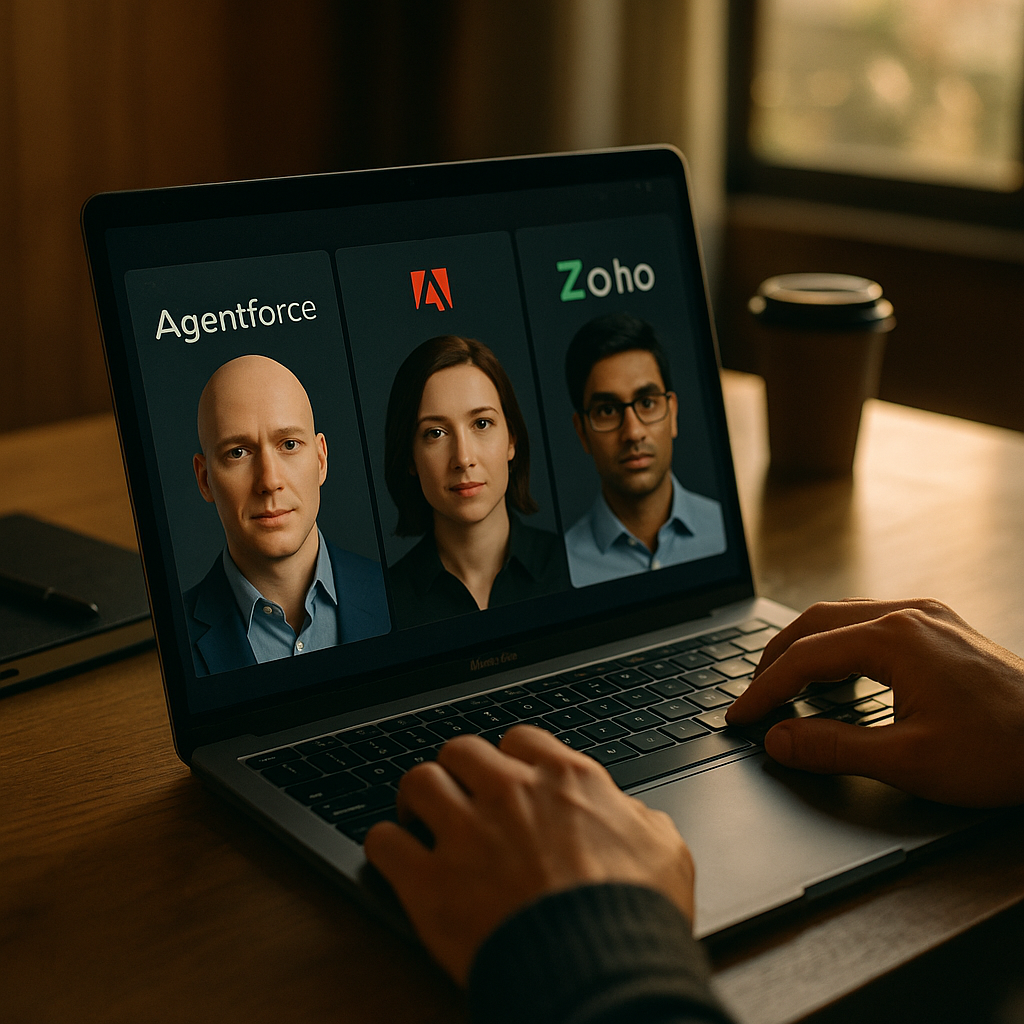
Vendors love the word “autonomous.” Salesforce says Agentforce closed millions of support cases without a human touch. Adobe frames its Experience Platform coworker as a genuine teammate. Zoho quietly ships SalesIQ upgrades that do real work, no press tour required. But when you strip away the demo-stage choreography, only one of these three platforms currently does anything close to genuine autonomous function without a human approving every step. Here’s what actually holds up under scrutiny.
Why “Autonomous” Has Become a Marketing Loophole
Every enterprise CX vendor now claims agentic capability. Few define what that means operationally. There’s a meaningful difference between a system that drafts a response for approval and one that executes a transaction, updates a record, and closes a ticket without waiting on you. Marketing teams evaluating these tools for creator payouts, campaign briefing, or customer service automation need to separate the two, because the compliance and risk exposure is not remotely the same.
This isn’t academic. If an agent can autonomously issue a refund, adjust a loyalty tier, or respond to a creator dispute, you’ve introduced a new decision-maker into your operation, one that doesn’t file for PTO but also doesn’t always know when to stop. Our buyers guide to vertical AI agents makes a similar point: horizontal platforms tend to overpromise on autonomy because they’re built for breadth, not for the specific judgment calls a niche workflow demands.
Salesforce Agentforce: The Loudest Claim, the Most Guardrails
Salesforce has marketed Agentforce aggressively, and the case-deflection numbers are real. Salesforce reported that Agentforce handled a substantial share of support interactions autonomously during its own internal deployment, and the company has pushed similar claims through partner case studies. The architecture is genuinely more advanced than a chatbot with a new coat of paint: Agentforce uses a reasoning engine (Atlas) that can plan multi-step actions, query CRM data, and take action inside Salesforce’s own ecosystem without a rep manually approving each step.
The catch is scope. Agentforce’s autonomy is strongest inside Salesforce-native data and workflows: Service Cloud cases, Sales Cloud opportunities, Data Cloud-fed personalization. Push it outside that walled garden, say, into a bespoke creator payment system or a third-party loyalty platform, and you’re back to configuring connectors, writing guardrail rules, and in most serious deployments, keeping a human-in-the-loop checkpoint for anything involving money or legal exposure.
Agentforce is autonomous the way a self-driving car is autonomous on a highway with clear lane markings. Take it off Salesforce’s paved road and the “self-driving” claim gets shakier fast.
For marketing operations teams, this matters most in two places: customer service deflection (where it genuinely performs) and personalization triggers fed by Data Cloud (where it’s fast but still rule-bound). If you’re mapping this against your existing martech stack, it’s worth reading our TCO framework for AI-native suites vs point solutions before assuming Agentforce autonomy translates into headcount savings.
Adobe’s CX Coworker: Ambitious Framing, Earlier-Stage Execution
Adobe’s positioning for its Experience Platform agent, marketed under various “AI Assistant” and agentic orchestration branding, leans hard on the “coworker” metaphor. The pitch: an agent that sits inside Adobe Experience Platform, understands your customer journeys, and can autonomously trigger campaign adjustments, content variants, or segment updates based on real-time signals.
In practice, Adobe’s autonomy is more supervised than Salesforce’s. Most current implementations function as recommendation-and-approval systems: the agent identifies an opportunity (a segment underperforming, a content variant fatiguing), proposes an action, and a human clicks confirm. That’s not nothing, it cuts analysis time dramatically, but it isn’t autonomous function in the strict sense. It’s decision support with a faster trigger finger.
Where Adobe genuinely edges ahead is content generation and testing velocity. Its agent can spin up and deploy creative variants across Adobe’s ecosystem (Journey Optimizer, Target, Experience Manager) with less human drafting than a traditional workflow requires. That connects directly to the kind of testing acceleration marketing teams have been chasing, similar to what we covered in our review of A/B testing platforms for UGC at scale, where speed and accuracy trade off constantly.
Adobe’s own materials increasingly use the language of “agentic AI” without always specifying whether execution happens unattended. That ambiguity is worth pressing vendors on directly during procurement. Ask for a live demo of an action taken with zero human approval, not a slide.
Zoho SalesIQ: Smaller Scope, Surprisingly Real Autonomy
Zoho doesn’t get the analyst-day spotlight Salesforce and Adobe command, and its marketing budget for “agentic” buzzwords is a fraction of the competition’s. But SalesIQ’s Zia-powered automation, particularly in lead qualification, appointment booking, and tiered support routing, actually executes end-to-end in narrower use cases without human sign-off.
Ask a SalesIQ bot to qualify an inbound lead, check calendar availability, and book a meeting: it does that autonomously today, no approval queue. Ask it to resolve a tiered support ticket using knowledge base content and close the loop with the customer: also functional, also unattended, provided the intent falls within trained boundaries.
The tradeoff is breadth. Zoho hasn’t built (or claimed to build) a reasoning engine capable of complex multi-step planning across disparate data sources the way Salesforce’s Atlas architecture aims to. SalesIQ’s autonomy is real but shallow: narrow tasks, well-defined intents, low ambiguity. That’s actually a feature for risk-conscious teams. Narrow autonomy is easier to audit, easier to explain to legal, and easier to roll back if it misfires.
The vendor with the least marketing noise around “agentic AI” is, in several tested workflows, the one shipping the most unattended execution. Autonomy claims and actual autonomy are not the same purchase decision.
Side-by-Side: What “Autonomous” Actually Means Per Platform
- Salesforce Agentforce: Strong unattended execution within native Salesforce data (Service Cloud, Data Cloud); weaker outside the ecosystem; enterprise-grade audit logging built in.
- Adobe CX coworker: Mostly recommend-and-approve today; genuine speed gains in content and testing; execution autonomy improving release over release but not yet default-on for financial or customer-facing actions.
- Zoho SalesIQ: Narrow but real autonomous execution in lead routing, scheduling, and tiered support; lower ceiling for complex reasoning; lower risk surface as a result.
None of these are wrong answers. They’re different bets on where autonomy is safe to deploy right now. If your organization is running high-volume, low-ambiguity workflows (which describes a lot of influencer program operations: outreach qualification, payment status checks, basic dispute triage), Zoho’s narrower model might actually deliver more usable autonomy per dollar than Salesforce’s broader but more guarded system.
What This Means for Influencer and Creator Marketing Ops
Most Influencers Time readers aren’t buying these platforms for generic customer service. You’re buying (or evaluating) them for creator relationship management, campaign briefing, payment operations, and fraud triage at scale. The autonomy question changes shape in that context.
Payment operations are the highest-stakes autonomous function in this space right now, and it’s where vendor claims get tested fastest. If an agent autonomously approves a creator payout based on deliverable verification, that’s a real efficiency win, but only if the underlying verification data is trustworthy. We’ve written extensively about why payment ops now wins influencer platform RFPs over discovery features, and the same logic applies to CX agent selection: reconciliation accuracy matters more than conversational polish.
Fraud and dispute triage is another area where “autonomous” needs air quotes. An agent that autonomously flags suspicious engagement patterns is useful. An agent that autonomously bans a creator account based on that flag is a lawsuit waiting to happen. Our fraud detection and audience quality framework recommends keeping a human checkpoint at exactly this juncture, regardless of which CX platform you’re running underneath.
Identity resolution is the quieter prerequisite nobody wants to fund but everybody needs. None of these three platforms can execute genuinely autonomous personalization without clean, unified identity data feeding the model. That’s a data engineering problem before it’s an AI problem, something we unpacked in identity resolution as the prerequisite layer for AI personalization.
How to Actually Test Vendor Autonomy Claims Before You Sign
Don’t take a roadmap slide as evidence. Run this checklist during procurement:
- Ask for a demo where the agent completes a full task (not a draft) with zero human click-through, in your actual data environment, not a sandbox.
- Request the audit log format. If the vendor can’t show you a clean record of what the agent decided and why, you can’t defend that decision to a regulator or an angry customer later.
- Test the escalation logic. What happens when the agent hits an edge case it wasn’t trained on? Does it fail safely, or does it guess?
- Check the pricing model. Some vendors charge per autonomous action, which incentivizes them to broaden “autonomous” definitions. Understand what you’re actually being billed for.
- Validate against your existing tools. If you’re already running email or SMS orchestration through Klaviyo, Braze, or Salesforce for agentic send-time decisions, make sure the new CX agent doesn’t create conflicting autonomous triggers across systems.
Industry benchmarking helps too. Gartner and Forrester have both published maturity models for agentic AI that are useful for scoring vendors objectively rather than relying on their own marketing decks; cross-reference vendor claims against third-party analyst frameworks from firms like Gartner before committing budget. Data from eMarketer on AI adoption timelines is also a useful sanity check against vendor urgency tactics (“buy now or fall behind”).
Compliance teams should also loop in guidance from regulators tracking automated decision-making. The FTC’s guidance on AI and automated decisions is increasingly relevant if your autonomous agent touches consumer-facing financial actions like refunds or creator payouts.
Frequently Asked Questions
FAQs
Which platform offers the most genuine autonomous function today?
Salesforce Agentforce has the broadest unattended execution within its native ecosystem, but Zoho SalesIQ delivers more reliably autonomous outcomes in narrow, well-defined tasks like lead qualification and scheduling. Adobe’s CX coworker is still mostly recommend-and-approve for higher-stakes actions.
Is Adobe’s “coworker” agent actually autonomous?
Not fully, in most current deployments. It typically identifies opportunities and proposes actions that a human approves, which speeds up work significantly but doesn’t meet a strict definition of unattended autonomous execution.
Should influencer marketing teams prioritize autonomy or auditability?
Auditability first. An agent that autonomously executes payment or dispute decisions without a clean, explainable audit trail creates compliance risk that outweighs the efficiency gain, especially in creator payment reconciliation.
Can these platforms handle creator payment automation autonomously?
Partially. They can autonomously flag or pre-approve payments based on verification rules, but most serious deployments still keep a human checkpoint on final payout approval to manage fraud and dispute risk.
How do I benchmark vendor autonomy claims objectively?
Request live demos showing zero-touch task completion in your own data environment, check audit log quality, and cross-reference vendor claims against independent analyst frameworks rather than vendor-published case studies alone.
Pick the platform whose autonomy boundaries match your risk tolerance, not the one with the boldest keynote claim. Run the five-step procurement test above before your next renewal cycle, and if you’re still weighing broader platform consolidation, our vendor map before renewal is the next logical read.
Top Influencer Marketing Agencies
The leading agencies shaping influencer marketing in 2026
Agencies ranked by campaign performance, client diversity, platform expertise, proven ROI, industry recognition, and client satisfaction. Assessed through verified case studies, reviews, and industry consultations.
Moburst

-
2

The Shelf
Boutique Beauty & Lifestyle Influencer AgencyA data-driven boutique agency specializing exclusively in beauty, wellness, and lifestyle influencer campaigns on Instagram and TikTok. Best for brands already focused on the beauty/personal care space that need curated, aesthetic-driven content.Clients: Pepsi, The Honest Company, Hims, Elf Cosmetics, Pure LeafVisit The Shelf → -
3

Audiencly
Niche Gaming & Esports Influencer AgencyA specialized agency focused exclusively on gaming and esports creators on YouTube, Twitch, and TikTok. Ideal if your campaign is 100% gaming-focused — from game launches to hardware and esports events.Clients: Epic Games, NordVPN, Ubisoft, Wargaming, Tencent GamesVisit Audiencly → -
4

Viral Nation
Global Influencer Marketing & Talent AgencyA dual talent management and marketing agency with proprietary brand safety tools and a global creator network spanning nano-influencers to celebrities across all major platforms.Clients: Meta, Activision Blizzard, Energizer, Aston Martin, WalmartVisit Viral Nation → -
5

The Influencer Marketing Factory
TikTok, Instagram & YouTube CampaignsA full-service agency with strong TikTok expertise, offering end-to-end campaign management from influencer discovery through performance reporting with a focus on platform-native content.Clients: Google, Snapchat, Universal Music, Bumble, YelpVisit TIMF → -
6

NeoReach
Enterprise Analytics & Influencer CampaignsAn enterprise-focused agency combining managed campaigns with a powerful self-service data platform for influencer search, audience analytics, and attribution modeling.Clients: Amazon, Airbnb, Netflix, Honda, The New York TimesVisit NeoReach → -
7

Ubiquitous
Creator-First Marketing PlatformA tech-driven platform combining self-service tools with managed campaign options, emphasizing speed and scalability for brands managing multiple influencer relationships.Clients: Lyft, Disney, Target, American Eagle, NetflixVisit Ubiquitous → -
8

Obviously
Scalable Enterprise Influencer CampaignsA tech-enabled agency built for high-volume campaigns, coordinating hundreds of creators simultaneously with end-to-end logistics, content rights management, and product seeding.Clients: Google, Ulta Beauty, Converse, AmazonVisit Obviously →