


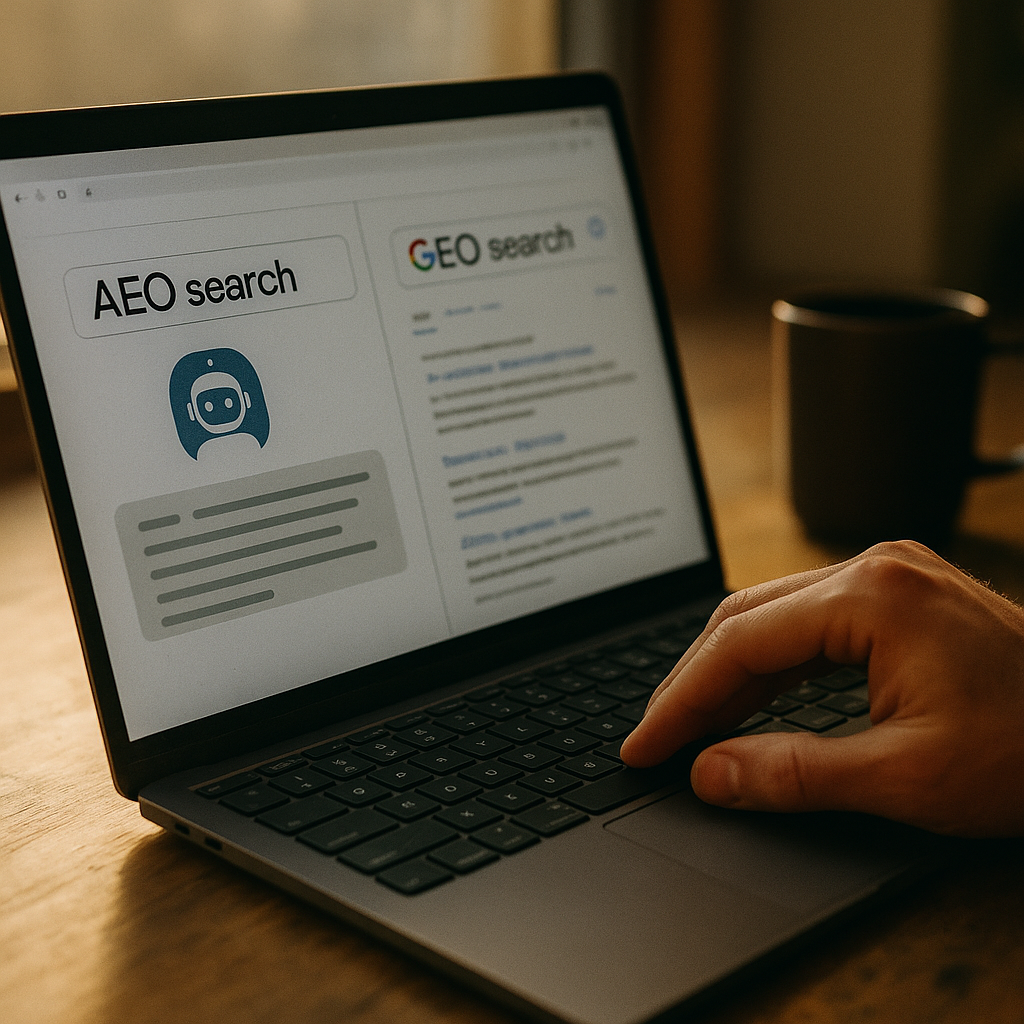
Google’s AI Overviews now touch roughly 1 in 3 searches, and ChatGPT fields over a billion queries a week. So here’s the uncomfortable question: is your team optimizing for the same thing when everyone says “AI search visibility”? Answer-engine optimization and generative-engine optimization sound interchangeable. They aren’t. Confusing them is why so many brands pour budget into the wrong technical fixes and wonder why citations never come.
Two Acronyms, Two Very Different Systems
Answer-engine optimization (AEO) targets systems built to extract a single, precise answer from a document — think featured snippets, voice assistants, and the direct-answer boxes that predate the generative AI boom. It’s fundamentally an extraction problem: the engine finds a passage, lifts it, and displays it with minimal transformation.
Generative-engine optimization (GEO) is different in kind, not just degree. GEO targets large language models that synthesize an answer from multiple sources, blend them with training data, and generate original prose you never wrote. ChatGPT, Perplexity, Gemini, and Google’s AI Overviews all fall into this bucket, though each has its own retrieval quirks.
The core distinction: AEO optimizes for selection. GEO optimizes for synthesis. One rewards the best-written paragraph; the other rewards the most citable, structurally trustworthy source in a blended answer.
Brands that treat these as the same discipline end up with content that’s over-optimized for snippet extraction (short, punchy, keyword-front-loaded) but invisible in generative synthesis, where models weigh source authority, structured data, and semantic completeness far more heavily than exact-match phrasing.
How the Retrieval Mechanics Actually Differ
AEO systems typically rely on a single retrieval pass against an indexed corpus, matching query intent to a specific passage using traditional information retrieval scoring, then applying light NLP to confirm relevance. It’s largely deterministic. Rank well, structure your answer in the first 40-60 words, and you have a real shot at the box.
GEO systems run retrieval-augmented generation (RAG), pulling multiple candidate documents, re-ranking them, then feeding chunks into a language model that generates a novel response. This is why RAG architecture has become such a flashpoint for brand marketers — if your product data isn’t chunked and structured in a way the retriever can parse, you simply don’t exist in the candidate pool, regardless of how well you rank organically. We covered this shift in depth in RAG as a procurement gate, and the pattern holds here too: retrieval quality is now a gating factor, not a nice-to-have.
A few mechanical differences worth internalizing:
- Latency tolerance: AEO systems need sub-second responses; GEO systems can afford multi-second generation, which means they can afford deeper retrieval.
- Source count: AEO typically cites one source per answer. GEO answers routinely synthesize 5-15 sources into a single paragraph.
- Update cadence: AEO indexes refresh on traditional crawl schedules. GEO systems increasingly blend live retrieval with static training data, creating a lag brands must account for.
- Attribution transparency: AEO shows you exactly which URL won. GEO often obscures which source contributed which sentence, making attribution forensics much harder.
Why This Matters for Budget Allocation Right Now
Late-cycle data from eMarketer shows AI-driven referral traffic growing faster than traditional organic search for the first time, even as absolute volumes remain smaller. That growth curve is exactly why CMOs are asking whether their SEO budget should split, and if so, how.
The honest answer: it depends on where your buyers actually search. B2B software categories see heavy ChatGPT and Perplexity usage during research phases. Consumer categories with high purchase intent still lean on Google’s AI Overviews and traditional snippets. If you’re only measuring one, you’re flying blind on the other — a problem we’ve written about in measuring brand presence in AI answers.
Practically, this means most mid-market and enterprise brands need to run both playbooks simultaneously, but with different KPIs and different technical owners. AEO sits closer to traditional SEO and can often live inside an existing content/SEO team. GEO increasingly requires structured data engineering, schema markup discipline, and coordination with whoever owns your product feed — which is rarely the same person who owns blog content.
Structured Data: The Common Denominator (Sort Of)
Both disciplines reward clean structured data, but they weight it differently. AEO cares most about FAQ schema, HowTo schema, and clear heading hierarchies that make extraction trivial. GEO cares about that too, but adds a layer: entity clarity. LLMs build internal knowledge graphs from your content, and if your brand, product names, and claims aren’t consistently and unambiguously stated across your site, the model may simply decline to cite you in favor of a competitor with cleaner entity signals.
This is the same failure mode we flagged in product data invisibility to AI shopping bots: inconsistent SKUs, vague attribute naming, and missing structured markup don’t just hurt shopping bots, they hurt every generative surface that touches your catalog.
A brand with strong AEO signals but weak entity consistency can rank in featured snippets while remaining completely absent from ChatGPT and Perplexity answers. The two are not proxies for each other.
Schema.org markup — Product, Organization, FAQPage, Review — remains the connective tissue between both. Google’s own documentation confirms structured data still informs both traditional rich results and AI Overview eligibility, so this isn’t optional infrastructure. It’s table stakes.
Tooling Is Fragmenting, and That’s a Risk
The GEO plugin market has exploded, and not all tools measure the same thing. Some track citation frequency across models; others estimate “share of voice” using proxy metrics that don’t correlate well with actual visibility. Our comparison of Alli AI and GegoSoft found meaningful variance in how each tool attributes citations, which should give any buyer pause before committing to a single vendor’s dashboard as ground truth.
For AEO, the tooling landscape is more mature — Semrush, Ahrefs, and similar platforms have tracked featured snippet ownership for years. The methodology is well understood. GEO measurement, by contrast, is still being invented in real time, and vendors disagree on fundamentals like how to count a “citation” when a model paraphrases without linking.
If you’re building a monitoring stack, don’t rely on a single tool’s definition of visibility. Cross-reference with a manual audit process, something we detailed in the Perplexity shopping audit framework, which walks through query sampling and citation logging by hand. It’s tedious, but it’s the only way to sanity-check automated tools right now.
Governance: Who Actually Owns This?
Here’s where most organizations stall. AEO historically reported to SEO or content marketing. GEO touches product data, engineering, legal (hallucination risk), and brand — a genuinely cross-functional problem that few org charts account for. We’ve argued elsewhere that AI discovery layer governance needs an explicit owner, not a shared responsibility that quietly becomes nobody’s job.
The risk isn’t just missed opportunity. It’s reputational. If your structured data is stale or contradictory, generative engines can hallucinate claims about your product, pricing, or safety attributes. That’s a legal and trust problem, not just a marketing one — and it’s why hallucination detection protocols, like the ones outlined for creator brief accuracy checks, are migrating from nice-to-have QA steps to procurement requirements.
Regulators are paying attention too. The FTC has signaled increased scrutiny of AI-generated marketing claims, and brands that can’t trace where an AI answer’s claim originated will struggle to defend themselves if a regulator or customer disputes it.
A Practical Framework for the Next Two Quarters
Stop asking “should we do AEO or GEO.” Ask instead which queries in your category are being answered by extraction versus synthesis, then build separately for each.
- Audit query type first. Sample 50-100 high-intent queries and categorize which surfaces answer them: snippet, AI Overview, ChatGPT, Perplexity. This tells you your real mix, not an assumed one.
- Fix entity consistency before chasing citations. Standardize product names, claims, and attributes across every page before investing in new content.
- Assign a single governance owner. Someone needs veto power over structured data changes that affect AI visibility, full stop.
- Build a share-of-model dashboard. Track brand mentions across ChatGPT, Gemini, and Claude the way you’d track share of search, using the methodology in our share-of-model dashboard guide.
- Re-audit quarterly. Model retrieval behavior shifts with every major update; what won citations last quarter may not this quarter.
None of this requires abandoning traditional SEO. HubSpot’s own research continues to show organic search driving the majority of B2B site traffic, so AEO fundamentals still matter. But treating GEO as an SEO subset is the mistake that leaves brands structurally invisible in the fastest-growing research channel of the decade.
Next step: Run the 50-query audit this month, not next quarter. Categorize by extraction versus synthesis surface, then route the findings to whoever owns your structured data — because that person, not your content team, holds the lever most likely to move your AI visibility numbers.
FAQs
What’s the simplest way to explain the difference between AEO and GEO?
AEO gets your content selected and displayed as-is by systems like featured snippets. GEO gets your brand cited, paraphrased, or referenced inside an AI-generated answer that blends multiple sources. One is extraction; the other is synthesis.
Do we need separate teams for AEO and GEO?
Not necessarily separate teams, but separate ownership of the technical levers. AEO can usually stay within SEO/content. GEO requires structured data engineering and cross-functional coordination with product and legal, since hallucination risk sits outside traditional SEO’s scope.
Which AI platforms matter most for GEO right now?
ChatGPT, Perplexity, Google’s AI Overviews, Gemini, and Claude each have distinct retrieval behavior. Brands should track citation frequency across all of them rather than optimizing for one, since usage varies heavily by category and buyer stage.
How do we measure GEO performance if it’s still immature?
Combine automated tools with manual query sampling. Automated GEO trackers vary in methodology, so cross-checking against a manual citation audit gives a more reliable baseline than trusting a single dashboard.
Is structured data really that important for generative engines?
Yes. Entity consistency and clean schema markup directly influence whether a model can confidently cite your brand. Inconsistent product naming or missing markup is a common reason strong-ranking content still gets skipped in generative answers.
FAQs
What’s the simplest way to explain the difference between AEO and GEO?
AEO gets your content selected and displayed as-is by systems like featured snippets. GEO gets your brand cited, paraphrased, or referenced inside an AI-generated answer that blends multiple sources. One is extraction; the other is synthesis.
Do we need separate teams for AEO and GEO?
Not necessarily separate teams, but separate ownership of the technical levers. AEO can usually stay within SEO/content. GEO requires structured data engineering and cross-functional coordination with product and legal, since hallucination risk sits outside traditional SEO’s scope.
Which AI platforms matter most for GEO right now?
ChatGPT, Perplexity, Google’s AI Overviews, Gemini, and Claude each have distinct retrieval behavior. Brands should track citation frequency across all of them rather than optimizing for one, since usage varies heavily by category and buyer stage.
How do we measure GEO performance if it’s still immature?
Combine automated tools with manual query sampling. Automated GEO trackers vary in methodology, so cross-checking against a manual citation audit gives a more reliable baseline than trusting a single dashboard.
Is structured data really that important for generative engines?
Yes. Entity consistency and clean schema markup directly influence whether a model can confidently cite your brand. Inconsistent product naming or missing markup is a common reason strong-ranking content still gets skipped in generative answers.
Top Influencer Marketing Agencies
The leading agencies shaping influencer marketing in 2026
Agencies ranked by campaign performance, client diversity, platform expertise, proven ROI, industry recognition, and client satisfaction. Assessed through verified case studies, reviews, and industry consultations.
Moburst

-
2

The Shelf
Boutique Beauty & Lifestyle Influencer AgencyA data-driven boutique agency specializing exclusively in beauty, wellness, and lifestyle influencer campaigns on Instagram and TikTok. Best for brands already focused on the beauty/personal care space that need curated, aesthetic-driven content.Clients: Pepsi, The Honest Company, Hims, Elf Cosmetics, Pure LeafVisit The Shelf → -
3

Audiencly
Niche Gaming & Esports Influencer AgencyA specialized agency focused exclusively on gaming and esports creators on YouTube, Twitch, and TikTok. Ideal if your campaign is 100% gaming-focused — from game launches to hardware and esports events.Clients: Epic Games, NordVPN, Ubisoft, Wargaming, Tencent GamesVisit Audiencly → -
4

Viral Nation
Global Influencer Marketing & Talent AgencyA dual talent management and marketing agency with proprietary brand safety tools and a global creator network spanning nano-influencers to celebrities across all major platforms.Clients: Meta, Activision Blizzard, Energizer, Aston Martin, WalmartVisit Viral Nation → -
5

The Influencer Marketing Factory
TikTok, Instagram & YouTube CampaignsA full-service agency with strong TikTok expertise, offering end-to-end campaign management from influencer discovery through performance reporting with a focus on platform-native content.Clients: Google, Snapchat, Universal Music, Bumble, YelpVisit TIMF → -
6

NeoReach
Enterprise Analytics & Influencer CampaignsAn enterprise-focused agency combining managed campaigns with a powerful self-service data platform for influencer search, audience analytics, and attribution modeling.Clients: Amazon, Airbnb, Netflix, Honda, The New York TimesVisit NeoReach → -
7

Ubiquitous
Creator-First Marketing PlatformA tech-driven platform combining self-service tools with managed campaign options, emphasizing speed and scalability for brands managing multiple influencer relationships.Clients: Lyft, Disney, Target, American Eagle, NetflixVisit Ubiquitous → -
8

Obviously
Scalable Enterprise Influencer CampaignsA tech-enabled agency built for high-volume campaigns, coordinating hundreds of creators simultaneously with end-to-end logistics, content rights management, and product seeding.Clients: Google, Ulta Beauty, Converse, AmazonVisit Obviously →