


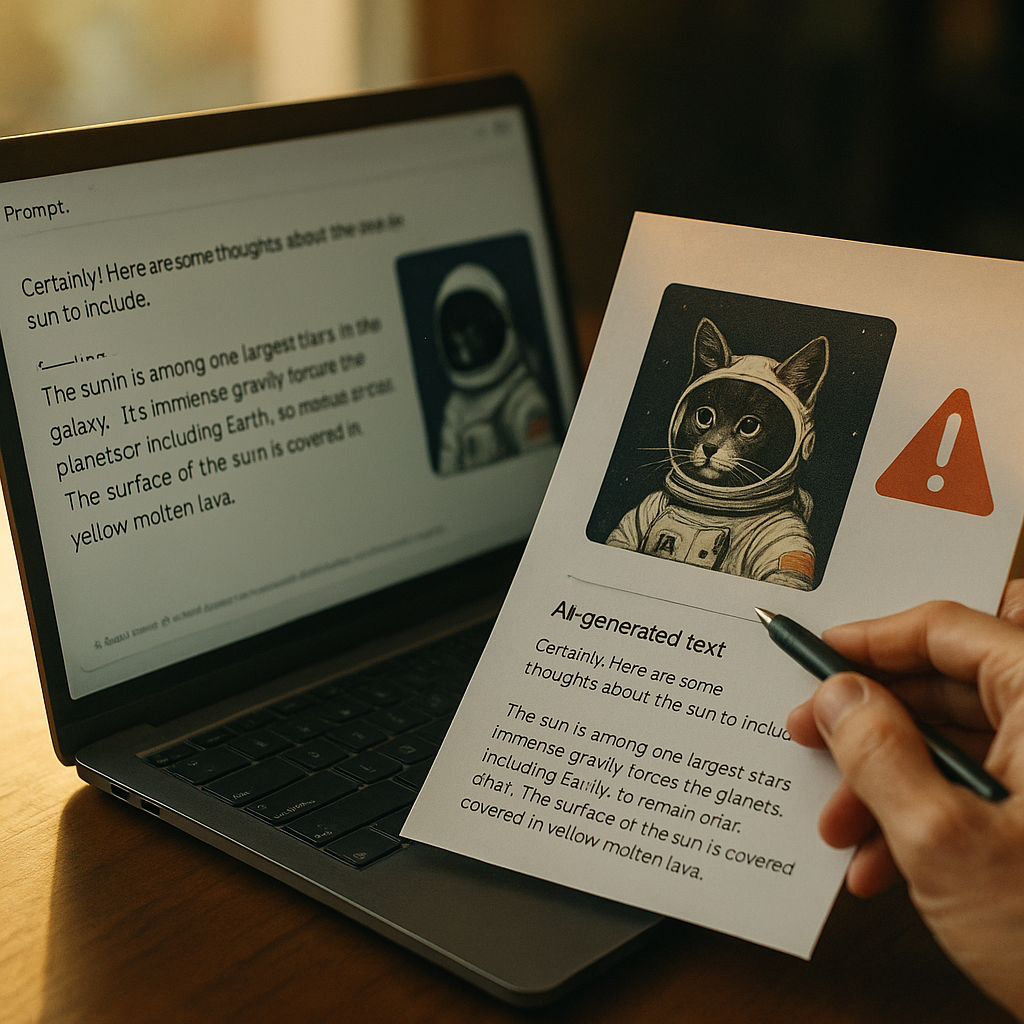
One fabricated stat in a creator brief can trigger an FTC inquiry, a platform strike, and a very uncomfortable call with legal. Marketing teams now generate product claims with AI tools faster than compliance can review them, and nobody has a clean answer for how to catch the errors before they reach a creator. An AI hallucination detection protocol isn’t a nice-to-have anymore. It’s the difference between a clean campaign and a retraction post.
Generative tools are writing first drafts of briefs, competitive comparisons, and even ingredient claims. They’re fast, cheap, and confident. They’re also wrong more often than most brand teams want to admit. The fix isn’t banning AI from the briefing process. It’s building a checkpoint that catches fabrications before a creator ever sees them.
Why This Problem Is Getting Worse, Not Better
Large language models don’t know what they don’t know. Ask one to summarize a product’s clinical benefits, competitive positioning, or regulatory status, and it will produce something plausible-sounding whether or not it’s accurate. That’s the nature of the tool. It’s optimized for fluency, not truth.
Brand teams have leaned into AI-assisted briefing because it saves time. Draft a brief in minutes instead of hours. Pull “facts” about a competitor’s formulation, a supplement’s efficacy, or a skincare ingredient’s clinical backing, and hand it to a creator who has no reason to question it. Creators aren’t scientists or lawyers. They trust the brief. That trust is exactly what makes hallucinated claims so dangerous.
A single hallucinated claim that reaches a creator brief doesn’t stay contained to one post — it gets repeated across dozens of creator channels before anyone notices the error.
This is compounding as brands scale creator programs. More creators, more briefs, more AI-generated first drafts, and the same compliance headcount reviewing all of it. Something has to give, and right now it’s often accuracy. Influencers Time covered a related failure mode in this audit breakdown, where product claims slipped through review entirely.
What Counts as a Hallucination in a Marketing Context?
Not every AI error is a wild fabrication. In practice, marketing hallucinations fall into a few recognizable buckets:
- Invented statistics: A model cites “73% of dermatologists recommend” a product with zero source, because it pattern-matched to language it had seen elsewhere.
- Outdated regulatory status: An ingredient claim that was true two product cycles ago but has since been reformulated or restricted.
- Competitive misattribution: Claims about a competitor’s product that are simply false or exaggerated, creating defamation exposure.
- Overconfident superlatives: “Clinically proven,” “the only,” “guaranteed results” — language that sounds like standard marketing copy but triggers FTC substantiation requirements the moment it’s untrue.
- Fabricated attribution: Quotes or endorsements attributed to studies, doctors, or reviews that don’t exist.
Each of these carries different risk. Invented stats are embarrassing. Regulatory misstatements are legally dangerous. Competitive misattribution can get you sued. Brand teams need a protocol that catches all five categories, not just the obvious ones.
Building the Protocol: Four Checkpoints Before a Brief Ships
A functional hallucination detection protocol isn’t a single tool. It’s a sequence of checkpoints, each catching a different failure mode. Think of it as a funnel: broad automated screening first, narrower human review last.
Checkpoint one: source-locking every factual claim
Before any AI-drafted claim enters a brief, it needs a traceable source. Not “the model said so” — an actual citation: a clinical study, a regulatory filing, an internal product spec sheet. If a claim can’t be traced to a verified source in under two minutes, it doesn’t go in the brief. This single rule eliminates most invented statistics before they spread further down the pipeline.
Practically, this means pairing your generative drafting tool with a retrieval system that pulls from an approved, closed corpus: your own product documentation, legal-approved claim libraries, and current regulatory guidance. Open-web retrieval introduces more hallucination risk, not less, because the model can’t distinguish a competitor’s marketing puffery from a peer-reviewed study.
Checkpoint two: automated claim-flagging before human review
Manual review of every brief doesn’t scale once you’re running hundreds of creator campaigns a quarter. This is where automated flagging earns its keep. Set up a screening layer that flags:
- Any numeric claim (percentages, “X times better,” study sample sizes)
- Superlative language (“best,” “only,” “clinically proven,” “guaranteed”)
- Any mention of a named competitor
- Health, safety, or efficacy language tied to regulated categories
Flagged items get routed to a human reviewer automatically. Everything else moves forward. This isn’t about catching every possible error with a machine; it’s about making sure the highest-risk language never skips human eyes. Similar logic applies to media-buying workflows, where automated decisions still fail without human review roughly one in six times.
Checkpoint three: a claims librarian, not just a compliance rubber stamp
Most brands already have someone doing legal or regulatory review. The gap is usually earlier in the process — nobody owns the “is this claim even real” question before it reaches legal. That’s a different skill than contract review. It’s closer to fact-checking.
Assign a claims librarian role (it can be a rotating responsibility, not necessarily a new hire) whose job is maintaining an approved-claims library: a living document of every product claim that’s been verified, sourced, and cleared for creator use. When a brief needs a claim, it pulls from this library first. New claims go through source-locking and legal sign-off before they’re added. Over time, this shrinks the surface area for hallucination because most briefs are reusing pre-verified language rather than generating new claims from scratch.
Checkpoint four: creator-facing plain-language flags
Even after internal review, creators themselves are a useful last line of defense, but only if you give them something to work with. Add a short “claims to double-check” section directly in the brief itself, listing any statistic or regulatory statement with a one-line explanation of the source. Creators who understand why a claim is true are far more likely to flag something that feels off than creators who are just handed copy to read verbatim.
This also protects the brand relationship. A creator who catches an error before posting is doing you a favor. A creator who posts a false claim and gets called out publicly is now a liability, through no fault of their own.
Where This Intersects With Existing Governance Work
Hallucination detection doesn’t exist in isolation. It’s part of the broader governance conversation brands are already having about AI in the creative and media pipeline. If your organization has built kill-switch protocols for agentic ad-ops platforms or audit trails for automated bidding, the same instinct applies here: don’t let an autonomous system make an unreviewable decision with legal exposure attached.
The parallel to creator brief sign-off is worth calling out directly. Influencers Time’s earlier piece on where human sign-off can’t be skipped in AI-generated briefs makes a similar case: automation can draft, but it shouldn’t approve. Hallucination detection is really a specific instance of that broader principle, applied to factual claims rather than creative direction or tone.
Governance charters that brands have built for peak-season campaign automation, covered in this governance charter breakdown, offer a useful template. Borrow the structure: define what AI can do autonomously, what requires review, and what triggers an immediate stop. Apply that same three-tier logic to product claims specifically.
The Regulatory Backdrop You Can’t Ignore
The FTC has been explicit that advertisers, not just creators, bear responsibility for substantiating claims made in influencer content. That liability doesn’t disappear because an AI tool generated the language first. If a hallucinated claim reaches a creator and that creator posts it, the brand is exposed regardless of who typed the sentence.
UK brands running creator campaigns face similar scrutiny from the ICO on data-backed claims and consumer protection standards. The regulatory posture globally is converging on the same principle: automation doesn’t dilute accountability, it just makes the accountability harder to trace back to a single decision point. That’s exactly why the protocol needs to be documented, not just practiced informally.
Regulators don’t care whether a human or a model wrote the false claim. They care whether the brand had a process to catch it. Documentation is your defense.
Measuring Whether the Protocol Actually Works
A protocol that exists on paper but isn’t measured is just theater. Track a few concrete metrics:
- Flag rate: What percentage of briefs trigger at least one automated flag? A dropping flag rate over time suggests your approved-claims library is doing its job.
- False negative rate: Are hallucinations slipping through and getting caught later, by legal, by a creator, or worse, by a regulator or a competitor? Every instance should trigger a protocol review.
- Time-to-brief: Does the added review step meaningfully slow down campaign timelines? If it does, the bottleneck is usually the claims library being incomplete, not the review process itself.
- Creator-reported catches: How often does a creator flag something in the “double-check” section? This is a strong signal for whether your plain-language flags are actually useful or just decorative.
Brands running high volumes of AI-generated creative variants already track similar friction points. The capacity planning logic covered in this variant volume analysis applies just as well to claims review: more automated output means more review capacity needed, not less.
External benchmarks help too. eMarketer and Statista both track growing AI adoption in content production, and the gap between AI adoption speed and governance maturity is consistently the story. HubSpot‘s marketing research has flagged similar trust gaps around AI-generated content accuracy across brand teams broadly, not just in creator marketing specifically.
The Takeaway
Build the source-locking rule first. Every AI-drafted claim needs a traceable citation before it enters a brief, full stop, no exceptions, because that one habit closes off most of the risk before it ever reaches a creator’s inbox.
Frequently Asked Questions
What is an AI hallucination detection protocol in marketing?
It’s a structured review process that catches false or unverifiable AI-generated product claims before they reach creator briefs, combining automated flagging, source verification, and human legal review.
Who is legally responsible if a creator posts a hallucinated claim?
The brand typically bears primary responsibility under FTC guidance, since advertisers must substantiate claims regardless of whether the language originated from an AI tool or a human copywriter.
How can brands catch hallucinated claims without slowing down campaigns?
Automated flagging for numeric claims, superlatives, and competitor mentions routes only high-risk language to human reviewers, keeping most briefs moving at normal speed.
What’s the difference between a hallucination and standard marketing exaggeration?
A hallucination is factually false or unverifiable content the AI generated with no real source; marketing exaggeration is puffery that’s understood as non-literal. Regulators and courts still distinguish between the two, but AI often blurs the line by generating exaggeration that reads as fact.
Should creators be responsible for catching hallucinated claims themselves?
No, but giving creators plain-language context on flagged claims adds a useful final check. The primary responsibility for accuracy still sits with the brand and its review process.
Frequently Asked Questions
Top Influencer Marketing Agencies
The leading agencies shaping influencer marketing in 2026
Agencies ranked by campaign performance, client diversity, platform expertise, proven ROI, industry recognition, and client satisfaction. Assessed through verified case studies, reviews, and industry consultations.
Moburst

-
2

The Shelf
Boutique Beauty & Lifestyle Influencer AgencyA data-driven boutique agency specializing exclusively in beauty, wellness, and lifestyle influencer campaigns on Instagram and TikTok. Best for brands already focused on the beauty/personal care space that need curated, aesthetic-driven content.Clients: Pepsi, The Honest Company, Hims, Elf Cosmetics, Pure LeafVisit The Shelf → -
3

Audiencly
Niche Gaming & Esports Influencer AgencyA specialized agency focused exclusively on gaming and esports creators on YouTube, Twitch, and TikTok. Ideal if your campaign is 100% gaming-focused — from game launches to hardware and esports events.Clients: Epic Games, NordVPN, Ubisoft, Wargaming, Tencent GamesVisit Audiencly → -
4

Viral Nation
Global Influencer Marketing & Talent AgencyA dual talent management and marketing agency with proprietary brand safety tools and a global creator network spanning nano-influencers to celebrities across all major platforms.Clients: Meta, Activision Blizzard, Energizer, Aston Martin, WalmartVisit Viral Nation → -
5

The Influencer Marketing Factory
TikTok, Instagram & YouTube CampaignsA full-service agency with strong TikTok expertise, offering end-to-end campaign management from influencer discovery through performance reporting with a focus on platform-native content.Clients: Google, Snapchat, Universal Music, Bumble, YelpVisit TIMF → -
6

NeoReach
Enterprise Analytics & Influencer CampaignsAn enterprise-focused agency combining managed campaigns with a powerful self-service data platform for influencer search, audience analytics, and attribution modeling.Clients: Amazon, Airbnb, Netflix, Honda, The New York TimesVisit NeoReach → -
7

Ubiquitous
Creator-First Marketing PlatformA tech-driven platform combining self-service tools with managed campaign options, emphasizing speed and scalability for brands managing multiple influencer relationships.Clients: Lyft, Disney, Target, American Eagle, NetflixVisit Ubiquitous → -
8

Obviously
Scalable Enterprise Influencer CampaignsA tech-enabled agency built for high-volume campaigns, coordinating hundreds of creators simultaneously with end-to-end logistics, content rights management, and product seeding.Clients: Google, Ulta Beauty, Converse, AmazonVisit Obviously →