


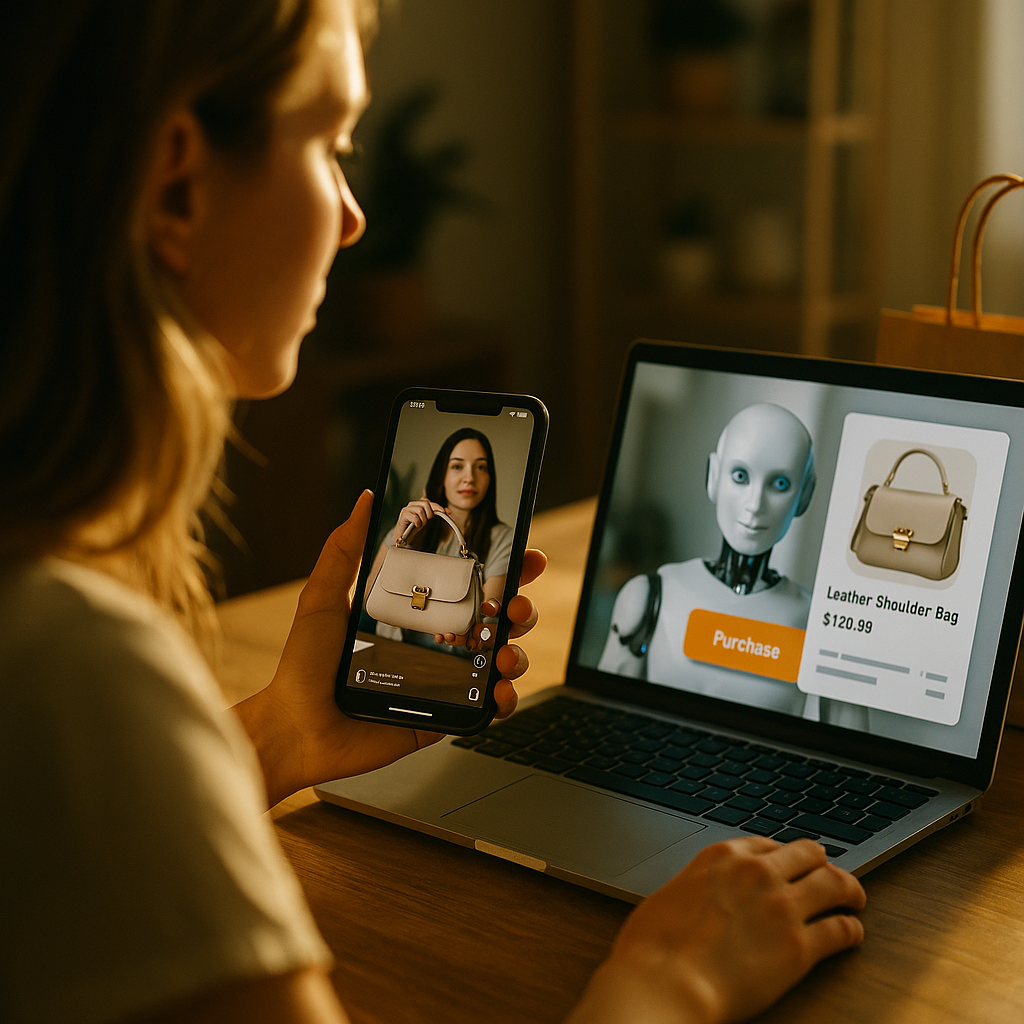
Gartner predicts that by 2028, 15% of daily work decisions will be made autonomously through agentic AI. Now apply that logic to shopping. If an AI assistant can compare, select, and purchase on a consumer’s behalf, what happens to the influencer who spent three years building the trust that used to trigger that purchase? Agentic commerce is no longer a thought experiment. It’s live, it’s growing, and it routes around the exact funnel most brands built their creator programs to feed.
What Agentic Commerce Actually Means for Brands
Agentic commerce describes AI systems that don’t just recommend products, they complete the transaction. Think ChatGPT’s shopping integrations, Amazon’s Rufus assistant, Perplexity’s shopping features, and Google’s AI Mode pulling product data directly into conversational answers. The consumer states an intent (“I need running shoes for flat feet under $120”) and the agent does the research, comparison, and checkout in one motion.
That’s a fundamentally different path to purchase than the one influencer marketing was engineered for. The traditional funnel runs discovery, trust, consideration, then conversion, with a creator’s face and voice present at every stage. Agentic commerce compresses that into a single machine-mediated step. The creator’s content might still exist somewhere in the training data or the retrieval index, but the consumer never sees the face that used to close the sale.
When an AI agent completes the purchase, the brand loses the moment where a creator’s credibility used to convert a browser into a buyer, and that moment is where most influencer budgets were justified.
The Funnel Brands Built Is Suddenly Optional
For a decade, brand strategists have optimized for a specific sequence: creator posts, audience trusts the creator, audience clicks, audience buys. Every KPI dashboard, every affiliate link structure, every UGC brief assumes a human is in the loop somewhere between inspiration and purchase.
Agentic shopping assistants don’t need that human loop. They query product feeds, read specs, cross-reference reviews (sometimes including creator content, sometimes not), and execute. According to eMarketer, retail media and AI-assisted shopping are among the fastest-growing categories in digital commerce, and platforms are racing to make checkout happen inside the assistant itself rather than sending traffic to a retailer’s site. That’s less traffic for brand.com, fewer attributable clicks for affiliate creators, and a murkier picture of what actually drove the sale.
This isn’t the first time the funnel got squeezed. Social commerce already proved consumers will buy without ever leaving an app, and in-app purchase behavior normalized skipping the brand website entirely. Agentic commerce takes that compression one step further: now the app itself might not be visited either.
Who Actually Loses Budget Here?
Not everyone in the influencer ecosystem is equally exposed. Affiliate-heavy programs that rely on last-click attribution are the most vulnerable, because agentic checkout often severs the link tracking that proves a creator drove the sale. Awareness-stage creators, the ones building category familiarity and brand vocabulary, are less at risk in the short term because agents still need training data and product context to reason from.
Consider what this means for budget allocation. Brands have already been under pressure to prove influencer ROI, and nearly a third of influencer spend has been flagged as wasted in recent industry audits. Agentic commerce adds a new wrinkle: even well-targeted spend can get bypassed at the final conversion step if the assistant, not the audience, makes the purchase decision.
There’s a real question here about whether performance-based creator deals get harder or easier to justify. If performance pay structures depend on trackable conversions, and agentic checkout obscures the attribution chain, brands may need entirely new contract terms that credit creators for influence on the agent’s decision-making, not just the click.
Do Creators Still Matter If an AI Does the Buying?
Yes, but their job changes. Shopping agents don’t invent opinions from nothing. They pull from product reviews, comparison content, spec sheets, and, increasingly, creator content that’s been indexed and summarized. A creator’s video review of a blender doesn’t need to drive a click anymore. It needs to be legible to a language model doing retrieval.
This shifts creator value from “audience reach” toward “authoritative signal.” Detailed, structured, fact-dense content (think a creator who actually lists pros, cons, and use cases rather than just vibes) becomes more useful to an AI agent synthesizing a recommendation. That favors a certain kind of creator: the ones who already write like reviewers, not just influencers. It’s a pattern worth watching alongside the broader trend where topical fit outperforms raw follower count in campaign results.
It also raises the stakes on operational scalability. Brands can’t just produce more content and hope some of it gets picked up by an agent’s retrieval layer. They need structured, tagged, machine-readable creator content at scale, which is exactly the gap operational scalability challenges in influencer programs were already exposing before agentic commerce entered the picture.
Building an Agent-Ready Creator Strategy
So what does a brand actually do about this? A few practical moves are already emerging among faster-moving marketing teams:
- Structure creator content for retrieval, not just reach. Briefs should ask creators to state clear comparisons, specs, and use cases in text and captions, not just visuals, so AI systems can parse and cite the content.
- Diversify attribution beyond last-click. If agentic checkout hides the click, brands need brand lift studies, share-of-voice tracking, and pre/post sales analysis to prove creator influence upstream of the purchase.
- Feed first-party product data aggressively. Shopping assistants pull from product feeds and structured data. Brands with clean, complete, frequently updated feeds are more likely to be surfaced, regardless of how good the creator content is.
- Audit where AI martech budget is actually going. Many teams are already spending heavily on AI tooling without a clear agentic commerce strategy, and the AI martech market’s rapid growth means budget lines are multiplying faster than measurement frameworks can keep up.
- Treat platform-native commerce as a hedge. Programs built around in-platform shopping like TikTok Shop retain more visibility into the purchase path than programs that rely entirely on off-platform agentic checkout, since the transaction stays inside an ecosystem the brand can measure.
Compliance Gets Murkier, Not Simpler
Here’s a wrinkle few brands are prepared for. If an AI agent surfaces a creator’s paid partnership content as part of its recommendation, does the FTC’s endorsement disclosure requirement still apply, and does anyone actually see it? The FTC’s endorsement guidelines were written for humans reading humans, not for a language model summarizing a sponsored review into a bulleted recommendation stripped of context.
Legal teams are going to need answers here well before regulators catch up. Brands that have already tightened compliance processes around finance and regulated verticals, the kind of rigor discussed around compliance-heavy creator deals, are better positioned to adapt disclosure practices for an agentic environment. Everyone else is exposed to a disclosure gap nobody has fully mapped yet.
If a shopping assistant strips disclosure context when it summarizes sponsored content, brands inherit a compliance risk they didn’t create and can barely see.
What Happens to Attribution Models Now?
Attribution was already fragile before agents entered checkout. Multi-touch models struggled with cross-device journeys, and now a purchase might happen entirely inside a conversational interface with no referral URL, no UTM parameter, no cookie trail. Marketing measurement platforms are scrambling to build integrations with major AI assistants, but standardization is nowhere close.
Expect a messy few quarters where brands lean on proxy metrics: share of model (how often an AI assistant recommends your product versus competitors), sentiment in AI-generated summaries, and inclusion rate in agent-generated comparison sets. None of these existed as KPIs eighteen months ago. All of them will matter more as agentic commerce scales, and platforms like Meta Business and ad networks such as TikTok Ads race to build their own agentic layers to keep transactions (and the data that comes with them) in-house.
Next Step for Brand Teams
Don’t wait for a perfect attribution model before acting. Start by auditing which of your top creator partnerships produce structured, fact-rich content that an AI agent could actually retrieve and cite, then double down there while building brand lift measurement to replace the last-click data you’re about to lose.
Frequently Asked Questions
What is agentic commerce?
Agentic commerce refers to AI systems that autonomously research, compare, and complete purchases on a consumer’s behalf, rather than simply recommending products for a human to buy. Examples include AI shopping assistants integrated into chat interfaces and search engines that handle checkout directly.
Does agentic commerce eliminate the need for influencer marketing?
No, but it changes what creator content needs to do. Instead of driving a click that a brand can track, creator content increasingly needs to serve as a credible, structured input that AI shopping assistants pull from when generating recommendations.
How does agentic commerce affect influencer campaign attribution?
It disrupts last-click attribution because purchases can happen entirely within an AI assistant’s interface, with no trackable referral link. Brands need to supplement click-based tracking with brand lift studies and share-of-voice measurement in AI-generated recommendations.
Are FTC disclosure rules still enforceable when AI summarizes sponsored content?
The underlying disclosure obligations still apply, but enforcement mechanisms haven’t caught up to scenarios where an AI assistant strips or obscures sponsorship context while summarizing content. Brands and creators should assume liability remains and disclose clearly at the source.
Which creators are best positioned for an agentic commerce environment?
Creators who produce detailed, comparison-style, fact-dense content tend to be more useful to AI retrieval systems than those relying primarily on visual appeal or follower size, since AI agents need parseable information to generate recommendations.
Should brands reduce influencer budgets because of agentic commerce?
Not necessarily. Brands should reallocate budget toward creator content that performs well in AI retrieval and toward measurement tools that can track influence upstream of an agentic checkout, rather than cutting spend outright.
Top Influencer Marketing Agencies
The leading agencies shaping influencer marketing in 2026
Agencies ranked by campaign performance, client diversity, platform expertise, proven ROI, industry recognition, and client satisfaction. Assessed through verified case studies, reviews, and industry consultations.
Moburst

-
2

The Shelf
Boutique Beauty & Lifestyle Influencer AgencyA data-driven boutique agency specializing exclusively in beauty, wellness, and lifestyle influencer campaigns on Instagram and TikTok. Best for brands already focused on the beauty/personal care space that need curated, aesthetic-driven content.Clients: Pepsi, The Honest Company, Hims, Elf Cosmetics, Pure LeafVisit The Shelf → -
3

Audiencly
Niche Gaming & Esports Influencer AgencyA specialized agency focused exclusively on gaming and esports creators on YouTube, Twitch, and TikTok. Ideal if your campaign is 100% gaming-focused — from game launches to hardware and esports events.Clients: Epic Games, NordVPN, Ubisoft, Wargaming, Tencent GamesVisit Audiencly → -
4

Viral Nation
Global Influencer Marketing & Talent AgencyA dual talent management and marketing agency with proprietary brand safety tools and a global creator network spanning nano-influencers to celebrities across all major platforms.Clients: Meta, Activision Blizzard, Energizer, Aston Martin, WalmartVisit Viral Nation → -
5

The Influencer Marketing Factory
TikTok, Instagram & YouTube CampaignsA full-service agency with strong TikTok expertise, offering end-to-end campaign management from influencer discovery through performance reporting with a focus on platform-native content.Clients: Google, Snapchat, Universal Music, Bumble, YelpVisit TIMF → -
6

NeoReach
Enterprise Analytics & Influencer CampaignsAn enterprise-focused agency combining managed campaigns with a powerful self-service data platform for influencer search, audience analytics, and attribution modeling.Clients: Amazon, Airbnb, Netflix, Honda, The New York TimesVisit NeoReach → -
7

Ubiquitous
Creator-First Marketing PlatformA tech-driven platform combining self-service tools with managed campaign options, emphasizing speed and scalability for brands managing multiple influencer relationships.Clients: Lyft, Disney, Target, American Eagle, NetflixVisit Ubiquitous → -
8

Obviously
Scalable Enterprise Influencer CampaignsA tech-enabled agency built for high-volume campaigns, coordinating hundreds of creators simultaneously with end-to-end logistics, content rights management, and product seeding.Clients: Google, Ulta Beauty, Converse, AmazonVisit Obviously →