


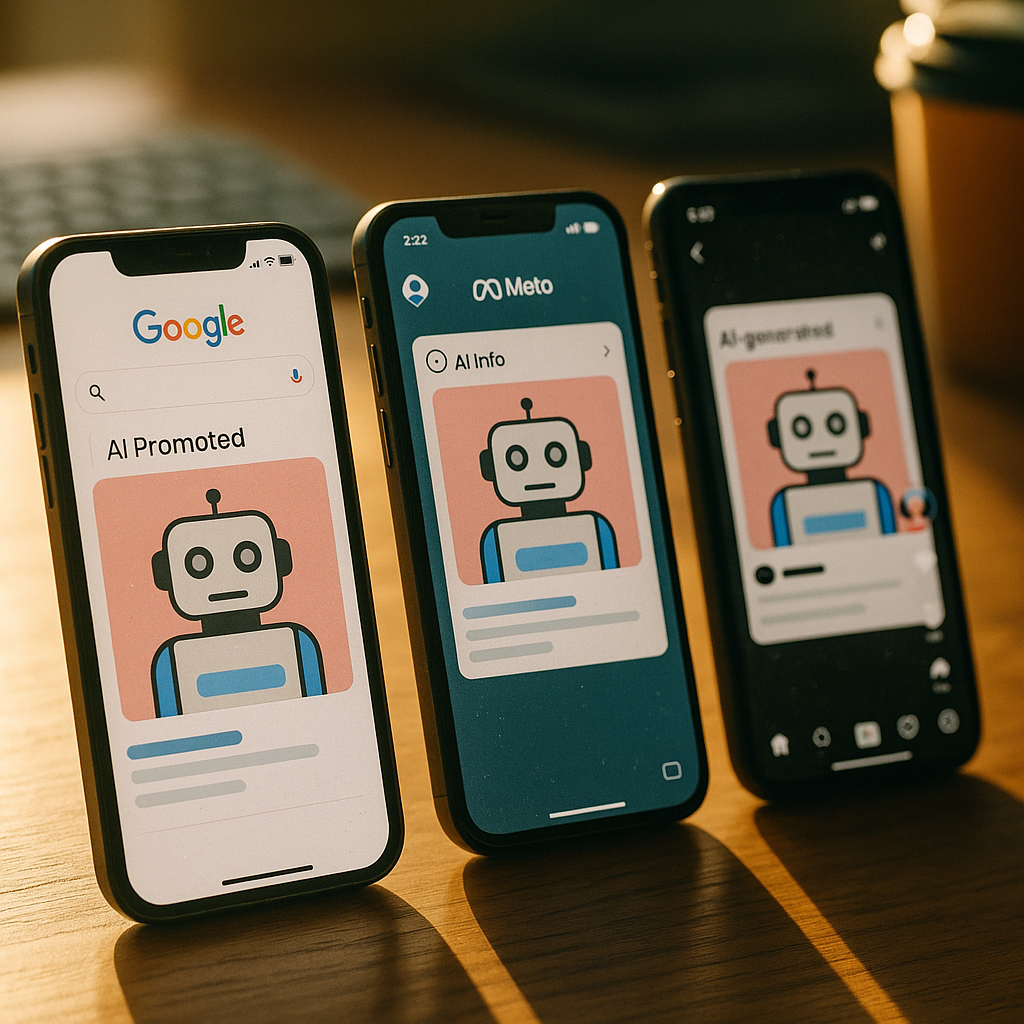
Three platforms, three definitions of “AI-generated,” zero shared vocabulary. That’s the mess brands face heading into another year of synthetic media in ads. Meta wants disclosure for anything that alters “reality.” TikTok flags realistic AI content but shrugs at obvious effects. Google splits the difference with its own carve-outs. AI-generated ad labeling is no longer optional anywhere, but the rules don’t match, and that gap is where compliance teams get burned.
Why This Fragmentation Happened
Nobody sat down and designed this system. Each platform reacted to its own pressure points, on its own timeline, with its own legal team’s risk tolerance. Meta got burned by deepfake scam ads impersonating celebrities and tightened its rules fast. TikTok’s youth-heavy audience and its regulatory scrutiny in the EU and UK pushed it toward broader “synthetic media” labels. Google, sitting on both search and programmatic display, built rules that lean on advertiser self-certification rather than automated detection.
The result: identical creative can be compliant on one platform and flaggable on another. A brand running the same AI-voiced product demo across all three channels needs three separate compliance checks, not one.
A single piece of AI-assisted creative can trigger different disclosure obligations on Google, Meta, and TikTok simultaneously — there is no universal “AI ad” label that satisfies all three.
Meta: Broad Definition, Automated Enforcement
Meta’s policy, rolled out through its Meta Business Tools suite, requires advertisers to disclose when ads contain a “photorealistic” image or video that was digitally created or altered, or when audio was generated or modified to sound like a real person saying something they didn’t say. This covers synthetic actors, voice clones, and manipulated footage of real people, including the advertiser’s own spokesperson if AI touched the final cut.
Meta’s enforcement leans heavily on automated detection combined with self-reported disclosure at the ad-creation stage. Miss the checkbox and get flagged by the classifier, and your account risks a compliance strike. Meta has been especially aggressive on finance and health verticals, where synthetic testimonials caused real consumer harm.
What trips brands up: Meta’s definition doesn’t care about intent. A stylized AI background swap for a fashion ad might not need a label. A realistic AI voiceover mimicking a real spokesperson almost certainly does. The line is “would a reasonable viewer believe this is real,” not “did we use AI in production.”
TikTok’s Line: Realism, Not Tooling
TikTok’s approach, detailed through TikTok for Business policies, similarly centers on realism but applies a slightly different threshold. TikTok requires labeling for AI-generated content depicting realistic scenes or people, especially anything that could be mistaken for authentic footage of real events, real people, or real endorsements. Stylized, clearly cartoonish, or obviously effect-driven AI content generally escapes the requirement.
The platform’s youth skew and international regulatory exposure (particularly in the UK and EU) mean TikTok has been quicker to expand labeling into organic content too, not just paid media. Brands running influencer-style ads through the Creator Marketplace or whitelisted partnerships face overlapping obligations: platform-level AI labels plus standard FTC-style endorsement disclosure. Our generative remix clause breakdown covers how TikTok’s remix tools complicate ownership and disclosure even further when creators reuse brand assets.
TikTok also treats its own generative ad tools, like Symphony-style AI ad creation, differently from third-party AI content uploaded by advertisers. Content made inside TikTok’s native AI ad generator carries platform-level metadata that can auto-trigger labeling. Content made externally and uploaded relies on advertiser honesty. That inconsistency alone should worry any compliance lead running multi-market campaigns.
Google’s Middle Path: Certification Over Detection
Google’s rules, published through Google Ads Help, take a more procedural approach. Advertisers must self-certify whether an ad contains synthetic or digitally altered content that could deceive users about its authenticity, particularly in political, election-related, and social issue ad categories, where disclosure has been mandatory for longer. For standard commercial ads, Google’s policy focuses on “restricted” AI content: things like synthetic depictions of real individuals in a way that misleads, or realistic fabricated events.
Google’s enforcement relies less on automated visual detection and more on advertiser certification at upload, backed by policy violation reports and manual review escalation. That means Google’s system is arguably the most exploitable of the three, but also the one carrying the steepest penalties if you get caught certifying falsely, given Google’s ability to suspend entire ad accounts network-wide.
Google’s newer complication: agentic and automated media buying. As AI systems increasingly select and traffic ads without a human reviewing every asset, certification gaps multiply. We’ve mapped this exposure in detail in our legal risk matrix for agentic buying, which is required reading if your media team is testing automated campaign management.
Where the Three Platforms Actually Disagree
Strip away the legal language and three real differences emerge.
- Trigger threshold: Meta and TikTok focus on realism and deception potential; Google focuses more on category (political, social issues) plus a general deception standard.
- Enforcement mechanism: Meta uses automated classifiers plus self-report; TikTok mixes native-tool metadata with self-report; Google relies almost entirely on advertiser certification.
- Scope of coverage: Meta’s policy reaches further into non-political commercial content than Google’s does by default. TikTok’s reaches into organic and creator content more aggressively than either.
None of these differences are cosmetic. They change what a compliance checklist actually needs to contain per platform, and they change where liability sits if something slips through.
What Brands Must Standardize Right Now
Chasing three separate rulebooks platform by platform is how compliance teams burn out and still miss things. The smarter move is building one internal standard that meets the strictest common denominator, then mapping exceptions downward per platform.
Practical steps that actually hold up:
- Default to disclosure. If any AI tool touched voice, likeness, or a realistic scene, label it. Assume Meta’s threshold as your baseline since it’s the broadest.
- Centralize a creative metadata log. Track which tools, models, and datasets touched every ad asset. When a platform asks you to certify, you need receipts, not memory.
- Separate synthetic performer disclosure from general AI-editing disclosure. These are legally distinct issues in several states now. Our synthetic performer disclosure audit template is a useful cross-check against platform rules, since state law can be stricter than any platform policy.
- Build a single disclosure template that satisfies multiple regulators at once rather than drafting bespoke language per market. We outlined this approach in one disclosure template for ASA and FTC rules, and the same logic extends to platform-specific requirements.
- Audit vendor contracts for AI-matching platforms and creator tools that generate content on your behalf. If a vendor’s tool auto-generates a voiceover or background, you’re still the advertiser of record. Use a vendor risk assessment template to close that gap before launch, not after a platform flag.
Building compliance to Meta’s broader disclosure threshold as your internal default is cheaper than retrofitting labels after a platform audit flags your account.
The Compliance Cost of Getting This Wrong
Ad account suspensions aren’t theoretical. Google, Meta, and TikTok have all suspended advertiser accounts over undisclosed synthetic content, and reinstatement isn’t fast. Beyond platform penalties, there’s regulatory exposure. The FTC has made clear that undisclosed AI-generated endorsements fall under existing endorsement guidelines, regardless of what a platform’s own labeling policy requires. Meeting Meta’s rules doesn’t exempt you from FTC scrutiny, and meeting FTC rules doesn’t exempt you from Meta’s classifier flagging your account anyway.
State-level rules add another layer. New Jersey’s recent AI disclosure legislation, covered in our breakdown of the bill, shows how quickly state law can outpace platform policy. Brands operating nationally can’t rely on platform compliance alone as a legal shield.
According to eMarketer data on AI ad adoption, the volume of AI-assisted creative in paid social is climbing fast enough that manual, platform-by-platform review is already unsustainable for teams running more than a handful of active campaigns. That trajectory alone makes standardization a 2026 budget line item, not a future problem.
Building the Actual Workflow
Here’s what a functioning cross-platform workflow looks like in practice. Creative teams tag every asset with an AI-use flag at production, before it ever reaches media buying. That flag travels with the asset through trafficking, so whoever uploads to Meta, TikTok, or Google Ads sees the disclosure requirement automatically rather than guessing. Legal or compliance reviews spot-check a percentage of flagged assets monthly, prioritizing anything using synthetic voice or likeness, since that’s where regulatory risk concentrates hardest.
Brands running influencer and whitelisted creator content face an extra layer here. Platform-banned content can still be FTC compliant, and vice versa, a mismatch we detailed in whitelisted creator ads, FTC compliant, platform banned. That’s exactly the kind of gap a unified internal standard is meant to close.
The brands getting ahead of this aren’t waiting for a fourth platform to force the issue. Standardize now to Meta’s stricter threshold, document everything, and treat platform compliance as the floor, not the ceiling of your legal obligation.
Frequently Asked Questions
Do Google, Meta, and TikTok all require the same AI disclosure label?
No. Each platform defines triggering content differently and uses different enforcement mechanisms, so a label acceptable on one platform may not satisfy another’s policy.
Does disclosing AI use on a platform satisfy FTC requirements?
Not automatically. Platform disclosure policies and FTC endorsement guidelines are separate legal obligations. Meeting one doesn’t exempt a brand from the other.
What AI content is most likely to require disclosure across all three platforms?
Realistic synthetic depictions of real people, cloned voices, and fabricated scenes that could be mistaken for authentic footage carry the highest disclosure risk everywhere.
Should brands label AI-assisted content even if a platform doesn’t require it?
Yes, when the content involves voice, likeness, or realistic scenes. Defaulting to the strictest standard reduces legal exposure and avoids platform account penalties later.
How often do these platform policies change?
Frequently enough that brands should review policy pages quarterly. Meta, TikTok, and Google have all updated AI disclosure rules multiple times as synthetic media use grew.
Top Influencer Marketing Agencies
The leading agencies shaping influencer marketing in 2026
Agencies ranked by campaign performance, client diversity, platform expertise, proven ROI, industry recognition, and client satisfaction. Assessed through verified case studies, reviews, and industry consultations.
Moburst

-
2

The Shelf
Boutique Beauty & Lifestyle Influencer AgencyA data-driven boutique agency specializing exclusively in beauty, wellness, and lifestyle influencer campaigns on Instagram and TikTok. Best for brands already focused on the beauty/personal care space that need curated, aesthetic-driven content.Clients: Pepsi, The Honest Company, Hims, Elf Cosmetics, Pure LeafVisit The Shelf → -
3

Audiencly
Niche Gaming & Esports Influencer AgencyA specialized agency focused exclusively on gaming and esports creators on YouTube, Twitch, and TikTok. Ideal if your campaign is 100% gaming-focused — from game launches to hardware and esports events.Clients: Epic Games, NordVPN, Ubisoft, Wargaming, Tencent GamesVisit Audiencly → -
4

Viral Nation
Global Influencer Marketing & Talent AgencyA dual talent management and marketing agency with proprietary brand safety tools and a global creator network spanning nano-influencers to celebrities across all major platforms.Clients: Meta, Activision Blizzard, Energizer, Aston Martin, WalmartVisit Viral Nation → -
5

The Influencer Marketing Factory
TikTok, Instagram & YouTube CampaignsA full-service agency with strong TikTok expertise, offering end-to-end campaign management from influencer discovery through performance reporting with a focus on platform-native content.Clients: Google, Snapchat, Universal Music, Bumble, YelpVisit TIMF → -
6

NeoReach
Enterprise Analytics & Influencer CampaignsAn enterprise-focused agency combining managed campaigns with a powerful self-service data platform for influencer search, audience analytics, and attribution modeling.Clients: Amazon, Airbnb, Netflix, Honda, The New York TimesVisit NeoReach → -
7

Ubiquitous
Creator-First Marketing PlatformA tech-driven platform combining self-service tools with managed campaign options, emphasizing speed and scalability for brands managing multiple influencer relationships.Clients: Lyft, Disney, Target, American Eagle, NetflixVisit Ubiquitous → -
8

Obviously
Scalable Enterprise Influencer CampaignsA tech-enabled agency built for high-volume campaigns, coordinating hundreds of creators simultaneously with end-to-end logistics, content rights management, and product seeding.Clients: Google, Ulta Beauty, Converse, AmazonVisit Obviously →