


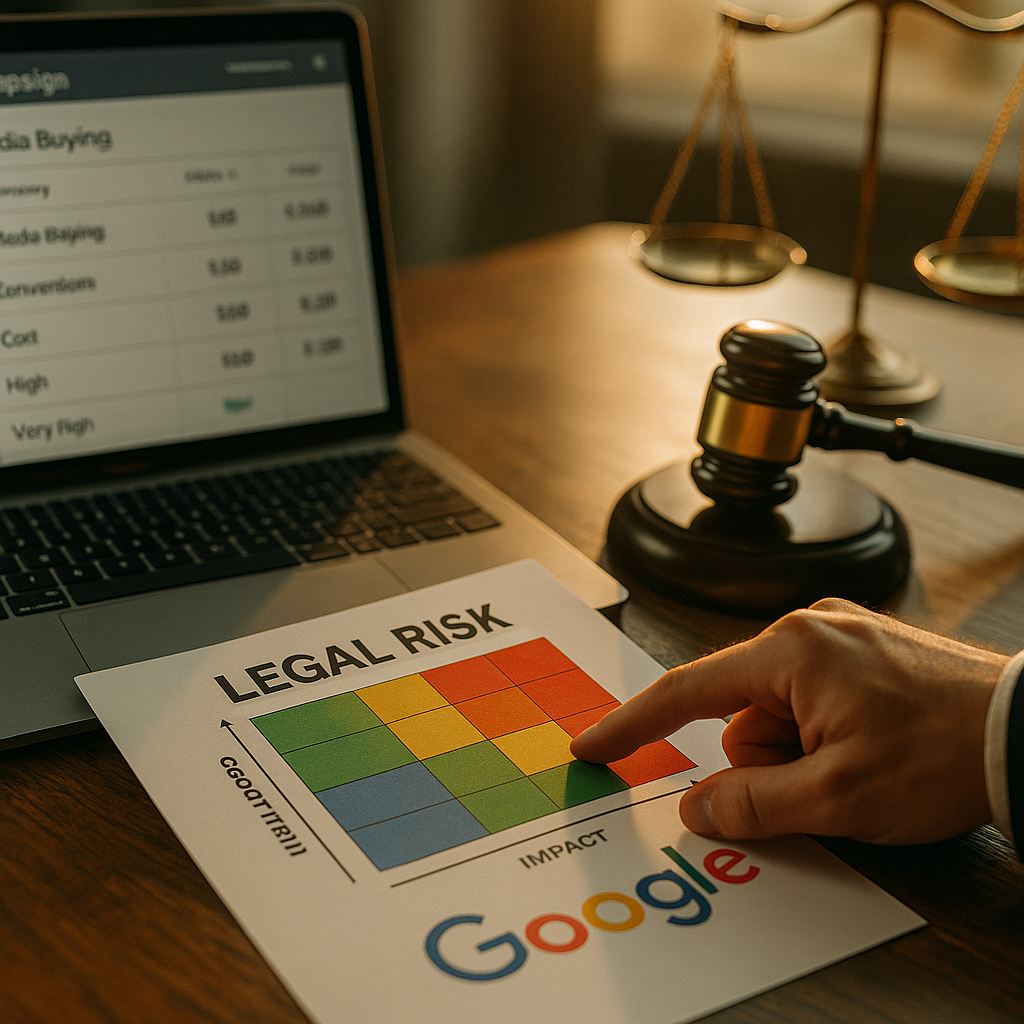
Seventy percent of Google’s ad inventory could soon be transacted through autonomous, goal-seeking agents rather than human traders clicking “publish.” That’s not a distant forecast — it’s the direction Google Ads is already moving with Performance Max automation and emerging agentic buying features. The question brands haven’t answered yet: who’s legally liable when an AI agent buys media, targets a protected class, or triggers a scam-ad violation with zero human sign-off? A legal risk matrix isn’t optional anymore. It’s the only way to keep pace with tools that move faster than your legal review cycle.
Why Agentic Media Buying Changes the Liability Equation
Traditional programmatic buying had a human in the loop somewhere — a trader setting parameters, an ops manager approving budgets, a compliance reviewer sanity-checking creative. Agentic tools collapse that chain. Google’s automated bidding and creative-optimization systems now make thousands of micro-decisions per hour: which audience to target, which headline variant to serve, which placement to bid on. No human sees most of these decisions before they go live.
That’s efficient. It’s also a liability nightmare if nobody’s mapped out where things can go wrong.
Regulators haven’t caught up to the technology, but they’ve made clear they don’t care whose algorithm did the targeting. The FTC has repeatedly stated that automated decision-making doesn’t shield advertisers from Section 5 liability. If your agent serves a deceptive ad, you’re the advertiser of record. Full stop.
An AI agent doesn’t get sued. Your brand does. Every agentic buying decision should be treated as a decision your General Counsel would have to defend in front of a regulator.
Mapping the Risk Matrix: Five Categories Brands Must Score
A useful risk matrix scores each agentic capability against two axes: likelihood of a compliance failure, and severity if it happens. Here’s how that breaks down across the areas where Google’s agentic tools currently operate without meaningful human review.
1. Autonomous Targeting and Discrimination Exposure
Google’s machine-learning models optimize toward conversion signals, not legal categories. That creates real risk: agentic systems have been shown to skew ad delivery by age, gender, or geography in ways that mirror historical discrimination patterns, even without anyone intending it. Housing, credit, and employment ads carry the highest exposure here, but retail and financial services aren’t far behind.
Risk score: High severity, medium-to-high likelihood. This is the category most likely to trigger regulatory scrutiny, because discrimination claims don’t require proof of intent — just outcome.
2. Creative Generation Without Disclosure Controls
Agentic tools increasingly generate ad copy, images, and even video variants on the fly. If those creative assets include synthetic endorsers, AI-generated testimonials, or performance claims the agent invented from product feed data, you’ve got a disclosure problem before a human ever reviews the output. This overlaps heavily with issues covered in synthetic performer disclosure rules, which now apply across a growing number of U.S. states.
Risk score: High severity, high likelihood. Creative volume at machine speed means violations scale just as fast as impressions.
3. Scam and Misleading Ad Triggers
Google, Meta, and TikTok all face growing regulatory pressure to police scam ads, particularly under frameworks like the UK’s Online Safety Act enforcement by Ofcom. Agentic bidding systems that chase conversion volume can inadvertently push ad variants that read as too-good-to-be-true, triggering the exact category of scrutiny brands are trying to avoid. If you’ve already built an audit process for this, it likely mirrors the logic in Ofcom’s Category 1 scam ad rules — the same audit discipline applies to agentic-generated creative, not just influencer posts.
Risk score: Medium-high severity, medium likelihood. Lower frequency than targeting issues, but reputational damage is severe when it hits.
4. Data Retention and Audience Signal Provenance
Agentic tools build and refine audience segments continuously, often blending first-party data with inferred signals in ways that aren’t fully documented. When a regulator asks “where did this audience segment come from,” can you answer? Most brands can’t, because the agent’s decision logic isn’t logged at a level lawyers can actually use. This is the same documentation gap explored in audience data retention policy work for FTC compliance — except now it’s the platform’s AI making the retention and blending decisions, not your team.
Risk score: Medium severity, high likelihood. Not headline-grabbing on its own, but a serious liability multiplier if it surfaces during an unrelated investigation.
5. Indemnification Gaps in Vendor Agreements
Here’s the uncomfortable truth: most brands’ contracts with Google Ads (and with the agencies managing those accounts) were written before agentic buying existed. Standard terms of service push liability back onto the advertiser for “automated features,” full stop. There’s rarely a contractual mechanism that holds Google accountable for agent-driven mistakes. This mirrors a problem already surfacing in creator selection tools, detailed in AI agent indemnification discussions — the contract language just hasn’t caught up to the automation.
Risk score: High severity, near-certain likelihood of a gap existing. This is the one item every legal team should check this quarter, not next.
Building the Matrix: A Practical Template
Forget theoretical frameworks. Here’s a matrix structure marketing ops and legal teams can actually populate and revisit quarterly.
- Column 1 — Agentic function: bidding, targeting, creative generation, audience building, budget pacing.
- Column 2 — Human touchpoint: is there a review gate before this goes live, and how often is it actually used versus bypassed?
- Column 3 — Regulatory exposure: FTC Section 5, state-level AI disclosure laws, EU DSA obligations, discrimination statutes.
- Column 4 — Likelihood score (1-5): based on volume of decisions made and historical incident rate.
- Column 5 — Severity score (1-5): financial penalty exposure plus reputational damage estimate.
- Column 6 — Mitigation owner: name a person, not a department. Ambiguity here is where accountability dies.
Multiply likelihood by severity and you get a prioritized action list. Anything scoring 15 or above (on a 25-point scale) needs a human review gate reinstated within 30 days, no exceptions.
If you can’t name the person accountable for a specific agentic decision, that’s your highest-priority risk — regardless of what the matrix score says.
What “Full Human Oversight” Actually Requires
Google will tell you their agentic tools include human-in-the-loop options. Technically true. Practically, most brands don’t activate them because doing so slows campaign velocity and undercuts the efficiency gains they bought the tool for in the first place.
There’s a middle path. Full human oversight doesn’t mean reviewing every bid. It means:
- Setting hard guardrails on targeting parameters that agents cannot override (protected categories, sensitive verticals).
- Requiring human sign-off on any new creative format or claim type before it enters rotation, not after it’s already served millions of impressions.
- Logging agent decisions at a granularity that satisfies legal discovery requirements, not just marketing performance dashboards.
- Running a monthly compliance sample — pulling 50-100 agent-generated ads for manual review against disclosure and claims standards.
This isn’t dramatically different from how brands have had to adapt creator compliance workflows. The escalation logic in NAD-to-FTC escalation triggers offers a useful model: define thresholds in advance, automate the flagging, but keep a human as the final decision-maker on anything above the threshold.
The Contract Fix Nobody’s Prioritizing
Most brand-agency and brand-platform contracts still treat “media buying” as a service performed by people. Renegotiate now, before an incident forces the conversation. Push for explicit language covering agentic decision liability, audit rights over agent decision logs, and indemnification triggers when platform-side automation — not brand instruction — causes a compliance failure. Agencies managing Google Ads accounts on your behalf should be contractually required to disclose which features run autonomously and which require sign-off. If they can’t answer that today, that’s itself a red flag worth escalating to procurement.
Industry data from eMarketer shows automated and AI-assisted ad buying now accounts for the majority of digital ad spend across major platforms, and that share is only growing. Waiting for a regulatory incident before updating contract language is a bet most General Counsels shouldn’t be willing to make.
Next Step
Build the matrix this quarter, not next: score every agentic function Google’s tools currently run unsupervised, name a human owner for each, and reopen any vendor contract that doesn’t explicitly address agentic decision liability. The brands that treat this as a 2027 problem will be the ones explaining agent behavior to a regulator in 2026.
FAQs
What is a legal risk matrix for agentic media buying?
It’s a structured framework scoring each autonomous ad-buying function (targeting, bidding, creative generation) against regulatory exposure, likelihood of failure, and severity of consequences, so legal and marketing teams can prioritize where human oversight is most urgently needed.
Is a brand liable if Google’s AI agent makes a targeting mistake?
Yes. The FTC and most consumer protection frameworks hold the advertiser of record responsible regardless of whether a human or an algorithm made the decision. Automation doesn’t transfer legal liability to the platform by default.
Does Google offer human-in-the-loop controls for agentic ad tools?
Some features include optional review gates, but many brands disable them to preserve campaign speed and automation efficiency, which is precisely where the compliance gap emerges.
How often should brands update their agentic media risk matrix?
Quarterly at minimum. Agentic tools evolve fast, and new features often ship without corresponding updates to vendor contracts or internal compliance checklists.
What contract language should brands demand from ad platforms or agencies?
Explicit disclosure of which features operate autonomously, audit rights over agent decision logs, and indemnification clauses covering platform-driven compliance failures, not just brand-directed errors.
Top Influencer Marketing Agencies
The leading agencies shaping influencer marketing in 2026
Agencies ranked by campaign performance, client diversity, platform expertise, proven ROI, industry recognition, and client satisfaction. Assessed through verified case studies, reviews, and industry consultations.
Moburst

-
2

The Shelf
Boutique Beauty & Lifestyle Influencer AgencyA data-driven boutique agency specializing exclusively in beauty, wellness, and lifestyle influencer campaigns on Instagram and TikTok. Best for brands already focused on the beauty/personal care space that need curated, aesthetic-driven content.Clients: Pepsi, The Honest Company, Hims, Elf Cosmetics, Pure LeafVisit The Shelf → -
3

Audiencly
Niche Gaming & Esports Influencer AgencyA specialized agency focused exclusively on gaming and esports creators on YouTube, Twitch, and TikTok. Ideal if your campaign is 100% gaming-focused — from game launches to hardware and esports events.Clients: Epic Games, NordVPN, Ubisoft, Wargaming, Tencent GamesVisit Audiencly → -
4

Viral Nation
Global Influencer Marketing & Talent AgencyA dual talent management and marketing agency with proprietary brand safety tools and a global creator network spanning nano-influencers to celebrities across all major platforms.Clients: Meta, Activision Blizzard, Energizer, Aston Martin, WalmartVisit Viral Nation → -
5

The Influencer Marketing Factory
TikTok, Instagram & YouTube CampaignsA full-service agency with strong TikTok expertise, offering end-to-end campaign management from influencer discovery through performance reporting with a focus on platform-native content.Clients: Google, Snapchat, Universal Music, Bumble, YelpVisit TIMF → -
6

NeoReach
Enterprise Analytics & Influencer CampaignsAn enterprise-focused agency combining managed campaigns with a powerful self-service data platform for influencer search, audience analytics, and attribution modeling.Clients: Amazon, Airbnb, Netflix, Honda, The New York TimesVisit NeoReach → -
7

Ubiquitous
Creator-First Marketing PlatformA tech-driven platform combining self-service tools with managed campaign options, emphasizing speed and scalability for brands managing multiple influencer relationships.Clients: Lyft, Disney, Target, American Eagle, NetflixVisit Ubiquitous → -
8

Obviously
Scalable Enterprise Influencer CampaignsA tech-enabled agency built for high-volume campaigns, coordinating hundreds of creators simultaneously with end-to-end logistics, content rights management, and product seeding.Clients: Google, Ulta Beauty, Converse, AmazonVisit Obviously →