


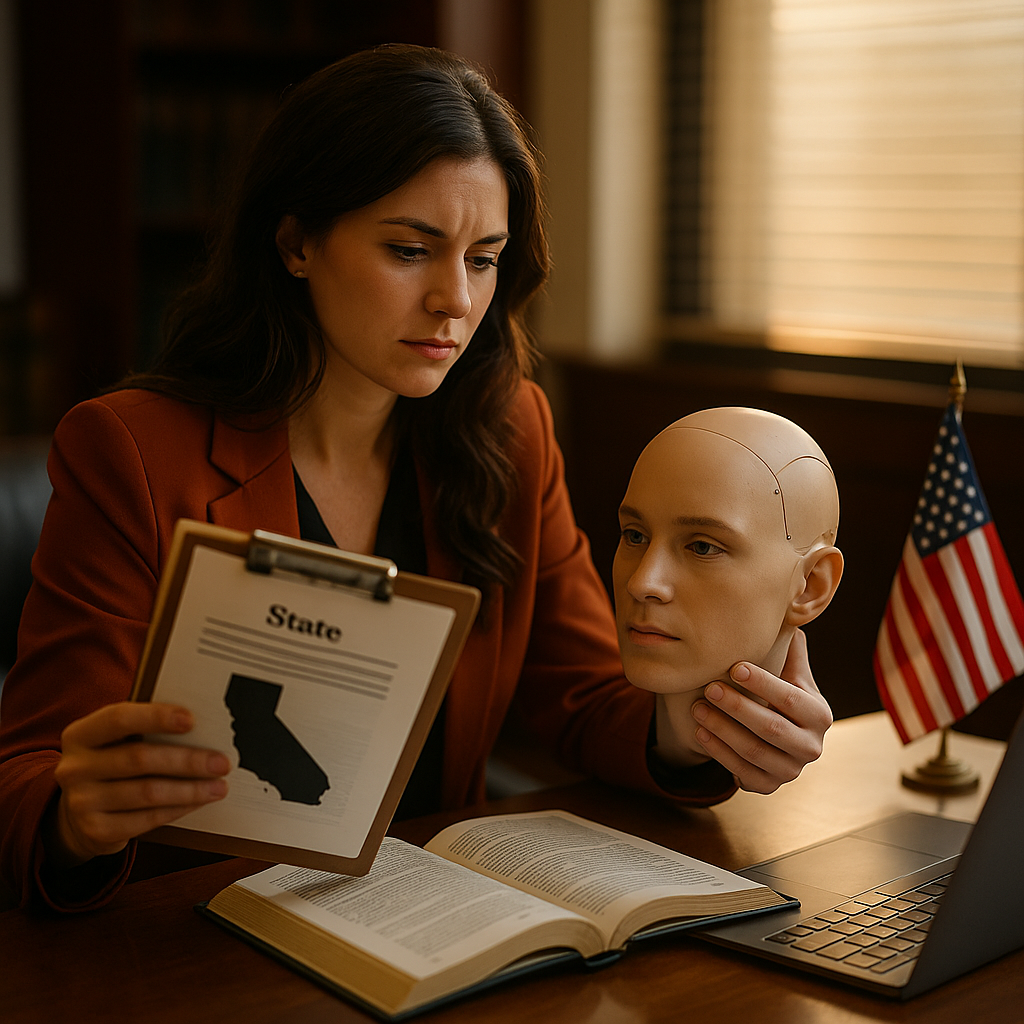
Nine states now require disclosure when a “performer” in an ad is fully or partially synthetic. By the end of the year, that number could hit fifteen. Synthetic performer disclosure is no longer a niche compliance question for AI shops — it’s becoming a patchwork of overlapping state laws that every brand running digital ads needs to map, and fast.
New York moved first. California, Illinois, and a handful of others followed with their own versions, some stricter, some vaguer, almost none identical. If your legal team is still treating this as a single national standard, you’re already behind.
Why This Suddenly Matters to Every Brand, Not Just AI-First Ones
Here’s the thing marketers keep missing: synthetic performer laws don’t just apply to companies building AI avatars from scratch. They apply the moment a brand uses a digitally altered voice, a de-aged spokesperson, a virtual influencer, or even a heavily filtered UGC clip that changes a real performer’s likeness in a material way. That’s a huge swath of modern content production.
Think about how many “creator” videos in a typical Q4 campaign involve some level of AI enhancement — voice cleanup, face retouching, synthetic B-roll inserts, AI-dubbed localization for international markets. Each of those can trigger disclosure obligations depending on where the ad runs and where the consumer sits.
Disclosure isn’t just about ethics anymore. It’s a state-by-state legal exposure problem, and the states are not coordinating with each other.
The FTC’s existing endorsement guidance already requires disclosure of material connections and deceptive AI use under Section 5 authority. States are now layering their own, more specific synthetic performer rules on top. Brands are left reconciling two systems that don’t fully talk to each other — a challenge we broke down in detail in reconciling state AI rules with federal enforcement.
The Matrix: How State Laws Actually Differ
No single federal synthetic media disclosure law exists yet. Instead, you get a fragmented matrix where the trigger, the required language, and the enforcement mechanism all vary. Here’s the rough shape of where things stand:
- New York: Requires clear, conspicuous disclosure whenever a synthetic performer is used in commercial advertising, with specific rules for political and commercial speech treated separately. Enforcement runs through the state attorney general with per-violation civil penalties.
- California: Broader definition of “digital replica,” covering deceased performers and AI-generated likeness composites. Ties into existing right-of-publicity statutes, so remedies can include private lawsuits, not just regulatory action.
- Illinois: Disclosure obligation is narrower on its face but pairs with the state’s biometric privacy law (BIPA), creating a double-exposure risk if the synthetic performer was trained on scraped biometric data.
- Texas: Focuses heavily on deepfake-style political and reputational harm, with commercial advertising disclosure requirements that are less detailed but still enforceable through the attorney general’s consumer protection office.
- Washington and Colorado: Both have proposed or partially enacted frameworks tying synthetic disclosure to broader AI governance statutes, meaning the disclosure rule is one clause inside a much bigger compliance document.
Notice the pattern? Every state picks a different anchor point — publicity rights, biometric privacy, consumer protection, or general AI governance. That means a single “synthetic disclosure” checkbox in your campaign workflow won’t cut it. You need a matrix, not a policy.
We built out a working reference for exactly this in our state-by-state disclosure laws breakdown, and paired it with a practical audit template covering ten states that legal and marketing ops teams can adapt directly.
Where the Real Risk Sits: Cross-State Campaigns
Most national brands don’t run state-specific ad variants for disclosure language — it’s operationally painful and expensive. So the practical question becomes: do you build to the strictest state’s standard and apply it everywhere, or do you geofence disclosure language by IP and ad platform targeting?
Both approaches have tradeoffs. Building to the strictest standard (usually California or New York) is simpler operationally but can look like overkill in states with looser rules, and some legal teams worry it invites scrutiny by implicitly admitting synthetic use everywhere. Geofencing is more precise but requires tighter integration with your ad tech stack and creator content management system, and it increases the chance of a compliance gap if targeting logic breaks.
Most enterprise marketers we talk to are landing on a hybrid: default to the strictest disclosure template, but build geofencing capability as a fallback for edge cases like influencer-posted content that platforms don’t let you fully control.
What Counts as a “Synthetic Performer,” Anyway?
This is the definitional mess nobody wants to deal with, but you have to. State statutes vary on where the line sits between “enhanced” and “synthetic.”
Generally, three categories trigger disclosure obligations across most current state laws:
- Fully AI-generated performers — virtual influencers, AI avatars, synthetic voice actors with no underlying human performer.
- Digital replicas of real people — de-aged actors, resurrected historical figures, AI clones of a real creator’s face or voice used without their live participation in that specific piece of content.
- Materially altered real performances — where AI changes what a real person actually said or did in a way that changes the substance of the endorsement.
What usually does NOT trigger disclosure: routine color grading, background removal, standard audio cleanup, or minor cosmetic touch-ups that don’t change the substance of the performance. But the line is genuinely blurry in a few states, and “material alteration” is exactly the kind of phrase that gets litigated.
If your creative team can’t clearly explain what was AI-generated versus AI-assisted in a piece of content, your legal team can’t tell you whether disclosure applies. Fix that documentation gap first.
Building an Operational Compliance Framework, Not Just a Legal Memo
A legal memo that sits in a shared drive doesn’t stop a non-compliant ad from going live. You need this baked into production workflow. Here’s what that looks like in practice for mid-to-senior marketing teams managing multi-state or national campaigns:
- Tag content at production, not at publish. Require creative and creator teams to flag any AI involvement — voice, face, background generation — at the point of asset creation, not as an afterthought during legal review.
- Build a state-tiering system. Rank states by disclosure strictness (strict, moderate, minimal) and assign a default creative template to each tier. This mirrors the approach we recommend in reconciling EU and US state compliance frameworks, where a tiered system beats a one-size-fits-all policy.
- Contract for it upfront. Creator and vendor agreements need explicit clauses defining who’s responsible for flagging synthetic elements and who eats the liability if disclosure gets missed. This connects directly to indemnification questions we’ve covered around AI-driven creator selection risk.
- Set up an escalation path. When ambiguity arises — and it will — you need a fast internal review process rather than a guess-and-hope approach. We outlined a workable version of this in our piece on escalation protocols for undisclosed sponsorships, which applies almost directly to synthetic performer ambiguity too.
- Audit quarterly, not annually. State legislatures are moving fast on this. A framework built in Q1 can be outdated by Q3. Put a recurring calendar review in place tied to your legal team’s regulatory tracking.
Platforms are also layering their own labeling requirements on top of state law, which adds another wrinkle. Meta, TikTok, and YouTube all have AI content labeling policies that don’t map cleanly onto state disclosure statutes — a gap we detailed in platform AI labels versus FTC rules. Brands need both boxes checked, not just one.
What Happens If You Get It Wrong
Penalties vary but they’re not trivial. New York’s statute allows per-violation civil fines that scale with campaign reach. California’s right-of-publicity tie-in opens the door to private litigation from performers or their estates, which can be far costlier than a regulatory fine given potential statutory damages. Illinois’ BIPA overlap has already produced large settlements in unrelated biometric contexts, and legal analysts expect synthetic performer cases to follow a similar path.
Beyond the legal exposure, there’s reputational risk. A brand caught running an undisclosed AI spokesperson reads very differently in the press than a brand that got a disclosure label slightly wrong. The former looks deceptive. Consumer trust research from eMarketer consistently shows synthetic media trust gaps widening, and marketers can’t afford to be the case study that proves the point.
Practical Next Steps for Marketing and Legal Teams
Don’t wait for a federal standard — it’s not coming soon, and states aren’t pausing for one. Start by inventorying every piece of active and in-production creative that involves any AI-assisted performer element, then map each asset against the states where it’ll run. Use a tiered compliance template rather than fifty custom disclosure lines, and put contractual liability language in place before your next creator brief goes out, not after a complaint lands.
For a deeper practical walkthrough, our audit template for synthetic performer disclosure is built to plug directly into existing campaign review workflows, and it’s worth running your current Q4 and Q1 creative through it this week.
Frequently Asked Questions
What is synthetic performer disclosure?
It’s a legal requirement, increasingly codified at the state level, that advertisers clearly label when an ad features an AI-generated, digitally replicated, or materially altered performer rather than an unmodified human performance. The goal is to prevent consumers from being deceived about who or what they’re watching.
Which states currently require synthetic performer disclosure?
New York was among the first to enact a specific statute, followed by California, Illinois, Texas, and several others with proposed or partial frameworks including Washington and Colorado. The requirements, triggers, and penalties differ significantly by state, so brands need a state-specific compliance matrix rather than a single national policy.
Does synthetic performer disclosure apply to AI-enhanced UGC or creator content?
It can. If a creator’s voice, face, or performance is materially altered using AI tools — even routine-seeming edits like AI dubbing or de-aging filters — several state laws treat that as a synthetic performance requiring disclosure, depending on jurisdiction and the extent of the alteration.
How is synthetic performer disclosure different from FTC endorsement rules?
FTC rules under Section 5 focus on preventing deceptive practices and require disclosure of material connections between brands and endorsers. State synthetic performer laws are narrower and specifically target AI-generated or digitally altered performances, often with their own penalty structures separate from FTC enforcement.
What’s the safest compliance approach for brands running national campaigns?
Most compliance teams default to the strictest applicable state standard as a baseline, then build geofencing or platform-level targeting as a fallback for jurisdiction-specific requirements. Pairing this with clear creator contract language and a documented production-stage tagging process significantly reduces legal exposure.
What penalties can brands face for non-compliance?
Penalties range from civil fines assessed by state attorneys general to private lawsuits under right-of-publicity or biometric privacy statutes, depending on the state. Reputational damage from being publicly identified as using undisclosed synthetic performers often carries costs beyond the direct legal penalty.
Visible FAQ (JSON-LD Duplicate Below)
Top Influencer Marketing Agencies
The leading agencies shaping influencer marketing in 2026
Agencies ranked by campaign performance, client diversity, platform expertise, proven ROI, industry recognition, and client satisfaction. Assessed through verified case studies, reviews, and industry consultations.
Moburst

-
2

The Shelf
Boutique Beauty & Lifestyle Influencer AgencyA data-driven boutique agency specializing exclusively in beauty, wellness, and lifestyle influencer campaigns on Instagram and TikTok. Best for brands already focused on the beauty/personal care space that need curated, aesthetic-driven content.Clients: Pepsi, The Honest Company, Hims, Elf Cosmetics, Pure LeafVisit The Shelf → -
3

Audiencly
Niche Gaming & Esports Influencer AgencyA specialized agency focused exclusively on gaming and esports creators on YouTube, Twitch, and TikTok. Ideal if your campaign is 100% gaming-focused — from game launches to hardware and esports events.Clients: Epic Games, NordVPN, Ubisoft, Wargaming, Tencent GamesVisit Audiencly → -
4

Viral Nation
Global Influencer Marketing & Talent AgencyA dual talent management and marketing agency with proprietary brand safety tools and a global creator network spanning nano-influencers to celebrities across all major platforms.Clients: Meta, Activision Blizzard, Energizer, Aston Martin, WalmartVisit Viral Nation → -
5

The Influencer Marketing Factory
TikTok, Instagram & YouTube CampaignsA full-service agency with strong TikTok expertise, offering end-to-end campaign management from influencer discovery through performance reporting with a focus on platform-native content.Clients: Google, Snapchat, Universal Music, Bumble, YelpVisit TIMF → -
6

NeoReach
Enterprise Analytics & Influencer CampaignsAn enterprise-focused agency combining managed campaigns with a powerful self-service data platform for influencer search, audience analytics, and attribution modeling.Clients: Amazon, Airbnb, Netflix, Honda, The New York TimesVisit NeoReach → -
7

Ubiquitous
Creator-First Marketing PlatformA tech-driven platform combining self-service tools with managed campaign options, emphasizing speed and scalability for brands managing multiple influencer relationships.Clients: Lyft, Disney, Target, American Eagle, NetflixVisit Ubiquitous → -
8

Obviously
Scalable Enterprise Influencer CampaignsA tech-enabled agency built for high-volume campaigns, coordinating hundreds of creators simultaneously with end-to-end logistics, content rights management, and product seeding.Clients: Google, Ulta Beauty, Converse, AmazonVisit Obviously →