


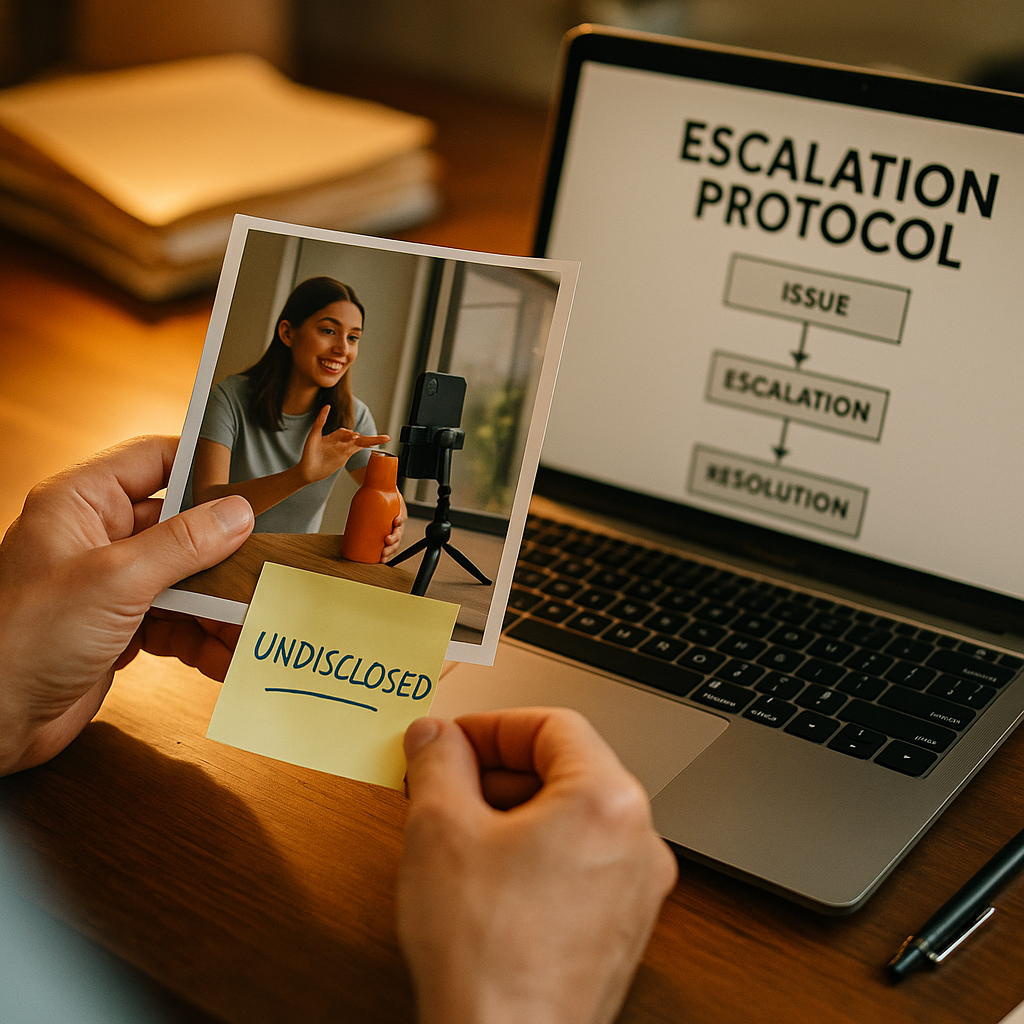
NAD referred a record number of unresolved ad-substantiation cases to the FTC last year, and undisclosed influencer sponsorships were a recurring theme. If your brand doesn’t have a documented internal escalation protocol for undisclosed creator sponsorships, you’re gambling that self-regulation stays voluntary. It won’t, not for you, once NAD loses patience.
Most brands treat disclosure compliance as a checklist item buried in a creator contract. That’s the wrong mental model. Disclosure failures are an operational risk, not a legal afterthought, and they need an escalation path with named owners, deadlines, and a paper trail long before NAD ever opens a case file.
Why This Matters More Than It Did Two Years Ago
NAD (the National Advertising Division, part of BBB National Programs) has always positioned itself as the industry’s self-regulatory first line of defense. Brands that cooperate get to resolve issues quietly, adjust practices, and avoid the FTC’s public enforcement machine. Brands that stonewall or ignore recommendations get referred. That referral is the nightmare scenario: public findings, FTC scrutiny, and a story trade press will cover.
The volume of influencer-related NAD inquiries has climbed steadily as creator spend has grown. eMarketer estimates influencer marketing spend in the US continues to outpace overall digital ad growth, which means more sponsored content, more edge cases, and more opportunities for a #ad tag to go missing. Add AI-driven content tools that can strip metadata or auto-generate captions without disclosure language, and you have a structural risk problem, not an isolated mistake.
A single undisclosed post rarely triggers a referral. A pattern of undisclosed posts, paired with no internal response process, is exactly what turns a warning letter into a public FTC case.
We’ve covered the mechanics of how NAD decides to escalate in our breakdown of NAD-to-FTC referral triggers. This piece is about what you build internally so you never test those triggers in the first place.
What an Escalation Protocol Actually Looks Like
Forget vague “compliance culture” language. An escalation protocol is a document with tiers, timeframes, and named roles. Here’s the skeleton most legal and marketing ops teams land on:
- Tier 1 — Detection: Automated or manual flag that a sponsored post lacks proper disclosure. Trigger: social listening tool, platform audit, consumer complaint, or NAD inquiry letter.
- Tier 2 — Internal Verification: Compliance or legal confirms whether the post is actually a paid partnership, checks contract terms, and determines scope (one creator, one campaign, or a pattern across the roster).
- Tier 3 — Containment: Creator is asked to correct the post within a defined window (24-48 hours is standard practice among brands we’ve reviewed). Legal drafts a response memo in case NAD follows up.
- Tier 4 — Root Cause Review: Was it creator error, a briefing gap, an AI tool stripping the tag, or a platform UI bug? This determines whether you fix a person or fix a system.
- Tier 5 — Escalation to Executive/Legal Leadership: If NAD has opened a formal inquiry, or if the same failure recurs across campaigns, this goes to General Counsel and CMO level, not just the influencer marketing manager.
Notice what’s missing from that list: panic. A protocol works precisely because it removes ad-hoc decision-making under pressure. When someone from BBB National Programs emails your compliance inbox, you want a runbook, not a Slack thread asking “who owns this?”
Who Should Own Each Tier?
This is where most protocols fall apart. Marketing wants to own creator relationships. Legal wants to own regulatory response. Neither wants to own the awkward middle: telling a creator their post violates FTC guidance while preserving the relationship.
Assign ownership explicitly:
- Influencer marketing team owns Tier 1 and Tier 3 (detection and creator-facing correction).
- Legal or compliance owns Tier 2 and Tier 5 (verification and executive escalation).
- A shared owner, often a compliance-marketing liaison, owns Tier 4, since root cause analysis needs both operational and legal context.
If your organization is too small for that structure, at minimum name one person as the single point of accountability. Diffuse ownership is how a fixable disclosure gap becomes a documented pattern of negligence in NAD’s eyes.
The Detection Layer Nobody Budgets For
You can’t escalate what you don’t detect. Most brands rely on creators to self-disclose correctly and hope platform-native tools catch the rest. That’s thin coverage. TikTok, YouTube, and Meta all have their own disclosure and AI-label systems, but as we’ve detailed in our comparison of platform AI labels versus FTC disclosure rules, none of them map cleanly onto FTC requirements. A TikTok “Paid Partnership” label satisfies the platform. It doesn’t automatically satisfy Section 5.
Build a detection layer with three components:
- Quarterly manual audits of a sample of live creator content, not just what was submitted for approval pre-publish.
- Automated monitoring tools (several social listening platforms now offer disclosure-keyword tracking) that flag posts mentioning your brand without #ad, #sponsored, or equivalent language.
- Creator self-reporting incentives, meaning creators get compensated faster or retained longer when they proactively flag their own disclosure mistakes instead of hiding them.
For a deeper audit framework, our disclosure audit protocol for catching AI-stripped sponsor tags walks through how automated editing tools quietly remove disclosure language during video processing, an increasingly common failure mode nobody flagged two years ago.
Documentation Is the Product, Not a Byproduct
Here’s the uncomfortable truth: NAD and the FTC don’t just evaluate whether a violation happened. They evaluate whether you had a reasonable compliance system in place. A brand that catches its own disclosure failure, corrects it within 48 hours, and documents the entire process looks fundamentally different to regulators than a brand that ignores three warning emails.
Every tier of your escalation protocol needs a paper trail:
- Timestamped detection logs (screenshot, URL, date flagged)
- Internal correspondence showing verification steps taken
- Creator communication showing correction requests and response times
- A root-cause memo, even a short one, explaining why the failure occurred
- Evidence of systemic fixes (updated briefing templates, revised contract language, new tool implementation)
Regulators aren’t looking for perfection. They’re looking for evidence that a brand treats disclosure compliance as an operational discipline, not a legal afterthought handled only when someone complains.
This documentation habit also pays off outside the NAD context. If you’re managing brand-directed creator liability exposure, the same records that protect you in a NAD inquiry double as evidence in FTC investigations or even private litigation.
Building the Contract Language That Makes Escalation Possible
None of this works if your creator contracts don’t give you the authority to act fast. Standard influencer agreements often include vague disclosure clauses (“Creator agrees to comply with applicable law”) without specifying response timeframes, correction obligations, or consequences for repeated failures.
Update your contract templates to include:
- A defined correction window (we recommend 24-48 hours from notice)
- Brand’s right to require content takedown if correction isn’t feasible
- Escalating consequences for repeat violations (warning, reduced compensation, contract termination)
- Explicit disclosure format requirements matching current FTC guidance, not just platform defaults
If your program spans multiple markets, layer in region-specific requirements too. A disclosure that satisfies the FTC may not satisfy the UK’s ASA or the EU’s DSA framework. Our cross-border disclosure matrix is a useful reference when drafting contract language for a global creator roster.
When AI Tools Are the Root Cause
A growing share of disclosure failures aren’t creator negligence at all. They’re tooling problems. AI-assisted editing apps, auto-caption generators, and repurposing tools frequently strip metadata, captions, or on-screen text when converting content between formats. A creator posts a properly disclosed TikTok, an agency repurposes it for a YouTube Short using an automated tool, and the disclosure tag vanishes in the process.
If your root cause review keeps surfacing tooling failures instead of human error, the fix isn’t creator retraining. It’s a technical audit of your content pipeline. Our legal review checklist for AI-generated UGC disclosure is built specifically for this scenario, and it pairs well with a broader look at disclosure requirements for AI-generated creator briefs if your briefing process itself relies on AI drafting tools.
Worth asking in every root cause review: did a human ever actually look at the final published asset? If the answer is no, that’s your systemic fix, not another warning email to the creator.
Building This Into Your Annual Calendar
An escalation protocol shouldn’t be a document that sits in a shared drive until something breaks. Bake the audit cadence, contract review, and training refreshers into your annual compliance calendar for creator programs. Quarterly disclosure audits, semi-annual contract language reviews, and an annual full-protocol stress test (literally simulate a NAD inquiry and time your team’s response) keep the system from going stale.
According to the FTC’s own enforcement guidance on endorsements, the agency has repeatedly signaled that it expects advertisers to actively monitor influencer compliance, not just react to complaints. That expectation, paired with NAD’s referral authority, means the absence of a protocol is itself a liability, independent of whether any single post ever gets flagged.
What About Smaller Brands Without a Legal Team?
You don’t need in-house counsel to run this protocol, but you do need a designated compliance owner, even a part-time one, and a template library. Use outside counsel for the Tier 5 escalation only. Most of the detection and containment work is operational, not legal, and can be run by an influencer marketing manager with a clear checklist and management buy-in on response deadlines.
Tools like Sprout Social and similar social listening platforms can handle a meaningful share of the detection layer for a fraction of what a compliance hire costs. Combine that with a documented protocol and a quarterly audit habit, and you’ve closed most of the gap that separates brands NAD works with quietly from brands NAD refers publicly.
FAQs
Frequently Asked Questions
What triggers a NAD referral to the FTC for undisclosed sponsorships?
NAD typically refers a case when a brand doesn’t respond to its inquiry, refuses to comply with recommendations, or shows a repeated pattern of disclosure violations without evidence of corrective action. A single isolated incident rarely triggers referral if the brand cooperates and fixes the issue.
How fast should a brand correct an undisclosed creator post?
Most compliance teams set a 24-48 hour correction window from the moment a disclosure gap is detected. Faster response times strengthen your position if NAD or the FTC later reviews your compliance history.
Who should own the escalation protocol internally?
Detection and creator communication typically sit with the influencer marketing team, while verification and formal regulatory responses sit with legal or compliance. At minimum, name one accountable owner so response isn’t delayed by unclear responsibility.
Does a platform’s built-in disclosure label satisfy FTC requirements?
Not automatically. Platform labels like TikTok’s “Paid Partnership” tag help but don’t guarantee compliance with FTC Section 5 guidance, especially if the underlying content is repurposed across platforms and the label doesn’t carry over.
What documentation matters most if NAD opens an inquiry?
Timestamped detection logs, internal verification records, creator correction communications, and a root-cause memo showing what systemic fix was implemented. This paper trail demonstrates a functioning compliance system rather than reactive damage control.
Can AI editing tools cause disclosure failures even when creators comply correctly?
Yes. Auto-captioning and repurposing tools frequently strip disclosure text or metadata when converting content between formats, which is why root cause reviews should include a technical audit of the content pipeline, not just creator behavior.
Draft the five-tier protocol this week, assign owners by name, and run a mock NAD inquiry within thirty days to see where it breaks. That dry run will tell you more about your actual compliance posture than any policy document sitting unused in a shared drive.
Top Influencer Marketing Agencies
The leading agencies shaping influencer marketing in 2026
Agencies ranked by campaign performance, client diversity, platform expertise, proven ROI, industry recognition, and client satisfaction. Assessed through verified case studies, reviews, and industry consultations.
Moburst

-
2

The Shelf
Boutique Beauty & Lifestyle Influencer AgencyA data-driven boutique agency specializing exclusively in beauty, wellness, and lifestyle influencer campaigns on Instagram and TikTok. Best for brands already focused on the beauty/personal care space that need curated, aesthetic-driven content.Clients: Pepsi, The Honest Company, Hims, Elf Cosmetics, Pure LeafVisit The Shelf → -
3

Audiencly
Niche Gaming & Esports Influencer AgencyA specialized agency focused exclusively on gaming and esports creators on YouTube, Twitch, and TikTok. Ideal if your campaign is 100% gaming-focused — from game launches to hardware and esports events.Clients: Epic Games, NordVPN, Ubisoft, Wargaming, Tencent GamesVisit Audiencly → -
4

Viral Nation
Global Influencer Marketing & Talent AgencyA dual talent management and marketing agency with proprietary brand safety tools and a global creator network spanning nano-influencers to celebrities across all major platforms.Clients: Meta, Activision Blizzard, Energizer, Aston Martin, WalmartVisit Viral Nation → -
5

The Influencer Marketing Factory
TikTok, Instagram & YouTube CampaignsA full-service agency with strong TikTok expertise, offering end-to-end campaign management from influencer discovery through performance reporting with a focus on platform-native content.Clients: Google, Snapchat, Universal Music, Bumble, YelpVisit TIMF → -
6

NeoReach
Enterprise Analytics & Influencer CampaignsAn enterprise-focused agency combining managed campaigns with a powerful self-service data platform for influencer search, audience analytics, and attribution modeling.Clients: Amazon, Airbnb, Netflix, Honda, The New York TimesVisit NeoReach → -
7

Ubiquitous
Creator-First Marketing PlatformA tech-driven platform combining self-service tools with managed campaign options, emphasizing speed and scalability for brands managing multiple influencer relationships.Clients: Lyft, Disney, Target, American Eagle, NetflixVisit Ubiquitous → -
8

Obviously
Scalable Enterprise Influencer CampaignsA tech-enabled agency built for high-volume campaigns, coordinating hundreds of creators simultaneously with end-to-end logistics, content rights management, and product seeding.Clients: Google, Ulta Beauty, Converse, AmazonVisit Obviously →