


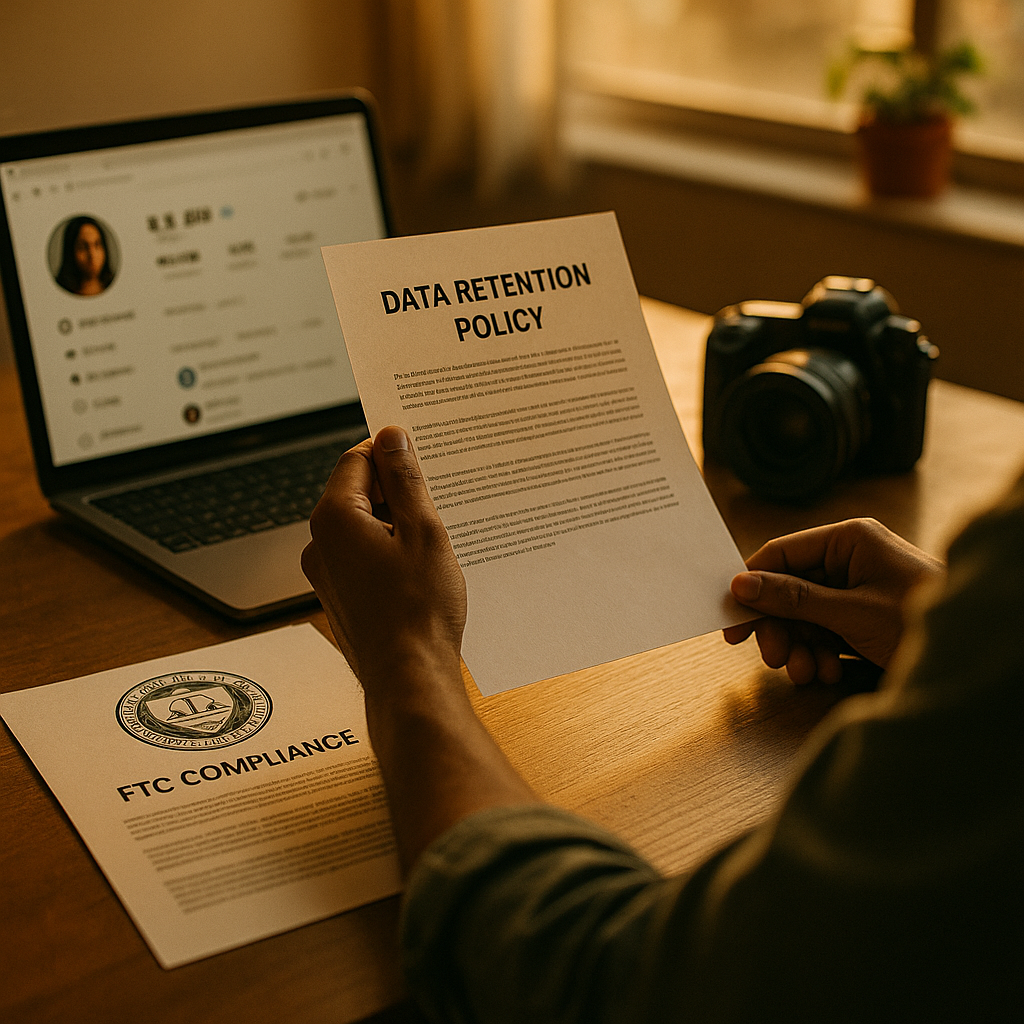
Every brand sitting on three years of creator campaign data — audience demographics, engagement logs, DM screenshots from gifting programs — is now holding a liability, not an asset. The FTC’s 2026 minimization guidance says quietly what privacy lawyers have warned for years: if you can’t justify why you still have it, you shouldn’t still have it. A data retention policy for creator audience data is no longer a nice-to-have compliance artifact. It’s the difference between a clean audit and a six-figure settlement.
Why the FTC Moved on Data Minimization Now
The FTC has spent years chasing disclosure violations — undisclosed sponsorships, AI-washed endorsements, the usual suspects. But the 2026 guidance shifts attention upstream, to the data infrastructure behind influencer campaigns. Brands and agencies collect enormous volumes of creator audience data: follower demographics pulled from platform APIs, engagement analytics, contact information harvested through gifting and seeding programs, even biometric-adjacent data from AI-powered audience verification tools.
Most of that data sits in marketing clouds indefinitely. Nobody deletes anything because deletion feels risky — what if we need it for next year’s campaign benchmarking? That instinct is exactly what the FTC is targeting. The agency’s position, consistent with its broader enforcement posture under Section 5 of the FTC Act, is that indefinite retention without a documented business purpose constitutes an unfair practice, separate from any breach or misuse.
The FTC isn’t asking whether your data is secure. It’s asking whether you had any right to keep it this long in the first place.
This mirrors trends already visible in state youth privacy laws, which increasingly treat over-retention of minors’ data as a standalone violation. If your influencer program touches gaming, beauty, or family content categories, you’ve likely already seen this logic play out — see our breakdown of how state youth privacy laws put beauty and gaming ads at risk.
What Counts as “Creator Audience Data,” Exactly?
This is where a lot of brand compliance teams get sloppy. Creator audience data isn’t just the follower count in a media kit. It spans:
- Demographic and psychographic breakdowns pulled from platform insights tools or third-party analytics vendors
- Engagement data tied to specific campaigns (comments, shares, click-throughs attributed to individual creators)
- Audience overlap and lookalike data used for paid amplification
- Contact and address information collected for gifting, product seeding, or affiliate payouts
- Age-verification or estimated-age data gathered to comply with minor-protection rules
- Screenshots, DMs, or comment threads preserved for legal or dispute purposes
Each category carries different risk and different retention logic. Payment-related data tied to gifting programs, for instance, has its own tax documentation requirements that can conflict with minimization pressure — a tension we’ve covered in auditing creator gifting programs for tax reporting accuracy. You can’t blanket-delete everything after 90 days if the IRS wants five-year documentation on 1099 payouts. The policy has to be granular by data type, not a single retention clock for everything.
Building the Policy: Start With a Data Inventory, Not a Deadline
Skip the temptation to just pick a number — “we’ll delete everything after 12 months” — and call it done. That’s the fastest way to build a policy that either fails an audit or breaks your measurement stack.
Start with an inventory. Map every place creator audience data lives: your influencer platform (Grin, CreatorIQ, Aspire), your CRM, shared drives where campaign managers stash spreadsheets, email threads with agency partners, and any third-party audience verification tool you use to flag bot followers or fake engagement. Most brands are shocked at how many silos exist. A 2024 eMarketer analysis of martech stacks found the average mid-size brand uses more than a dozen disconnected tools touching creator or campaign data — and almost none of them talk to each other on retention rules.
Once you know where the data lives, classify it by purpose:
- Active campaign data — needed for the duration of the engagement plus reporting.
- Performance benchmarking data — aggregated, ideally anonymized, used for future creator selection.
- Legal and financial records — contracts, payment records, tax forms, subject to statutory retention periods.
- Compliance evidence — disclosure screenshots, age-verification logs, content approvals kept to defend against FTC or state AG inquiries.
- Everything else — data with no clear ongoing purpose. This is your deletion queue.
That fifth bucket is usually the largest, and it’s the one the FTC guidance is aimed squarely at.
Setting Retention Windows That Survive an Audit
There’s no single FTC-mandated number of days or months — the guidance is principles-based, not a fixed schedule, which frustrates compliance teams looking for a simple answer. But industry practice is converging around a few benchmarks:
- Active campaign data: retain through campaign completion plus one reporting cycle (typically 90-180 days post-campaign).
- Aggregated benchmarking data: can be retained longer if stripped of personally identifiable elements — this is the minimization principle in action. Anonymize, then keep.
- Financial and tax records: follow statutory minimums (generally three to seven years depending on jurisdiction), regardless of marketing preferences.
- Disclosure and compliance evidence: retain for the length of the applicable statute of limitations on FTC or state enforcement action, typically a rolling multi-year window.
- Age-verification data: treat with extra caution. Retain only what’s needed to prove compliance, and consult frameworks like those outlined in age-verification compliance documentation brands need now.
Write these windows into a table, attach owners, and put it in your compliance playbook. If your legal team can’t produce this table in under sixty seconds during an FTC inquiry, the policy doesn’t exist in any meaningful sense — it’s a slide deck, not a control.
The Under-16 Data Problem Nobody Wants to Own
Here’s where retention policy collides with a much thornier issue: creator audiences increasingly include minors, and several states now restrict how platforms and brands can collect, process, or retain data tied to under-16 users. If your influencer campaigns touch gaming, toys, beauty, or youth fashion, this isn’t hypothetical.
The overlap between the FTC’s minimization guidance and emerging age-verification law is significant enough that brands should treat it as one workstream, not two. Our pre-campaign legal checklist for under-16 social media bans covers the front-end collection rules; the retention policy has to cover the back end — how long you keep any data that touches minor audiences, and under what safeguards.
If your creator campaign could plausibly reach an under-16 audience, assume regulators will ask not just what you collected, but why you still have it a year later.
Vendor Contracts Are Your Weakest Link
Most brands don’t directly hold creator audience data — their influencer marketing platform, agency, or AI-powered audience analysis tool does. That means your retention policy is only as good as your vendor contracts.
Audit every vendor agreement for three things: does the vendor have its own retention schedule, does that schedule align with yours, and do you have contractual rights to force deletion on demand? Many platform agreements are silent on this, written before minimization became an enforcement priority. That silence is now a liability. The same logic that applies to AI vendor contracts around agentic bidding errors — covered in who pays in your AI vendor contract — applies here: if the contract doesn’t explicitly assign responsibility, you own the risk by default.
Practical fix: add a data retention addendum to every renewal. Require vendors to certify deletion annually. If a vendor won’t agree to a deletion clause, that’s a signal worth escalating before the next contract cycle, not after an FTC inquiry.
Documentation Beats Perfection
No policy will be perfect on day one. What regulators actually reward — and what the FTC’s own guidance documents emphasize — is evidence of a documented, risk-based process. According to the FTC, enforcement actions around data practices consistently focus on whether a company had a reasonable, documented rationale for its data handling, not whether it achieved theoretical perfection.
That means your policy needs a paper trail: who approved the retention schedule, when it was last reviewed, what changed and why. Treat it the way you’d treat a disclosure escalation protocol — similar in spirit to the structured approach in internal escalation protocols for undisclosed creator sponsorships. A defined process, reviewed quarterly, with named owners, will outperform an aspirational zero-retention policy that nobody actually follows.
Build a review cadence: quarterly for active campaign data, annually for the full policy. Assign it to whoever owns compliance for your influencer program — not a rotating intern, a named senior stakeholder. When the FTC or a state AG comes calling, “we review this every quarter and here’s the log” is a far stronger position than silence.
Where This Intersects With Disclosure and AI Risk
Retention policy doesn’t live in isolation. It connects directly to disclosure compliance work your team is likely already doing. Audience data often gets used to verify whether disclosure requirements were met — proof that a sponsored post reached the audience segment it claimed to. If you’re retaining data specifically to defend disclosure practices, as outlined in our disclosure template built for both ASA and FTC rules, that’s a legitimate, documentable purpose — keep it, and label it as such in your retention schedule.
The goal isn’t zero data. It’s justified data, held for a defined reason, for a defined period, with a defined owner. According to HubSpot‘s ongoing research on marketing operations, teams with documented data governance policies report significantly fewer compliance escalations than those without — the discipline itself reduces risk, independent of the specific rules in play.
Next Step
Don’t wait for an FTC inquiry to build your first data inventory — start with a 30-day audit of every tool touching creator audience data, then draft retention windows by data type, not by calendar year. Assign an owner, document the rationale, and review it quarterly. That’s the whole policy; the rest is discipline.
FAQs
What is the FTC’s 2026 data minimization guidance, in plain terms?
It’s guidance clarifying that companies, including brands running influencer campaigns, must limit how long they retain consumer and audience data to what’s reasonably necessary for a documented business purpose. Indefinite retention without justification can itself be treated as an unfair practice under Section 5 of the FTC Act.
Does this apply to small and mid-size brands, or just major advertisers?
It applies regardless of size. The FTC’s enforcement history shows it pursues cases based on practice, not company revenue. Any brand collecting creator audience data — demographics, engagement analytics, contact info for gifting — falls within scope.
How long should we keep creator campaign performance data?
Active campaign data is typically retained through the campaign plus one reporting cycle, often 90-180 days. Aggregated, anonymized benchmarking data can be kept longer since minimization concerns focus on identifiable data, not de-identified aggregates.
What happens if our influencer platform vendor won’t agree to a deletion clause?
That’s a red flag worth escalating internally before your next contract renewal. Without contractual deletion rights, your brand carries the compliance risk for data you don’t directly control, which undermines your entire retention policy.
Do gifting program tax records conflict with data minimization rules?
Not if handled correctly. Financial and tax records tied to creator payments follow statutory retention minimums (often three to seven years) that override general minimization pressure. Your policy should carve these out as a distinct category with its own schedule.
How does this connect to under-16 audience data rules?
If campaigns reach audiences that plausibly include minors, retention policy must account for stricter state-level age-verification and data handling rules on top of FTC minimization guidance. Treat both as one compliance workstream rather than separate issues.
FAQs
What is the FTC’s 2026 data minimization guidance, in plain terms?
It’s guidance clarifying that companies, including brands running influencer campaigns, must limit how long they retain consumer and audience data to what’s reasonably necessary for a documented business purpose. Indefinite retention without justification can itself be treated as an unfair practice under Section 5 of the FTC Act.
Does this apply to small and mid-size brands, or just major advertisers?
It applies regardless of size. The FTC’s enforcement history shows it pursues cases based on practice, not company revenue. Any brand collecting creator audience data — demographics, engagement analytics, contact info for gifting — falls within scope.
How long should we keep creator campaign performance data?
Active campaign data is typically retained through the campaign plus one reporting cycle, often 90-180 days. Aggregated, anonymized benchmarking data can be kept longer since minimization concerns focus on identifiable data, not de-identified aggregates.
What happens if our influencer platform vendor won’t agree to a deletion clause?
That’s a red flag worth escalating internally before your next contract renewal. Without contractual deletion rights, your brand carries the compliance risk for data you don’t directly control, which undermines your entire retention policy.
Do gifting program tax records conflict with data minimization rules?
Not if handled correctly. Financial and tax records tied to creator payments follow statutory retention minimums (often three to seven years) that override general minimization pressure. Your policy should carve these out as a distinct category with its own schedule.
How does this connect to under-16 audience data rules?
If campaigns reach audiences that plausibly include minors, retention policy must account for stricter state-level age-verification and data handling rules on top of FTC minimization guidance. Treat both as one compliance workstream rather than separate issues.
Top Influencer Marketing Agencies
The leading agencies shaping influencer marketing in 2026
Agencies ranked by campaign performance, client diversity, platform expertise, proven ROI, industry recognition, and client satisfaction. Assessed through verified case studies, reviews, and industry consultations.
Moburst

-
2

The Shelf
Boutique Beauty & Lifestyle Influencer AgencyA data-driven boutique agency specializing exclusively in beauty, wellness, and lifestyle influencer campaigns on Instagram and TikTok. Best for brands already focused on the beauty/personal care space that need curated, aesthetic-driven content.Clients: Pepsi, The Honest Company, Hims, Elf Cosmetics, Pure LeafVisit The Shelf → -
3

Audiencly
Niche Gaming & Esports Influencer AgencyA specialized agency focused exclusively on gaming and esports creators on YouTube, Twitch, and TikTok. Ideal if your campaign is 100% gaming-focused — from game launches to hardware and esports events.Clients: Epic Games, NordVPN, Ubisoft, Wargaming, Tencent GamesVisit Audiencly → -
4

Viral Nation
Global Influencer Marketing & Talent AgencyA dual talent management and marketing agency with proprietary brand safety tools and a global creator network spanning nano-influencers to celebrities across all major platforms.Clients: Meta, Activision Blizzard, Energizer, Aston Martin, WalmartVisit Viral Nation → -
5

The Influencer Marketing Factory
TikTok, Instagram & YouTube CampaignsA full-service agency with strong TikTok expertise, offering end-to-end campaign management from influencer discovery through performance reporting with a focus on platform-native content.Clients: Google, Snapchat, Universal Music, Bumble, YelpVisit TIMF → -
6

NeoReach
Enterprise Analytics & Influencer CampaignsAn enterprise-focused agency combining managed campaigns with a powerful self-service data platform for influencer search, audience analytics, and attribution modeling.Clients: Amazon, Airbnb, Netflix, Honda, The New York TimesVisit NeoReach → -
7

Ubiquitous
Creator-First Marketing PlatformA tech-driven platform combining self-service tools with managed campaign options, emphasizing speed and scalability for brands managing multiple influencer relationships.Clients: Lyft, Disney, Target, American Eagle, NetflixVisit Ubiquitous → -
8

Obviously
Scalable Enterprise Influencer CampaignsA tech-enabled agency built for high-volume campaigns, coordinating hundreds of creators simultaneously with end-to-end logistics, content rights management, and product seeding.Clients: Google, Ulta Beauty, Converse, AmazonVisit Obviously →