


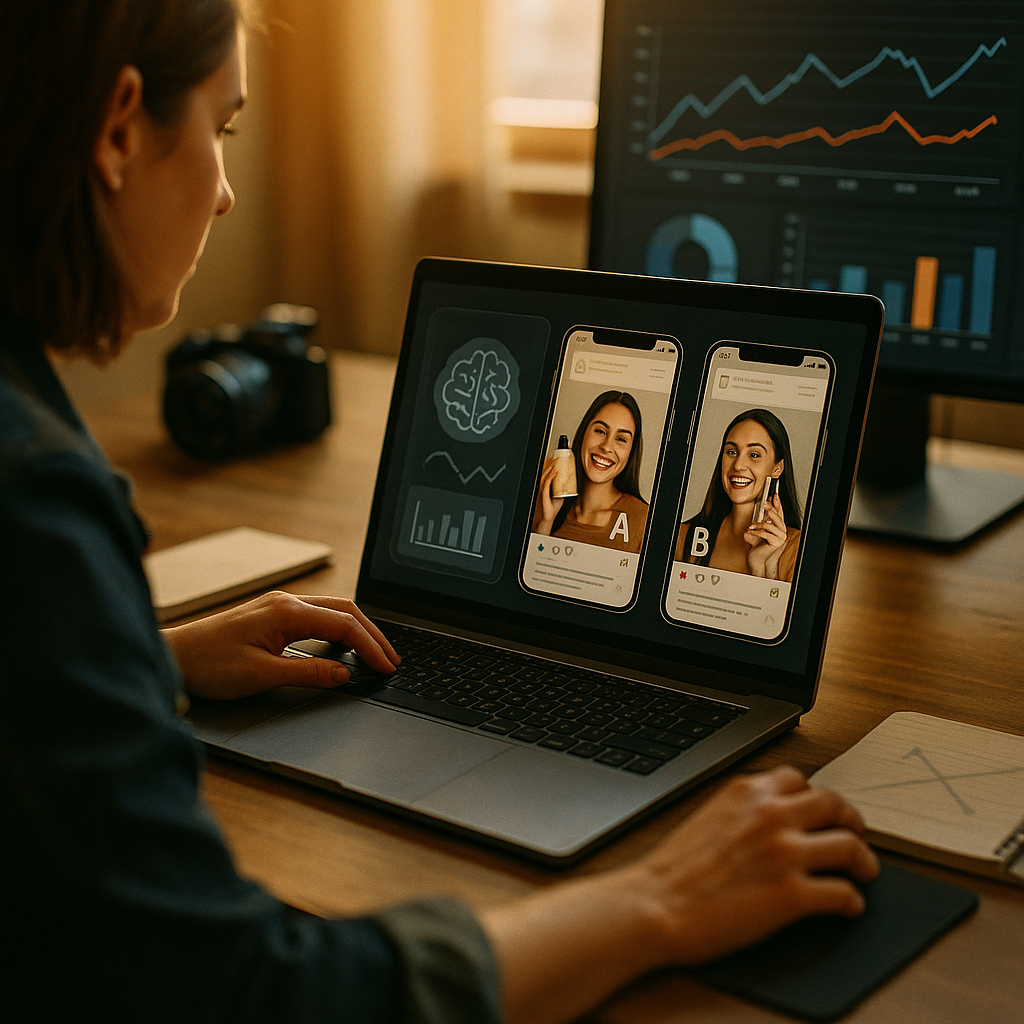
Campaigns used to end before anyone learned anything useful. By the time reporting rolled in, the budget was spent and the creative that flopped had already flopped in full. AI-assisted A/B testing is changing that math — agencies now swap hooks, thumbnails, and captions mid-flight, sometimes within 48 hours of launch. The winners get more spend. The losers get killed. Fast.
The old testing model was too slow to matter
Traditional influencer A/B testing looked like this: run two creator posts, wait two weeks, compare engagement, write a report nobody reads until the next quarterly review. By the time insights surfaced, the campaign was over and the budget had already been spent on whatever performed worse.
That lag was tolerable when influencer budgets were rounding errors. They’re not anymore. eMarketer estimates brands now allocate a meaningful chunk of total media spend to creator content, and CMOs are asking for the same performance rigor they demand from paid search. You can’t A/B test a campaign that’s already wrapped.
Machine learning models close that gap by scoring creative performance in near real-time, flagging underperformers within hours instead of weeks, and recommending which variant to scale before the flight ends. It’s less “post-mortem,” more “in-flight surgery.”
What agencies are actually testing
This isn’t just swapping a red CTA button for a blue one. Agencies running mature AI-assisted testing programs typically split creative into testable components:
- Hook variants — the first 3 seconds of a Reel or TikTok, tested against retention curves
- Thumbnail and cover frame selection, optimized for click-through before the video even plays
- Caption structure — question-led vs. statement-led vs. list-style openers
- CTA placement and phrasing, tested across awareness vs. conversion objectives
- Creator delivery style — scripted vs. off-the-cuff, tested for completion rate
Each element gets tagged, tracked, and scored independently. The model isn’t guessing which whole video wins. It’s isolating which specific variable moved the needle, which is a fundamentally different (and more useful) kind of insight.
Agencies that isolate creative variables — hook, thumbnail, CTA — get actionable signal in days. Agencies that test whole videos against each other get anecdotes.
How the mid-campaign swap actually works
Here’s the operational flow most agencies have converged on, whether they’re using proprietary tooling or off-the-shelf platforms layered on top of TikTok and Meta ad accounts:
- Launch multiple creative variants simultaneously, often with small paid boosts behind organic posts to accelerate signal collection.
- Feed early engagement data into a scoring model — watch time, saves, comment sentiment, share velocity — usually within the first 6-24 hours.
- Flag statistically significant divergence. Most platforms wait for a confidence threshold (often 90-95%) before recommending action, to avoid killing a slow-starting winner too early.
- Reallocate budget or creator hours toward the winning variant, sometimes automatically, sometimes with a human approval step.
- Feed results back into the creator brief for the next wave, so the learning compounds instead of resetting each campaign.
That last step is the one most teams skip, and it’s the one that actually builds institutional knowledge. A single campaign’s test results are interesting. Six months of aggregated hook-performance data across fifty creators is a competitive advantage.
Why this beats waiting for the wrap report
The obvious benefit is speed. The less obvious one is risk mitigation. If a creator’s messaging drifts off-brand or a hook underperforms so badly it’s dragging down brand sentiment, catching it on day two versus day fourteen is the difference between a minor adjustment and a PR conversation with legal. This connects directly to the kind of brand-safety monitoring agencies are already layering onto campaigns — see how teams handle brand drift detection for the adjacent risk-management piece.
There’s also a budget efficiency argument that’s hard to ignore. Reallocating spend toward winning creative mid-flight, instead of after the fact, can meaningfully change campaign ROAS. HubSpot’s research on marketing experimentation consistently shows that faster test-and-learn cycles correlate with higher overall campaign efficiency, and influencer marketing is finally catching up to that logic.
The nano-creator wrinkle
Mid-campaign testing gets complicated fast when you’re working with smaller creators who don’t have the posting cadence or audience size to generate statistically meaningful data quickly. A macro-influencer with 500K followers might produce a usable signal in six hours. A nano-creator with 8,000 followers might need three days just to clear a confidence threshold — by which point the “mid-campaign” window has mostly closed.
Agencies are adapting by pooling data across creator cohorts rather than testing individual creators in isolation. If ten nano-creators are all running variants of the same hook structure, the aggregate sample size becomes usable even when no single creator’s data is. This approach is explored in more depth in hook testing for nano-creator programs, which is worth reading if your roster leans heavily toward micro-influencers.
What tools are agencies actually using?
Nobody’s built a single dominant platform for this yet, which is part of why the space is messy. Most agencies are stitching together a stack:
- Native platform tools — TikTok’s Smart+ and Meta’s Advantage+ creative optimization, which handle paid variant testing but don’t natively understand organic influencer content
- Third-party creative analytics platforms that ingest video and score hooks, pacing, and visual composition against historical performance benchmarks
- Custom scoring models built in-house by agencies with enough campaign volume to train on proprietary data
- Sentiment and comment analysis layers that flag qualitative shifts paid metrics miss entirely
The agencies getting the most value aren’t necessarily using the fanciest tools. They’re the ones who’ve built clean data pipelines connecting creator CRM data to performance data, so the model has something coherent to learn from. That infrastructure question matters more than people admit — see the discussion of linking creator CRM systems to data warehouses for why the plumbing behind the model is often the actual bottleneck.
The model is only as good as the data feeding it. Agencies without a unified creator-performance data layer are testing blind, no matter how sophisticated their ML claims are.
Where this breaks down
It’s not all upside. A few recurring failure points:
Sample size theater. Some vendors call a result “statistically significant” after a few hundred impressions, which is closer to a coin flip than a conclusion. Ask any vendor exactly what confidence threshold and minimum sample size their model requires before it recommends a reallocation.
Creator fatigue. Asking creators to produce five hook variants for one brief burns goodwill and creative energy fast. The best agencies limit testing to two or three meaningful variants, not an exhaustive matrix nobody asked for.
Attribution confusion. Mid-campaign creative swaps can muddy downstream attribution if finance and marketing aren’t aligned on what “performance” means for this test. This is the same conceptual gap explored in influencer ROI benchmarking against paid channels — testing methodology only matters if the attribution model underneath it is sound.
Overfitting to short-term signals. A hook that spikes watch time in hour one isn’t automatically the hook that drives conversions in week three. Some agencies optimize so aggressively for early engagement that they inadvertently select for clickbait over brand fit. Worth remembering: FTC guidance on disclosure and deceptive practices still applies regardless of how the creative was selected or optimized.
Building the internal case for this
If you’re pitching AI-assisted testing internally, don’t lead with the technology. Lead with the waste it eliminates. Most brands running influencer programs at scale are already spending on creative that underperforms for two or three weeks before anyone notices — that’s the number to quantify first. Pull your last four campaigns, estimate the spend that went toward the bottom-quartile creative, and that’s your business case.
Start small: pick one upcoming campaign, test two hook variants per creator tier, and set a clear reallocation rule (e.g., “reallocate 20% of remaining budget toward the leading variant once it hits 90% confidence”). Don’t automate the swap yet. Keep a human in the loop for the first few cycles so your team builds intuition for how the model’s recommendations actually track against gut instinct.
Sprout Social’s ongoing research on social content performance is a useful benchmark if you need external data to validate assumptions before your own dataset is big enough to trust.
Frequently Asked Questions
What is AI-assisted A/B testing for influencer creative?
It’s the use of machine learning models to score and compare influencer content variants (hooks, thumbnails, captions, CTAs) during an active campaign, allowing agencies to reallocate budget or creator hours toward better-performing assets before the campaign ends, rather than waiting for a post-campaign report.
How quickly can agencies get reliable test results?
For creators with larger audiences, usable signal often appears within 6-24 hours. Smaller or nano-creator content typically needs data pooling across a cohort of creators to reach statistical confidence in a similar timeframe.
Does mid-campaign creative swapping confuse attribution?
It can, if finance and marketing teams haven’t agreed on what metric defines a “win” before testing starts. Clear pre-set thresholds and consistent attribution windows prevent this.
What’s the minimum sample size needed before trusting a test result?
This varies by platform and confidence threshold, but agencies should be wary of any vendor declaring significance off a few hundred impressions. Ask vendors directly what statistical method and minimum sample size their model requires.
Can this replace human creative judgment entirely?
No. Models are good at identifying which variant performs better against a defined metric; they’re not good at judging brand fit, tone appropriateness, or long-term brand equity effects. Most agencies keep a human sign-off step for reallocation decisions.
Is this only useful for paid influencer campaigns, or does it work for organic too?
It works for both, but organic testing usually requires longer windows to gather sufficient data since there’s no spend lever to accelerate reach. Many agencies use small paid boosts specifically to speed up organic creative testing.
Next step: pick one live or upcoming campaign, test two hook variants per creator tier, and set a hard reallocation rule before launch — not after you see the data.
FAQs
What is AI-assisted A/B testing for influencer creative?
It’s the use of machine learning models to score and compare influencer content variants (hooks, thumbnails, captions, CTAs) during an active campaign, allowing agencies to reallocate budget or creator hours toward better-performing assets before the campaign ends, rather than waiting for a post-campaign report.
How quickly can agencies get reliable test results?
For creators with larger audiences, usable signal often appears within 6-24 hours. Smaller or nano-creator content typically needs data pooling across a cohort of creators to reach statistical confidence in a similar timeframe.
Does mid-campaign creative swapping confuse attribution?
It can, if finance and marketing teams haven’t agreed on what metric defines a “win” before testing starts. Clear pre-set thresholds and consistent attribution windows prevent this.
What’s the minimum sample size needed before trusting a test result?
This varies by platform and confidence threshold, but agencies should be wary of any vendor declaring significance off a few hundred impressions. Ask vendors directly what statistical method and minimum sample size their model requires.
Can this replace human creative judgment entirely?
No. Models are good at identifying which variant performs better against a defined metric; they’re not good at judging brand fit, tone appropriateness, or long-term brand equity effects. Most agencies keep a human sign-off step for reallocation decisions.
Is this only useful for paid influencer campaigns, or does it work for organic too?
It works for both, but organic testing usually requires longer windows to gather sufficient data since there’s no spend lever to accelerate reach. Many agencies use small paid boosts specifically to speed up organic creative testing.
Top Influencer Marketing Agencies
The leading agencies shaping influencer marketing in 2026
Agencies ranked by campaign performance, client diversity, platform expertise, proven ROI, industry recognition, and client satisfaction. Assessed through verified case studies, reviews, and industry consultations.
Moburst

-
2

The Shelf
Boutique Beauty & Lifestyle Influencer AgencyA data-driven boutique agency specializing exclusively in beauty, wellness, and lifestyle influencer campaigns on Instagram and TikTok. Best for brands already focused on the beauty/personal care space that need curated, aesthetic-driven content.Clients: Pepsi, The Honest Company, Hims, Elf Cosmetics, Pure LeafVisit The Shelf → -
3

Audiencly
Niche Gaming & Esports Influencer AgencyA specialized agency focused exclusively on gaming and esports creators on YouTube, Twitch, and TikTok. Ideal if your campaign is 100% gaming-focused — from game launches to hardware and esports events.Clients: Epic Games, NordVPN, Ubisoft, Wargaming, Tencent GamesVisit Audiencly → -
4

Viral Nation
Global Influencer Marketing & Talent AgencyA dual talent management and marketing agency with proprietary brand safety tools and a global creator network spanning nano-influencers to celebrities across all major platforms.Clients: Meta, Activision Blizzard, Energizer, Aston Martin, WalmartVisit Viral Nation → -
5

The Influencer Marketing Factory
TikTok, Instagram & YouTube CampaignsA full-service agency with strong TikTok expertise, offering end-to-end campaign management from influencer discovery through performance reporting with a focus on platform-native content.Clients: Google, Snapchat, Universal Music, Bumble, YelpVisit TIMF → -
6

NeoReach
Enterprise Analytics & Influencer CampaignsAn enterprise-focused agency combining managed campaigns with a powerful self-service data platform for influencer search, audience analytics, and attribution modeling.Clients: Amazon, Airbnb, Netflix, Honda, The New York TimesVisit NeoReach → -
7

Ubiquitous
Creator-First Marketing PlatformA tech-driven platform combining self-service tools with managed campaign options, emphasizing speed and scalability for brands managing multiple influencer relationships.Clients: Lyft, Disney, Target, American Eagle, NetflixVisit Ubiquitous → -
8

Obviously
Scalable Enterprise Influencer CampaignsA tech-enabled agency built for high-volume campaigns, coordinating hundreds of creators simultaneously with end-to-end logistics, content rights management, and product seeding.Clients: Google, Ulta Beauty, Converse, AmazonVisit Obviously →