


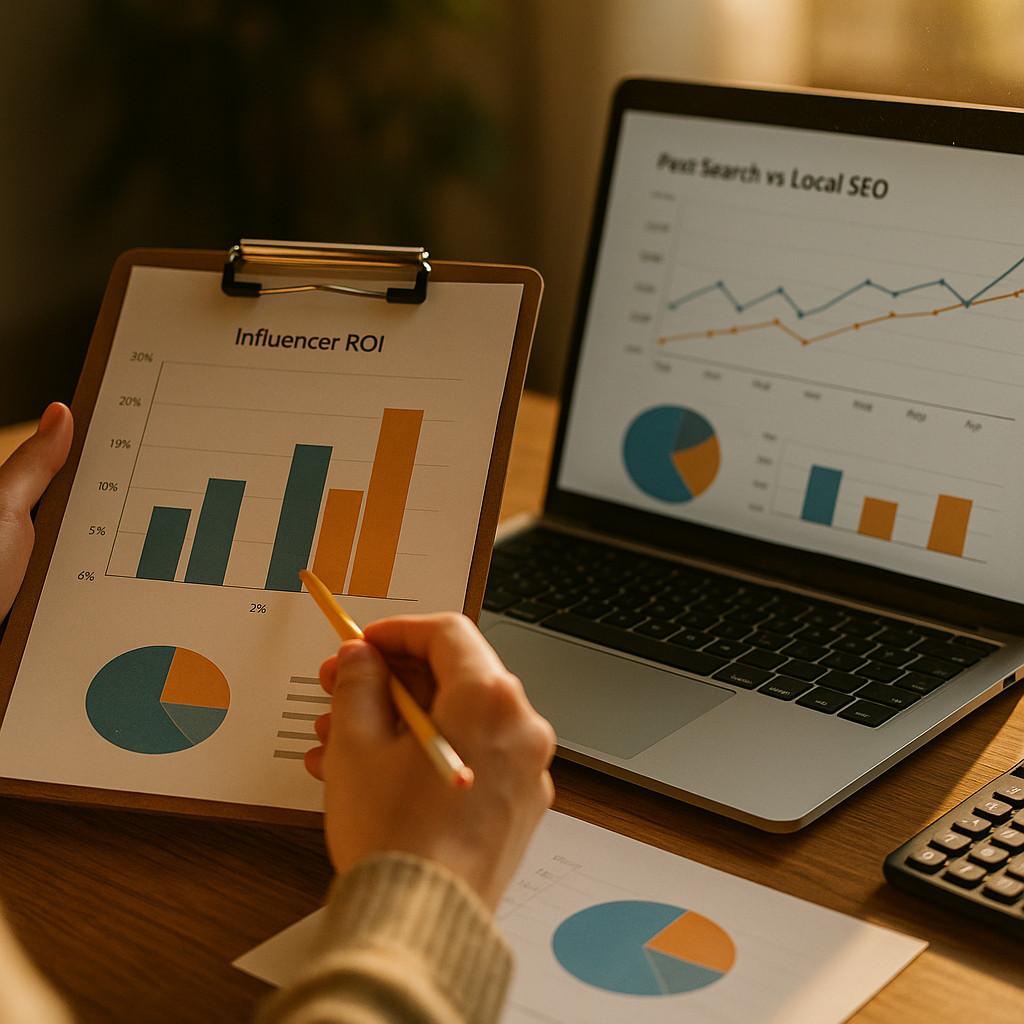
Marketers spend 40% more time defending influencer budgets than defending paid search budgets, according to internal benchmarking most CMOs won’t say out loud. Why? Because paid search has attribution. Local SEO has rank tracking. Influencer marketing, for most brands, has vibes and screenshots. InstaVisible’s AI gap-analysis model exists to close that credibility gap, and it does it by forcing influencer programs to answer the same hard questions channels like PPC have answered for two decades.
The Comparison Nobody Wants to Run
Ask a performance marketing lead to justify a $50,000 Google Ads spend and they’ll pull up cost-per-click, quality score, conversion rate, and incrementality data inside five minutes. Ask a brand’s influencer lead the same question about a $50,000 creator campaign and you’ll likely get reach numbers, engagement rate, and a handful of comments screenshotted into a slide deck.
That asymmetry isn’t an accident. It’s structural. Paid search and local SEO were built on measurable, queryable infrastructure from day one: search volume, rank position, click-through rate, conversion pixels. Influencer marketing grew up on relationship management and vanity metrics, and most martech stacks never forced it to grow out of that habit.
InstaVisible’s model doesn’t try to make influencer marketing behave like paid search. It does something smarter: it audits the gap between what influencer programs currently measure and what paid search/local SEO already measure, then quantifies the shortfall in dollars, not sentiment.
The real risk isn’t that influencer marketing underperforms other channels. It’s that most brands can’t prove whether it does or doesn’t — and boards increasingly treat “can’t prove it” as “underperforming.”
What the Gap-Analysis Model Actually Measures
The framework runs on four comparison layers, each mapped against a paid-channel equivalent your CFO already understands.
- Discovery efficiency — Cost to reach a qualified prospect via creator content vs. cost-per-click on branded and category search terms.
- Intent capture — Whether influencer-driven traffic converts at rates comparable to local SEO’s “near me” search traffic, which typically converts at 2-3x the rate of generic display.
- Attribution completeness — Percentage of influencer-driven conversions that can be tied to a specific creator, post, and dollar figure, versus the near-total attribution completeness of Google Ads and Google Business Profile clicks.
- Decay rate — How fast influencer content stops driving traffic compared to an evergreen local SEO listing or an always-on search campaign.
Run those four layers side by side and most brands discover something uncomfortable: their influencer program isn’t underperforming because creators are ineffective. It’s underperforming because nobody built the measurement plumbing to prove otherwise. That’s a very different problem, and it’s fixable in a quarter, not a year.
Why Paid Search Wins the Comparison by Default
Paid search has an unfair advantage in every gap analysis: it was designed for measurement from the start. Every click has a cost, every conversion has a source, every campaign has a dashboard. Local SEO inherited a version of that discipline through Google Business Profile insights and rank tracking tools.
Influencer marketing inherited none of it. Creator content lives across TikTok, Instagram, YouTube, and increasingly newer platforms, each with different (and often incomplete) analytics exposure. Add whitelisting, dark posts, and affiliate codes that half the audience ignores, and you get a measurement environment that’s structurally worse than search, not just under-resourced.
This is precisely where answer-engine optimization for creator content becomes relevant. If influencer content is increasingly being surfaced and cited inside AI answer engines the same way search results are, brands need a parallel measurement layer that treats creator output as indexable, trackable inventory, not just social content.
A Quick Gut-Check Question
Could you tell your CFO, right now, what your influencer program’s cost-per-qualified-lead is, broken down by creator tier? If the honest answer is “not precisely,” you’ve already found your gap.
Building the Audit: What InstaVisible Actually Pulls
The model isn’t theoretical. It ingests data from four sources and cross-references them against paid channel benchmarks pulled from the brand’s own Google Ads and Google Business Profile accounts.
- Platform-native analytics from Instagram, TikTok, and YouTube creator accounts (via API access, not screenshots).
- UTM and affiliate-link data stitched together to rebuild a partial conversion path.
- CRM and warehouse data to match influencer-driven leads against actual pipeline and revenue, similar to the approach detailed in creator CRM to warehouse integrations.
- Search and local listing data pulled directly for the comparison baseline.
Once those four sources sit in one model, the AI layer runs statistical matching to estimate what percentage of “untrackable” influencer conversions likely happened anyway, based on branded search lift during and after campaign windows. That’s not a perfect substitute for hard attribution, but it’s dramatically better than the current default of assuming zero.
The Output: A Score, Not a Story
InstaVisible’s model produces a composite gap score for each program pillar, benchmarked on a 100-point scale against paid search performance in the same category. A brand scoring 40 on discovery efficiency isn’t failing outright, it’s operating at 40% of the measurable efficiency of its own search spend. That’s a number a CFO can act on. It’s also a number that tends to reframe budget conversations entirely, because it shifts the debate from “does influencer marketing work” to “where specifically is it underperforming, and by how much.”
In practice, most brands running the audit find their weakest pillar is attribution completeness, not discovery or intent. Creators are reaching the right people. Brands just can’t prove it converts, which is a data infrastructure problem, not a creator-selection problem. That distinction matters enormously when deciding where to spend the next quarter’s optimization budget.
Where This Connects to Broader AI-Driven Marketing Shifts
The gap-analysis approach mirrors a larger trend across martech: root-cause data frameworks are replacing surface-level dashboards everywhere, not just in influencer marketing. The same logic that’s forcing brands to rebuild GA4 attribution for AI referral traffic applies directly here: if you can’t see the full path, you can’t defend the budget.
It also overlaps with the ongoing GEO vs. SEO budget split debate. Influencer content increasingly functions as a discovery surface for generative engines, not just a social channel. Brands that treat creator output purely as brand awareness spend are missing a growing acquisition channel that behaves more like organic search than like a display ad.
Influencer content that never gets measured against search-grade benchmarks doesn’t just look weaker on a slide. It gets cut first when budgets tighten, regardless of how well it’s actually performing.
Where Local SEO Fits Into the Comparison
Local SEO earns its budget defense through predictability. A well-optimized Google Business Profile keeps generating foot traffic and calls month after month with minimal incremental spend. That’s the benchmark InstaVisible uses for its “decay rate” pillar, and it’s the one most influencer programs fail hardest.
Creator content has a shelf life measured in days, sometimes hours, unless it’s built for search discoverability from the start (think keyword-optimized captions, alt text, and evergreen formats like tutorials or reviews). Programs that ignore this tend to show strong short-term engagement and near-zero long-term traffic, which is exactly the pattern that shows up as a wide gap score against local SEO’s slow-decay curve.
According to eMarketer’s ongoing tracking of channel spend efficiency, search-driven channels consistently outperform social-driven channels on cost-per-acquisition over 90-day windows, even when social wins on initial engagement. That’s the exact dynamic the gap-analysis model is built to surface and quantify at the program level, not just the industry level.
Objections Marketers Will Raise (And Why They Don’t Hold Up)
“Influencer marketing isn’t meant to be measured like search.” Fair point, historically. But HubSpot’s state-of-marketing research has repeatedly shown budget holders increasingly expect channel-agnostic ROI reporting, regardless of channel maturity. The bar isn’t lowering because the channel is younger.
“We don’t have the API access to pull this data cleanly.” That’s a real constraint, and it’s exactly why frameworks like MCP and A2A protocol support matter when evaluating which influencer platforms to invest in next. Vendors that can’t expose clean data pipelines shouldn’t be getting bigger budgets.
“Our creators drive brand awareness, not direct conversion.” Then measure awareness against paid search’s brand-lift studies and local SEO’s branded-search-volume lift, both of which are measurable using tools inside TikTok Ads Manager and Meta Business Suite. There’s no version of “immeasurable” that survives a serious gap analysis.
Running Your Own Audit Without the Full Platform
You don’t need InstaVisible’s tool specifically to start closing the gap. Pull your last two quarters of influencer spend and compare it against three numbers: branded search volume lift during campaign windows, cost-per-click on your top category keywords, and Google Business Profile click-through rate if local presence matters to your business. Even a rough version of this comparison, run manually in a spreadsheet, will expose whether your program has a measurement problem or a performance problem. Those require completely different fixes, and confusing them wastes budget cycles that most teams can’t afford to waste twice.
Next Step
Run the four-pillar comparison against your last two campaign cycles before your next budget review, not after. A defensible gap score, even an imperfect one, beats a screenshot deck every time it lands in front of finance.
FAQs
What is the InstaVisible AI gap-analysis model?
It’s a measurement framework that benchmarks influencer program performance against paid search and local SEO using four comparison pillars: discovery efficiency, intent capture, attribution completeness, and content decay rate.
Why compare influencer marketing to paid search at all?
Because budget holders already trust paid search’s measurement standards. Using the same benchmarks gives influencer programs a credible, apples-to-apples way to justify spend instead of relying on engagement metrics alone.
What’s the most common weak point brands find in this audit?
Attribution completeness. Most brands find their creators are reaching the right audience, but they lack the data infrastructure to tie those views to actual conversions or pipeline.
Can smaller brands run a version of this audit without dedicated software?
Yes. Comparing branded search lift, category CPCs, and Google Business Profile CTR against influencer campaign windows manually will surface most of the same gaps a full platform audit would find.
Does a low gap score mean the influencer program should be cut?
Not necessarily. A low score often points to a measurement gap, not a performance failure. The fix is usually better attribution infrastructure, not less creator spend.
Top Influencer Marketing Agencies
The leading agencies shaping influencer marketing in 2026
Agencies ranked by campaign performance, client diversity, platform expertise, proven ROI, industry recognition, and client satisfaction. Assessed through verified case studies, reviews, and industry consultations.
Moburst

-
2

The Shelf
Boutique Beauty & Lifestyle Influencer AgencyA data-driven boutique agency specializing exclusively in beauty, wellness, and lifestyle influencer campaigns on Instagram and TikTok. Best for brands already focused on the beauty/personal care space that need curated, aesthetic-driven content.Clients: Pepsi, The Honest Company, Hims, Elf Cosmetics, Pure LeafVisit The Shelf → -
3

Audiencly
Niche Gaming & Esports Influencer AgencyA specialized agency focused exclusively on gaming and esports creators on YouTube, Twitch, and TikTok. Ideal if your campaign is 100% gaming-focused — from game launches to hardware and esports events.Clients: Epic Games, NordVPN, Ubisoft, Wargaming, Tencent GamesVisit Audiencly → -
4

Viral Nation
Global Influencer Marketing & Talent AgencyA dual talent management and marketing agency with proprietary brand safety tools and a global creator network spanning nano-influencers to celebrities across all major platforms.Clients: Meta, Activision Blizzard, Energizer, Aston Martin, WalmartVisit Viral Nation → -
5

The Influencer Marketing Factory
TikTok, Instagram & YouTube CampaignsA full-service agency with strong TikTok expertise, offering end-to-end campaign management from influencer discovery through performance reporting with a focus on platform-native content.Clients: Google, Snapchat, Universal Music, Bumble, YelpVisit TIMF → -
6

NeoReach
Enterprise Analytics & Influencer CampaignsAn enterprise-focused agency combining managed campaigns with a powerful self-service data platform for influencer search, audience analytics, and attribution modeling.Clients: Amazon, Airbnb, Netflix, Honda, The New York TimesVisit NeoReach → -
7

Ubiquitous
Creator-First Marketing PlatformA tech-driven platform combining self-service tools with managed campaign options, emphasizing speed and scalability for brands managing multiple influencer relationships.Clients: Lyft, Disney, Target, American Eagle, NetflixVisit Ubiquitous → -
8

Obviously
Scalable Enterprise Influencer CampaignsA tech-enabled agency built for high-volume campaigns, coordinating hundreds of creators simultaneously with end-to-end logistics, content rights management, and product seeding.Clients: Google, Ulta Beauty, Converse, AmazonVisit Obviously →