


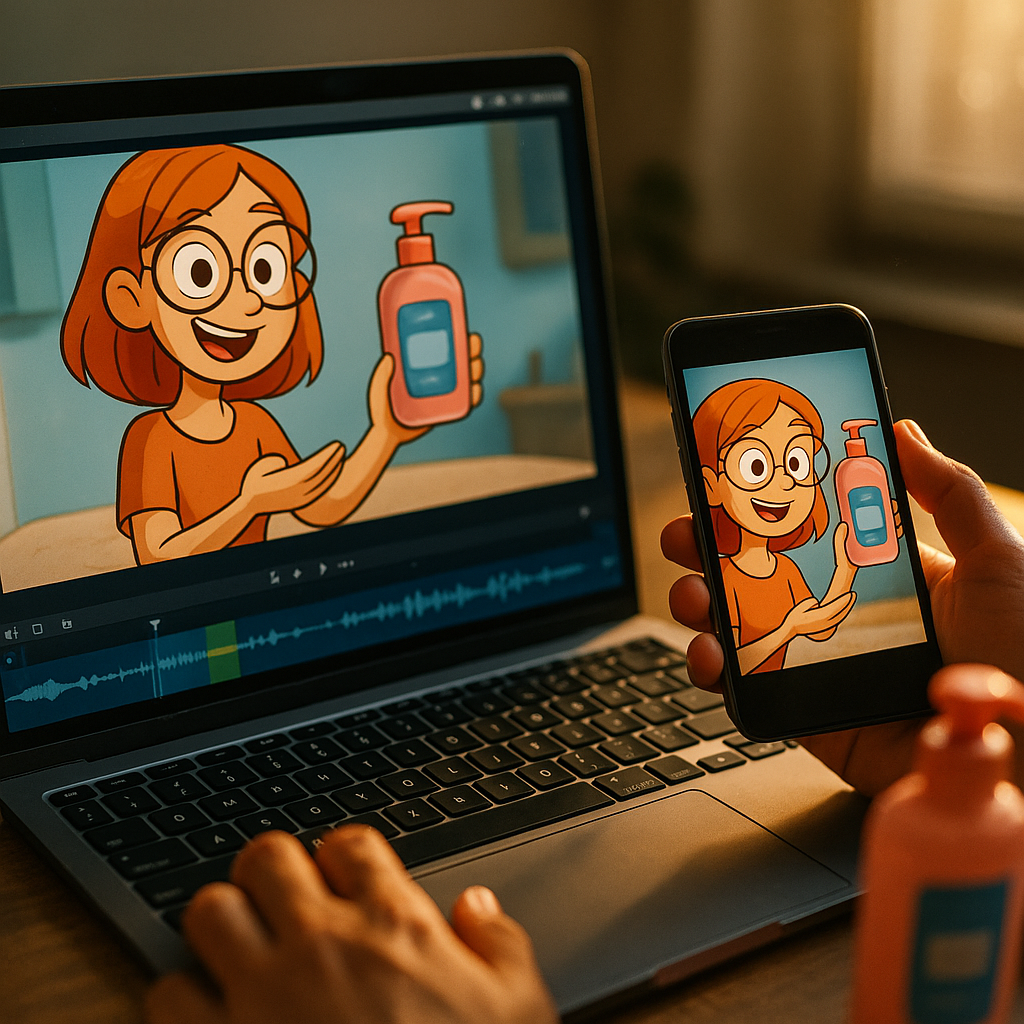
Animated ads outperform live-action UGC by double digits on hook rate in early tests from several mid-market DTC brands running both formats side by side. That’s not a fluke. An AI cartoon product demo strips away the skepticism viewers bring to a human talking head, while still delivering the specificity that makes UGC convert. The format is cheap to produce, fast to iterate, and oddly disarming. But most brands are wasting the opportunity by treating it like a novelty instead of a script-driven conversion tool.
Why Cartoon Demos Are Suddenly Everywhere
Scroll TikTok or Instagram Reels for ten minutes and you’ll hit at least one animated explainer selling a skincare serum, a SaaS tool, or a kitchen gadget. Tools like Vidnoz, Powtoon, and various Sora and Runway-adjacent pipelines have made it possible to generate a full animated spot in hours, not weeks. No casting calls. No shipping product to a creator in Ohio. No reshoots because the lighting was wrong.
The appeal for brand teams is obvious: speed and cost control. A live-action UGC batch might run $2,000 to $8,000 for a handful of usable assets. An animated cartoon demo pipeline, once set up, can produce variants for a fraction of that, with near-instant localization and resizing. For performance marketers running constant creative refreshes, that math is hard to ignore. It pairs naturally with the kind of rapid-iteration thinking covered in our creative refresh calendar playbook.
The format isn’t winning because it looks impressive. It’s winning because audiences process cartoon exaggeration as “obviously a demo,” which paradoxically lowers their guard against being sold to.
The Trust Paradox Nobody Talks About
Here’s the counterintuitive part. You’d think animation would feel less trustworthy than a real person holding a product. In practice, it often feels more honest, because nobody mistakes a cartoon for an unbiased third-party recommendation. There’s no uncanny valley of “is this creator actually being paid to say this?” The ad format announces itself. That transparency, weirdly, builds permission to sell harder inside the script.
The Script Is the Product. The Animation Is Just Packaging
Brands that fail with this format almost always skip straight to tool selection: which AI generator, which voice model, which art style. Wrong starting point. The script structure determines whether the demo converts or gets scrolled past in 1.5 seconds, exactly like any other short-form ad.
A converting cartoon demo script needs five beats, and skipping any one of them tanks performance:
- The exaggerated problem cold open. Cartoons let you dramatize pain points live-action can’t touch, like a character literally drowning in laundry or a tiny villain representing “forgetting to take vitamins.”
- The product reveal as relief, not lecture. One beat, one visual metaphor. Don’t explain the product. Show the problem dissolving.
- A single specific proof point. A number, a before/after, a comparison. Animation makes abstraction easy, which is exactly why you need one concrete, almost boring fact anchoring the fantasy.
- A character reaction that mirrors the viewer’s skepticism. Give your cartoon a moment of “wait, really?” This mirrors what the viewer is thinking and answers it before they bounce.
- A CTA that matches platform intent. Shop now for commerce placements, learn more for consideration, swipe up for DTC retargeting.
This structure borrows heavily from proven UGC scripting logic, just reskinned for animation. If you’ve read our breakdown of nano creator briefs, the beat logic will feel familiar. Same bones, different skin.
Writing Dialogue That Doesn’t Sound Like a Robot Wrote It
This is where most AI cartoon demos fall apart. The visuals look polished, but the script reads like it was generated by a template with no human pass. Avoid generic phrasing like “introducing the solution you’ve been waiting for.” Nobody talks like that, animated or not.
Write dialogue the way you’d brief a human UGC creator: conversational, slightly messy, with one quirky line that feels improvised even if it’s scripted word for word. If you’ve built founder-style scripts before, the same instinct applies here. Check our guide on founder UGC scaffolds for tone calibration that transfers almost directly to cartoon voiceover writing.
Picking the Right Style for the Right Funnel Stage
Not every cartoon style converts equally at every stage. Top-of-funnel awareness ads benefit from bold, exaggerated, almost Looney Tunes-style physical comedy because it stops the scroll. Mid-funnel consideration content performs better with cleaner, more explainer-style animation, closer to a whiteboard video than a sitcom. Bottom-funnel retargeting works best with a hybrid: cartoon visuals paired with a real screen recording or product shot spliced in, which reintroduces tangible proof right before the purchase decision.
Mapping style to funnel stage isn’t optional anymore. Platforms are getting stricter about ad fatigue, and Meta’s ad platform and TikTok’s ad tools both reward creative that matches stated campaign objectives rather than generic brand awareness assets dropped into conversion campaigns.
Disclosure and Compliance: The Part Everyone Skips
Animated doesn’t mean exempt. If an AI-generated cartoon is standing in for a creator endorsement, or if the “character” is modeled on a real influencer persona, FTC disclosure rules still apply. The FTC’s endorsement guidelines don’t carve out an animation loophole, and regulators in the UK have signaled similar expectations through ICO guidance on AI-generated marketing content.
There’s a second compliance layer unique to this format: claims inflation. Animation makes it tempting to show a product solving problems in physically impossible ways. A cartoon serum that erases wrinkles in two seconds flat might be “obviously exaggerated,” but regulators increasingly don’t care about obvious. If the underlying claim implies a real performance benefit, it needs substantiation, cartoon or not.
Animation gives you more creative license than live action, but less legal cover than most teams assume. Script the claim the same way you would for a human creator, then let the art style carry the exaggeration, not the words.
If you’re building a review process for this, the compliance scripting approach in versus format scripts translates well, since it was built around the same “entertaining but defensible” tension.
Build a Claims Checklist Before Production
Before any animation gets generated, run the script through three questions. Does the visual metaphor imply a specific, measurable outcome? Does the voiceover state a result rather than an experience? Would a regulator watching this clip assume it’s a factual demonstration rather than stylized marketing? If any answer is yes, soften the language or add an on-screen disclaimer before production starts, not after legal flags it in review.
Measuring What Actually Converts
Hook rate and watch time are the easy metrics, and most teams stop there. That’s a mistake. Animated demos tend to inflate top-funnel engagement metrics because they’re novel, which means a high hook rate doesn’t automatically translate to purchase intent. Track thumb-stop ratio against click-through rate specifically, not in isolation. If hook rate is strong but CTR lags behind your live-action benchmarks, the animation is working as entertainment, not as a sales tool.
Run A/B tests pairing the same script structure in cartoon form versus live UGC. According to industry benchmarking from eMarketer, short-form video ad formats continue to shift budget away from static creative, but format preference within video (animated versus live-action) still varies heavily by vertical and audience age. Beauty and wellness audiences often respond better to live UGC for trust reasons; software and consumer tech audiences tend to tolerate, even prefer, animated explainers because the product itself is less tactile.
Track performance by placement too. A cartoon demo that crushes it on TikTok’s For You feed might underperform on LinkedIn, where a more polished, data-driven explainer style tends to land better with B2B buyers, a dynamic explored further in our piece on building trust in B2B content.
Production Workflow That Doesn’t Bottleneck Your Team
Set up a repeatable pipeline rather than treating each cartoon demo as a bespoke project. Lock a character model once, then reuse it across a dozen script variants. Build a voice bank of two or three consistent tones so brand recognition compounds across campaigns instead of resetting every time. Keep a swipe file of proven visual metaphors (the “problem monster,” the “relief cloud,” the “before/after split”) so writers aren’t reinventing structure every brief cycle.
This mirrors the batching logic already working well in other UGC-adjacent formats, like the efficiency gains documented in budget UGC scripting, where consistency, not novelty, drove the cost-per-asset down over time.
Where This Format Breaks
Cartoon demos fail hardest in categories that require tactile trust: skincare texture, food taste, fabric feel. Viewers want to see a real hand touching real product in those categories. Animation also wears out faster than live UGC because the visual style itself becomes the novelty, and once an audience has seen your character three or four times, the stop-scroll effect decays quickly. Budget for style refreshes every few campaign cycles, not just script refreshes.
It also struggles in markets or audiences wary of AI content generally. Some segments, older B2B buyers especially, read animation as “the budget got cut” rather than “this is a bold creative choice.” Know your audience before committing a campaign’s hero creative to a cartoon pipeline.
Start with one high-intent script, built on the five-beat structure above, and test it against your best-performing live-action UGC before scaling a full cartoon demo pipeline. If the compliance checklist and conversion data hold up, you’ve found a format that’s genuinely cheaper and faster, not just cheaper.
FAQs
What makes an AI cartoon product demo different from a regular animated ad?
An AI cartoon product demo follows UGC script logic (problem, reveal, proof, reaction, CTA) rather than a traditional brand explainer structure. It’s built to convert like influencer content, not just inform like a corporate animation.
Do I still need FTC disclosures for animated content?
Yes. If the animation functions as an endorsement or implies a real performance claim, standard disclosure and substantiation rules apply regardless of whether the content is live-action or animated.
Which platforms perform best for cartoon demo ads?
Short-form feeds like TikTok and Instagram Reels tend to reward bold, exaggerated cartoon styles for top-funnel awareness, while LinkedIn and other B2B-heavy platforms respond better to cleaner, explainer-style animation.
How long should an AI cartoon product demo script be?
Most converting scripts run 15 to 30 seconds for top-funnel placements, enough to hit all five structural beats without losing attention before the CTA.
Can animated demos replace live-action UGC entirely?
No. They work best as a complement, especially for categories where tactile proof (texture, taste, physical feel) isn’t essential to the buying decision. Tactile categories still need live-action trust signals.
FAQs
What makes an AI cartoon product demo different from a regular animated ad?
An AI cartoon product demo follows UGC script logic (problem, reveal, proof, reaction, CTA) rather than a traditional brand explainer structure. It’s built to convert like influencer content, not just inform like a corporate animation.
Do I still need FTC disclosures for animated content?
Yes. If the animation functions as an endorsement or implies a real performance claim, standard disclosure and substantiation rules apply regardless of whether the content is live-action or animated.
Which platforms perform best for cartoon demo ads?
Short-form feeds like TikTok and Instagram Reels tend to reward bold, exaggerated cartoon styles for top-funnel awareness, while LinkedIn and other B2B-heavy platforms respond better to cleaner, explainer-style animation.
How long should an AI cartoon product demo script be?
Most converting scripts run 15 to 30 seconds for top-funnel placements, enough to hit all five structural beats without losing attention before the CTA.
Can animated demos replace live-action UGC entirely?
No. They work best as a complement, especially for categories where tactile proof (texture, taste, physical feel) isn’t essential to the buying decision. Tactile categories still need live-action trust signals.
Top Influencer Marketing Agencies
The leading agencies shaping influencer marketing in 2026
Agencies ranked by campaign performance, client diversity, platform expertise, proven ROI, industry recognition, and client satisfaction. Assessed through verified case studies, reviews, and industry consultations.
Moburst

-
2

The Shelf
Boutique Beauty & Lifestyle Influencer AgencyA data-driven boutique agency specializing exclusively in beauty, wellness, and lifestyle influencer campaigns on Instagram and TikTok. Best for brands already focused on the beauty/personal care space that need curated, aesthetic-driven content.Clients: Pepsi, The Honest Company, Hims, Elf Cosmetics, Pure LeafVisit The Shelf → -
3

Audiencly
Niche Gaming & Esports Influencer AgencyA specialized agency focused exclusively on gaming and esports creators on YouTube, Twitch, and TikTok. Ideal if your campaign is 100% gaming-focused — from game launches to hardware and esports events.Clients: Epic Games, NordVPN, Ubisoft, Wargaming, Tencent GamesVisit Audiencly → -
4

Viral Nation
Global Influencer Marketing & Talent AgencyA dual talent management and marketing agency with proprietary brand safety tools and a global creator network spanning nano-influencers to celebrities across all major platforms.Clients: Meta, Activision Blizzard, Energizer, Aston Martin, WalmartVisit Viral Nation → -
5

The Influencer Marketing Factory
TikTok, Instagram & YouTube CampaignsA full-service agency with strong TikTok expertise, offering end-to-end campaign management from influencer discovery through performance reporting with a focus on platform-native content.Clients: Google, Snapchat, Universal Music, Bumble, YelpVisit TIMF → -
6

NeoReach
Enterprise Analytics & Influencer CampaignsAn enterprise-focused agency combining managed campaigns with a powerful self-service data platform for influencer search, audience analytics, and attribution modeling.Clients: Amazon, Airbnb, Netflix, Honda, The New York TimesVisit NeoReach → -
7

Ubiquitous
Creator-First Marketing PlatformA tech-driven platform combining self-service tools with managed campaign options, emphasizing speed and scalability for brands managing multiple influencer relationships.Clients: Lyft, Disney, Target, American Eagle, NetflixVisit Ubiquitous → -
8

Obviously
Scalable Enterprise Influencer CampaignsA tech-enabled agency built for high-volume campaigns, coordinating hundreds of creators simultaneously with end-to-end logistics, content rights management, and product seeding.Clients: Google, Ulta Beauty, Converse, AmazonVisit Obviously →