


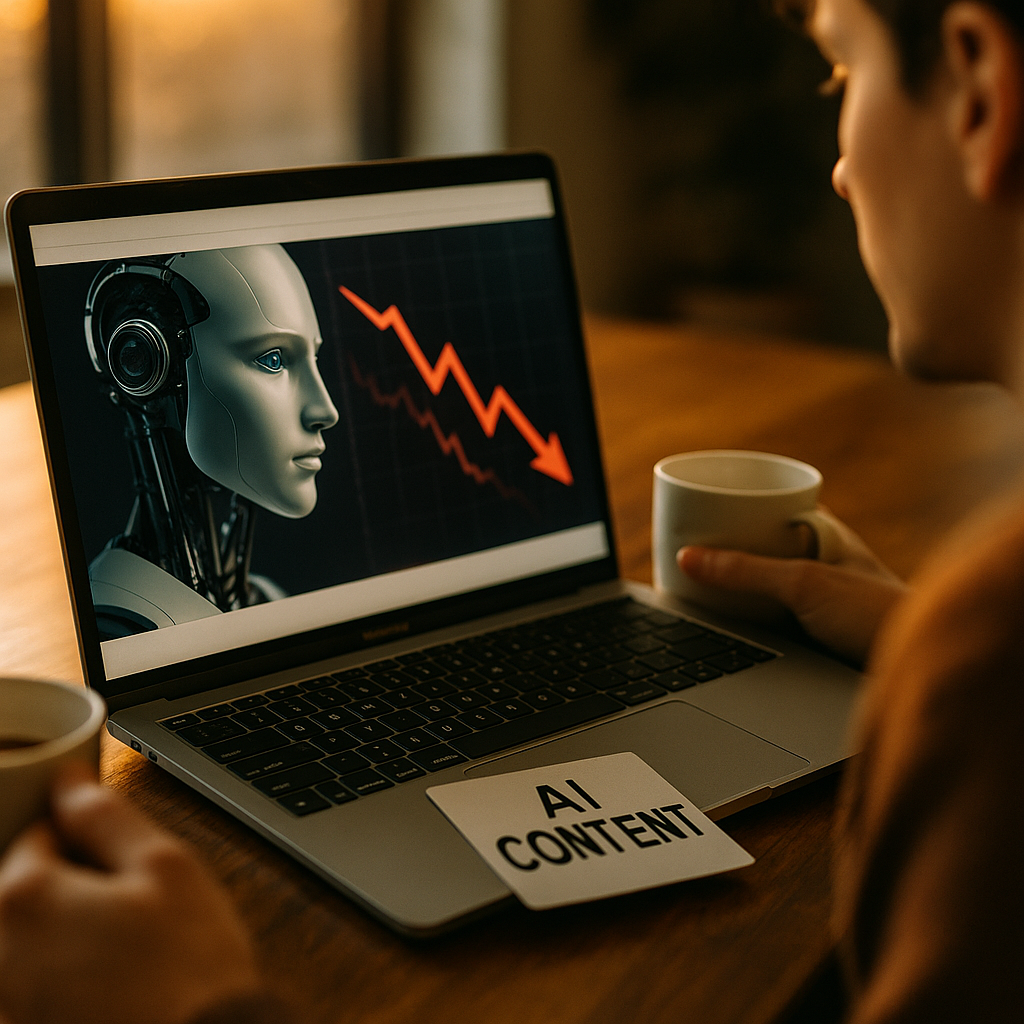
Only 34 percent of consumers now say they trust content when they know AI made it, down from 47 percent two years ago. That drop isn’t a slow slide. It’s a cliff edge. Consumer trust in AI generated content has hit an inflection point, and brands still leaning on synthetic media without a clear disclosure strategy are about to find out the hard way what that means for conversion, retention, and reputation.
The Data Behind the Shift
A wave of recent surveys tells a consistent story: audiences are getting better at spotting AI generated content, and they’re penalizing brands that don’t own up to using it. Trust doesn’t erode gradually here. It falls off once people cross a detection threshold, then it’s brutally hard to win back.
Marketers who spent the last two years treating AI content as a cost-saving shortcut are now discovering it’s also a trust liability. The math used to be simple: AI content is cheaper, so more of it is better. That math no longer holds. Cheaper content that tanks trust is not actually cheaper once you account for the lifetime value you torch.
Nearly two-thirds of consumers say they’d stop following a brand’s social account if they discovered AI generated content was passed off as authentic without disclosure.
This isn’t abstract. It shows up in comment sections, in DM sentiment, in refund rates on products marketed through synthetic influencer content. Brands running creator scorecards tied to sentiment are already seeing the correlation between undisclosed AI content and negative comment velocity.
Why Are Consumers Suddenly So Skeptical?
Three things converged at once. First, generative tools got good enough to fool casual scrollers but not good enough to fool motivated ones, and motivated ones talk. Second, a string of high-profile brand fails (AI-generated spokespeople, fabricated reviews, synthetic “customer” testimonials) made mainstream news. Third, platforms started labeling AI content more aggressively, which trained users to look for the tells even on posts that weren’t labeled.
Put those together and you get an audience primed for suspicion. Gen Z and younger millennials are the most skeptical cohort, according to eMarketer research on digital trust, largely because they’ve grown up parallel to the tools and can spot the uncanny valley faster than older demographics.
There’s also a simpler explanation nobody wants to say out loud: people are tired. Feed fatigue plus AI fatigue equals trust fatigue. When every third post might be synthetic, the cognitive load of constant verification pushes people toward blanket skepticism rather than case-by-case judgment.
The Disclosure Paradox
Here’s the part that should worry every CMO. Disclosing that content is AI generated should build trust through transparency. Instead, current data shows disclosed AI content still underperforms fully human content on trust metrics, just less badly than undisclosed AI content that gets discovered. Disclosure is damage control, not a trust multiplier. It’s the difference between a bruise and a fracture.
That’s a hard pill for teams that assumed a small “AI generated” label would neutralize the issue. It won’t. It just keeps you out of the FTC’s crosshairs and off the front page of a consumer advocacy blog.
What This Means for Brand Strategy
If you’re running influencer programs, this data should reshape how you allocate budget between human creators and AI-assisted production. It doesn’t mean abandon AI tools. It means stop treating AI generated content as a substitute for human creator credibility, and start treating it as a production accelerant that still needs a human face attached to it.
- Audit your content mix. Know exactly what percentage of your brand’s social output is fully synthetic, AI-assisted, or fully human, and map that against engagement and sentiment data.
- Disclose proactively, not defensively. Waiting to disclose until someone calls it out is the worst version of transparency.
- Reinvest in human creator relationships. This is exactly why more marketers now call creators brand builders rather than distribution channels. Trust travels through people, not pixels.
- Watch your compliance exposure. Undisclosed synthetic content that mimics testimonials or endorsements is squarely in the FTC’s enforcement zone. Review guidance at the FTC’s site before you greenlight anything that could read as a fabricated endorsement.
Agencies are already restructuring around this reality. The rise in agencies restaffing for AI oversight isn’t a compliance nicety, it’s a direct response to exactly this kind of trust data. Someone needs to own the line between AI-assisted efficiency and AI-generated deception, and right now that person is often missing from the org chart.
Creators Are the Trust Firewall
Here’s the uncomfortable truth for brands that scaled content production through AI tools alone: human creators aren’t just a content source anymore. They’re functioning as a trust firewall between your brand and an increasingly skeptical audience. A creator’s face, voice, and track record carry an authenticity premium that no AI model can replicate, at least not yet, and not without triggering the exact suspicion this data describes.
That premium is showing up in the numbers. Brands shifting budget toward micro expert creators cutting acquisition costs aren’t doing it purely for efficiency. They’re doing it because audiences trust a known, verifiable person over a polished but ownerless piece of content. Efficiency and trust turned out to be the same lever.
Compare that to the anxiety building around AI shopping agents erasing creator credit at the point of sale. If the industry can’t even preserve attribution for human creators inside AI-mediated commerce, the trust gap between synthetic and human content is only going to widen, not close.
How Platforms Are Responding
Meta, TikTok, and Google have all rolled out labeling requirements for synthetic media, and enforcement is tightening. Meta’s business tools now flag AI-generated ad creative for mandatory disclosure, and TikTok’s advertising policies require similar labeling for branded content using synthetic voices or likenesses. These aren’t just platform housekeeping rules. They’re a signal that regulators and platforms both expect brands to get ahead of consumer suspicion rather than react to it.
Search behavior is shifting too. As zero click search now covers 68 percent of queries, consumers are forming brand impressions from AI-summarized content before they ever land on a brand’s own page. If that summarized content pulls from sources questioning your authenticity, you’ve lost the trust battle before the click even happens.
The Compliance Angle Brands Keep Underestimating
Legal and compliance teams have been slower to catch up than marketing teams, and that gap is a liability. The compliance gaps exposed at the IBC summit included AI content disclosure as a top-line issue, right alongside FTC endorsement rules and international ad standards. If your brand operates across markets, remember disclosure expectations vary. The UK’s Information Commissioner’s Office has different transparency requirements than U.S. regulators, and treating one region’s compliance checklist as universal is a common, costly mistake.
Brand safety teams are already building formal vetting pipelines in response to this exact pressure. The move toward formal influencer vetting after brand safety fallout should extend to AI content vetting too. If you’re auditing creator authenticity, you should be auditing your own content pipeline with the same rigor.
Where Trust Recovers Fastest
Not all AI content is treated equally by consumers. Utilitarian uses (product visualization, size guides, translation) get a pass because the value exchange is obvious and low-stakes. Emotional or persuasive content (testimonials, lifestyle imagery, spokesperson videos) gets scrutinized hardest because that’s where trust actually does the selling.
The practical takeaway: segment your AI use case by trust sensitivity, not just production cost. Low-stakes, high-utility AI content can scale freely. High-stakes, trust-dependent content needs a human anchor, full disclosure, or both.
Next Step for Brands
Run an internal audit this quarter: tag every piece of active content as human, AI-assisted, or fully synthetic, then cross-reference against engagement and complaint data. If synthetic content is underperforming or drawing scrutiny, shift that budget toward disclosed, human-fronted creator work before the next data cycle confirms the trend and your competitors get there first.
Frequently Asked Questions
What does “consumer trust in AI generated content” actually measure?
It typically refers to survey data measuring whether audiences believe, engage with, and act on content they know or suspect was created using generative AI tools, as opposed to human-made content.
Does labeling content as AI generated fix the trust problem?
Not fully. Disclosed AI content still underperforms human content on trust metrics, though it performs better than AI content that gets discovered without disclosure. Disclosure reduces risk, it doesn’t eliminate the trust gap.
Which types of AI content face the least consumer resistance?
Utilitarian applications like product visualizations, sizing tools, and translations tend to face minimal pushback because the AI’s role is transparent and functional rather than persuasive.
Are younger consumers more or less trusting of AI content?
Data consistently shows younger consumers, particularly Gen Z, are more skeptical of AI generated content than older demographics, largely because they can identify synthetic media patterns more quickly.
What compliance risks does undisclosed AI content create?
Undisclosed AI content that resembles endorsements or testimonials can trigger FTC enforcement in the U.S. and similar regulatory action in other markets, particularly where consumer protection laws require clear disclosure of material connections.
Should brands stop using AI generated content altogether?
No. The data points to a need for smarter segmentation, using AI for low-stakes, high-utility content while relying on disclosed AI or human-fronted content for anything trust-dependent, like testimonials or spokesperson-style messaging.
Top Influencer Marketing Agencies
The leading agencies shaping influencer marketing in 2026
Agencies ranked by campaign performance, client diversity, platform expertise, proven ROI, industry recognition, and client satisfaction. Assessed through verified case studies, reviews, and industry consultations.
Moburst

-
2

The Shelf
Boutique Beauty & Lifestyle Influencer AgencyA data-driven boutique agency specializing exclusively in beauty, wellness, and lifestyle influencer campaigns on Instagram and TikTok. Best for brands already focused on the beauty/personal care space that need curated, aesthetic-driven content.Clients: Pepsi, The Honest Company, Hims, Elf Cosmetics, Pure LeafVisit The Shelf → -
3

Audiencly
Niche Gaming & Esports Influencer AgencyA specialized agency focused exclusively on gaming and esports creators on YouTube, Twitch, and TikTok. Ideal if your campaign is 100% gaming-focused — from game launches to hardware and esports events.Clients: Epic Games, NordVPN, Ubisoft, Wargaming, Tencent GamesVisit Audiencly → -
4

Viral Nation
Global Influencer Marketing & Talent AgencyA dual talent management and marketing agency with proprietary brand safety tools and a global creator network spanning nano-influencers to celebrities across all major platforms.Clients: Meta, Activision Blizzard, Energizer, Aston Martin, WalmartVisit Viral Nation → -
5

The Influencer Marketing Factory
TikTok, Instagram & YouTube CampaignsA full-service agency with strong TikTok expertise, offering end-to-end campaign management from influencer discovery through performance reporting with a focus on platform-native content.Clients: Google, Snapchat, Universal Music, Bumble, YelpVisit TIMF → -
6

NeoReach
Enterprise Analytics & Influencer CampaignsAn enterprise-focused agency combining managed campaigns with a powerful self-service data platform for influencer search, audience analytics, and attribution modeling.Clients: Amazon, Airbnb, Netflix, Honda, The New York TimesVisit NeoReach → -
7

Ubiquitous
Creator-First Marketing PlatformA tech-driven platform combining self-service tools with managed campaign options, emphasizing speed and scalability for brands managing multiple influencer relationships.Clients: Lyft, Disney, Target, American Eagle, NetflixVisit Ubiquitous → -
8

Obviously
Scalable Enterprise Influencer CampaignsA tech-enabled agency built for high-volume campaigns, coordinating hundreds of creators simultaneously with end-to-end logistics, content rights management, and product seeding.Clients: Google, Ulta Beauty, Converse, AmazonVisit Obviously →