


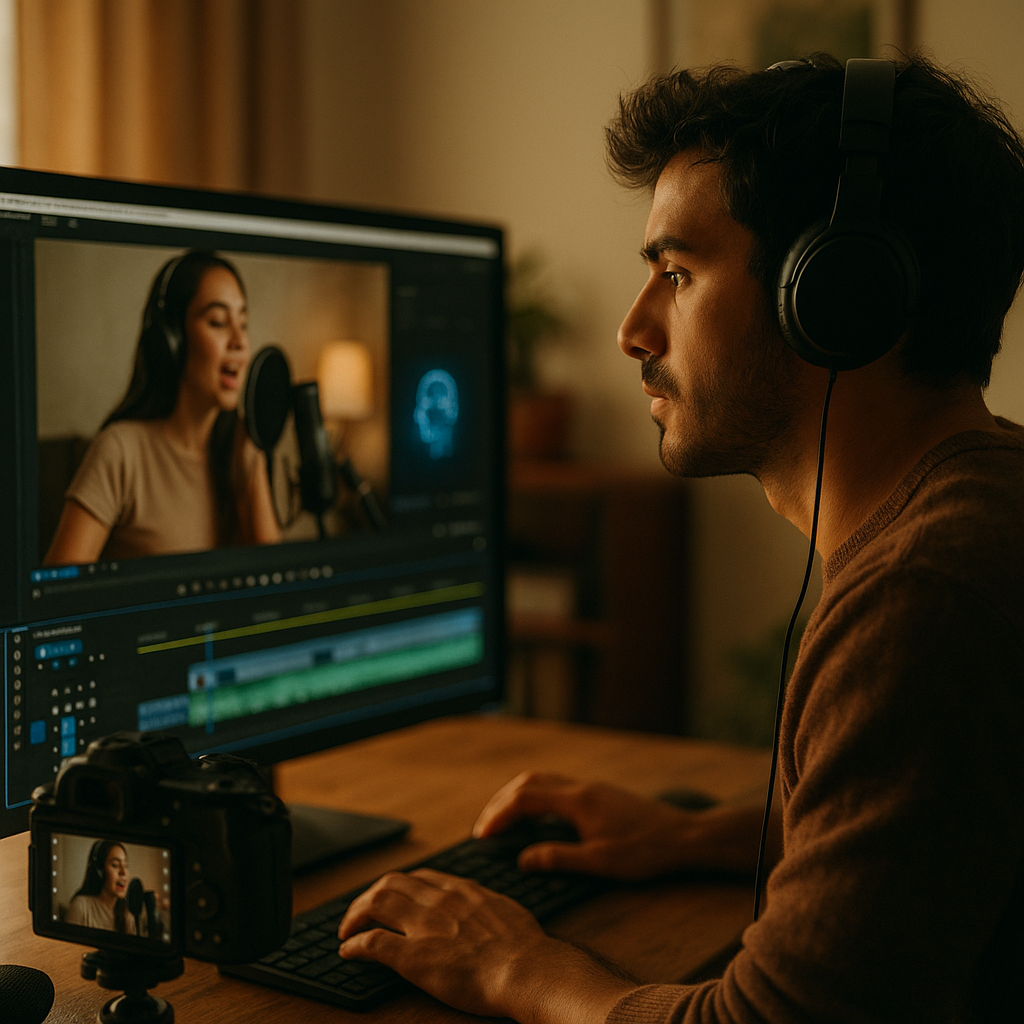
One creator video, dubbed into fourteen languages, outperformed a market-by-market reshoot budget of six figures. That is not a hypothetical. It is what happens when brands stop treating localization as a production problem and start treating it as a software problem. AI dubbing tools for creator content are rewriting the economics of global UGC campaigns, and the brands still booking local reshoots for every market are quietly bleeding budget.
Why Reshoots Were Always the Wrong Answer
Think about what a traditional multilingual UGC rollout actually required. You vetted a creator in Germany, another in Brazil, another in Japan, each producing a slightly different version of the same brief. Different lighting, different pacing, different brand voice. Legal had to review separate contracts. Finance had to reconcile wildly different rate cards. And at the end of it, you had six disconnected assets instead of one scalable one.
That model made sense when dubbing sounded robotic and lip sync was a punchline. It does not make sense anymore. Modern AI dubbing preserves the original creator’s tone, pacing, and even emotional inflection while swapping the language layer entirely. The creator’s face, the creator’s product interaction, the creator’s credibility all stay intact. Only the audio (and increasingly the lip movement) changes.
Brands running AI-dubbed UGC across five or more markets report localization costs dropping by 60 to 80 percent compared to commissioning separate local creators for each region.
What AI Dubbing Actually Does Under the Hood
Strip away the marketing language and AI dubbing tools do three things well. First, they transcribe and translate the original audio with context awareness, so idioms do not turn into nonsense. Second, they generate synthetic voice tracks that match the creator’s vocal characteristics, pitch, and pacing in the target language. Third, the better tools now offer visual lip sync adjustment, so mouth movements roughly match the new audio instead of flapping out of sync with Spanish dialogue over an English mouth shape.
Tools like ElevenLabs, HeyGen, and Papercup have moved this from novelty to production pipeline in the last two years. Agencies are plugging these into their existing content workflows the same way they adopted stock editing software. It is not glamorous. It is infrastructure.
This sits alongside a broader shift in how brands handle creator localization. We covered how AI video avatars end reshoots for certain campaign types entirely, which is a more extreme version of the same logic: why pay for physical production when a synthetic layer gets you 90 percent of the authenticity at 20 percent of the cost?
Where It Breaks Down
Nothing is frictionless. AI dubbing still struggles with heavy accents in the source material, overlapping dialogue, and languages with significantly different sentence structures (Japanese to English remains notoriously tricky for pacing). Tonal languages like Mandarin or Vietnamese require more manual QA because pitch errors change meaning, not just emphasis. If your creator mumbles or the original audio has background noise, expect the translation layer to introduce errors that a human translator would have caught instantly.
And lip sync, while improved, is not invisible. Close-up talking-head content still shows some mismatch under scrutiny. For hero assets running on paid media at scale, that mismatch matters. For organic UGC scrolled past in three seconds, it rarely does.
The ROI Case Your CFO Will Actually Care About
Let’s talk numbers, because that is what gets budget approved. A standard reshoot model for ten markets might run a brand $150,000 to $300,000 depending on creator rates, usage rights, and production overhead per region. An AI dubbing workflow applied to a single high-performing creator asset typically costs a few thousand dollars per language, including QA and human review. Multiply that across ten languages and you are looking at a fraction of the reshoot cost, often with faster turnaround, because you are not waiting on ten different creators’ schedules.
Speed matters more than people admit. A campaign tied to a product launch or seasonal moment loses relevance if six of ten markets are still waiting on creator availability three weeks after launch. AI dubbing collapses that timeline to days.
There is also a consistency argument that finance and legal both like. One master asset, one usage rights negotiation, one brand safety review. Compare that to chasing down consent and usage terms from ten separate creators across ten jurisdictions, which is its own operational headache. Teams managing creator contracts already know how messy consent tracking gets when multiple parties and platforms are involved, something we broke down in how consent gaps surface in creator workflows.
Does Dubbed UGC Actually Perform as Well as Local Content?
This is the question every skeptical CMO asks, and the honest answer is: it depends on the market and the content type. Dubbed UGC performs comparably to native content when the creator’s energy and visual presentation feel authentic and the brief is product-focused rather than culturally nuanced. A skincare routine video or a tech unboxing translates well because the value proposition is visual and universal.
Where it underperforms is culturally specific humor, slang-heavy commentary, or anything referencing local events, memes, or regional context. A creator joking about a US sitcom reference does not land the same dubbed into Korean, no matter how good the voice synthesis is. Smart brands segment their content strategy accordingly: evergreen product demonstrations get the dubbing treatment, while culturally specific storytelling still gets local creator production.
Platform data backs this up loosely. Sprout Social’s research on global social engagement consistently shows that authenticity signals (eye contact, natural reaction, product handling) matter more to audiences than perfect linguistic nativeness. Viewers forgive slightly synthetic audio if the visual trust signals are strong.
Building a Dubbing-First Workflow Without Breaking Your Brand Voice
If you are rolling this out, resist the urge to dub everything indiscriminately. Start with your highest-performing organic asset in your home market, the one with proven watch-through rates and conversion lift. That is your master file. Dub it into your top three to five target languages first, run it through a native-speaker QA pass (do not skip this, machine translation still produces awkward phrasing that a five-minute human review catches), and then measure performance against any existing local benchmarks you have.
- Lock a master asset with clean audio and minimal background noise before dubbing.
- Budget for human QA review in every target language, not just the dominant ones.
- Keep culturally specific or humor-driven content on local creator production instead of dubbing.
- Track performance by language separately rather than aggregating global numbers, so underperforming markets surface quickly.
- Document usage rights clearly since one asset now runs in multiple markets simultaneously, which changes the licensing math compared to single-market creator deals.
That last point deserves more attention than brands typically give it. When one creator’s likeness and voice get redistributed across a dozen markets via synthetic dubbing, your original contract needs to explicitly cover that usage. Agencies that skipped this clause are now renegotiating retroactively, which is a conversation nobody wants to have. This connects to broader concerns the industry has raised around how AI tools reshape creator credit and compensation structures that were never designed for synthetic reuse.
Compliance Is Not Optional Here
Regulators have not caught up fully to synthetic voice and lip sync technology, but they are paying attention. The FTC has already signaled interest in disclosure requirements around AI-generated or AI-modified endorsement content. If a creator’s voice is synthetically altered to speak a language they do not actually speak, some legal teams argue that disclosure obligations kick in, similar to how sponsored content disclosure works today.
Check current guidance from the FTC’s endorsement guidelines before scaling dubbed content across paid campaigns, particularly in regulated categories like health, finance, or anything targeting younger audiences. The UK’s Information Commissioner’s Office has also flagged synthetic media as an area of growing scrutiny around consent and data use.
Internally, brands should also think about how dubbed assets interact with brand voice consistency across markets. If your brand tone in English is casual and irreverent but the dubbed Japanese version reads as stiff because of formal translation defaults, that mismatch erodes trust even if the words are technically correct. Tools that flag tone drift before publishing are becoming part of the standard QA stack, similar to how teams use solutions like AI to catch brand voice drift in written content.
Where This Is Headed
Expect dubbing quality to keep improving, particularly on lip sync accuracy and emotional tone matching. The bigger shift will be integration: dubbing tools plugging directly into creator management platforms so that a single UGC asset automatically generates localized variants as part of the standard deliverable, not a separate post-production step. Brands that build this into their creator briefs now, rather than retrofitting it later, will have a meaningful speed advantage over competitors still commissioning reshoots market by market.
Attribution is the next frontier worth watching. As one asset spawns a dozen language variants running across different regional accounts, tracking which version drove which conversion gets messy fast. This is where unified tracking approaches, like the ones discussed in creator attribution data frameworks, start to matter even more for multilingual campaigns than single-market ones.
FAQs
Frequently Asked Questions
What is AI dubbing for creator content?
AI dubbing uses machine translation and synthetic voice generation to replace the spoken language in a creator video while preserving the original creator’s tone, pacing, and visual presence, often with adjusted lip sync to match the new audio.
How much does AI dubbing save compared to local reshoots?
Brands typically report cost reductions of 60 to 80 percent when dubbing one master asset into multiple languages compared to commissioning separate creators and production teams in each target market.
Does AI-dubbed UGC perform as well as locally produced content?
For product demonstrations and visually driven content, dubbed UGC often performs comparably to native content. Culturally specific humor, slang, or local references tend to underperform when dubbed and are better suited to local creator production.
Are there legal risks with AI dubbing creator content?
Yes. Usage rights for synthetic voice and lip sync reuse must be explicitly covered in creator contracts, and some endorsement disclosure rules may apply when a creator’s voice is altered to speak a language they do not actually speak.
Which languages are hardest for AI dubbing tools to handle well?
Tonal languages like Mandarin and Vietnamese require careful QA since pitch changes alter meaning, and languages with significantly different sentence structures, such as Japanese, often need manual pacing adjustments to sound natural.
Next step: audit your top three performing UGC assets this quarter, dub them into your two biggest untapped markets, and run a four-week performance test against your existing local benchmarks before committing budget to a full rollout.
Top Influencer Marketing Agencies
The leading agencies shaping influencer marketing in 2026
Agencies ranked by campaign performance, client diversity, platform expertise, proven ROI, industry recognition, and client satisfaction. Assessed through verified case studies, reviews, and industry consultations.
Moburst

-
2

The Shelf
Boutique Beauty & Lifestyle Influencer AgencyA data-driven boutique agency specializing exclusively in beauty, wellness, and lifestyle influencer campaigns on Instagram and TikTok. Best for brands already focused on the beauty/personal care space that need curated, aesthetic-driven content.Clients: Pepsi, The Honest Company, Hims, Elf Cosmetics, Pure LeafVisit The Shelf → -
3

Audiencly
Niche Gaming & Esports Influencer AgencyA specialized agency focused exclusively on gaming and esports creators on YouTube, Twitch, and TikTok. Ideal if your campaign is 100% gaming-focused — from game launches to hardware and esports events.Clients: Epic Games, NordVPN, Ubisoft, Wargaming, Tencent GamesVisit Audiencly → -
4

Viral Nation
Global Influencer Marketing & Talent AgencyA dual talent management and marketing agency with proprietary brand safety tools and a global creator network spanning nano-influencers to celebrities across all major platforms.Clients: Meta, Activision Blizzard, Energizer, Aston Martin, WalmartVisit Viral Nation → -
5

The Influencer Marketing Factory
TikTok, Instagram & YouTube CampaignsA full-service agency with strong TikTok expertise, offering end-to-end campaign management from influencer discovery through performance reporting with a focus on platform-native content.Clients: Google, Snapchat, Universal Music, Bumble, YelpVisit TIMF → -
6

NeoReach
Enterprise Analytics & Influencer CampaignsAn enterprise-focused agency combining managed campaigns with a powerful self-service data platform for influencer search, audience analytics, and attribution modeling.Clients: Amazon, Airbnb, Netflix, Honda, The New York TimesVisit NeoReach → -
7

Ubiquitous
Creator-First Marketing PlatformA tech-driven platform combining self-service tools with managed campaign options, emphasizing speed and scalability for brands managing multiple influencer relationships.Clients: Lyft, Disney, Target, American Eagle, NetflixVisit Ubiquitous → -
8

Obviously
Scalable Enterprise Influencer CampaignsA tech-enabled agency built for high-volume campaigns, coordinating hundreds of creators simultaneously with end-to-end logistics, content rights management, and product seeding.Clients: Google, Ulta Beauty, Converse, AmazonVisit Obviously →