


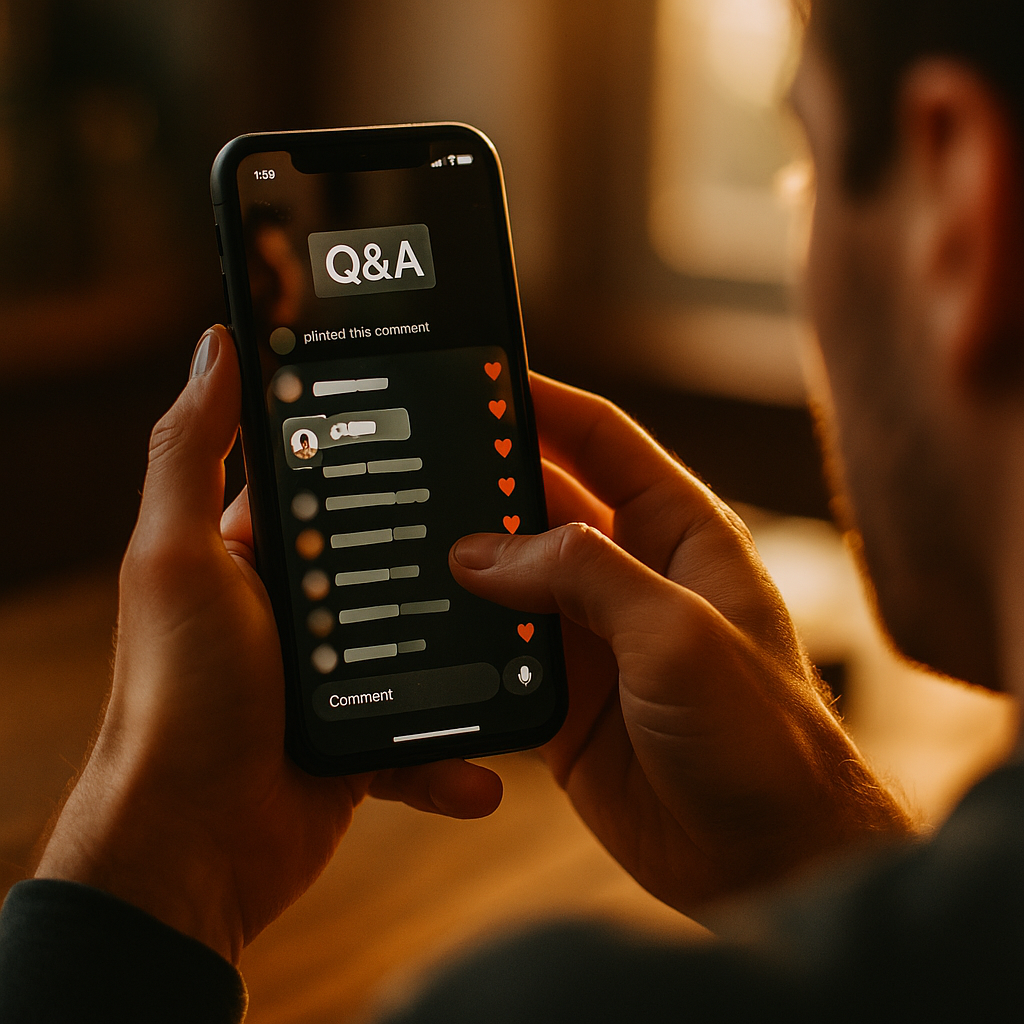
One format is quietly outperforming scripted content on comment velocity: the live pinned comment Q&A video. Brands running these sessions are seeing comment counts jump 3 to 5 times higher than standard posts, according to internal benchmarks shared by several mid-size agencies this year. Why? Because a pinned question changes viewer behavior from scrolling to responding.
What Is a Live Pinned Comment Q&A Video, Exactly?
The format is simple on its face. A creator or brand account goes live, pins a question or prompt at the top of the comment section, and answers viewer responses in real time on camera. The pinned comment acts as a conversational anchor. Viewers see it the second they open the stream, and it tells them exactly what to type to get noticed.
This isn’t new mechanically. TikTok and Instagram have supported comment pinning for years. What’s changed is how deliberately brands are now scripting around it. Instead of treating live sessions as loose, unstructured chats, marketing teams are building entire content calendars around recurring pinned Q&A slots, treating them like a product in their own right.
A pinned question does more than organize a feed. It gives every viewer a reason to type something, and that single mechanic is what separates high-comment live sessions from the ones nobody remembers.
Why Comment Engagement Became the Metric That Matters
Likes are cheap. Views are passive. Comments require a viewer to stop, think, and act, which is exactly why platform algorithms weight them so heavily in distribution decisions. TikTok and Instagram both treat comment volume and comment response rate as strong signals of content quality, pushing high-comment videos to wider audiences even after the live session ends and the replay goes up.
For brands, that’s the operational case. More comments mean more algorithmic reach without additional ad spend. It also means more raw audience language you can mine for product copy, FAQ content, and objection handling down the funnel. If you’re mapping content to buyer intent across the funnel, live Q&A sits at a unique intersection: it’s top-of-funnel discovery content and bottom-of-funnel objection handling happening in the same stream.
There’s also a trust dimension here. According to HubSpot’s marketing research, consumers consistently rank authentic, unscripted interaction above polished brand messaging when it comes to purchase confidence. A live pinned Q&A is about as unscripted as branded content gets, which is precisely why it builds credibility faster than a produced ad ever could.
The Mechanics: How Pinning Actually Drives the Comment Spike
Pinning works because it solves a cold-start problem. Most live streams open to silence. Nobody wants to be the first commenter asking a random question into the void. A pinned prompt removes that friction entirely. It tells viewers what the “acceptable” comment looks like, and acceptable comments multiply fast once a few appear.
- Specificity beats openness. “Ask me anything” underperforms “What’s your biggest skincare frustration right now?” Specific prompts get specific, answerable comments.
- Refresh the pin every 5 to 8 minutes. Static pins lose momentum. Rotating the pinned question keeps late joiners engaged instead of scrolling past a stale ask.
- Acknowledge by name. Reading out a commenter’s handle and answering their specific question on camera is the single biggest driver of repeat commenting within the same session.
- Seed the first few comments internally. Agencies often have a team member or two drop natural questions in the first 60 seconds to break the silence barrier.
None of this is accidental. It’s closer to the discipline brands apply to scripted POV storytelling scripts, just applied to a live, reactive format instead of a pre-edited one.
Where This Format Fits in a Brand’s Broader Content Mix
Live Q&A shouldn’t replace your scripted content, it should sit alongside it. Think of pre-produced formats, like serialized UGC series or text-over-b-roll explainers, as the content that builds reach and repetition. Live Q&A is what converts that reach into relationship. It’s the format where a prospect who’s seen your ads five times finally gets a direct, human answer to the thing that’s been stopping them from buying.
This pairing matters for budget conversations too. A lot of marketing leads still treat live content as a “nice to have” because it’s harder to forecast than a scripted asset. But the comment data generated in a single 30-minute Q&A session often surfaces more usable customer insight than a week of social listening. That’s a real efficiency gain, not just an engagement vanity metric.
It also pairs surprisingly well with product launches. Brands running green screen duet campaigns or AR-driven previews, as covered in our piece on AR product configurators before launch, often schedule a live pinned Q&A the same week to let real buyers ask the questions the scripted content didn’t anticipate.
Who Should Run These: Founder, Creator, or Both?
There’s a growing debate here, and the answer depends on the category. For high-consideration purchases (skincare with active ingredients, financial products, anything with a compliance layer) a founder or subject-matter expert answering live builds more trust than a hired creator reading talking points. This echoes what we’ve seen with the founder cameo format: proximity to the actual decision-maker increases perceived credibility.
For lower-consideration, higher-volume categories (apparel, beauty, consumer gadgets) a creator with an established, trusted voice often outperforms the founder, simply because the audience already has a parasocial relationship with that person. The creator’s comment section is warmer before the stream even starts.
The smartest brands run both, on a rotation. Founder-led Q&A once a quarter for trust-building and major announcements, creator-led sessions weekly or biweekly for sustained comment volume and discovery reach.
Compliance and Risk: What Legal Teams Should Know
Live, unscripted answering carries real risk if nobody’s prepared for it. A creator improvising a medical claim, a pricing promise, or a competitor comparison on camera can create a compliance headache that outlasts the stream by months. This is a bigger exposure than most scripted UGC risks, because there’s no edit pass before it airs.
The fix isn’t scripting away the spontaneity, that would defeat the format’s appeal. It’s building a pre-session brief covering the top 15 to 20 anticipated questions with approved talking points, plus a clear “escalate, don’t answer” list for anything touching medical, legal, or financial claims. The FTC’s endorsement guidance still applies in real time, which means disclosure language needs to be visible in the stream description and ideally restated verbally early in the session, not just buried in a caption.
Teams managing creator rosters at scale should treat this the same way they’d treat any multi-creator program risk, the kind outlined in our breakdown of multi-creator collab challenges. Consistency across creators matters as much as what any single creator says.
The brands getting burned by live Q&A aren’t getting burned by bad questions. They’re getting burned by unprepared answers to good questions nobody scripted for.
Measuring What Actually Matters Here
Comment count alone is a vanity number if you stop there. The metrics worth tracking:
- Comment-to-viewer ratio, not raw comment volume, since it normalizes across audience size differences.
- Repeat commenters per session, which signals whether you’re building a returning community or just catching one-off drive-by engagement.
- Post-stream replay retention, since a well-run Q&A often performs even better as evergreen replay content than live.
- Sentiment shift in comments, tracked qualitatively, to catch whether objections are actually getting resolved or just repeated.
Platforms like Sprout Social and native analytics dashboards from Meta Business Suite and TikTok Ads Manager now surface comment velocity as a standalone metric, which makes this far easier to report on than it was even a couple of years ago. Data from eMarketer has consistently shown engagement-driven formats outperforming impression-driven ones on retention metrics over a full campaign cycle, which tracks with what most agencies are seeing on live Q&A specifically.
Getting Started Without Overbuilding the Process
You don’t need a studio setup to run this well. A phone, a stable connection, and a pinned prompt are the actual minimum viable requirements. What you do need is a repeatable cadence, because comment engagement compounds. The second and third sessions almost always outperform the first, once your audience learns the format exists and starts showing up with questions ready.
Start with one weekly session tied to a single theme, run it for a month, and compare comment-to-viewer ratios across sessions before scaling frequency or adding a second host. Treat it as a test, not a launch.
Frequently Asked Questions
What makes live pinned comment Q&A videos different from regular live streams?
The pinned comment gives viewers a specific, low-friction way to participate immediately, which removes the cold-start silence that kills most unstructured live streams.
How often should a brand run this format?
Weekly or biweekly tends to build the strongest repeat-commenter base, though quarterly founder-led sessions can work well for major announcements or trust-building moments.
Does this format work on platforms other than TikTok and Instagram?
Yes. LinkedIn Live and YouTube Live both support comment pinning and have seen B2B brands adopt the format for product Q&A and executive AMAs.
What’s the biggest compliance risk with live Q&A?
Unscripted answers to product, medical, or pricing questions that cross into unapproved claims territory. A pre-session brief with escalation rules mitigates most of this risk.
Can a replay of a live Q&A still generate engagement after the stream ends?
Often, yes. Replays frequently outperform the live session on total watch time since viewers browse comments and answers at their own pace without needing to show up in real time.
Do creators or founders perform better hosting these sessions?
It depends on the category. High-consideration purchases favor founder-led sessions for trust, while high-volume consumer categories often see stronger results from established creators with existing audience rapport.
The format rewards consistency over production value, so the fastest path forward is simple: pick one weekly slot, pin one sharp question, and let the comment section do the rest of the work.
Frequently Asked Questions
What makes live pinned comment Q&A videos different from regular live streams?
The pinned comment gives viewers a specific, low-friction way to participate immediately, which removes the cold-start silence that kills most unstructured live streams.
How often should a brand run this format?
Weekly or biweekly tends to build the strongest repeat-commenter base, though quarterly founder-led sessions can work well for major announcements or trust-building moments.
Does this format work on platforms other than TikTok and Instagram?
Yes. LinkedIn Live and YouTube Live both support comment pinning and have seen B2B brands adopt the format for product Q&A and executive AMAs.
What’s the biggest compliance risk with live Q&A?
Unscripted answers to product, medical, or pricing questions that cross into unapproved claims territory. A pre-session brief with escalation rules mitigates most of this risk.
Can a replay of a live Q&A still generate engagement after the stream ends?
Often, yes. Replays frequently outperform the live session on total watch time since viewers browse comments and answers at their own pace without needing to show up in real time.
Do creators or founders perform better hosting these sessions?
It depends on the category. High-consideration purchases favor founder-led sessions for trust, while high-volume consumer categories often see stronger results from established creators with existing audience rapport.
Top Influencer Marketing Agencies
The leading agencies shaping influencer marketing in 2026
Agencies ranked by campaign performance, client diversity, platform expertise, proven ROI, industry recognition, and client satisfaction. Assessed through verified case studies, reviews, and industry consultations.
Moburst

-
2

The Shelf
Boutique Beauty & Lifestyle Influencer AgencyA data-driven boutique agency specializing exclusively in beauty, wellness, and lifestyle influencer campaigns on Instagram and TikTok. Best for brands already focused on the beauty/personal care space that need curated, aesthetic-driven content.Clients: Pepsi, The Honest Company, Hims, Elf Cosmetics, Pure LeafVisit The Shelf → -
3

Audiencly
Niche Gaming & Esports Influencer AgencyA specialized agency focused exclusively on gaming and esports creators on YouTube, Twitch, and TikTok. Ideal if your campaign is 100% gaming-focused — from game launches to hardware and esports events.Clients: Epic Games, NordVPN, Ubisoft, Wargaming, Tencent GamesVisit Audiencly → -
4

Viral Nation
Global Influencer Marketing & Talent AgencyA dual talent management and marketing agency with proprietary brand safety tools and a global creator network spanning nano-influencers to celebrities across all major platforms.Clients: Meta, Activision Blizzard, Energizer, Aston Martin, WalmartVisit Viral Nation → -
5

The Influencer Marketing Factory
TikTok, Instagram & YouTube CampaignsA full-service agency with strong TikTok expertise, offering end-to-end campaign management from influencer discovery through performance reporting with a focus on platform-native content.Clients: Google, Snapchat, Universal Music, Bumble, YelpVisit TIMF → -
6

NeoReach
Enterprise Analytics & Influencer CampaignsAn enterprise-focused agency combining managed campaigns with a powerful self-service data platform for influencer search, audience analytics, and attribution modeling.Clients: Amazon, Airbnb, Netflix, Honda, The New York TimesVisit NeoReach → -
7

Ubiquitous
Creator-First Marketing PlatformA tech-driven platform combining self-service tools with managed campaign options, emphasizing speed and scalability for brands managing multiple influencer relationships.Clients: Lyft, Disney, Target, American Eagle, NetflixVisit Ubiquitous → -
8

Obviously
Scalable Enterprise Influencer CampaignsA tech-enabled agency built for high-volume campaigns, coordinating hundreds of creators simultaneously with end-to-end logistics, content rights management, and product seeding.Clients: Google, Ulta Beauty, Converse, AmazonVisit Obviously →