


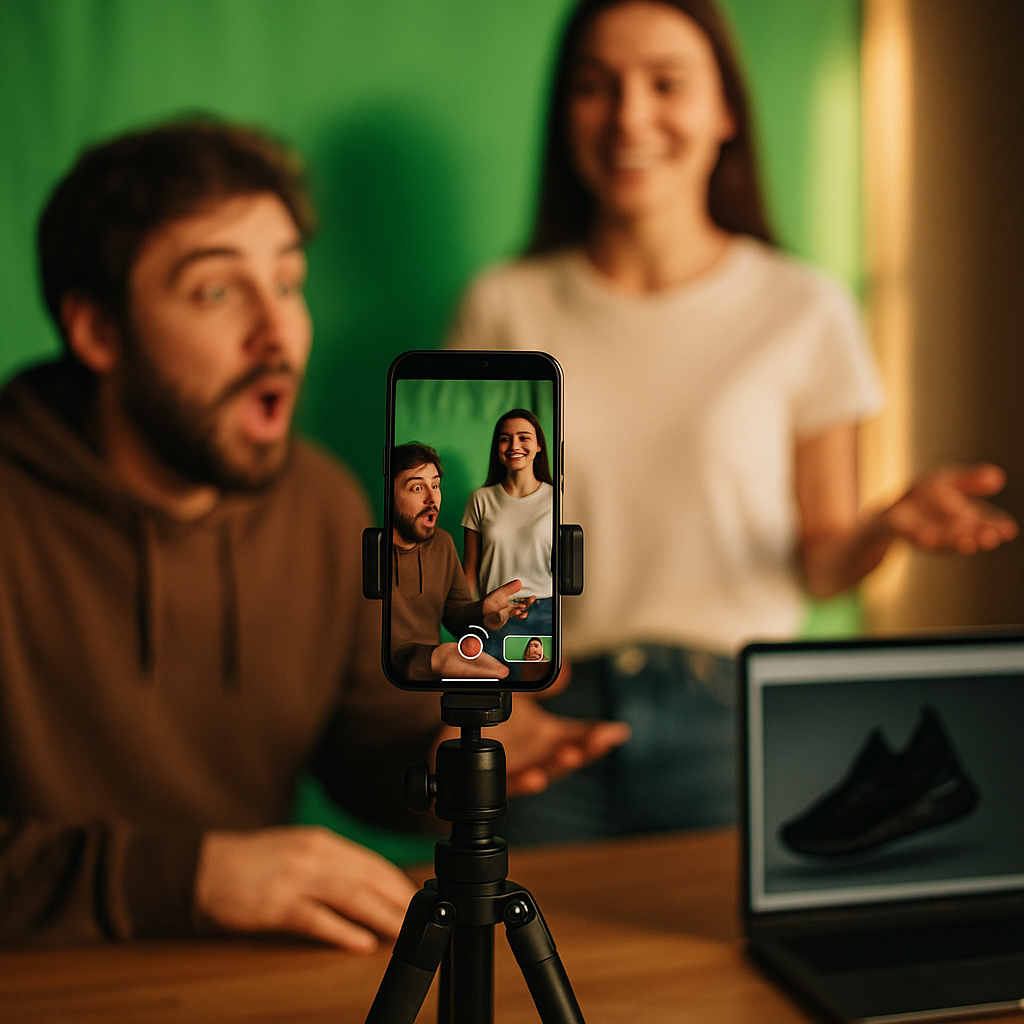
Product launches fail for a boring reason: nobody outside the brand’s own feed believes the hype. A green screen duet format flips that problem into a growth lever, letting creators react to your product against a branded backdrop while stitching in real launch footage. It costs a fraction of a traditional shoot, and early data from agencies running it during launch windows shows engagement rates 30 to 45 percent above standard product demo videos. This isn’t a gimmick. It’s a distribution mechanic.
What a Green Screen Duet Actually Is
Strip away the TikTok jargon and it’s simple. A creator records themselves in front of a background image or video, which is usually your product shot, launch trailer clip, or unboxing footage. The green screen effect (native to TikTok, replicable on Reels and Shorts with overlay tools) puts your content directly behind the creator’s live reaction. The result feels like a split-screen commentary track over your own launch asset, except the creator is the one narrating it, not your brand voice.
It’s a cousin of the traditional duet, but with more creative control for the brand. You supply the background clip. The creator supplies the authenticity. Neither side has to compromise on production quality, and that’s exactly why it works during launch windows when you need volume and credibility simultaneously.
Why Launch Campaigns Specifically Benefit
Launches are compressed timelines with high visibility and low forgiveness. You get one shot at a first impression, and traditional influencer briefs (send product, wait for content, hope for the best) don’t scale fast enough when you need forty creators live within a 72 hour window.
Green screen duets solve the speed problem because the brand asset is fixed. You’re not waiting on individual creators to film product B roll, edit transitions, or source their own footage of the item in use. You send one polished background clip, maybe fifteen seconds of hero shots or a founder announcement, and creators layer their honest reactions on top. Production time per creator drops from days to hours.
Brands running green screen duets across ten or more creators during a launch week report content turnaround averaging under 24 hours per creator, compared to 3 to 5 days for fully independent UGC briefs.
There’s also a psychological trust angle. Viewers have grown skeptical of polished ads, but a creator visibly reacting in real time (even to branded footage) reads as unscripted. It borrows credibility from the reaction format while still controlling the visual narrative underneath it. This is the same trust mechanic explored in split-screen reaction formats, where audiences respond more to visible authenticity than to production polish.
Building the Brief Without Killing the Format
Here’s where most brands overcorrect. They send a 12 page brand guideline document and wonder why every creator’s duet sounds identical and lifeless. The format only works if the creator’s reaction stays genuinely theirs.
A workable brief includes three things and nothing more:
- The background asset itself, cropped and formatted for vertical use, ideally under 20 seconds.
- Three optional reaction prompts (not scripts) like “first impression,” “would you actually buy this,” or “compare to what you use now.”
- Disclosure language that satisfies FTC guidance on material connections, since this is still sponsored content even if the format feels casual.
Anything beyond that risks flattening the spontaneity that makes duets convert. If you’ve read our breakdown of green screen tutorial briefs, the same principle applies here: specificity in the visual asset, freedom in the verbal delivery.
Choosing the Right Background Footage
Not every launch clip translates well as duet background material. Static product shots with no motion tend to underperform because they give the creator nothing to react to in real time. The best performing backgrounds have a visible reveal moment, whether that’s a founder pulling back packaging, a feature demo, or a countdown graphic building anticipation. Timing your background clip to a specific reveal beat gives creators a natural cue for their reaction, which is the same logic behind milestone countdown series that build hype incrementally rather than dumping the full reveal at once.
Where This Fits in the Broader Launch Stack
Green screen duets shouldn’t carry a launch alone. They work best as the mid-funnel trust layer, sitting between top-funnel awareness content and bottom-funnel conversion assets. Think of the sequence like this:
- Teaser and countdown content builds anticipation before the drop.
- Founder or executive announcement clips establish the “why” behind the launch, similar to the approach in founder as creator video strategies.
- Green screen duets go live at launch, giving third party validation against your own footage.
- Winning duets get pulled into paid amplification once organic performance signals which creators resonate.
That last step matters more than most brands realize. A duet that performs organically is a strong candidate for paid scaling, using the same principles covered in spark ads amplification. You’re not guessing which creative to boost. The algorithm already told you.
Platform Mechanics You Need to Know
TikTok’s native duet and green screen tools remain the easiest execution path, and TikTok’s ad platform supports boosting organic duets directly without reshoot. Instagram Reels requires a workaround since native duet stitching is more limited, so most agencies use third party overlay apps or brief creators to film against a physical green screen and key it in post. YouTube Shorts sits somewhere in between, with react style content performing well but less native tooling for the exact duet mechanic.
Cross-platform consistency matters for launch campaigns running simultaneously across channels. According to Sprout Social’s ongoing platform research, short-form reactive content sees the highest completion rates when the hook lands in the first two seconds, which puts pressure on your background clip’s opening frame. If the reveal moment is buried at second eight, you’ve lost half your audience before the duet even gets interesting.
Measuring What Actually Matters
Vanity metrics lie during launches. Views spike naturally because of algorithmic push around new sounds and trending duet chains, but views don’t tell you whether the format moved product. Track these instead:
- Save rate, which signals purchase intent more reliably than likes, echoing findings in carousel saves research.
- Duet chain depth, meaning how many secondary duets your original creator’s content spawned.
- Click-through from bio link or shop tag during the specific hours the duet was live.
- Comment sentiment, since duets often generate direct comparison comments (“does this work better than X”) that double as informal market research.
Attribution windows on launch content are tight. Most of the conversion lift happens in the first 48 to 72 hours, so daily reporting during launch week beats waiting for a weekly rollup. eMarketer data on short-form video consumption patterns supports this: engagement decays fast once a format loses novelty, and duets are especially novelty dependent.
Common Mistakes That Tank the Format
Three failure patterns show up repeatedly when brands run green screen duets for the first time.
Over-scripting the reaction. If a creator’s duet sounds like it was read off a card, viewers spot it immediately and engagement collapses. Give direction, not dialogue.
Using the wrong background pacing. A 45 second background clip is too long. Creators need room to react without the underlying footage dragging past the point of interest. Keep it tight, under 20 seconds where possible.
Skipping disclosure consistency. Every creator needs the same disclosure standard applied, whether that’s #ad, #partner, or platform-native paid partnership labels. Inconsistent disclosure across a creator cohort creates compliance exposure that’s entirely avoidable, a risk also flagged in our FTC framework coverage for transformation and demo content.
The single biggest predictor of duet performance isn’t creator follower count. It’s whether the background clip gives the creator something genuine to react to within the first three seconds.
FAQs
Frequently Asked Questions
What makes green screen duets different from standard influencer UGC?
Standard UGC has the creator produce everything independently, including any product footage. Green screen duets give the creator a brand-supplied background clip to react to in real time, which speeds production and keeps the visual narrative on-brand while preserving the creator’s authentic voice.
How many creators should a brand use for a single product launch?
Most successful launch cohorts run between 15 and 40 creators across a launch week, staggered rather than posted simultaneously, so the algorithm treats each duet as fresh rather than duplicate content competing for the same audience attention.
Does the green screen duet format work outside TikTok?
Yes, though execution varies. TikTok has native tooling for the fastest turnaround. Instagram Reels and YouTube Shorts require overlay apps or manual keying, which adds production time but the reaction mechanic still performs well on both platforms.
What’s the ideal length for the background clip creators react to?
Under 20 seconds, with the key reveal or hook landing within the first two to three seconds. Longer clips give creators too much dead time to react to and reduce completion rates.
How do we handle FTC disclosure for duet content?
Apply the same material connection standard used across your influencer program: clear, unavoidable disclosure using #ad or platform-native paid partnership tags, applied consistently across every creator in the cohort regardless of follower size.
Run a five-creator pilot on your next launch, keep the background clip under 20 seconds, and measure save rate before you scale the cohort. If the format earns its place, fold it into the same amplification pipeline you already use for winning organic content.
Top Influencer Marketing Agencies
The leading agencies shaping influencer marketing in 2026
Agencies ranked by campaign performance, client diversity, platform expertise, proven ROI, industry recognition, and client satisfaction. Assessed through verified case studies, reviews, and industry consultations.
Moburst

-
2

The Shelf
Boutique Beauty & Lifestyle Influencer AgencyA data-driven boutique agency specializing exclusively in beauty, wellness, and lifestyle influencer campaigns on Instagram and TikTok. Best for brands already focused on the beauty/personal care space that need curated, aesthetic-driven content.Clients: Pepsi, The Honest Company, Hims, Elf Cosmetics, Pure LeafVisit The Shelf → -
3

Audiencly
Niche Gaming & Esports Influencer AgencyA specialized agency focused exclusively on gaming and esports creators on YouTube, Twitch, and TikTok. Ideal if your campaign is 100% gaming-focused — from game launches to hardware and esports events.Clients: Epic Games, NordVPN, Ubisoft, Wargaming, Tencent GamesVisit Audiencly → -
4

Viral Nation
Global Influencer Marketing & Talent AgencyA dual talent management and marketing agency with proprietary brand safety tools and a global creator network spanning nano-influencers to celebrities across all major platforms.Clients: Meta, Activision Blizzard, Energizer, Aston Martin, WalmartVisit Viral Nation → -
5

The Influencer Marketing Factory
TikTok, Instagram & YouTube CampaignsA full-service agency with strong TikTok expertise, offering end-to-end campaign management from influencer discovery through performance reporting with a focus on platform-native content.Clients: Google, Snapchat, Universal Music, Bumble, YelpVisit TIMF → -
6

NeoReach
Enterprise Analytics & Influencer CampaignsAn enterprise-focused agency combining managed campaigns with a powerful self-service data platform for influencer search, audience analytics, and attribution modeling.Clients: Amazon, Airbnb, Netflix, Honda, The New York TimesVisit NeoReach → -
7

Ubiquitous
Creator-First Marketing PlatformA tech-driven platform combining self-service tools with managed campaign options, emphasizing speed and scalability for brands managing multiple influencer relationships.Clients: Lyft, Disney, Target, American Eagle, NetflixVisit Ubiquitous → -
8

Obviously
Scalable Enterprise Influencer CampaignsA tech-enabled agency built for high-volume campaigns, coordinating hundreds of creators simultaneously with end-to-end logistics, content rights management, and product seeding.Clients: Google, Ulta Beauty, Converse, AmazonVisit Obviously →