


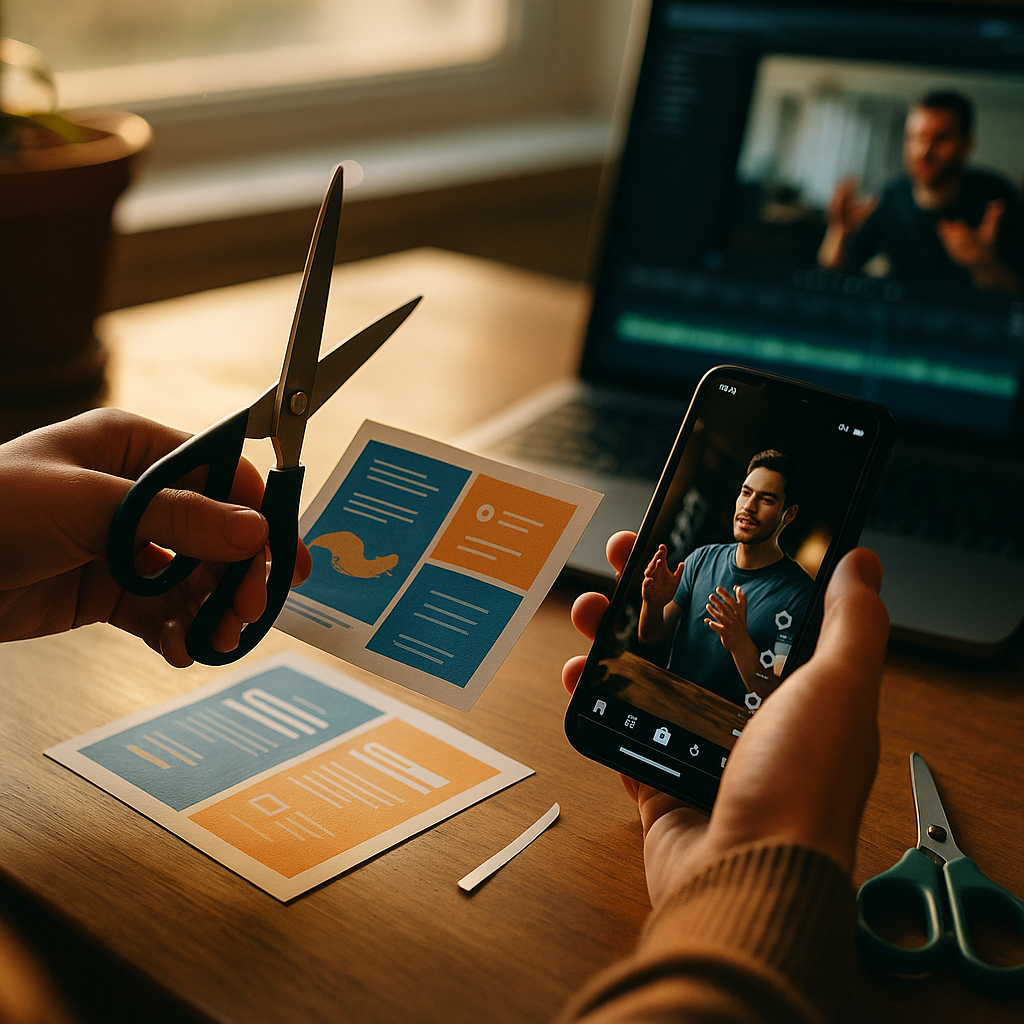
Meta’s own data shows Reels now account for over half of time spent on Instagram, yet most brands are still briefing carousels and reels as two separate line items with two separate budgets. That’s money left on the table. Carousel to reel conversion, the practice of repurposing high-performing static creator posts into short video, is quietly becoming the highest-ROI move in creator content operations. Why brief twice when the winning idea already exists?
The Math Nobody’s Doing on Repurposed Creative
Here’s the uncomfortable truth: most brands treat carousels and reels as separate production efforts, with separate briefs, separate creator fees, and separate approval cycles. That’s operationally lazy and financially wasteful. A carousel that already proved it converts, high saves, strong dwell time, screenshot behavior, is a validated concept. Turning it into video isn’t a creative leap. It’s a production task.
Consider the typical influencer program budget. Agencies quote per-deliverable, and video costs anywhere from 30% to 80% more than a static carousel depending on editing complexity and usage rights. If a brand is commissioning both formats from scratch every time, that premium compounds across dozens of creators and hundreds of assets a quarter. Repurposing flips that math. You’re not paying for a new idea. You’re paying for reformatting a proven one.
A carousel that already earned saves and screenshots isn’t just a post, it’s a pre-validated script waiting to be filmed.
Why Static Wins Give You a Head Start on Video
Static creator posts leave a paper trail that video briefs never get upfront: which slide got the longest dwell time, which caption line drove comments, which product angle got screenshotted and saved for later. That’s not vanity metrics. That’s a script outline.
When a brand’s photo dump carousel format or a slide-based tutorial performs well, the sequencing already tells you the narrative arc. Slide one is the hook. Slide three is the objection handle. Slide five is the payoff. Convert that structure into a fifteen-second reel and you’ve essentially pre-tested the storyboard against a real audience before a single frame of video exists.
This is the same logic behind frame grab stills, just running in reverse. Instead of pulling video into static, you’re pushing static into motion. Both directions share one principle: format follows proof, not the other way around.
What Actually Transfers From Slide to Screen
Not every carousel converts cleanly. Some formats are inherently static, dense infographics, side-by-side comparison grids, long-form text posts, and forcing them into video usually flattens what made them work. Know what transfers before you brief the conversion.
- Sequential product reveals. Carousels that build toward a payoff (before, during, after) map almost directly onto reel pacing. The slide order becomes the shot list.
- Testimonial quote cards. A strong quote slide becomes a talking-head hook or a silent subtitled video opener in seconds.
- Problem/solution framing. If the carousel walked through a pain point and resolution, that’s already a three-act script.
- UGC style photo grids. These translate well into testimonial stitch ads, where multiple creator clips get cut together around a shared theme.
What doesn’t transfer: dense text carousels meant to be read and re-read, or comparison charts that rely on side-by-side visual scanning. Video is a linear format. If the value of your carousel depended on the viewer controlling pace, forcing it into a scrollable-to-sequential conversion kills the thing that made it work.
Building the Conversion Brief
The brief for a carousel-to-reel conversion looks nothing like a brief for original video content, and that’s the point. You’re not asking a creator to invent. You’re asking them to translate.
Start with the performance data from the original post. Pull the top-performing slide order, the caption hook that drove saves, and any comment themes that reveal what resonated. Hand that to the creator as source material, not inspiration. Specify:
- Which slides must appear as scenes, in what order.
- Whether the original caption hook becomes spoken dialogue, on-screen text, or voiceover.
- Target length. Most conversions run 15 to 30 seconds, matching the average carousel’s read time.
- Platform destination, since a reel built for Instagram needs different pacing than one destined for TikTok Shop.
This is also where AI concept-to-script pipelines earn their keep. Feed a validated carousel caption into a script generator and you get a rough shot list in minutes, not days. Human editors still need to tighten pacing and add authentic delivery, but the heavy lifting of “what should this video say” is already solved by the static post’s own performance data.
Rights, Usage, and the Contract Gap Brands Keep Missing
Here’s where a lot of marketing teams get burned. The usage rights negotiated for a static carousel almost never cover video repurposing. If your creator agreement says “one static carousel post, organic use only,” converting that content into a paid video reel without renegotiating is a contract violation waiting to surface in an audit, or worse, a creator dispute that goes public.
Before any conversion work starts, confirm three things in writing: whether the creator’s likeness and voice can appear in a new video format, whether the usage window extends to paid amplification (relevant if you’re planning to run this through spark ads amplification), and whether additional compensation is owed for the derivative format. Most creators are reasonable about this if you approach it as an added fee for extended usage rather than a scope-creep surprise.
Usage rights written for a static post do not automatically cover video repurposing, and treating that as a formality instead of a contract clause is how brands end up in avoidable disputes.
FTC disclosure rules apply here too, and they don’t reset just because you changed the format. If the original carousel carried a #ad or #sponsored tag, the reel version needs the same clear disclosure, ideally built into the opening seconds rather than buried in a caption. The FTC’s endorsement guidance treats disclosure as a per-asset requirement, not a per-campaign one. Brands that have already built disclosure into their creative process, the way transformation reveal scripts do, have a much easier time scaling this kind of repurposing without legal review becoming a bottleneck.
Where the Budget Argument Gets Interesting
There’s a broader shift happening in how brands allocate spend between formats, and it’s worth naming directly. Some teams are finding that carousel saves actually outperform reel views on a cost-per-outcome basis, which raises the question of why convert at all. The honest answer: it depends on the goal. If you’re optimizing for saves and considered purchase decisions, the static format might still win, a dynamic covered in depth in the budget shift brands are missing on static-first spend allocation.
But if your goal is top-of-funnel reach, algorithmic favor still tilts toward video across Instagram, TikTok, and increasingly LinkedIn. Sprout Social’s platform research consistently shows video content getting disproportionate distribution compared to static posts, even when engagement rates are comparable. Carousel to reel conversion isn’t about abandoning what works statically. It’s about extending a proven asset’s reach into the format the algorithm currently rewards, without paying full price to reinvent the idea.
Run both formats in parallel where budget allows. Let the carousel do its job with save-heavy audiences and let the converted reel chase reach. Track them as one campaign with two channels, not two separate line items competing for the same budget approval.
A Quick Workflow Brands Can Actually Run
Operationalizing this doesn’t require new headcount. Most in-house teams and agencies can build a lightweight conversion pipeline in a single sprint:
- Audit the last quarter’s carousel performance and flag anything in the top 20% by saves or shares.
- Score each flagged post for “video transferability” using the sequential-narrative test above.
- Renegotiate usage rights with the original creator before any script work begins.
- Brief the conversion using the original slide order as the shot list, not a blank creative brief.
- Route the finished reel through the same disclosure and legal review as any new paid asset.
Track cost-per-asset against a fresh video brief for the same concept over two or three cycles. Most teams see the savings show up fast, usually within the first quarter of running the workflow, once the renegotiation step stops being a bottleneck.
The Takeaway
Stop briefing carousels and reels as if they’re unrelated deliverables. Audit your top-performing static posts this month, renegotiate usage rights where needed, and convert the three highest scorers into reels before you commission a single new concept from scratch.
FAQs
What is carousel to reel conversion?
It’s the practice of taking a static, multi-slide creator post that already performed well and rebuilding it as a short video, using the original slide sequence and caption hooks as the foundation for the video script.
Does converting a carousel to video require new creator contracts?
Usually yes. Most creator agreements specify usage by format and platform, so a contract covering a static carousel typically doesn’t extend to video repurposing without an addendum or added compensation.
Which carousel formats convert best into reels?
Sequential formats work best: product reveals, before-and-after posts, testimonial quote cards, and problem-solution narratives. Dense text or comparison-chart carousels generally don’t translate well into a linear video format.
Do FTC disclosure rules change when a static post becomes a video?
No. Disclosure requirements apply per asset, not per campaign, so any sponsored carousel that gets converted into a reel needs the same clear, unavoidable disclosure in the new format.
Is it cheaper to convert an existing carousel than to commission a new reel?
In most cases, yes. Because the narrative and messaging are already validated, conversion work focuses on filming and editing rather than concept development, which typically cuts cost and production time compared to briefing an original video from scratch.
Top Influencer Marketing Agencies
The leading agencies shaping influencer marketing in 2026
Agencies ranked by campaign performance, client diversity, platform expertise, proven ROI, industry recognition, and client satisfaction. Assessed through verified case studies, reviews, and industry consultations.
Moburst

-
2

The Shelf
Boutique Beauty & Lifestyle Influencer AgencyA data-driven boutique agency specializing exclusively in beauty, wellness, and lifestyle influencer campaigns on Instagram and TikTok. Best for brands already focused on the beauty/personal care space that need curated, aesthetic-driven content.Clients: Pepsi, The Honest Company, Hims, Elf Cosmetics, Pure LeafVisit The Shelf → -
3

Audiencly
Niche Gaming & Esports Influencer AgencyA specialized agency focused exclusively on gaming and esports creators on YouTube, Twitch, and TikTok. Ideal if your campaign is 100% gaming-focused — from game launches to hardware and esports events.Clients: Epic Games, NordVPN, Ubisoft, Wargaming, Tencent GamesVisit Audiencly → -
4

Viral Nation
Global Influencer Marketing & Talent AgencyA dual talent management and marketing agency with proprietary brand safety tools and a global creator network spanning nano-influencers to celebrities across all major platforms.Clients: Meta, Activision Blizzard, Energizer, Aston Martin, WalmartVisit Viral Nation → -
5

The Influencer Marketing Factory
TikTok, Instagram & YouTube CampaignsA full-service agency with strong TikTok expertise, offering end-to-end campaign management from influencer discovery through performance reporting with a focus on platform-native content.Clients: Google, Snapchat, Universal Music, Bumble, YelpVisit TIMF → -
6

NeoReach
Enterprise Analytics & Influencer CampaignsAn enterprise-focused agency combining managed campaigns with a powerful self-service data platform for influencer search, audience analytics, and attribution modeling.Clients: Amazon, Airbnb, Netflix, Honda, The New York TimesVisit NeoReach → -
7

Ubiquitous
Creator-First Marketing PlatformA tech-driven platform combining self-service tools with managed campaign options, emphasizing speed and scalability for brands managing multiple influencer relationships.Clients: Lyft, Disney, Target, American Eagle, NetflixVisit Ubiquitous → -
8

Obviously
Scalable Enterprise Influencer CampaignsA tech-enabled agency built for high-volume campaigns, coordinating hundreds of creators simultaneously with end-to-end logistics, content rights management, and product seeding.Clients: Google, Ulta Beauty, Converse, AmazonVisit Obviously →